Proper Response to "Population Control"

  • Thread starter Thread starter DamianaJo
  • Start date Start date
Status
Not open for further replies.
Better safe than sorry.
The rise in cancer is a multifaceted statistic. On one hand it seems that we seem to notice more and more cancer around us. Certainly by this point in our lives we probably all know someone who has battled it. But whether that simple increased awareness implies dramatic or unexpected turn is not as clear cut.

In America in particular, the incidence of cancer does seem to be rising. But then there are the dynamics of the risk factors and demographics that are need to be considered. Without going into too much medical mumbo-jumbo, the population is aging, cancer incidence increases with age. Medicine is getting better, so we now have better detection, screening and treatment. So whereas in the past people die of short term idiopathic causes, we now have long drawn out battles with cancer which skews the statistics. Also to be honest, Americans in particular are not known for taking exceptional good care of themselves, as a result you have increased risk of incidence that is otherwise completely preventable. So as it stands, the rising incidence and prevalence of cancer can actually be explained without the conspiracy theory. The burden of proof of such a theory will have to lie with the proposer if you wish to promote it, otherwise it’s wrong at best and dangerous at worst.
 
I haven’t read all of the responses

So the problem is more with resources than land, right? Specifically, water and fossil fuels?

What I don’t understand is why we, as human beings with dignity and worth, supposedly have to suppress ourselves/ignore that dignity and worth (abortion/contraception/etc) to solve these problems rather than solving the actual problems. That is, for a water problem, find out how to do mass desalinization. I simply can’t believe there is not enough water on this planet. I don’t know the facts on this, but is there any effort at all going on to work out “water shortage” this way? If we accept the fact that serious water shortage in the current system is going to be real in the near future, then why is there so much effort put towards killing our own race through euthanasia, abortion, contraception, rather than an effort to use the ocean as a water source? There simply HAS to be a way to do this.

For a fossil fuel problem, well, I don’t know. Solar energy? My whole thing with this is, I can accept the fact that there’s overpopulation, in the sense that we are more or less running out of resources. I don’t know if it’s true, but I can accept that - it’s just that there HAS to be a moral solution to it. Immorality is not the answer - if anything, that will only make things worse.

OP, I suppose I didn’t really answer your question, but those are my thoughts anyway.
You have identified the key assumption that underlies every argument for population bombs: people are consumers, therefore more people will consume more at an increasing rate. Those of us who trust to Providence think otherwise.

People don’t just consume resources. We innovate and produce things which make more resources. Not everyone farms, but scientists develop fertilizers and engineers design machines which increase crop yields. The earlier observation about the annual farm subsidies in the US is spot on. If there were enough demand, we wouldn’t need to control supply in that way.

Fossil fuels are another good example of a ‘finite’ resource. As demand has gone up for oil, we’ve found new ways to procure it (cracking, tar sands, deep water). I know those are all hot button environmental issues, but the point is we have made technologies which have effectively created oil supply.

Even though right now many of our best minds are finding new ways to sell you imaginary stuff on your iPhone or to generate likes, having more people would focus our economies on solving problems like traffic and food/water supply. But those aren’t big problems right now, so the incentives aren’t there to work on them.

The underlying assumption that each marginal increase in population (over some arbitrary number which doesn’t “feel” so big) results only in increased consumption is incorrect. 7 billion is a big number, but that doesn’t have anything to do with a supposed limit to what the Earth can support.
 
People don’t just consume resources. We innovate and produce things which make more resources. Not everyone farms, but scientists develop fertilizers and engineers design machines which increase crop yields. The earlier observation about the annual farm subsidies in the US is spot on. If there were enough demand, we wouldn’t need to control supply in that way.
What this ignores is that modern agriculture no longer converts sunlight into food – it converts oil and phosphorus into food. Both are non-renewable resources, so modern agriculture does not produce resources – it consumes resources. The reason it appears to produce more resources is that oil and phosphorus mining do not appear to be directly related to agriculture. (This knowledge is quite obscure; I learned about the link accidentally while reading a study on the impacts of a nuclear war.)
Fossil fuels are another good example of a ‘finite’ resource. As demand has gone up for oil, we’ve found new ways to procure it (cracking, tar sands, deep water). I know those are all hot button environmental issues, but the point is we have made technologies which have effectively created oil supply.
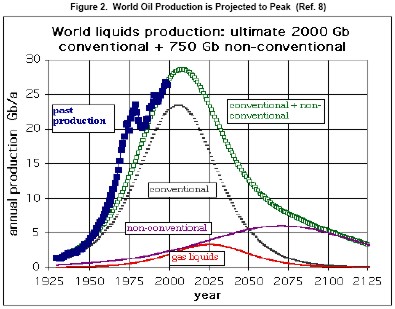
Again, see the lecture I’ve linked upthread – about 20 minutes of it are dedicated to dealing with this misconception. First off, what matters is the rate at which supply increases. Currently, oil is being consumed about three times faster than it is being discovered. Next, increase in resource size does not mean that the resource will not run out – it means that the resource will run out later. And not much later at that. See the graph below. All the shale oil does is delay the inevitable peak by 10-20 years:


Further, this ignores the fact that extracting oil takes energy. The magic word is energy return on investment – EROI – which tells you how many gallons of oil you can extract by using one gallon of oil for powering your drilling rings, pumps, tankers etc. At the beginning of the oil age, EROI was about 100, now it is about 12, and dropping – Alberta tar oil has EROI of 3. The EROI of non-conventional oil is so bad that I’ve read proposals to develop small portable nuclear reactors to power the extraction operations. (Of course, if you had a portable nuclear reactor you could use it to power trucks, which would make the whole oil business redundant.)

As higher EROI means higher price, it is sort of true that we will never completely run out of oil – at some point, the remainder will be too expensive to extract, which also means that it will be too expensive for you to buy.
The underlying assumption that each marginal increase in population (over some arbitrary number which doesn’t “feel” so big) results only in increased consumption is incorrect.
Sure, you can have increase in population without increase in production (GDP). This means decrease in GDP per capita, i.e. becoming poorer.
7 billion is a big number, but that doesn’t have anything to do with a supposed limit to what the Earth can support.
I’m just going to leave this here:

 
What this ignores is that modern agriculture no longer converts sunlight into food – it converts oil and phosphorus into food. Both are non-renewable resources, so modern agriculture does not produce resources – it consumes resources. The reason it appears to produce more resources is that oil and phosphorus mining do not appear to be directly related to agriculture. (This knowledge is quite obscure; I learned about the link accidentally while reading a study on the impacts of a nuclear war.)

Again, see the lecture I’ve linked upthread – about 20 minutes of it are dedicated to dealing with this misconception. First off, what matters is the rate at which supply increases. Currently, oil is being consumed about three times faster than it is being discovered. Next, increase in resource size does not mean that the resource will not run out – it means that the resource will run out later. And not much later at that. See the graph below. All the shale oil does is delay the inevitable peak by 10-20 years:

http://www-personal.umich.edu/~bgoodsel/post911/peakoil.jpg

Further, this ignores the fact that extracting oil takes energy. The magic word is energy return on investment – EROI – which tells you how many gallons of oil you can extract by using one gallon of oil for powering your drilling rings, pumps, tankers etc. At the beginning of the oil age, EROI was about 100, now it is about 12, and dropping – Alberta tar oil has EROI of 3. The EROI of non-conventional oil is so bad that I’ve read proposals to develop small portable nuclear reactors to power the extraction operations. (Of course, if you had a portable nuclear reactor you could use it to power trucks, which would make the whole oil business redundant.)

As higher EROI means higher price, it is sort of true that we will never completely run out of oil – at some point, the remainder will be too expensive to extract, which also means that it will be too expensive for you to buy.

Sure, you can have increase in population without increase in production (GDP). This means decrease in GDP per capita, i.e. becoming poorer.

I’m just going to leave this here:

http://media.peakprosperity.com/images/A-brief-history-oi-humans.jpg
People have been saying this sort of thing since Parson Malthus, and probably before, but it hasn’t proved out so far.

one thing doomsayers/population control people always do is assume stable states in all but population. Even in pre-petroleum eras that wasn’t true.

Phosphorus is one of the most common elements on earth. It’s also recoverable, since it doesn’t “go away”. Current sources are simply cheaper to extract than others. It can also be considered “renewable” inasmuch as it can be recovered again and again.

Interesting too that despite all this EROI business, gasoline costs approximately the same, adjusted for inflation, that it always has.
 
It seems like “population control” is a concern for people who live in the bubbles of their urban worlds.

Take a drive for about a half-hour or so outside of any urban area in the U.S. and then tell me yhat the earth is “overpopulated”.
 
Your comparison is not valid. I’m referring to scare tactics. The reality is if people don’t have enough food, clean drinking water and proper sanitation, most of them, wherever they are, will die. The odds are the same if they have one child or 10. Add a lack of good medical care and the odds of an early death increase.

Peace,
Ed
With all the respect I can muster, your statement,“The reality is if people don’t have enough food, clean drinking water and proper sanitation, most of them, wherever they are, will die. The odds are the same if they have one child or 10.” is just not true. If I made $10,000 a year, it makes a GREAT difference if that money is supporting one child, or having to support 10 children. Do you honestly not see that?
 
I should also note that the whole reason that these people believe that we need to stop having children is to save the environment, more or less. So this worldview is coming from an ecological perspective, apparently.
I think this is the point, but from the other direction. Currently the way we deal with our resources is what is making population growth a concern. Human beings, as a species, have forgotten their home and how to live in it. How many Americans honestly know how to tend a garden? Or are even concerned with that being a potential food source?

Your progressive friends might laugh at the idea of raising their own food with the idea that not everyone has land (apartment, inner-city) but that is exactly the point. Why are we (for so long now) living in conditions that are not self-sustaining? The short answer is industrialization. Advancements in technology have forced humans to move out of nature and into cities.

We have moved out of our homes into something we think is better for us because the technology that makes living “easier” requires it.

Population control is not simply “stop having babies”. That is a complete oversimplification of a long history (not to mention it reeks of tyranny, but that is another rant all together).
 
If your proffesor thinks there needs to be population control, does he believe the world is ovepropulated?

Indian economist Raj Krishna has said India could provide the whole world’s food supply by increasing crop yields:

i-bites.com/india-alone-could-feed-the-world

Even though the population is much larger globally overall than it was in the 1970s, more grain was being grown as of 2004, based on USDA statistics, on less hectares of land than in the 1970s.

There are hundreds of millions of hectares of land in Africa that can be cultivated:

fao.org/news/story/en/item/20964/icode
The world produces enough food to feed every person on the planet. World agriculture produces 17 percent more calories per person today than it did 30 years ago, despite a 70 percent population increase. This is enough to provide everyone in the world with at least 2,720 kilocalories (kcal) per person per day according to the most recent estimate that we could find.(FAO 2002, p.9). The principal problem is that many people in the world do not have sufficient land to grow, or income to purchase, enough food.
echonet.org/world-hunger-statistics
Colin Clark, former director of the Agricultural Economic Institute at Oxford University, classified world land-types by their food-raising capabilities and found that if all farmers were to use best methods, enough food could be raised to provide an American-type diet for 35.1 billion people, more than seven times the present population (ibid, p. 44). Since the American diet is a very rich one. Clark found that it would be possible to feed three times as many again, or more than twenty-two times as many as now exist, at a Japanese standard of food intake. Clark’s estimate assumed that nearly half of the earth’s land area would remain in conservation area. for recreation and the preservation of wildlife (ibid., 48)
miraclerosarymission.org/hab280.htm
That is from 1972. Think of how technology for cutivation must have changed since then. I doubt Colin Clark took into considertion the way food is grown now, such as in high rise builidings etc.
A practically limitless supply of freshwater could be available by desalting ocean water, something which occurs naturally in the hydrologic cycle.
mhhe.com/physsci/physical/tillery/tutorialtest/Waters/EarWatsb.html

From article, recyling waste water is another way to get water.
 
If your professor thinks there needs to be population control, does he believe the world is ovepropulated?

Indian economist Raj Krishna has said India could provide the whole world’s food supply by increasing crop yields:

i-bites.com/india-alone-could-feed-the-world

There are hundreds of millions of hectares of land in Africa that can be cultivated:

fao.org/news/story/en/item/20964/icode
The world produces enough food to feed every person on the planet. World agriculture produces 17 percent more calories per person today than it did 30 years ago, despite a 70 percent population increase. This is enough to provide everyone in the world with at least 2,720 kilocalories (kcal) per person per day according to the most recent estimate that we could find.(FAO 2002, p.9). The principal problem is that many people in the world do not have sufficient land to grow, or income to purchase, enough food.
echonet.org/world-hunger-statistics
Colin Clark, former director of the Agricultural Economic Institute at Oxford University, classified world land-types by their food-raising capabilities and found that if all farmers were to use best methods, enough food could be raised to provide an American-type diet for 35.1 billion people, more than seven times the present population (ibid, p. 44). Since the American diet is a very rich one. Clark found that it would be possible to feed three times as many again, or more than twenty-two times as many as now exist, at a Japanese standard of food intake. Clark’s estimate assumed that nearly half of the earth’s land area would remain in conservation area. for recreation and the preservation of wildlife (ibid., 48)
miraclerosarymission.org/hab280.htm
That is from 1972. Think of how technology for cutivation must have changed since then. I doubt Colin Clark took into considertion the way food is grown now, such as in high rise builidings etc.
A practically limitless supply of freshwater could be available by desalting ocean water, something which occurs naturally in the hydrologic cycle.
mhhe.com/physsci/physical/tillery/tutorialtest/Waters/EarWatsb.html

From article, recyling waste water is another way to get water.
 
If your professor thinks there needs to be population control, does he believe the world is ovepropulated?

Indian economist Raj Krishna has said India could provide the whole world’s food supply by increasing crop yields:

i-bites.com/india-alone-could-feed-the-world

There are hundreds of millions of hectares of land in Africa that can be cultivated:

fao.org/news/story/en/item/20964/icode
The world produces enough food to feed every person on the planet. World agriculture produces 17 percent more calories per person today than it did 30 years ago, despite a 70 percent population increase. This is enough to provide everyone in the world with at least 2,720 kilocalories (kcal) per person per day according to the most recent estimate that we could find.(FAO 2002, p.9). The principal problem is that many people in the world do not have sufficient land to grow, or income to purchase, enough food.
echonet.org/world-hunger-statistics
Colin Clark, former director of the Agricultural Economic Institute at Oxford University, classified world land-types by their food-raising capabilities and found that if all farmers were to use best methods, enough food could be raised to provide an American-type diet for 35.1 billion people, more than seven times the present population (ibid, p. 44). Since the American diet is a very rich one. Clark found that it would be possible to feed three times as many again, or more than twenty-two times as many as now exist, at a Japanese standard of food intake. Clark’s estimate assumed that nearly half of the earth’s land area would remain in conservation area. for recreation and the preservation of wildlife (ibid., 48)
miraclerosarymission.org/hab280.htm
That is from 1972. Think of how technology for cutivation must have changed since then. I doubt Colin Clark took into considertion the way food is grown now, such as in high rise builidings etc.
A practically limitless supply of freshwater could be available by desalting ocean water, something which occurs naturally in the hydrologic cycle.
mhhe.com/physsci/physical/tillery/tutorialtest/Waters/EarWatsb.html

From article, recyling waste water is another way to get water.
 
If your professor thinks there needs to be population control, does he believe the world is overpopulated?

Indian economist Raj Krishna has said India could provide the whole world’s food supply by increasing crop yields:

i-bites.com/india-alone-could-feed-the-world

There are hundreds of millions of hectares of land in Africa that can be cultivated:

fao.org/news/story/en/item/20964/icode
The world produces enough food to feed every person on the planet. World agriculture produces 17 percent more calories per person today than it did 30 years ago, despite a 70 percent population increase. This is enough to provide everyone in the world with at least 2,720 kilocalories (kcal) per person per day according to the most recent estimate that we could find.(FAO 2002, p.9). The principal problem is that many people in the world do not have sufficient land to grow, or income to purchase, enough food.
echonet.org/world-hunger-statistics
Colin Clark, former director of the Agricultural Economic Institute at Oxford University, classified world land-types by their food-raising capabilities and found that if all farmers were to use best methods, enough food could be raised to provide an American-type diet for 35.1 billion people, more than seven times the present population (ibid, p. 44). Since the American diet is a very rich one. Clark found that it would be possible to feed three times as many again, or more than twenty-two times as many as now exist, at a Japanese standard of food intake. Clark’s estimate assumed that nearly half of the earth’s land area would remain in conservation area. for recreation and the preservation of wildlife (ibid., 48)
miraclerosarymission.org/hab280.htm

That is from 1972. Think of how technology for cutivation must have changed since then. I doubt Colin Clark took into considertion the way food is grown now, such as in high rise builidings etc.
A practically limitless supply of freshwater could be available by desalting ocean water, something which occurs naturally in the hydrologic cycle.
mhhe.com/physsci/physical/tillery/tutorialtest/Waters/EarWatsb.html

From article, recyling waste water is another way to get water.u
 
If your professor thinks there needs to be population control, does he believe the world is overpopulated?

Indian economist Raj Krishna has said India could provide the whole world’s food supply by increasing crop yields:

i-bites.com/india-alone-could-feed-the-world

There are hundreds of millions of hectares of land in Africa that can be cultivated:

fao.org/news/story/en/item/20964/icode
The world produces enough food to feed every person on the planet. World agriculture produces 17 percent more calories per person today than it did 30 years ago, despite a 70 percent population increase. This is enough to provide everyone in the world with at least 2,720 kilocalories (kcal) per person per day according to the most recent estimate that we could find.(FAO 2002, p.9). The principal problem is that many people in the world do not have sufficient land to grow, or income to purchase, enough food.
echonet.org/world-hunger-statistics
Colin Clark, former director of the Agricultural Economic Institute at Oxford University, classified world land-types by their food-raising capabilities and found that if all farmers were to use best methods, enough food could be raised to provide an American-type diet for 35.1 billion people, more than seven times the present population (ibid, p. 44). Since the American diet is a very rich one. Clark found that it would be possible to feed three times as many again, or more than twenty-two times as many as now exist, at a Japanese standard of food intake. Clark’s estimate assumed that nearly half of the earth’s land area would remain in conservation area. for recreation and the preservation of wildlife (ibid., 48)
miraclerosarymission.org/hab280.htm

That is from 1972. Think of how technology for cutivation must have changed since then. I doubt Colin Clark took into considertion the way food is grown now, such as in high rise builidings etc.
A practically limitless supply of freshwater could be available by desalting ocean water, something which occurs naturally in the hydrologic cycle.
mhhe.com/physsci/physical/tillery/tutorialtest/Waters/EarWatsb.html

From article, recyling waste water is another way to get water
 
Phosphorus is one of the most common elements on earth. It’s also recoverable, since it doesn’t “go away”. Current sources are simply cheaper to extract than others. It can also be considered “renewable” inasmuch as it can be recovered again and again.
Yes, but if the price of phosphorus goes up, then the price of fertilizer also goes up, and the price of food will go up also. Not a very good news for the folks living on $1 per day, eh?
Interesting too that despite all this EROI business, gasoline costs approximately the same, adjusted for inflation, that it always has.
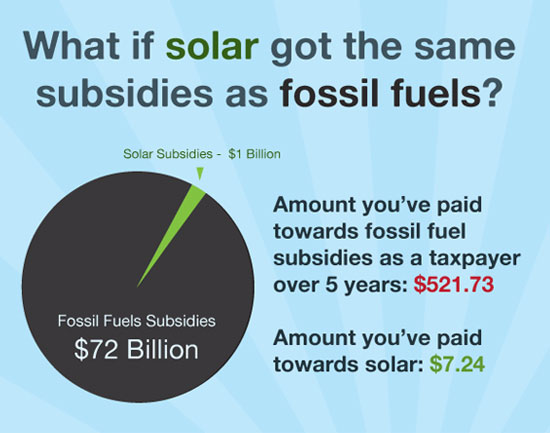
Yup, because it is subsidized by the taxpayer:

http://www.imf.org/external/pubs/ft/fandd/2010/06/images/pict_1.jpg

To put that in perspective:


Here’s a fun fact: renewable energy is becoing competitive – not because its economics (i.e. EROI) has improved, but because EROI of fossil fules is dropping to the levels comparable to that of renewables.
 
Someone once did a study were,

If you give each person on earth a four foot square box to stand in, then everyone would be able to fit in Oakland County Michigan.

Being more realistic if you gave each person 5 Acres to live on, then every one would fit in the US or Canada(forget which)

Maybe a Math Geek here would like to show us the math,
 
well, I still have this doubts about it, there might be space for everybody, there might be food for everybody, but the resourses seem to be bad administrated, I’ve heard that 99% of the worlds resourses are controlled by 1% of the population, for the rest of the 99% of the population we have to live with that 1%(this of course might be an exageration but still has something of a point).

Also in the past at least here in Mexico being a “Bachiller” (finished highschool) was something good and respected, now you need it to work cleaning a building. now there is work for everybody here, but the minimal wage is only 64 pesos the day, now take away the transportation and food. outsourcing becoming the newest form of hiring, where a company would keep part of your salary, because there is no other way to get a job. college degrees are worth as if they came out in a cereal box, because there are thousands of others with the same title wanting to enter the same company that you want.

in short, everytime i hear someone says that overpopulation is a myth, my blood boils. but I want to know if im wrong, please somebody explain to me why this has nothing to do with people having more children.
 
in short, everytime i hear someone says that overpopulation is a myth, my blood boils. but I want to know if im wrong, please somebody explain to me why this has nothing to do with people having more children.
Well, I’ll suggest that the term “overpopulation” is not an objective term, but represents a value judgment. As such, it can be neither reality nor a myth.

I prefer to stick to the facts, and welcome anyone to add their own. Everyone has their own favorite fact that they will throw at “the other side,” but fundamentally, facts aren’t political stances. A fact, as I define it here, is a verifiable (i.e., measurable and/or repeatable) phenomena that is observed in the present world or reconstructed on the basis of archaeological, scientific, or historical research.

Predictions about the future are not facts. People often make predictions of the future that correspond to their worldview.

There are some facts that I think are important, and that are widely accepted as true:
  • *The global population is higher than it has ever been. Humanity has never lived in a world with so many people.
  • Civilizations in long-term population decline are at greater risk of collapse.
  • Economic productivity is higher than it has ever been. Humanity has never lived in a world in which the economic produce of human labor is higher.
  • The rate of extinction of plant and animal species is higher than it has ever been in human history.
  • Over time, birth rates follow a trend that is highly correlated with industrialization, which changes the economic incentives for childbearing.
  • On a decade-over-decade basis, birth rates are declining in every region of the world.
  • The rate of soil erosion and the corresponding loss of arable land are higher than they has ever been in human history.
  • Cultures are often defined by traditions of food, music, art, and religion, making it more likely that those cultural mores will be repeated with greater frequency in areas with growing populations.
  • Population control has historically been used by elites as a means of controlling minorities.
  • “Overkill” is one likely hypothesis to explain the loss of native megafauna upon the arrival of humans in locations previously uninhabited by them, including New Zealand (Moa extinction) and the Americas (extinction of dire wolf, sabretooth tiger, wooly mammoth).
  • Scarcity in one product pushes prices of that product higher, which provides incentive to find other cheaper products.
  • In the late 1960s, the predictions made by biologist Paul Ehrlich in his book, “The Population Bomb” have not generally come to pass and Ehrlich lost “The Bet.” with economist Julian Simon.
  • The consequences often raised as a concern associated with population growth (e.g., resource scarcity, environmental degradation, greater military conflict) generally do not pose an existential threat to the human race as a whole, unlike possibilities such as nuclear war, gamma ray burst, Caldera eruption, or asteroid or comet collision.
  • Since World War 2, the rate of land development and vehicle miles traveled in the United States has exceeded population growth by a considerable margin.
  • Population growth/control is a highly politicized issue, making it hard to discuss facts objectively and in a balanced way.
The way I see it personally, there are real and legitimate concerns that humanity faces. But to me, the level of concern about the future depends more on how we live than how many of us there are. I’m not dismissing that there are concerns associated with population growth, but saying that those concerns may be averted by changes in lifestyle.
 
Status
Not open for further replies.
Back
Top