Pseudo-Cyril of Jerusalem and the Shapeshifting Jesus

  • Thread starter Thread starter patrick457
  • Start date Start date
Status
Not open for further replies.
Have you read what I said earlier about Origen? I know this idea sounds a bit hokey to us nowadays, but it was a possibility some early Christians took seriously. I should note the following: the Alexandrian school had traditionally approached the question from the divine angle, on how God could become a human, while the Antiochian school focused on the human angle, on how the man Jesus could be divine.

I kindly suggest you read the whole thread. I know it’s very long, I’m sorry. But it’s gonna get even longer. 😊
Hello Patrick457
first of all there is no need to apologise if it turns out to be a long thread.
Please take it that I have a simple mind. So I don’t think it hurts to make things clear. 👍
What is it about Jesus that determines the document is a fake?
 
There’s a recent article with the following headline: Shape-Shifting Jesus Described in Ancient Egyptian Text. The report reads, in part:

A newly deciphered Egyptian text, dating back almost 1,200 years, tells part of the crucifixion story of Jesus with apocryphal plot twists, some of which have never been seen before.

Written in the Coptic language, the ancient text tells of Pontius Pilate, the judge who authorized Jesus’ crucifixion, having dinner with Jesus before his crucifixion and offering to sacrifice his own son in the place of Jesus. It also explains why Judas used a kiss, specifically, to betray Jesus — because Jesus had the ability to change shape, according to the text — and it puts the day of the arrest of Jesus on Tuesday evening rather than Thursday evening, something that contravenes the Easter timeline.

Now what is this “Egyptian text” the article talks about? This is actually a Coptic homily written by an anonymous author claiming to be St. Cyril of Jerusalem (ca. 313-386) - we’ll call him pseudo-Cyril for short - entitled On the Life and the Passion of Christ, which was recently translated by Roelof van den Broek in his book Pseudo-Cyril of Jerusalem On the Life and the Passion of Christ: A Coptic Apocryphon. The text, which van den Broek dates to the 8th-9th century, survives in only two manuscripts (Pierpont Morgan Library M610 and the fragmentary Manuscript E16262 from the University of Pennsylvania).

http://img89.imageshack.us/img89/171/coptichomilytextjw.jpg
MS M610, folio 1r, Homily delivered on Wednesday after Easter

The article explains:

The text is written in the name of St. Cyril of Jerusalem who lived during the fourth century. In the story Cyril tells the Easter story as part of a homily (a type of sermon). A number of texts in ancient times claim to be homilies by St. Cyril and they were probably not given by the saint in real life, van den Broek explained in his book.

Near the beginning of the text, Cyril, or the person writing in his name, claims that a book has been found in Jerusalem showing the writings of the apostles on the life and crucifixion of Jesus. “Listen to me, oh my honored children, and let me tell you something of what we found written in the house of Mary …” reads part of the text.

Again, it’s unlikely that such a book was found in real life. Van den Broek said that a claim like this would have been used by the writer “to enhance the credibility of the peculiar views and uncanonical facts he is about to present by ascribing them to an apostolic source,” adding that examples of this plot device can be found “frequently” in Coptic literature.
It all makes sense now…

Because ‘life’ could have evolved into any shape or form through natural selection, Jesus would need to have had the capability of being anything He needed to be.

Perhaps Jesus could have even been a miniature tree squid, if humans would have developed that way. 😉
 
Just to give a context of the story. The work begins with the following words:

A homily which the holy Apa Cyril, the archbishop of Jerusalem, delivered in the early morning of the fourth day of the Great Pascha. He delivered it at the door of the sanctuary, as the people beseeched him: ‘Give us to drink from the well of your blessing.’ He, then, began with the writings of the apostles and related a good deal of their contents. And they marvelled at his teaching, which was sweeter than honey. He started with the sufferings our Saviour endured for us, which are as follows. In the peace of God. Amen.

http://dormitionpgh.org/orthodoxy/images/CyrilofJerusalem.jpg

‘Cyril’ begins his homily by noting that it was now the (Coptic!) month of Parmoute (corresponding to April-May in the Gregorian calendar). He says that Parmoute was actually the month in which Adam and Eve fell, noting how it “brought forward a great disease which had been hidden since the transgression of Eve.”

During this long time, nobody was able to reveal it, except for Judas, this money-loving murderer. What else is the disease that had been hidden for these long times but the disease from which Eve was suffering as she desired the tree, stretched out her hand and ate from the tree of the paradise of delight? Judas also stretched out his hands, which were worthy to be cut off; he received the price of the Lord of everything which is in heaven and on earth; he delivered him into the hands of the senseless Jews, and they killed him in the month of Parmoute. They killed [him when the day of the mo]on coincided with the day of the month, like we found written in the writings of our fathers, the holy apostles, which they wrote in this holy city of Jerusalem.

‘Cyril’ then tells the congregation of “something of what we found written in the house of Mary, the mother of John, who is called Mark … [which] was a dwelling place of the apostles because of the fear of the Jews.” A deacon named Theodosius was rummaging around the ancient house-church looking “for the writings of our fathers, the apostles,” when he discovered a small parchment codex written entirely in shorthand. Theodosius passed this book to Cyril, who gave it to a shorthand expert, Apa Bachios, to decipher. The book, according to Cyril, purportedly contained “the commandments of Christ and what happened to him and the apostles, and the way Judas became a traitor and delivered Jesus for money.” This small book, according to ‘Cyril’, was supposedly written by the apostles themselves because they realized that they will be killed “before we have preached the Gospel to all the cities.” The book was a means of recording down their teaching in written form for posterity; in fact, it envisions itself as being circulated by Christians everywhere “so that when the enemies of Christ kill us it will be as if we are still preaching to you.”
 
Pseudo-Cyril attributes Jesus’ death due to His popularity and to simple greed. The homily purports that:

In that time, the people of the children of Israel gave great gifts to the temple of Jerusalem: many sheep, pigeons and turtle doves, in accordance with the law of Moses, gold, silver and tin, which they gave as tithes for their sins. The sheep and the goats and the turtle doves and the oil and the fine flour were used for burnt offerings. And the whole race of the children of Israel went and gave them in their ignorance, with many other things.

Because of Jesus’ miracles, many people came to believe in Him and thus stopped attending synagogue and following the Mosaic law. In fact, His followers no longer gave tithes to the Temple: instead, they offered their gold and silver to Jesus and spread out their cloaks at His feet (cf. Matthew 21:8; Mark 11:8; Luke 19:36). The gold and silver did not benefit anyone tough, since Judas usually stole whatever the people offered to Jesus (cf. John 12:6). The reason for Judas’ kleptomania is his greedy, domineering wife, “a money lover” according to our author.

With their source of income lost, “the chief priests and the teachers of the law” convene together with the rulers to discuss how to get rid of Jesus.

When, then, the chief priests saw their own shortage and the dissolution of their synagogue, the chief priests and the teachers of the law said: ‘Let us rise and go into the rulers and chiefs of the people and let us speak to their hearts because of the son of that carpenter, for he is the man who has destroyed the synagogue.’

And they rose and went to the rulers, saying: ‘Oh faithful people, behold, you know that the crowds have stopped going to the temple; they have rejected our law and have begun to follow the son of the carpenter. If you refrain from action, he will draw the multitude to him and make the temple desert and abolish our law, and the whole of Israel will be ashamed because he says: “I am the Son of God.” And he is not, but his mother is Mary and his father is Joseph and he is one of our people.’

Joseph of Arimathaea rises up in Jesus’ defense, and manages to convince one of the authorities, Nicodemus, that Jesus was not the biological Son of Joseph but is conceived by the Holy Spirit. Annas and Caiaphas plan to kill Joseph in response, but Nicodemus in turn rebukes them for their unbelief. Seeking Jesus at night (cf. John 3:1-21), Nicodemus formally becomes His disciple and is baptized by Jesus Himself.

The hostility toward Jesus by the Jewish authorities increase after He raises Lazarus from the dead (cf. John 11). Jesus, by now realizing that “the time had come that he would redeem Adam and his children and that they would return to their origin again and that he would go to his Father,” proposes to His disciples that they go to Jerusalem to celebrate the feast of Unleavened Bread. At the same time, He predicts that He will be killed. Mary, Jesus’ mother, (naturally) objects:
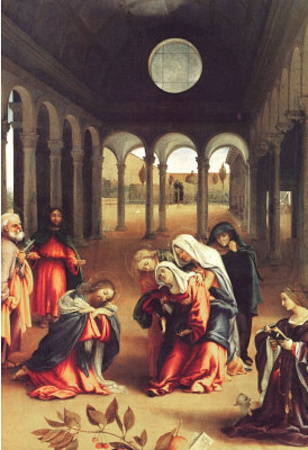


Then Mary, the queen of all the women of the world, came to Jesus and said to him: ‘My son, besides whom I have no one, I hear you now speaking with your brethren: “I shall go to Jerusalem”; kills the prophets and Israel has no mercy, for they seek to kill you. Arise, my son, and let me flee with you to Egypt, which loves strangers, so that the Hebrews might not kill you. Oh my son, oh my son, behold, by now it is thirty years ago that I fled with you from city to city because of your persecutors who wanted to kill you, because it was said of you that you were a royal son.’

Jesus alleviates her fears, and she accompanies Him and the disciples to Jerusalem.

 
Upon arriving in Jerusalem, Jesus casts the sellers and the moneychangers out of the Temple (Matthew 21:12-13; Mark 11:15-17; Luke 19:45-46; John 2:13-16). ‘Cyril’ comments how “because [the cattle, pigeons and sheep] were too many for the priests and the Levites they sold them to others; for the Hebrews do not have much land, since they are sojourners in a land that is not theirs.” After driving the vendors away, Jesus begins to preach.

And he cried out saying: ‘In truth, in truth I tell you: Who listens to my word shall never taste of death.’ (John 8:51) Then the chief priests and the scribes said to each other: ‘See the arrogance of the son of that carpenter, this destroyer of the law. Come, let us kill him so that the people will say that his words are not true. Abraham has died and the prophets (John 8:52), and this man says: “Who shall keep my word shall never taste of death.” Is this one better than Abraham and the prophets? And see, their tomb can still be seen. Come, let us kill him!’ They, then, picked up stones to throw at him, but he hid himself and went out of the temple. (John 8:59)

Judas goes home to tell his evil wife of what had happened. Her wife goads him to get some money by betraying Jesus to the Jewish authorities. Despite a little hesitancy (since Judas knows that Jesus already knows what will happen), he follows her advice and goes to sell information about Jesus to them.

Back to our analysis. After Jesus’ transformation into a column of fire before the disciples, they celebrate their last meal together in the Kidron brook (81-87).

As Jesus, then, had said this, he went out with his disciples across the brook Kedron, where there was a garden which he entered with his disciples. But Judas also knew that place because Jesus had often met there with his disciples, and he knew that Peter and John had prepared the passover there so that he might eat it with his disciples.

As it, then, had become evening on the third day of the week, the eleventh of the month and the eleventh of the moon, when the day of the moon coincided with the day of the month, and as they ate, Jesus took a bread, blessed it, and said to them: ‘Take it and eat of it.’ And in the same way, he also took a cup, mingled it and gave it to them, saying: ‘Take it and drink of it, all of you.’ And as they ate he said to them: ‘In this night all of you will fall into sin because of me. Oh, behold, my soul is grieved to death.’

http://thumbs.anyclip.com/tYpjauiBa/tmb_3193_480.jpg

As he, then had said this, he said to his disciples: ‘Arise, let us go out of this place, for behold, the dragon has mingled a cup of poison, he has given it to the children of Israel and has induced them to seek to kill me.’ Then Jesus took the eleven and went out to the mountain. Judas, for his part, took swords and torches and went out at the great hour and withdrew from the crowd in order to go to the garden. But Jesus knew the hearts of the Jews and saw that the disciples were afraid, and he also knew that Judas would seek to deliver up Mary, too, and receive her price. For that reason he did not take her with him to the mountain but left her in the garden where they had eaten the passover.

You know that I said a little earlier that Judas’ wife had told him: ‘I shall make you deliver Mary too, and all the apostles.’ But Jesus knew the heart of everyone, and left Mary hidden. He took the apostles, went out to the mountain, left them sleeping, went away, prayed, came back to them and found them asleep with grief. He said to them: ‘Arise, pray that you may not come into temptation.’ Jesus then, knew that his hour had come, that he would go away from here and go to the Father. He withdrew a little from the apostles.
 
After that, Judas comes with the arrest party, kisses Jesus, prompting Jesus to deliver a curse on Judas. All I can say is, whoa. 😃

Judas, then, came with the crowd. He stopped in embarrassment at the head of the crowd. Jesus said: ‘Friend, do what you have come for!’ Judas kissed him guilefully. Then Jesus said to Judas: ‘Would you deliver the Son of Man with a kiss? Really, it would have been better for you not to have been born than to have done this. Do I not know what is in your heart from the time that you followed me, namely that you are a traitor? But I have endured you until your end comes to you badly. Do I not know the hour you went to the chief priests and made an arrangement with them to hand me over to death for thirty silver pieces?

‘Oh, woe to you with a twofold woe, oh Judas, traitor and shameless one, your end has come for you badly. Oh Judas, you will die without sickness, your body will not be worthy a burial, your soul will not walk in the light but in the darkness. Your name will not be given to anyone into eternity. When people give your name to their sons, they will not live but will be cursed before me for three generations. Behold, they will put me on the wood at the sixth hour of Great Preparation Day of the Great Week of the Pascha. But you will throttle yourself with a snare and you will hang yourself on a tree, namely a tamarisk. And there will be no mercy for you because of what you have done, but your punishment will be twofold: your fire will not be quenched nor will your worm die when you are tortured. Oh Judas, great is your fall.’

They arrest Him and then bring Him to Caiaphas.
 
I love your posts, Patrick. Remember the Puer-Senex cuts two ways: the Eternal Youth hidden in the Old Man’s Form; and the Widom of the Old Man Time hidden in the child.

Classical thinkers (and some modern psychologists, HIllman for instance) connect the Puer-Senex with Saturn/Kronos, the Grim Reaper (who governs Capricorn on the Time-Wheel) or the birth time of the Logos. The Jews refer to this Eternal Youth as Metatron, the Archangel, which is a form of Michael – Michael’s sword, I say, which cuts both directions. Michael is almost always shown with a sword (a symbol of Aries, Mars, in the beginning, through his war against Satan (Saturn)) and a scale (a symbol of Libra, governed by Venus, or Love). Michael in his Earthly aspect is Jesus Christ; Jesus in his Heavenly Aspect is Michael the Archangel. I know this is not Catholic doctrine. But this is an exemplare of “I am the Alpha and the Omega, the First and the Last”. Aries is the First Man; Libra is the Last Man, the Judge of the World, and the beginning of the Night, the Dark Age, or the Sabbath.

The Jews connect the Old Man component of Puer-Senex with The Ancient of Days, or with God himself. If you look at the Asian symbol of the Yin-Yang you see a small white seed inside a Black Whale or wave (Night-Cycle) and you see a small black seed into the White Whale or wave (Day-Cycle). This also is a symbol for Puer-Senex. The small White Seed is Metatron; the small Black Seed is the Ancient of Days. Saturn is the guardian of ETERNAL TIME, and the adversary of MODERN TIME. Saturn is the guardian of NIGHT TIME; and hhe is the adversary of DAY TIME. Jupiter, Saturn’s Son, is the gurdian of DAY TIME, MODERN TIME, material expansion, Heaven on Earth. Jupiter expands the world; and Saturn deflates the world.

Plato said the universe was ‘shaped’ like the dodecahedron. By this (I think) he meant the inner universe, with 12-sides, each reflecting an aspect of the whole man. Jesus was the whole man. His so-called shape-sifting may simple have been his ability to show everyone in the world their opposite side, by being the mirror of the world – showing the world what they were lacking in order to become whole.

Happy Easter to all. We are heading into a time where our faith will be sorely tested. That is why Jesus is coming close again.
 
Now, go to to the Homily itself. In pseudo-Cyril, when Judas goes to the chief priests to sell information about Jesus, they say to him:

“How shall we arrest him, for he does not have a single shape but his appearance changes? Sometimes he is ruddy, sometimes he is white, sometimes he is red, sometimes he is wheat-coloured, sometimes he is pallid like ascetics, sometimes he is a youth, sometimes an old man, sometimes his hair is straight and black, sometimes it is curled, sometimes he is tall, sometimes he is short. In one word, we have never seen him in one and the same appearance.”

Judas answered and said to the chief priests: “Come, pay me the rest of the money and I shall tell you everything. For you know that except for this man’s friend nobody is able to deliver him up to affliction, because no stranger knows his manner of life.” Then the Jews paid him the rest of the money and he told them the way he would deliver him to them, and he said: “Jesus will make preparations to eat the unleavened bread, too, like all of the people, and it is for this reason that he has come to the city. Therefore, prepare good weapons, for there are some among his disciples who are outstanding warriors, and prepare good torches. Since you said to me: ‘We have never seen him in a single shape,’ this is the sign which I shall give to those who will follow me: He whom I shall kiss on his mouth and embrace and to whom I shall say: ‘Hail rabbi!’ he is your man. Arrest him!” As he, then, had said this to the Jews, he took the rest of the money, went to his home and gave it to his wicked wife. He said to her: “Behold, the total of the price of my master!” Then she was very pleased and said to him: “Excellent that you came home today with a better result than on all (other) days. In truth, when you listen to me, I shall make you deliver Mary too, and Peter and John, and then all the apostles.”

Pseudo-Cyril shows an agreement with Origen here: Judas had to identify Jesus to the arrest party because He does not always appear the same to people.

I find the comment about Jesus’ hair sometimes being “straight and black” and at other times being “curled” particularly interesting due to the fact that in early iconography, Jesus could be shown as being either. Before the iconography of Christ became fixed, artists often did not agree on how to portray Him: some showed Him as a clean-shaven young man, others showed Him as having a close-cropped, curly hair and a short beard, while still others showed Him with long, flowing hair. It was only later that the third type (now with a full beard becoming mandatory) became the standard way of depicting Jesus.

http://upload.wikimedia.org/wikipedia/commons/thumb/4/4b/1407_-Milano-_S.Lorenzo-_Cappella_S.Aquilino-Traditio_Legis-Dall%27Orto-18-May-2007.jpg/320px-1407-Milano-_S.Lorenzo-_Cappella_S.Aquilino-Traditio_Legis-Dall%27Orto-_18-May-2007.jpg

http://img684.imageshack.us/img684/967/6thsinaipantocrator.jpg

http://www.college.columbia.edu/core/sites/core/files/images/2Christ-RomeSP.thumbnail.jpg

The Semitic-looking Jesus with short, frizzy hair (which somewhat appropriately enough, could be traced to Syria and Palestine) was the main competitor for the depiction of Christ with long hair during the early Byzantine period.
 
After that, Judas comes with the arrest party, kisses Jesus, prompting Jesus to deliver a curse on Judas. All I can say is, whoa. 😃

Judas, then, came with the crowd. He stopped in embarrassment at the head of the crowd. Jesus said: ‘Friend, do what you have come for!’ Judas kissed him guilefully. Then Jesus said to Judas: ‘Would you deliver the Son of Man with a kiss? Really, it would have been better for you not to have been born than to have done this. Do I not know what is in your heart from the time that you followed me, namely that you are a traitor? But I have endured you until your end comes to you badly. Do I not know the hour you went to the chief priests and made an arrangement with them to hand me over to death for thirty silver pieces?

‘Oh, woe to you with a twofold woe, oh Judas, traitor and shameless one, your end has come for you badly. Oh Judas, you will die without sickness, your body will not be worthy a burial, your soul will not walk in the light but in the darkness. Your name will not be given to anyone into eternity. When people give your name to their sons, they will not live but will be cursed before me for three generations. Behold, they will put me on the wood at the sixth hour of Great Preparation Day of the Great Week of the Pascha. But you will throttle yourself with a snare and you will hang yourself on a tree, namely a tamarisk. And there will be no mercy for you because of what you have done, but your punishment will be twofold: your fire will not be quenched nor will your worm die when you are tortured. Oh Judas, great is your fall.’
As Jesus curses Judas, He also imposes a gruesome one on his wife:

‘And your wife in her turn was pleased because you brought her my price. She told you: “Excellent that you have come with the price of your master.” She will not live to eat from my price but she will get the burning diarrhoea which is the … (?), her throat will be throttled, and her anus will excrete worms, and she will die at the ninth hour of that same day, which is the Sabbath. All these things will happen to you at the time of the ninth hour of the Sabbath, but at dawn of the Lord’s day, which is that of my resurrection, the four corners of your house will be leveled to the ground. And another one will receive your apostleship and he will preach after Pentecost. Oh Judas, woe unto you, it is a guileful kiss you gave me on my mouth today, so that you take away the kiss of peace from those who bear my name. Oh this kiss of peace you guilefully gave me! You have made that the peace of the world is taken away from these days each year!’

As Jesus, then, said this to Judas, he (Judas) did not care at all but made a sign to the Jews and they arrested Jesus and brought him to the High Priest. The disciples were afraid, they fled and left him.

Peter then strikes the ear of the high priest’s servant. The author is now at pains to excuse Peter’s actions: he was planning to slice the servant’s head off, but Jesus prevented Peter from blackening his own name and so had Peter only cutting off the servant’s ear. It was apparently inconceivable for Pseudo-Cyril that the prince of the apostles should be a common murderer, so he compares him to another holy man who allegedly committed murder, Moses.

But one of his disciples, who was a hotheaded, grey-haired man, drew his sword and struck at a servant who belonged to the High Priest. In his ardent feeling for Christ he wanted to behead the servant. Peter did so in order to make the servant a substitute for the High Priest. Was there no other in that crowd than this one? ‘Yea,’ he said, ‘but when I strike this one, it is as if I have struck his master, for he seeks to kill Jesus more than the rest of the Jews. For this reason, I desired to strike his servant more than a great many of the Jews.’ But Christ disposed in this way: Peter did not take the head of the servant, but the sword only came upon his ear and cut it off. Christ did not want Saint Peter to shed blood but he obliged the desire of the apostle: he struck, but he did not commit murder.

You know, oh my beloved sons, that no murder occurred in this fight. But look at the hierophant Moses: when he struck the Egyptian he actually struck him with a papyrus scroll, and he died. How many times the devil has quarrelled with the archangel about this event, and behold, until the present day the devil calls him the prophet-killer, although it is not with a sword that he struck but with a papyrus. Therefore, Christ made Peter hit his shoulder: he did not act in vain, nor, on the other hand, did he shed blood. Therefore, Christ said to him: “Put your sword into its sheath, for all who take the sword will be killed by the sword.”
 
The fact that Moses killed the Egyptian (Exodus 2:11-15) has been a source of embarassment for both Jews and Christians. The Jewish historian Artapanus (between 250 to 100 BC) rationalized the action as self-defense: Moses was being targeted by a conspiracy and only acted to protect himself. Josephus apparently found the incident too hard to handle and so quietly omits it from his retelling of the Moses story (Antiquities 2.255).

http://img21.imageshack.us/img21/1996/cnbi.jpg

Clement of Alexandria (Stromateis 1.151-157), invokes another early Jewish historian Eupolemus (ca. 158/157 BC), who on his work On the Kings of Judea asserted that Moses was the real inventor of the alphabet (“Moses was the first wise man and that he had transmitted the alphabet to the Jews and that the Phoenicians had received it from the Jews and the Greeks from the Phoenicians”). Clement says that Moses had such a zeal for the culture of his people that he went as far as to strike and kill the Egyptian who attacked the Jew. But here’s the interesting claim: “And the mystics say that he slew the Egyptian by a word only; as, certainly, Peter in the Acts is related to have slain by speech those who appropriated part of the price of the field, and lied” (Acts 5:1). The ‘mystics’ in question here are apparently a specific class of Christians who had a deeper religious knowledge than ordinary believers. As Clement himself says: “the true philosophy, which the initiated possess, …] found it, or rather received it, from the truth itself.” By postulating that the Egyptian died from the words of Moses, the ‘mystics’ obviously wanted to avoid having to come to terms with the idea that Moses killed a man with his bare hands. A similar ‘solution’ was found in Jewish tradition: some rabbis thought that what killed the Egyptian was Moses’ pronouncing the Name of God (Yhwh), which is ascribed a great - even lethal - power in Jewish thought.

Pseudo-Cyril gives another, very Egyptian, explanation to excuse Moses: here he is said to have struck the Egyptian only with a papyrus scroll (itself a typical Egyptian product) - hardly a lethal weapon. He then links it with the supposed dispute between the devil and the archangel Michael over Moses’ body (Jude v. 9), with the devil claiming Moses to be a murderer. Similar ideas are found in other Christian works. The author of a commentary on Jude, claiming to be the author Oecumenius, explains that the dispute arose because the devil contested Michael’s right to give Moses an honorable burial; the devil charged Moses with the murder of the Egyptian as a reason. Greek Catenae have preserved a tradition that Michael’s retort to Satan (“The Lord rebuke you”) was said in reply to the devil’s using insulting language against Moses and calling him “a murderer.” A Slavonic story also has the same formula. There the devil prevents Michael from burying Moses, saying, “Moses is a murderer, he slew a man in Egypt and hid him in the sand.”
 
Status
Not open for further replies.
Back
Top