
Question about authority

  • Thread starter Thread starter joe371
  • Start date Start date
Status
Not open for further replies.
All Protestants believe that God (using fallible leaders), spoke authoritatively, through His written Word. Why is it so hard to believe, or accept the fact that God spoke, and continues to speak, authoritatively (using fallible leaders) via His Church, the same church that protected, preserved, and actively produced Sacred Scripture?
Because many of us don’t believe the church “protected, preserved, and actively produced Sacred Scripture,” instead, we believe that was done by the Holy Spirit in a direct way that is actually promised to all believers. The Spirit protected, preserved, and actively produced Sacred Scripture and it is He that is to be the “Vicar of Christ” on Earth.

God spoke in diverse ways in the past, but now speaks through the voice of His Son, Who told us of the Spirit Who was coming to us, to lead and guide us into all truth. We don’t believe that promise to only be to a certain segment of the church proper. And, also, we don’t believe that the scripture can be read and understood properly without the help of the Spirit. It’s all about Him. He is our authority, comforter, and guide. In short, many protestants think the “ability” the RCC says the Pope and Magisterium have, all believers can tap into, not just them. Why the differences of belief that we find amongst all different denominations (including the Catholic churches, Orthodox churches, protestant churches, etc…)? Human issues and limitations, human pride and arrogance.
 
[Kliska;12650735]Because many of us don’t believe the church “protected, preserved, and actively produced Sacred Scripture,” instead, we believe that was done by the Holy Spirit in a direct way that is actually promised to all believers. The Spirit protected, preserved, and actively produced Sacred Scripture and it is He that is to be the “Vicar of Christ” on Earth.
OK, :)so how did the bible get from the Holy Spirit, to the human race? Let’s leave all churches out of the discussion.
 
Just my thoughts here:

A definition of what Gospel means - something accepted or promoted as infallible truth or as a guiding principle or doctrine

Jesus Commissions the Disciples Mark 16:15 And he said to them, “Go into all the world and preach the gospel to the whole creation.

What I notice is that Christ did not tell them to go out and read the gospels to the world, He said to preach the Gospel. So are the truths “preached” (Sacred Tradition - the spoken word of our Lord) less authoritative than what is written in the Bible?

So as was previously suggested then why not add it to the Bible. If that was necessary then why was not everything Christ spoke and taught the Apostles not written in the Bible?

John 21:25 But there are also many other things which Jesus did; were every one of them to be written, I suppose that the world itself could not contain the books that would be written.

So again, Christ our Lord and His infinite wisdom knew this and ensured that there was a teaching authority for His Church.

John 16:13 When the Spirit of truth comes, he will guide you into all the truth; for he will not speak on his own authority, but whatever he hears he will speak, and he will declare to you the things that are to come.

1 Timothy 3:15 if I am delayed, you may know how one ought to behave in the household of God, which is the church of the living God, the pillar and bulwark of the truth.

Again to me, and my understanding this is telling me that there is more than just the Bible that contains truths. Since Christ established one Church not many, there is only one teaching authority, and that is the Magisterium of the Catholic Church.

Again, just putting my thoughts out there.
 
Because many of us don’t believe the church “protected, preserved, and actively produced Sacred Scripture,” instead, we believe that was done by the Holy Spirit in a direct way that is actually promised to all believers. The Spirit protected, preserved, and actively produced Sacred Scripture
Kliska-

Could you give some examples of the Holy Spirit producing copies of the New Testament during the centuries prior to the invention of the printing press?

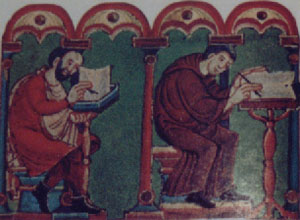
My understanding is that Catholic monks carefully preserved the sacred texts by producing those copies by hand.


and it is He that is to be the “Vicar of Christ” on Earth.
Since you know that Jesus is the Good Shepherd, perhaps you can tell us why Jesus told Peter to tend and feed the Sheep (cf. Jn 21:15-20).

Who tends and feeds sheep, Kliska? A Shepherd.

Peter is the Vicarious Shepherd, the Vicar of Christ.
 
Randy Carson;12651035]Kliska-
Could you give some examples of the Holy Spirit producing copies of the New Testament during the centuries prior to the invention of the printing press?
My understanding is that Catholic monks carefully preserved the sacred texts by producing those copies by hand.
Catholic monks to boot, and they deferred to the authority of the church, as we do…👍
Since you know that Jesus is the Good Shepherd, perhaps you can tell us why Jesus told Peter to tend and feed the Sheep (cf. Jn 21:15-20).
Who tends and feeds sheep, Kliska? A Shepherd.
Peter is the Vicarious Shepherd, the Vicar of Christ.
👍
 
All Protestants believe that God (using fallible leaders), spoke authoritatively, through His written Word. Why is it so hard to believe, or accept the fact that God spoke, and continues to speak, authoritatively (using fallible leaders) via His Church, the same church that protected, preserved, and actively produced Sacred Scripture?
Many people say that God spoke to them. But do they actually hear a voice, or is it just a conviction that they feel they have received? My own belief is that Jesus was the last Prophet to come. He made prophets of the Apostles, and that was the end of it. The OT was full of prophets. Why none in the NT? Is there proof that God gave people visions or messages, or was what was written enough? Are we to take the word from any human that thinks they were given authority by God? It would have to be heavily scrutinized.There have been and are many false prophets. I believe i was given insight to the lake of fire, but i was doing drugs at the time so i’m sure it wouldn’t be taken seriously. I think i will post a question on the subject of prophets.
 
Even So;12651480]Many people say that God spoke to them. But do they actually hear a voice, or is it just a conviction that they feel they have received?
God’s guidance, as explained in John 16:13, is surely an ineffable and supernatural act i.e. Jesus is not whispering in the ears of those Catholic leaders who worked via council to settle doctrinal matters e.g. the Trinity. Your thoughts?
My own belief is that Jesus was the last Prophet to come.
👍
He made prophets of the Apostles, and that was the end of it.
So, in terms of God guiding His church, that ended when the last apostle took his last breath?
The OT was full of prophets. Why none in the NT?
Now in the church at Antioch there were prophets and teachers: Barnabas, Simeon called Niger, Lucius of Cyrene, Manaen (who had been brought up with Herod the tetrarch) and Saul. Acts 13
Is there proof that God gave people visions or messages, or was what was written enough?
Public revelation - yes, as recorded in the bible. Private as well, but that has nothing to do with the deposit of faith. However, visions such as the ones that occurred in Fatima are awesome, and the corresponding miracle witnessed by many thousands gives it a great deal of credence/authenticity, in my humble opinion.
Are we to take the word from any human that thinks they were given authority by God?
That would fall under the heading of sola scriptura I’m afraid. 😛
It would have to be heavily scrutinized.There have been and are many false prophets. I believe i was given insight to the lake of fire, but i was doing drugs at the time so i’m sure it wouldn’t be taken seriously. I think i will post a question on the subject of prophets.
Many would discard it, but I wouldn’t. I am a former drug addict, and I too had some crazy and lucid dreams; scary stuff. :eek:
 
God’s guidance, as explained in John 16:13, is surely an ineffable and supernatural act i.e. Jesus is not whispering in the ears of those Catholic leaders who worked via council to settle doctrinal matters e.g. the Trinity. Your thoughts?

👍
So, in terms of God guiding His church, that ended when the last apostle took his last breath?

Now in the church at Antioch there were prophets and teachers: Barnabas, Simeon called Niger, Lucius of Cyrene, Manaen (who had been brought up with Herod the tetrarch) and Saul. Acts 13

Public revelation - yes, as recorded in the bible. Private as well, but that has nothing to do with the deposit of faith. However, visions such as the ones that occurred in Fatima are awesome, and the corresponding miracle witnessed by many thousands gives it a great deal of credence/authenticity, in my humble opinion.

That would fall under the heading of sola scriptura I’m afraid. 😛

Many would discard it, but I wouldn’t. I am a former drug addict, and I too had some crazy and lucid dreams; scary stuff. :eek:
Thanks for some splainin, brother. I do believe God still does guide His Church, but i was wondering about any prophets. If there were, there would be books on it ala Ellen White, Joseph Smith, what have you. There are those who can interpret the Word of God today, but i don’t take everything as concrete until i cross ref it with the old solo scrippolo thing;). I tell you what Joe, that vision (not saying it was of God, but it…) was sooo real. I was scared and could not sleep for nights afterwards. Maybe there is somewhere else we can share these?
 
You have the general idea. If you read that link which I posted in my first comment, you should understand their motivations even better.
 
Kliska-

Could you give some examples of the Holy Spirit producing copies of the New Testament during the centuries prior to the invention of the printing press?

My understanding is that Catholic monks carefully preserved the sacred texts by producing those copies by hand.

http://www.johnstockmyer.com/mwcc/wciilect/3.jpg

Since you know that Jesus is the Good Shepherd, perhaps you can tell us why Jesus told Peter to tend and feed the Sheep (cf. Jn 21:15-20).

Who tends and feeds sheep, Kliska? A Shepherd.

Peter is the Vicarious Shepherd, the Vicar of Christ.
I like your post!👍
 
All Protestants believe that God (using fallible leaders), spoke authoritatively, through His written Word. Why is it so hard to believe, or accept the fact that God spoke, and continues to speak, authoritatively (using fallible leaders) via His Church, the same church that protected, preserved, and actively produced Sacred Scripture?
Some of the info that I’m reading presently is actually showing that some of the early church fathers made statements that showed their belief that the scriptures should be the “rule of faith.”

Couple examples:

Irenaeus - “We have learned from none others the plan of our salvation, than from those through whom the gospel has come down to us, which they die at one time proclaim in public, and, at a later period, by the will of God, handed down to us in the Scriptures, to be the ground and pillar of our faith…”

Augustine- What more shall I teach you than what we read in the apostle? For Holy Scripture fixes the rule for our doctrine, lest we dare be wiser than we ought. Therefore I should not teach you anything else except to expound to you the words of the Teacher."

Reference: The Church of Rome at the Bar of History, William Webster, (pp 24 & 25)
 
Many people say that God spoke to them. But do they actually hear a voice, or is it just a conviction that they feel they have received? My own belief is that Jesus was the last Prophet to come. He made prophets of the Apostles, and that was the end of it.The OT was full of prophets. Why none in the NT?
I agree with joe371 on this. The New Testament is full of the prophetic ministry. In addition to the 5 mentioned in Acts 13, Acts 21 tells us of Agabus who spoke to Paul (yes the Apostle Paul) “Thus says the Holy Spirit.” In the same chapter, we are told that Philip the evangelist had 4 unmarried daughters who prophesied.

In 1 Corinthians 11, men are directed to pray or prophesy with uncovered heads, while women are directed to pray or prophesy with heads covered (verses 4-5). In 1 Corinthians 12, Paul teaches that there are spiritual gifts given to the church. These include prophesy as well as other forms of revelatory gifts:

8 For to one is given through the Spirit the utterance of wisdom, and to another the utterance of knowledge according to the same Spirit, 9 to another faith by the same Spirit, to another gifts of healing by the one Spirit, 10 to another the working of miracles, to another prophecy, to another the ability to distinguish between spirits, to another various kinds of tongues, to another the interpretation of tongues.
Is there proof that God gave people visions or messages, or was what was written enough?
Of course there is proof. The New Testament is full of people receiving visions and messages from God. On the day of Pentecost recorded in Acts 2, Peter quotes the Old Testament prophet Joel, who prophesied about the outpouring of God’s Spirit upon the Church:

‘And in the last days it shall be, God declares,
that I will pour out my Spirit on all flesh,
and your sons and your daughters shall prophesy,
and your young men shall see visions,
and your old men shall dream dreams;
18 even on my male servants and female servants
in those days I will pour out my Spirit, and they shall prophesy.

In 2 Corinthians 12:3, Paul mentions some unnamed person who was “caught up” to the 3rd heaven. Paul goes so far as to mention that he isn’t even sure if this experience of heaven occurred “in the body or out of the body.”
Are we to take the word from any human that thinks they were given authority by God? It would have to be heavily scrutinized.There have been and are many false prophets.
Well, it’s quite simple really. We obey the word of God:

Do not quench the Spirit. Do not despise prophecies, but test everything; hold fast what is good. Abstain from every form of evil (1 Thessalonians 5:19-22).

This is why if you do believe in continuing prophecy that sola scriptura is even more important. Scripture is the only objective standard by which all prophecy can be judged.
 
I agree with joe371 on this. The New Testament is full of the prophetic ministry. In addition to the 5 mentioned in Acts 13, Acts 21 tells us of Agabus who spoke to Paul (yes the Apostle Paul) “Thus says the Holy Spirit.” In the same chapter, we are told that Philip the evangelist had 4 unmarried daughters who prophesied.

In 1 Corinthians 11, men are directed to pray or prophesy with uncovered heads, while women are directed to pray or prophesy with heads covered (verses 4-5). In 1 Corinthians 12, Paul teaches that there are spiritual gifts given to the church. These include prophesy as well as other forms of revelatory gifts:

8 For to one is given through the Spirit the utterance of wisdom, and to another the utterance of knowledge according to the same Spirit, 9 to another faith by the same Spirit, to another gifts of healing by the one Spirit, 10 to another the working of miracles, to another prophecy, to another the ability to distinguish between spirits, to another various kinds of tongues, to another the interpretation of tongues.

Of course there is proof. The New Testament is full of people receiving visions and messages from God. On the day of Pentecost recorded in Acts 2, Peter quotes the Old Testament prophet Joel, who prophesied about the outpouring of God’s Spirit upon the Church:

‘And in the last days it shall be, God declares,
that I will pour out my Spirit on all flesh,
and your sons and your daughters shall prophesy,
and your young men shall see visions,
and your old men shall dream dreams;
18 even on my male servants and female servants
in those days I will pour out my Spirit, and they shall prophesy.

In 2 Corinthians 12:3, Paul mentions some unnamed person who was “caught up” to the 3rd heaven. Paul goes so far as to mention that he isn’t even sure if this experience of heaven occurred “in the body or out of the body.”

Well, it’s quite simple really. We obey the word of God:

Do not quench the Spirit. Do not despise prophecies, but test everything; hold fast what is good. Abstain from every form of evil (1 Thessalonians 5:19-22).

This is why if you do believe in continuing prophecy that sola scriptura is even more important. Scripture is the only objective standard by which all prophecy can be judged.
what good is an objective standard without an objective understanding of it?
In practice so what if we have objective standards if they are misused??
How do we norm the norm? for sure its a two-way back and forth process but SS makes it a one way process BIBLE norms everything. This has failed miserably from the second century (before NT canon) onward and reached maximum velocity with the Reformation. Unity completely destroyed! You obey the word of God according to who’s understanding of it? yours? the historical Church that gave birth to it or some reformers?? Don’t get me wrong John’s Gospel makes clear we each have the Paraclete within us and that means our generation is no less gifted with the comforter/advocate than the first few centuries but that doesn’t negate the absolute necessity for the top down authority required to protect the deposit of faith including its proper objective understanding e.g. doctrine, it just means many times throughout history the Spirit works also from the bottom up through laity.
 
Some of the info that I’m reading presently is actually showing that some of the early church fathers made statements that showed their belief that the scriptures should be the “rule of faith.”

Couple examples:

Irenaeus - “We have learned from none others the plan of our salvation, than from those through whom the gospel has come down to us, which they die at one time proclaim in public, and, at a later period, by the will of God, handed down to us in the Scriptures, to be the ground and pillar of our faith…”

Augustine- What more shall I teach you than what we read in the apostle? For Holy Scripture fixes the rule for our doctrine, lest we dare be wiser than we ought. Therefore I should not teach you anything else except to expound to you the words of the Teacher."

Reference: The Church of Rome at the Bar of History, William Webster, (pp 24 & 25)
Not scripture alone of course. I have a bunch of quotes from those men deferring to the authority of the Catholic Church, because they were Christians belonging to the Catholic Church. Your thoughts on them being Catholic, and not Protestant? I only ask because it was an important question to me as a former Protestant; just curious brother.

I cannot find one early church father that did not agree with the following; can you?

Catechism of the CC

Sacred Tradition and Sacred Scripture, then, are bound closely together, and communicate one with the other. For both of them, flowing out from the same divine well-spring, come together in some fashion to form one thing, and move towards the same goal." Each of them makes present and fruitful in the Church the mystery of Christ, who promised to remain with his own “always, to the close of the age”…“Yet this Magisterium is not superior to the Word of God,** but is its servant**. It teaches only what has been handed on to it. At the divine command and with the help of the Holy Spirit, it listens to this devotedly, guards it with dedication and expounds it faithfully. All that it proposes for belief as being divinely revealed is drawn from this single deposit of faith.”
 
Not scripture alone of course. I have a bunch of quotes from those men deferring to the authority of the Catholic Church, because they were Christians belonging to the Catholic Church. Your thoughts on them being Catholic, and not Protestant? I only ask because it was an important question to me as a former Protestant; just curious brother.

I cannot find one early church father that did not agree with the following; can you?

Catechism of the CC

Sacred Tradition and Sacred Scripture, then, are bound closely together, and communicate one with the other. For both of them, flowing out from the same divine well-spring, come together in some fashion to form one thing, and move towards the same goal." Each of them makes present and fruitful in the Church the mystery of Christ, who promised to remain with his own “always, to the close of the age”…“Yet this Magisterium is not superior to the Word of God,** but is its servant**. It teaches only what has been handed on to it. At the divine command and with the help of the Holy Spirit, it listens to this devotedly, guards it with dedication and expounds it faithfully. All that it proposes for belief as being divinely revealed is drawn from this single deposit of faith.”
I’m still studying…those guys wrote a LOT!!! As far as them being Catholic…I will concede that they were part of the catholic (universal) church at this point.

I hear the word Magisterium come up a lot with Catholics… Let me put the ball back in your court as I still study the writings of the Early Church Fathers…Where does Scripture speak about the Magisterium? 😃 😛
 
I’m still studying…those guys wrote a LOT!!! As far as them being Catholic…I will concede that they were part of the catholic (universal) church at this point.

I hear the word Magisterium come up a lot with Catholics… Let me put the ball back in your court as I still study the writings of the Early Church Fathers…Where does Scripture speak about the Magisterium? 😃 😛
Matthew 28
16 Then the eleven disciples went to Galilee, to the mountain where Jesus had told them to go. 17 When they saw him, they worshiped him; but some doubted. 18 Then Jesus came to them and said, “All authority in heaven and on earth has been given to me. 19 Therefore go and make disciples of all nations, baptizing them in the name of the Father and of the Son and of the Holy Spirit, 20 and teaching them to obey everything I have commanded you. And surely I am with you always, to the very end of the age.”
 
A foundation and a pillar have a particular function. A job that they do . Their reason for being is to hold something up. Other wise we have no need for them. So the churches function then is to hold up the truth. Why? So that the world can see it. Truth is not a church, it is a person-Jesus.

Not an excuse to lord it over others.
Correct.

For 2,000 years, the Catholic Church has been holding up Jesus to the world and saying, “Follow Him.”
 
It’s just another fancy shmancy catchy Latin word ;).

It means teaching office. It was established on Matthew 28 as Randy posted.
Thank you, Isaiah45!!! That was going to be my next question…

Catholics use a lot of big, technical terms…at least for my brain. 👍
 
Status
Not open for further replies.
Back
Top