Question about copying CDs and copyright

  • Thread starter Thread starter renepape
  • Start date Start date
Status
Not open for further replies.
R

renepape

Guest
My brother recently copied a bunch of his CDs and gave them to me. He bought them, they are his property, so do you think that he can do what he wants with them? Or can I not take the CDs, because it would be violating copyright laws? If so, do you think it is a mortal or venial sin? I don’t see how it could be mortal, and at the most venial. Thanks for your (name removed by moderator)ut everyone!
 
Well, I would say that’s probably alright… making copies for yourself or close friends sems fine to me. Selling them is where things go south, or even distributing them lately.
 
My brother recently copied a bunch of his CDs and gave them to me. He bought them, they are his property, so do you think that he can do what he wants with them? Or can I not take the CDs, because it would be violating copyright laws? If so, do you think it is a mortal or venial sin? I don’t see how it could be mortal, and at the most venial. Thanks for your (name removed by moderator)ut everyone!
Personally, I think it’s just fine and sharing a little really isn’t immoral IMHO.
I mean, if one makes a whole bunch of copies and starts selling them, then yes, that’s not only illegal but immoral.

However, just making a copy for someone is apparently breaking the man-made law.

I think it’s really ridiculous right now and the RIAA is really taking advantage of this with their army of lawyers.
$1.92 million for 24 songs is very excessive.

wearelistening.org/blog/radiohead-against-the-riaa/

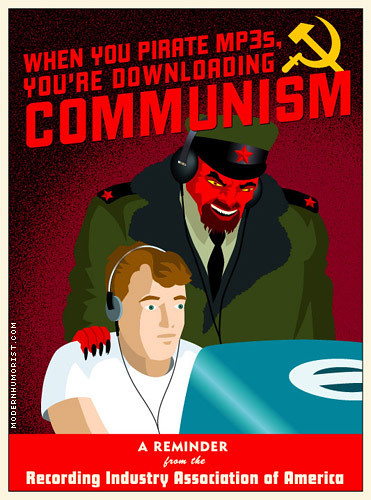
Propaganda helps,

(satire :rolleyes:)
 
Personally, I think it’s just fine and sharing a little really isn’t immoral IMHO.
I mean, if one makes a whole bunch of copies and starts selling them, then yes, that’s not only illegal but immoral.

However, just making a copy for someone is apparently breaking the man-made law.

I think it’s really ridiculous right now and the RIAA is really taking advantage of this with their army of lawyers.
$1.92 million for 24 songs is very excessive.

wearelistening.org/blog/radiohead-against-the-riaa/

Propaganda helps,
http://farm1.static.flickr.com/25/53295111_637be17159.jpg
(satire :rolleyes:)
It’s not about just breaking a “man-made law”. The law is there in part to protect the creators of these works. CD’s can only be created after people work to create the product on the cd and the creators deserve just compensation if one wants to own a copy of their work. Selling it or not selling it doesn’t change the fact that someone gets a copy of something they were supposed to pay for but didn’t.
 
Personally, I think it’s just fine and sharing a little really isn’t immoral IMHO.
I mean, if one makes a whole bunch of copies and starts selling them, then yes, that’s not only illegal but immoral.

However, just making a copy for someone is apparently breaking the man-made law.

I think it’s really ridiculous right now and the RIAA is really taking advantage of this with their army of lawyers.
$1.92 million for 24 songs is very excessive.

wearelistening.org/blog/radiohead-against-the-riaa/

Propaganda helps,
http://farm1.static.flickr.com/25/53295111_637be17159.jpg
(satire :rolleyes:)
yeah your right stealing just a little is fine and moral:rolleyes:
the problem is that alot of people stealing just a little add’s up to a lot of stolen stuff
 
My brother recently copied a bunch of his CDs and gave them to me. He bought them, they are his property, so do you think that he can do what he wants with them? Or can I not take the CDs, because it would be violating copyright laws? If so, do you think it is a mortal or venial sin? I don’t see how it could be mortal, and at the most venial. Thanks for your (name removed by moderator)ut everyone!
It would be a venial sin. You didn’t make them, so the theft is not on you, you simply were given the stolen goods. You should say an Act of Contrition and destroy the CD’s so they cannot be used by someone else.
 
I think this situtation is a little complicated.

The most important factor in this whole question is the fact that the creator of the music deserves to be compensated for their efforts.

In addition however, it is complicated by the fact that music and other “intellectual property” is not really property in the normal sense of the word. This is recognized by the Constitution which specifically mandates that copyrights and patents exist for only a limited time (Which was a great improvement on the previous system where works essentially entered the public domain immediately).

The final complication in this is that fair use comes into play. With any piece of music you here on CD there are two distinct copyrights at work – the first is for the song itself, the second is for performance of that song. Playing a song for a friend is not violating copyright… nor is it a violation of that copyright if the friend later sings the song in the shower or for another friend. It would be violating copyright if the friend sang it in pub band they play in without compensating the copyright holder. So in a funny way, copyright is easier to break for performance (where any copy distributed is a violation of copyright) than it is for the writing.

Now this only really begins to scratch the surface… However, here is where I come down on the matter…

Freely distributing mp3s of music online to anyone is clearly both a violation of copyright and deprives the performer and song writer of potential royalties. It is clearly wrong.

Personally I think making a mix CD of music, where you sample some of your music to give to a friend is a different matter. While there is some potential loss of revenue to the artists involved, there is also a potential gain. I.e., you might be introducing your friend to artists they have never encountered before and as a result gain the artist new sales. The key here though is that you should be sampling the work… if you are making a best of CD of a particular artist, that is different.

Another question I have been wondering about is copyright law as it applies to dead artists? Do we have the same moral obligation to observe those copyrights? Particularly if the dead artist has no close living relatives?


Bill
 
I think this situtation is a little complicated.

The most important factor in this whole question is the fact that the creator of the music deserves to be compensated for their efforts.

In addition however, it is complicated by the fact that music and other “intellectual property” is not really property in the normal sense of the word. This is recognized by the Constitution which specifically mandates that copyrights and patents exist for only a limited time (Which was a great improvement on the previous system where works essentially entered the public domain immediately).

The final complication in this is that fair use comes into play. With any piece of music you here on CD there are two distinct copyrights at work – the first is for the song itself, the second is for performance of that song. Playing a song for a friend is not violating copyright… nor is it a violation of that copyright if the friend later sings the song in the shower or for another friend. It would be violating copyright if the friend sang it in pub band they play in without compensating the copyright holder. So in a funny way, copyright is easier to break for performance (where any copy distributed is a violation of copyright) than it is for the writing.

Now this only really begins to scratch the surface… However, here is where I come down on the matter…

Freely distributing mp3s of music online to anyone is clearly both a violation of copyright and deprives the performer and song writer of potential royalties. It is clearly wrong.

Personally I think making a mix CD of music, where you sample some of your music to give to a friend is a different matter. While there is some potential loss of revenue to the artists involved, there is also a potential gain. I.e., you might be introducing your friend to artists they have never encountered before and as a result gain the artist new sales. The key here though is that you should be sampling the work… if you are making a best of CD of a particular artist, that is different.

Another question I have been wondering about is copyright law as it applies to dead artists? Do we have the same moral obligation to observe those copyrights? Particularly if the dead artist has no close living relatives?


Bill
Well, the ones that I would want to keep are classical music CDs–Mozart, Beethoven, Verdi, Dvorak, etc. So the only revenue that would be lost would be for the music companies. But what right does a company have to tell us if we can copy a CD and give it to a friend? It’s obviously different if you start your own business copying CDs and selling them, but if the CD is your property and you want to copy them and give them to your brother, I don’t know exactly why the CD company would have a right to tell you not to. In any case, I think also that it is at the most a venial sin.
 
Well, the ones that I would want to keep are classical music CDs–Mozart, Beethoven, Verdi, Dvorak, etc. So the only revenue that would be lost would be for the music companies. But what right does a company have to tell us if we can copy a CD and give it to a friend? It’s obviously different if you start your own business copying CDs and selling them, but if the CD is your property and you want to copy them and give them to your brother, I don’t know exactly why the CD company would have a right to tell you not to. In any case, I think also that it is at the most a venial sin.
Umm. what about the revenue for the performers? Unlike popular music, classical music generally needs every source of revenue it can to survive.


Bill
 
By the legal law of copyright, those songs are older than what 75 or 90 something years needed for it to automatically loose it’s copyright. The original artists are long dead. I don’t even think it has a copyright.
 
By the legal law of copyright, those songs are older than what 75 or 90 something years needed for it to automatically loose it’s copyright. The original artists are long dead. I don’t even think it has a copyright.
There are two different types of copyright involved with music CDs… the first is the copyright on the tune or song. The second is the copyright on the actual performance. Thus, someone could record tunes from the middle ages which have never been under copyright, and the CD would still have a copyright.


Bill
 
Wouldn’t that be taking credit for someone else’s work? The same exact thing copyright is suppose to defend? Doesn’t sound right to me. I use to believe in copyright and the originial idea I still do but I believe the motive enforcement of that law today lately has really twisted what it was originally created for in the interest of the highest possible profits.

I think we need to stop listening to the media and the large conglomerates who like to brainwash the public and think for ourselves on the issue on the right or wrong of it.

I just hear too much of “it’s wrong because it’s illegal” “it’s wrong because it’s stealing” “it’s wrong because it hurts so and so” which is exactly what is being fed to them, I’d by all means love to listen to their opinions if it is their own and they can reasonably offer reasonable proof of the claim or what they believe to be proof and not something spoon fed to them by other sources supporting these corporations. Often though when asked to elaborate more on their statements they are often unable to because they really haven’t thought for themselves on the issue.

Here’s the first thing, how many copyright claims and violations do you see outside of big business’s ? Very few if even any hit the news.

Even many business claims are legit, but the ones we’re giving all the attention to in relation to file sharing and music, the artists never see any of the money won in the first place!!!

The original law no longer exists as it was intended (to protect and give credit to the original artists of intellectual creations) instead it is used to shadow a more greedy motive.

I’m still researching the issue bit by bit as things come up and considering new things but that is how I see it or have seen it the last decade thus far.
 
My brother recently copied a bunch of his CDs and gave them to me. He bought them, they are his property, so do you think that he can do what he wants with them? Or can I not take the CDs, because it would be violating copyright laws? If so, do you think it is a mortal or venial sin? I don’t see how it could be mortal, and at the most venial. Thanks for your (name removed by moderator)ut everyone!
Ten years ago, a friend of mine whose father is a lawyer asked him about music sharing. His dad said that it was perfectly legal to make copies of CDs for members of your immediate family (like your brother did for you).

Now, whether or not this has changed in the last ten years, and whether or not this friend’s dad knew what he was talking about are debatable. But it’s something for you to look into.

I know many of us have a knee-jerk reaction that any CD copying whatsoever is automatically an infringement of copyright laws, but I don’t know that that’s necessarily the case. At least, I have yet to come across anything concrete that would contradict what my friend told me ten years ago. 🤷
 
Wouldn’t that be taking credit for someone else’s work? The same exact thing copyright is suppose to defend? Doesn’t sound right to me. I use to believe in copyright and the originial idea I still do but I believe the motive enforcement of that law today lately has really twisted what it was originally created for in the interest of the highest possible profits.
No, its not taking credit for someone else’s work. Have you ever learned to play an instrument? Its a lot of work. I play music for fun, but I am nowhere near as good as the best musicians out there who have spent thousands upon thousands of hours developing the skill necessary to play the music in a way that is not only enjoyable, but often sublime. Their creative efforts need to be protected every bit as much as the person who wrote the tune in the first place (Played by different musicians, it can sound very different).
I think we need to stop listening to the media and the large conglomerates who like to brainwash the public and think for ourselves on the issue on the right or wrong of it.
I just hear too much of “it’s wrong because it’s illegal” “it’s wrong because it’s stealing” “it’s wrong because it hurts so and so” which is exactly what is being fed to them, I’d by all means love to listen to their opinions if it is their own and not spoon fed to them by other sources. Often though when asked to elaborate more on their statements they are often unable to because they really haven’t thought for themselves on the issue.
Look, I agree that copyright needs reform. Certainly I see no need for copyright protection to last 70 years after an author or artist has died. On the flip side, there is a huge difference between believing copyright needs reform and justifying a violation of copyright. While copyright might be odious, it is not immoral, so I can’t really see much moral justification for violating it.


Bill
 
It takes a lot of skill to play an instrument, sing at a professional quality or to be an artist or writer. In a cooperative society we should all follow the rules. So, if you are allowed to make one copy for yourself, make it. If not, then no copies. It’s simple.

Some wrong ideas to avoid.

Promotion. The record companies and the artists themselves should be in charge of promotion. That’s why big companies use PR Agencies - to get effective, professional promotion.

Money. The artists and/or record companies are rich. They won’t miss my not paying them.

Hey. Today, anyone can pay $1.99 to pick up any current song for download. The internet allows for the global tracking down of any CD ever made.

And copyright should not be overhauled. It should remain just the way it is. Some people want to make a buck off of something they didn’t make. I say, create something new.

Peace,
Ed
 
Wouldn’t that be taking credit for someone else’s work? The same exact thing copyright is suppose to defend? Doesn’t sound right to me. I use to believe in copyright and the originial idea I still do but I believe the motive enforcement of that law today lately has really twisted what it was originally created for in the interest of the highest possible profits.

I think we need to stop listening to the media and the large conglomerates who like to brainwash the public and think for ourselves on the issue on the right or wrong of it.

I just hear too much of “it’s wrong because it’s illegal” “it’s wrong because it’s stealing” “it’s wrong because it hurts so and so” which is exactly what is being fed to them, I’d by all means love to listen to their opinions if it is their own and they can reasonably offer reasonable proof of the claim or what they believe to be proof and not something spoon fed to them by other sources supporting these corporations. Often though when asked to elaborate more on their statements they are often unable to because they really haven’t thought for themselves on the issue.

Here’s the first thing, how many copyright claims and violations do you see outside of big business’s ? Very few if even any hit the news.

Even many business claims are legit, but the ones we’re giving all the attention to in relation to file sharing and music, the artists never see any of the money won in the first place!!!

The original law no longer exists as it was intended (to protect and give credit to the original artists of intellectual creations) instead it is used to shadow a more greedy motive.

I’m still researching the issue bit by bit as things come up and considering new things but that is how I see it or have seen it the last decade thus far.
I work in the media and every big business started as a small business.

You start Bob’s Records with some borrowed money, hire some talent and produce some CDs. Who should get the money?

Original copyright still exists. You don’t think the artists want to be rich? Elvis bought his mom a car and Graceland. What you’re referring to are contracts which might give 60% of the money to the company and 40% to the performer.

The company I work for has filed copyright claims, it happens all the time. But the newspaper can’t publish everything, only those violations that involve millions of dollars and/or celebrities.

The performer/writer/artist should get every penny that is due to the them. If you published a physical book hoping to sell it, would you be happy to see a scan of that book on a file sharing site a month later? That happened with a book put out by my company.

Put yourself in the other guy’s shoes.

Peace,
Ed
 
And copyright should not be overhauled. It should remain just the way it is. Some people want to make a buck off of something they didn’t make. I say, create something new.

Ed
With respect Ed, copyright does need to be overhauled.

According to the Constitution of the United States, the whole point of copyright is to encourage artists to produce works and publish them. Ultimately, the goal is for the works to enter the public domain. By allowing authors and those they designate a limited time period to exploit their work, we give them an opportunity to make a fair profit on their labor. However, lets consider some facts…
  1. Well over 90% of creative works are out of print within 10 years of their being published. At this point the artist is no longer profitting from the work. At the same time the work remains locked in copyright right for some period that could (assuming no changes in the current law) be over 100 years depending on when the author dies. By the time the work “enters” the public domain it might be forgotten and all but lost to history.
  2. Copyright is a hammer covering a wide range of creative works identically. This may have made sense 200 years ago when only printed works were copyrighted. Now however, it makes little sense for software to receive the same type of copyright protection as a novel or a song. After all, by the time DOS 1.0 enters the public domain, there will effectively nothing in it that will benefit the public interest (This despite the fact that the entire software industry is built on reusing and repurposing existing code).
  3. Copyright already allows people to make a buck off of something they didn’t create. Hemingway certainly hasn’t profitted from his writings since his death.
  4. Derivative works are often a valid addition to the body of human knowledge. Certainly these days more people are familiar with the Disney versions of Snow White, Sleeping Beauty and Beauty and the Beast than they are with the original versions of those stories. Yet Disney now is leading the fight to prevent others from creating derivative works based on their own works (even when said works are themselves derivative).
    Even more so, its interesting to note that many public domain works, when they are published are published with commentary… thus different editions might give you different insight to the book. Such is generally not possible with works still under copyright.

Bill
 
With respect Ed, copyright does need to be overhauled.

According to the Constitution of the United States, the whole point of copyright is to encourage artists to produce works and publish them. Ultimately, the goal is for the works to enter the public domain. By allowing authors and those they designate a limited time period to exploit their work, we give them an opportunity to make a fair profit on their labor. However, lets consider some facts…
  1. Well over 90% of creative works are out of print within 10 years of their being published. At this point the artist is no longer profitting from the work. At the same time the work remains locked in copyright right for some period that could (assuming no changes in the current law) be over 100 years depending on when the author dies. By the time the work “enters” the public domain it might be forgotten and all but lost to history.
  2. Copyright is a hammer covering a wide range of creative works identically. This may have made sense 200 years ago when only printed works were copyrighted. Now however, it makes little sense for software to receive the same type of copyright protection as a novel or a song. After all, by the time DOS 1.0 enters the public domain, there will effectively nothing in it that will benefit the public interest (This despite the fact that the entire software industry is built on reusing and repurposing existing code).
  3. Copyright already allows people to make a buck off of something they didn’t create. Hemingway certainly hasn’t profitted from his writings since his death.
  4. Derivative works are often a valid addition to the body of human knowledge. Certainly these days more people are familiar with the Disney versions of Snow White, Sleeping Beauty and Beauty and the Beast than they are with the original versions of those stories. Yet Disney now is leading the fight to prevent others from creating derivative works based on their own works (even when said works are themselves derivative).
    Even more so, its interesting to note that many public domain works, when they are published are published with commentary… thus different editions might give you different insight to the book. Such is generally not possible with works still under copyright.

Bill
Hi Bill,

I’ve heard these before.
  1. Yeah, so what? It appears the only real desire here is to get the work into a something for nothing “public domain.” Most businesses fail in their first few years and thousands of new books are published every year, plus lots of independent records get made every year. Given unlimited, free access, no one could physically read or listen to all the creative work produced in one year.
  2. Rights can be sold. Happens all the time. You want to use my software? Pay me a reasonable fee.
  3. The Edgar Rice Burroughs Estate still exists, the same with Tolkien. If I want to pass my Intellectual Properties on to my children, I sure can. Sony recently picked up the rights to Buck Rogers.
  4. Derivative works? It takes years to be recognized as a skilled artist, writer, singer, or football player, not including the years it takes to develop the talent into a professional skill. Based on my experience, a lot of people seeking to get their hands on certain properties are a little less interested in promoting human knowledge and more on riding on the coattails of giants in the medium they want to contribute to. Now I’m not saying everyone thinks like this, but it is my impression that a lot do.
Speaking as a writer and editor, I don’t think I could handle writing a new Sherlock Holmes novel.

I encourage people to develop their own talent. I’m not waiting for anything to go into the public domain. I have plenty of ideas for books. And that, I think, is where the problem comes in. I’m skeptical that ‘adding to human knowledge’ or insight is the real goal. Talented people are first and foremost, interested in sharing their talent with as many as they can, but waiting for something to enter the public domain and not having the skill of a company like Disney, what are you really going to contribute?

I don’t want to discourage young creatives but the fact that you can go to a publisher like lulu and get your book published does not turn you into a professional. I’ve gone there and read some sample pages from a book. It read exactly like the stuff we reject at my company all the time. Then, on the message board, the author asks, “Why isn’t my book selling?” He does not yet have the refined, professional skill and expertise to produce a book. Not yet. Just because we live in the 21st Century, it doesn’t mean you can go to college for one year instead four and walk out with a diploma. The learning curve does not go away.

Peace,
Ed
 
First let me point out that my above arguments, and my rebuttals are based on the following line of the Constitution:

“To promote the Progress of Science and useful Arts, by securing for limited Times to Authors and Inventors the exclusive Right to their respective Writings and Discoveries.”
Hi Bill,

I’ve heard these before.
  1. Yeah, so what? It appears the only real desire here is to get the work into a something for nothing “public domain.” Most businesses fail in their first few years and thousands of new books are published every year, plus lots of independent records get made every year. Given unlimited, free access, no one could physically read or listen to all the creative work produced in one year.
The public domain is not a something for nothing approach. The whole concept of the public domain is based on the fact that authors and other artists are granted exclusive rights to their works for a “limited” time.

In any case, the whole point here is to promote the general welfare. Perpetual exclusive rights run contrary to that perpetual welfare.

Further, I have never seen any justification that current copyright terms serve as an incentive to creative works. I doubt very few people were motivated to create more works when copyright was extended from death + 50 years to death + 70 years… and none of the works already written were created because of such an extension.
  1. Rights can be sold. Happens all the time. You want to use my software? Pay me a reasonable fee.
But what is a reasonable fee? What if you decide you don’t want to sell the rights? By its very nature copyright ensures that ultimately, a work becomes available to the general public without any limitation so that it can be built upon. With software (and mind you I am not talking about new software, but 25 year old software), the current law keeps things bottled up for such a long period of time that copyright fails in its basic goal of benefiting society when it comes to copyright.
  1. The Edgar Rice Burroughs Estate still exists, the same with Tolkien. If I want to pass my Intellectual Properties on to my children, I sure can. Sony recently picked up the rights to Buck Rogers.
And? Why should the simple act of being genetically related to an author who has been dead nearly 60 years (in Burroughs case) give a person the right to continue to have control over a book that was written before they were born?
  1. Derivative works? It takes years to be recognized as a skilled artist, writer, singer, or football player, not including the years it takes to develop the talent into a professional skill. Based on my experience, a lot of people seeking to get their hands on certain properties are a little less interested in promoting human knowledge and more on riding on the coattails of giants in the medium they want to contribute to. Now I’m not saying everyone thinks like this, but it is my impression that a lot do.
What is wrong with riding the coattails of giants? To some extent, almost every giant has themselves built on what was done before them. Stephen King would not have been possible without Brahm Stoker and Mary Shelly.
Speaking as a writer and editor, I don’t think I could handle writing a new Sherlock Holmes novel.
And? Your point? Others have (Generally not that good) or have taken advantage of Doyle’s work being in the Public Domain to make movie and television versions of the stories (The Grenada TV series was generally excellent).
I encourage people to develop their own talent. I’m not waiting for anything to go into the public domain. I have plenty of ideas for books. And that, I think, is where the problem comes in. I’m skeptical that ‘adding to human knowledge’ or insight is the real goal. Talented people are first and foremost, interested in sharing their talent with as many as they can, but waiting for something to enter the public domain and not having the skill of a company like Disney, what are you really going to contribute?
You never know until you try do you? Shakespeare did not write the first Hamlet. How pooerer would the world be today if he had been prevented from writing a Hamlet because someone else already had?

And just because 99.9% of the derivative works will be utter ****, that doesn’t justify preventing the .1% that might be brilliant by setting a standard of copyright that has become an encumberence on society.
I don’t want to discourage young creatives but the fact that you can go to a publisher like lulu and get your book published does not turn you into a professional. I’ve gone there and read some sample pages from a book. It read exactly like the stuff we reject at my company all the time. Then, on the message board, the author asks, “Why isn’t my book selling?” He does not yet have the refined, professional skill and expertise to produce a book. Not yet. Just because we live in the 21st Century, it doesn’t mean you can go to college for one year instead four and walk out with a diploma. The learning curve does not go away.
Of course most of the work on sites like Lulu is ****… but then again most of the books that publishers publish are **** as well. There has been more than one book that was self published that was picked up by a publisher because it started to gain traction.


Bill
 
Status
Not open for further replies.
Back
Top