Questions about Presentation at the Temple

  • Thread starter Thread starter ag11
  • Start date Start date
Status
Not open for further replies.
You’ve expended quite a lot of verbiage in your last 5 lengthy posts to basically say, you disagree with another scholar (big surprise) and you find his arguments unconvincing (again, big surprise)
I didn’t know random, broke art students on the internet are considered ‘scholars’. If that’s a compliment, I’ll take it. 😃 Let’s just say I guess I talk a lot (here) to compensate for the fact that I don’t talk a lot (IRL). My stock of word is running out, so better sooner than later. Soon I’ll…
My question is this: What exactly (in your opinion) is the Church celebrating on November 21st? A feast that is most ancient in the Universal Church. You have argued away the entire premise of the feast it would seem.
What happened to the Sacred Triduum? That is the most ancient feast in the Church. The Presentation of Jesus / the Purification of Mary is the first Marian feast introduced in the West (640s I believe); the Presentation of Mary was widely celebrated in the East by the 8th century and introduced in southern Italy (then a Byzantine domain) the following century.

Just my personal opinion, but I tend to view the spirit/theological meaning of the feast as being more important than its historical reality. Sure, I don’t think things happened as the Protoevangelium purports it happened, but I still agree with what TimothyH said in the last post. I mean, there are some saints in the calendar whose actual historical names we can’t know for sure (the Good Thief, and even Sts. Joachim and Anna count) or whose biographies are for some reason or another not that reliable, but that doesn’t take anything from them, even if we don’t know their ‘real’ names or their actual lives. History can only take you so far.
Secondly, you are probably mistaking the intent of Marshall’s arguments. NO ONE (including Marshall, from what I can gather) is trying to establish the existence of a dedicated “convent of nuns” in the Second Temple. But rather a dedicated group of young maidens/virgins who after completing their service, would leave the temple and marry (exactly as the Blessed Virgin Mary did.)
For example, It may have been a two way street. The child was provided for and educated in the Law and the Prophets (to the degree proper to a young Jewish maiden) and she provided a service to the temple in exchange until a fitting age when she was released.
What everyone can agree on, is that hard evidence is sketchy at best, other than what the Church has told us (in the form of her Liturgies.)
Sorry, I guess I made a poor choice of words. You might say my problem is not so much there. My main problem would be rather Mr. Marshall’s argumentation and choice of prooftexts. At least two or three of them do open the possibility that there were historically young female weavers who were working for Herod’s temple and were under the temple’s payroll, but were these young virgins actually ‘dedicated’ or lived (even for a time) at the temple - which I gather is the main thrust of Mr. Marshall’s argument? Even his prooftexts doesn’t really say that. As I said (and as ‘Mitchell’ on his comments section implied) he’s reading too much into the data. Even the Protoevangelium really only speaks of Mary living during her early years at the temple; it doesn’t say as far as I am aware that there were other virgins like her. (I don’t think the other seven Davidic virgins chosen to weave the veil count.)
 
Because I feel responsible for derailing the thread I say we need to get back on topic before our train crashes somewhere.
 
What exactly is/was presentation?

Does it still happen today by Jewish people?

Was Jesus circumcised at the Temple, or before His Presentation at the Temple?
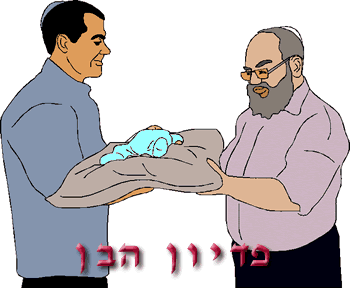
Jesus was circumcised on the eighth day after His birth. The ‘presentation’, as mentioned, involves (1) the purification of the woman who had given birth, and (2) the redemption of the firstborn son, which occurs at least thirty days or so after birth. Mary would have been considered ritually impure for forty days after giving birth; at the end of those forty days, she was required to immerse herself in a miqveh or a pool of ‘living water’ and then offer a purification sacrifice. Apparently Joseph and Mary thought it was more convenient to combine her purification ritual with Jesus’ redemption - hey, they’re in Jerusalem anyway so why not hold the two events together?

The idea behind ransoming the firstborn is, that the first of all things are ‘sacred’ and thus belongs to God. That’s why the first agricultural produce of the harvest and firstborn kosher animals were brought to the priests to be offered as a sacrifice. (This is an idea that is found in many cultures at the time, not just the Israelite one.) The same rule applies to humans, but instead of demanding the sacrifice of firstborn male babies, the practice of redeeming firstborn boys was instituted, where the family would symbolically buy them back from God (represented by the priests) at the price of five silver shekels.

Another reason for the practice is the tenth plague of Egypt, where the Egyptian firstborn males were all killed, but the Hebrew firstborn were spared. According to a Jewish tradition, because the Hebrew firstborn owed their lives to God, they were considered priests consecrated to His service. However, most of the Israelites forfeited this privilege because of the sin of the calf; so as per Jewish belief, since then only firstborns from the tribe of Levi (who did not participate in the worship of the Golden Calf) became exempt from the requirement to ransom the firstborn - because they became priests in place of the first-born of the other tribes and thus cannot be redeemed from the obligation to serve God.

Yes, the purification ritual and the redemption of the firstborn (Pidyon ha-Ben) are still practiced today by Jews. In fact, because most modern money contain little or no silver (making them invalid for use), there is now this practice of making special coins with the necessary silver content for the ceremony.
Was presentation nececssary for ALL Jewish children (male and female), or some?
No. It was even argued that the redemption of the female firstborn is not necessary nor appropriate, since the tenth plague of Egypt never placed the lives of female firstborns in jeopardy.
 
40.png
patrick457:
What happened to the Sacred Triduum? That is the most ancient feast in the Church. The Presentation of Jesus / the Purification of Mary is the first Marian feast introduced in the West (640s I believe); the Presentation of Mary was widely celebrated in the East by the 8th century and introduced in southern Italy (then a Byzantine domain) the following century.
I meant “most” in the sense that it is VERY old, not that it was the very first feast. I didn’t even forsee that misunderstanding! 😉
40.png
patrick457:
Just my personal opinion, but I tend to view the spirit/theological meaning of the feast as being more important than its historical reality. Sure, I don’t think things happened as the Protoevangelium purports it happened, but I still agree with what TimothyH said in the last post. I mean, there are some saints in the calendar whose actual historical names we can’t know for sure (the Good Thief, and even Sts. Joachim and Anna count) or whose biographies are for some reason or another not that reliable, but that doesn’t take anything from them, even if we don’t know their ‘real’ names or their actual lives. History can only take you so far.
I can understand that, although I would add that the historical view of the Church’s liturgical feast is not one that should be casually dismissed without very good evidence. (Something, IMHO, you haven’t shown. IOW, you have cast doubt but not proved anything.) I admit I take the Protoevangelium with a grain of salt myself, although there may actually be some nuggets of Truth buried under the well intentioned fabrications. 😉 Further, it has always been celebrated as a historical event as well as a spiritual one. Unlike some of the other events described in the Protoevangelium; viz: The church doesn’t liturgically celebrate the supposed other children of St. Joseph in any way.

What I am saying is that the Presentation of the Virgin Mary to the temple, may have had a currency of its own, which is HOW it found itself in the Protoevangelium. (just a conjecture of course.) Still, a church liturgical feast in memory of a historical event is what we have.
 
I meant “most” in the sense that it is VERY old, not that it was the very first feast. I didn’t even forsee that misunderstanding! 😉

I can understand that, although I would add that the historical view of the Church’s liturgical feast is not one that should be casually dismissed without very good evidence. (Something, IMHO, you haven’t shown. IOW, you have cast doubt but not proved anything.) I admit I take the Protoevangelium with a grain of salt myself, although there may actually be some nuggets of Truth buried under the well intentioned fabrications. 😉 Further, it has always been celebrated as a historical event as well as a spiritual one. Unlike some of the other events described in the Protoevangelium; viz: The church doesn’t liturgically celebrate the supposed other children of St. Joseph in any way.

What I am saying is that the Presentation of the Virgin Mary to the temple, may have had a currency of its own, which is HOW it found itself in the Protoevangelium. (just a conjecture of course.) Still, a church liturgical feast in memory of a historical event is what we have.
First, I’d like to thank you for being civil. If only more people on the internet were like you, it’d be a less messy place. 🙂 😃

I’m now interested in the whole history of the feast of the Presentation of Mary.

What I only right now is (I just looked it up), it probably first arose in the 6th century, in Jerusalem (commemorating the dedication of a basilica to Our Lady there, built near the site where the temple once stood - Santa Maria Nova or ‘Saint Mary the New’ - in 543; this basilica was destroyed during the Persian invasion of 614), but is first explicitly mentioned in the 7th-8th centuries when it was already popular in the East (but still unknown in the West), then it arrived in southern Italy. It spread in the West by the 14th century, while Pope Gregory XI was at Avignon; a French knight named Philippe de Mezieres, who lived for a time in Cyprus, introduced the feast (already celebrated by Latins in Cyprus, under Greek influence) to the pope, perhaps in an ecumenical attempt to convince the Greeks to reunion. The pope, and then the French, liked it that they adopted it. Then Pope Sixtus IV brought it to Rome and allowed any church to celebrate it.

Then for a time the feast was suppressed in 1568 by Pope Pius V because of the lack of concrete historical evidence and because of some faulty worded sequence in the Mass dating from 1505 (to be fair on pope Pius, this was the Counter-Reformation, when the Church was trying to stand up to Protestant accusations by shedding off anything thought to be ‘apocryphal’ or ‘spurious’ - well, anything that could give Protestants ammunition to use against the Church), but was soon reestablished in 1585 by Pope Sixtus V, when it finally became a universal feast. Clement VIII in 1597 raised the feast’s rank (greater double) and gave the feast new texts, but did not insist on the historical fact; rather he simply recalled the words of St. John of Damascus without accenting historicity. The feast eventually survived the liturgical reforms of Pope Pius VI as a memorial.

Do you have anything to add to the history? I’d like to know more.

(Hey, the feast does have a historical basis: the dedication of the New Church of St. Mary, aka the Nea Church, on Mount Zion, on November 21st, 543.)

http://dbcfaa79b34c8f5dfffa-7d3a62c...cdn.com/wp-content/uploads/BSBA390604003L.jpg
 
40.png
patrick457:
First, I’d like to thank you for being civil. If only more people on the internet were like you, it’d be a less messy place.

I’m now interested in the whole history of the feast of the Presentation of Mary.
Your welcome! 😉 I have taken issue with you only because I feel pretty strongly in a Church that is guided by the Holy Spirit, and in Faith. I know you share this opinion too, as you have already stated that the historical aspect of this feast is decidedly secondary.

It is always appreciated that you share your findings as you do however! 😃
 
I just learned that there are two feasts, which are are both from late 4th-5th century Jerusalem, which could count as the earliest Marian feasts: the feast of the Presentation of Jesus in the Temple and the Purification of Mary, aka the Hypapante (then February 14th - counting forty days from January 6th, which was then the standard Eastern date for the Nativity and other events in Jesus’ early life), and a commemoration of Our Lady in August 15th, the day we now celebrate the Assumption/Dormition.

The thing is, we don’t know what was commemorated on the August feast at that time other than it was something connected to Mary. Now some scholars think that the original commemoration was probably that of the Annunciation/Incarnation. In some Armenian lectionaries, there is a curious mention of the feast of the Holy Innocents falling on May 18th. So, these people have a hunch: maybe there was originally a commemoration of Jesus’ birth in May, at least in Jerusalem - counting nine months from August 15th - that was later obscured by the January 6th and the December 25th feasts? In this scenario, you have a cycle observed by the Church in Jerusalem: Jesus’ conception in August, Jesus’ birth in May (coinciding with Pentecost), and Jesus’ death and resurrection on March/April (coinciding with Passover).

What’s interesting is that this would coincide with a scenario found in the 2nd-century BC Book of Jubilees, where Isaac is said to have been born to Sarah on Pentecost (which was fixed by Jubilees on May 15th - exactly nine months after August 15th!) and was nearly sacrificed by Abraham around Passover. Jubilees was well known to early Christians, and Isaac is seen as a type of Christ, so who knows? As per this theory, maybe Jubilees exerted an influence in the Jerusalem liturgical year. Now we don’t know if this theory - of the August 15th feast originally being that of the Incarnation - is really correct, but it has something interesting going for it.
 
Just a little tangent. The very first source I found (just some moments ago, in fact) which claims that Mary joined a company of virgins in the temple was the Gospel of Pseudo-Matthew, written much later than the Protoevangelium (AD 600-625?)

In the Protoevangelium, Mary at six months was entertained by “undefiled daughters of the Hebrews” in her bedroom sanctuary (6.1). The “undefiled daughters of the Hebrews” also show up when Joachim and Anna finally decide to give Mary (now three years old) to the temple, but they are not said to be specially-dedicated virgins or resident in the temple:

When the child turned three, Joachim said, “We should call the undefiled daughters of the Hebrews and have each take a torch and set them up, blazing, that the child not turn back and her heart be taken captive away from the Temple of the Lord.” They did this, until they had gone up to the Lord’s Temple. (7.2)

The implication in the Protoevangelium was Mary was really the only girl in the temple; in fact, the priests even hold a council concerning Mary when she turned twelve and thus, likely to menstruate any time soon (8.2-3). It’s also implied that the seven other “undefiled virgins from the tribe of David” who were to weave the temple veil aside from Mary were not resident in the temple, because the servants/officials of the temple priests had to fetch them (10.1-2).

Now here’s the interesting thing. The texts of apocryphal gospels are more likely to be changed and edited than those of the canonical gospels; because of this, the Protoevangelium actually exists in different versions, and our surviving manuscripts have a lot of disagreements with each other, both small and great. (Here’s an example: some manuscripts do not name the high priest mentioned in 8.2-3, while others - especially later ones - he is specified to be Zechariah; note the popular image of “Zechariah the high priest” creeping into the text.)

I have this hunch that the mention of “the community of virgins, in which the virgins remained day and night praising God” in Pseudo-Matthew may be due to the rise of monasticism in the West at around this time. In fact, it is thought Mary’s fixed daily schedule of prayer and wool-weaving described in the text may have been inspired by St. Benedict’s rule of ora et labora!

And she occupied herself constantly with her wool-work, so that she in her tender years could do all that old women were not able to do. And this was the order that she had set for herself: From the morning to the third hour she remained in prayer; from the third to the ninth she was occupied with her weaving; and from the ninth she again applied herself to prayer. She did not retire from praying until there appeared to her the angel of the Lord, from whose hand she used to receive food; and thus she became more and more perfect in the work of God. (Ps.Matt. 6.1)
 
Just to expand on the redemption of the first-born.

The modern requirement for pidyon ha-ben is that the child should be (1) male; (2) born of a Jewish mother (modern Judaism is matrilineal; in order to be considered a Jew your mom’s gotta be Jewish); (3) the firstborn (that rules out mothers who had babies before this child’s birth, or had a prior abortion or stillbirth*); (4) someone who literally ‘opens his mother’s womb’ (that rules out babies born by C-section). People with Levite ancestry, including priests (kohanim), do not redeem their firstborn sons; the rationale as mentioned earlier is because they are pledged to serve God in place of the first-born of the other tribes and thus cannot be redeemed from this obligation. These requirements make the actual ceremony AFAIK very rare: I’ve heard only one of out of ten families meet the requirements to perform pidyon ha-ben. (Let’s assume that 50% of firstborn births are female, then subtract from that the male babies who are ineligible for the ceremony due to the above requirements. See? It’s very uncommon.)

If someone who is eligible for the ritual did not have it performed as a baby, if he’s an adult, he is responsible for arranging the ritual for himself.
  • If a male baby’s birth was preceded by an earlier miscarriage by the mother that occurred after the third month of pregnancy, the child is not redeemed. However, if the miscarriage occurred during the first 40 days of pregnancy, redemption is required.
The ceremony takes place - as do many Jewish ceremonies - before a group of at least 10 Jewish adult males (a minyan). It can be held anywhere: either at home or at synagogue. It is performed in the context of a special festive meal: before the actual redemption, everyone washes their hands and bread is broken and blessed first.


The father then brings the child to a priest (kohen) in attendance and declares that this is the Israelite mother’s firstborn son and he has come to redeem him as commanded in the Torah. The kohen will then ask the father which he prefers: the baby or the five silver shekels. The father replies that he prefers the child over the money, recites two blessings (one regarding the commandment of pidyon ha-ben, the other a thanksgiving for bringing them to this occasion), and then gives the money to the kohen. (Because the ceremony is considered a legal transaction - money is handled and the baby is ‘bought back’ - it cannot be held on a Sabbath or on a holy day.) The kohen will then recite a blessing over a cup of wine. (If there was no wine, the redemption is performed before the meal and the kohen blesses another beverage.) Afterwards, the meal continues.


Sometimes the baby is presented on a silver tray surrounded by jewelry.

Here’s the Ashkenazic version of the ceremony, and here is the Sephardic one. In the Ashkenazic version, you have a rather nice declaration by the kohen when sealing the deal, so to speak. He places or holds the money over the child’s head and declares: “This instead of that, this in exchange for that and this in remission for that.”

If any Jewish posters are reading this, I’d appreciate your (name removed by moderator)ut.
 
Your welcome! 😉 I have taken issue with you only because I feel pretty strongly in a Church that is guided by the Holy Spirit, and in Faith. I know you share this opinion too, as you have already stated that the historical aspect of this feast is decidedly secondary.

It is always appreciated that you share your findings as you do however! 😃
It’s kinda like Veronica in a way. To explain: we’re all familiar with Veronica via the Stations of the Cross - she’s the woman who, as an act of kindness, wipes Jesus’ face with her veil on the way to Golgotha.

But here’s the thing: the connection between Veronica and Good Friday only arose during the Middle Ages, around the 13th century I believe. In earlier traditions, Veronica (or in Greek, Berenice) was the name given to the Haemorrhoissa, the woman who was healed of her issue of blood when she touched Jesus’ garment. Some traditions (mainly from the West) do connect her with a portrait of Jesus from life, but it was not made during the Passion, but well before that, during Jesus’ ministry.

The story goes that Veronica wanted a memento of Jesus and so commissioned a painter to paint His portrait, either on a panel or on a canvas (depending on the version). That’s as far as the earlier versions of the story go, but the later versions add a miraculous element: it is said that when Jesus learned that Veronica was trying to have an image of Him painted, He decided to give her something better: He personally came to her house, washed His face, wiped it on the canvas, and miraculously, an image of His face appeared on it. Now that story itself is so highly similar to that of King Abgar and the Holy Mandylion of Edessa (which was also about a (possibly ‘not made by human hands’) portrait of Jesus from life) that some even surmise that maybe the stories linking Veronica and an image of Jesus is essentially just the Western adaptation of the (much earlier) Eastern story of the Holy Mandylion; maybe it was even invented to be a Western ‘rival’ to the Mandylion. Who knows?

Where it kind of gets confusing is the relic purportedly preserved at St. Peter’s, also called the veronica, a vera icona ‘true image’ of Jesus from life. It’s true that the veronica (the image) was more commonly associated with Veronica (the woman), but there’s also at least another rival tradition which does not involve her. In fact, our earliest testimony to the existence of the veronica in St. Peter’s (from 1160) gives a different version of the origin story of the image: there it is claimed to be an imprint of Jesus’ face that appeared when He wiped the bloody sweat off His face with a towel in the garden of Gethsemane (no woman involved here).

As for feastdays, in many medieval missals (especially German ones), there is usually a votive Mass dedicated to the veronica - but in many cases they refer to the vera icona, the image of Christ’s face, rather than the woman. (Votive Masses dedicated to the different instruments used in the Passion of Jesus - say, the cross or the nails or the crown of thorns - were quite popular at that time.) In Milan though, the feast of the woman Veronica (with special office) found its way into the Ambrosian Rite missal printed in 1555 and 1560 (Missa in festo S. Veronicae matronae ‘Mass in the feast of St. Veronica, matron’). However, St. Charles Borromeo removed her from the Ambrosian calendar, apparently because of the lack of concrete historical evidence. The Roman Martyrology (first published in 1583 under Pope Gregory XIII) also fails to include her - especially since the earliest martyrologies do not list her either. She does have in the popular level though the feastday of July 12th (also, February 4th). For all intents and purposes, the more neutral feast of the Holy Face of Jesus essentially stands in the place of the medieval commemorations of the vera icona.
 
Status
Not open for further replies.
Back
Top