Reasons to receive the Eucharist on the tongue?

  • Thread starter Thread starter Holly3278
  • Start date Start date
Status
Not open for further replies.
H

Holly3278

Guest
Hi everyone. What are the top or main reasons to receive the Eucharist on the tongue? I know that some say it shows more piety to receive on the tongue but what are other reasons to receive on the tongue? 🤷:confused:
 
As an Episcopalian, I usually received on the tongue.

When I became Orthodox, the Mysteries are given directly into the mouths of the faithful from a spoon, and so I was still used to it.

Even when I attend the Roman rite, I receive on my tongue.
 
I have been wondering about this also. How do people who think that receiving on the tongue is preferable defend this opinion? I know that receiving on the tongue was used exclusively when I was growing up. I know that the hands of the priest are consecrated at ordination, so maybe only he should handle the sacred species. Or the common farmers hands might be dirty, so out of respect…
But, I subscribe to DGO and recently read this in the daily commentary:

Commentary of the day : Wed. of the 3rd Week of Easter 2009

Saint Cyril of Jerusalem (313-350), Bishop of Jerusalem, Doctor of the Church
Catechetical Lectures to the Newly Baptized, 22
«I am the bread of life»
So when you draw near to receive him do not do so without respect, holding out the palms of your hands with your fingers spread apart. But since the King is about to rest in your right hand, make a throne for him with your left. Receive the Body of Christ in the hollow of your hand and answer: Amen!

Look at that date!! And we know at the Last Supper the Apostles used their hands.

So I’m really curious how the tongue reception is supposed to be preferrable.
 
I know in my confirmation training as a child ( I am 46 ) and again with my own children - we were never shown the option of receiving it on the tongue.
Though my own mother said that is how they were taught. ( circa 1942 )
My children and I were both taught to make a bed with our left hands, with our right hand underneath, so that we use the ( R ) hand to transfer the host to our own mouth.
The nuns also explained to me, children are often nervous and using the usually dominant ( R ) hand also helped overcome tremors or errors.
It was interesting to read that the instructions of St. Cyril are exactly how my children and I were taught.
I note sometimes though, there will be the odd parishioner who offers their tongue but it appears to be seen less and less often in the churches I’ve attended.
 
Look at that date!! And we know at the Last Supper the Apostles used their hands.

So I’m really curious how the tongue reception is supposed to be preferrable.

It’s late so this response might not be the best but…

Firstly, simply because something was done in antiquity does not necessitate that it is the way it should be done. As the Real Presence of our Lord was and is more fully understood it demands greater and greater responses on our part in reverence and respect, for what and who the Eucharist is. Therefore, if the Church had, as it does, established a high standard of reverence which is receiving on the tongue, this most current standard is to be preferred over the more ancient practice of receiving in the hand.

Secondly, it should tell us something when the reason the Church allows communion in the hand only as a result of and indult that was drafted as an attempt to maintain communion with Catholics who refused to live in obedience to the Churches standards. Why would we want to make that the norm?
 
Secondly, it should tell us something when the reason the Church allows communion in the hand only as a result of and indult that was drafted as an attempt to maintain communion with Catholics who refused to live in obedience to the Churches standards. Why would we want to make that the norm?

Hmmm. I didn’t know that.

But still, why is it more respectful to stick out your tongue than to hold out your hand?
 
But still, why is it more respectful to stick out your tongue than to hold out your hand?

If you have ever been to an EF mass or a OF mass said by a very traditional priest you will notice that after they consecrate the host, they don’t allow their fingers forefinger and thumb to separate, so that not even a crumb would fall to the ground. (Also pre-Vatican II when priests were ordained only their forefingers and thumbs were anointed with holy oil so that they were to be the only part of the priest that would come into contact with the consecrated elements.) So if such regard is given so that not even the least bit of the host would fall how much more likely is it that our Lords Body and Blood would be dropped or a crumb fall to the ground when they are handled by thousands and millions of Catholics who receive in their unconsecrated un purified hands?
 
Hi everyone. What are the top or main reasons to receive the Eucharist on the tongue? I know that some say it shows more piety to receive on the tongue but what are other reasons to receive on the tongue? 🤷:confused:
More piety? No way. It usually just boils down to personal preference. The only real reasons I see in real life are:
  • No hands free due to carrying an infant up for communion.
  • A physical handicap that does not allow communion in hand.
  • Unclean or just shopworn hands. A good friend is an automotive technician. Even when freshly scrubbed, his hands are terribly stained. He receives on the tongue for just that reason.
 
“Firstly, simply because something was done in antiquity does not necessitate that it is the way it should be done.”
Yet history is often the reason given by people who prefer to receive on tongue!
As the Real Presence of our Lord was and is more fully understood it demands greater and greater responses on our part in reverence and respect, for what and who the Eucharist is.
Well, uhhhh, OK… 🤷
Therefore, if the Church had, as it does, established a high standard of reverence which is receiving on the tongue, this most current standard is to be preferred over the more ancient practice of receiving in the hand.
Wrong. The Church does not say one method is more reverent than the other. You are inserting a personal opinion as if it were fact.
Secondly, it should tell us something when the reason the Church allows communion in the hand only as a result of and indult that was drafted as an attempt to maintain communion with Catholics who refused to live in obedience to the Churches standards. Why would we want to make that the norm?
No, it should not, and no it was not.
 
More piety? No way. It usually just boils down to personal preference. The only real reasons I see in real life are:
  • No hands free due to carrying an infant up for communion.
  • A physical handicap that does not allow communion in hand.
  • Unclean or just shopworn hands. A good friend is an automotive technician. Even when freshly scrubbed, his hands are terribly stained. He receives on the tongue for just that reason.
Then why does the Church to this day and in the Vatican II documents say that recieving communion on the tongue is to be the prefered way? What makes more sense, the reasons you’ve sited, or the reasons I’ve sited? If it really doesn’t matter than why say anything at all.

Also, in your last responce in your second quote, yes, the reason you can recieve communion in the hand is as a result of an indult, i.e. and exception from the norm established by the Church, which is communion on the tongue.

Also why does the Holy Father only allow those who recieve from him to do so on the tongue and kneeling? No hands free due to carrying an infant up for communion? A physical handicap that does not allow communion in hand? Unclean or just shopworn hands? I really don’t think so.
 
Here is some quotes from Msgr. Guido Marini concerning the recent practice of the distribution of communion at papal masses:

VATICAN CITY (CNS) – Receiving the Eucharist on the tongue while kneeling before the pope will become the norm at papal liturgies, said the Vatican’s liturgist.

While current norms allow the faithful to receive the Eucharist in the hand while standing, Pope Benedict XVI has indicated a preference for the more traditional practice, said Msgr. Guido Marini, master of papal liturgical ceremonies.

Kneeling and receiving Communion on the tongue highlights "the truth of the real presence (of Christ) in the Eucharist, helps the devotion of the faithful and introduces the sense of mystery more easily," he said in a June 26 interview with the Vatican newspaper, L’Osservatore Romano.

Pastorally speaking, he said "it is urgent to highlight and recover" these aspects of the sacredness and mystery of the Eucharist in modern times.

Generally at papal Masses, those receiving Communion from the pope stand and the majority choose to receive on the tongue.

But starting with a May 22 Mass outside the Basilica of St. John Lateran, two ushers placed a kneeler in front of the altar and the chosen communicants all knelt and received on the tongue.

At a June 15 Mass in the southern Italian port city of Brindisi, the pope again distributed Communion to the faithful on the tongue while they were kneeling.

In the Vatican newspaper interview, Msgr. Marini was asked if this practice was destined to become the norm in all papal celebrations, and he replied, “I really think so.”

He said “it is necessary not to forget that the distribution of Communion in the hand, from a juridical standpoint, remains up to now an indult,” which is an exemption from a general requirement that is granted by the Vatican to the bishops’ conferences which have requested it. He said the pope’s adoption of the traditional practice of distributing Communion “aims to highlight the force of the valid norm for the whole church.”
 
Here is some quotes from Msgr. Guido Marini concerning the recent practice of the distribution of communion at papal masses:

VATICAN CITY (CNS) – Receiving the Eucharist on the tongue while kneeling before the pope will become the norm at papal liturgies, said the Vatican’s liturgist.

While current norms allow the faithful to receive the Eucharist in the hand while standing, Pope Benedict XVI has indicated a preference for the more traditional practice, said Msgr. Guido Marini, master of papal liturgical ceremonies.

Kneeling and receiving Communion on the tongue highlights "the truth of the real presence (of Christ) in the Eucharist, helps the devotion of the faithful and introduces the sense of mystery more easily," he said in a June 26 interview with the Vatican newspaper, L’Osservatore Romano.

Pastorally speaking, he said "it is urgent to highlight and recover" these aspects of the sacredness and mystery of the Eucharist in modern times.

Generally at papal Masses, those receiving Communion from the pope stand and the majority choose to receive on the tongue.

But starting with a May 22 Mass outside the Basilica of St. John Lateran, two ushers placed a kneeler in front of the altar and the chosen communicants all knelt and received on the tongue.

At a June 15 Mass in the southern Italian port city of Brindisi, the pope again distributed Communion to the faithful on the tongue while they were kneeling.

In the Vatican newspaper interview, Msgr. Marini was asked if this practice was destined to become the norm in all papal celebrations, and he replied, “I really think so.”

He said “it is necessary not to forget that the distribution of Communion in the hand, from a juridical standpoint, remains up to now an indult,” which is an exemption from a general requirement that is granted by the Vatican to the bishops’ conferences which have requested it. He said the pope’s adoption of the traditional practice of distributing Communion “aims to highlight the force of the valid norm for the whole church.”
Gotta love Papa 👍
 
yeah, I was watching on EWTN. The pope does that. And all those pre-arranged to receive from him were in black suits and ties (men) and black dresses (ladies). It was beautiful, and so devout and respectful looking. But there were other Eucharistic Ministers, I think they were the priests that con-celebrated, and I couldn’t see kneelers in from of them, or whether the people received on the hand or the tongue.

I have often wondered, after receiving on the hand, whether there might be a speck of the host left on my hand from where it had lain. I have even be temped to lick my palm, to be sure to consume all. But never did really go that far.

Another thought occurred to me though,
Everything anyone gives us we take with our hands. Receiving a gift on the tongue could be reserved only for Jesus. It does emphasize the direct nourishing of the soul.

But I posted the ancient practice of receiving in the palm of the hand. It sounded also very respectful, with the symbolism of the throne.

So I can see allowing a choice. I think the attention, consciousness, faith devotion of the recipient is important. God sees the heart.

I think most parishes try to make the Communion part of the Mass sort of equal in time to the other important parts of the Mass, to avoid the impression that Communion is the main thing. The Mass in its entireity is the main thing!🙂
 
This is what I was taught. I went to Catholic schools from 1956 through 1969. I am merely going to reltate to you that which I was taught in a straightforward way.

I was 5 in 1956. Primer (not kindegarten). We were taught that the church building was Holy. The House of God. One did not cut-up in the House of God. One did not talk in the House of God. One was in the presence of God and kept silent. (I had no idea of what was going on up on the altar but I knew I was in the presence of God).

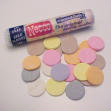
I was 7 in 1958. Seven was considered to be the “age of reason” when kids are capable of discerning good from evil. Second grade. We were prepared the entire year to make our First Holy Communion in the late spring. We were taught that we were going to receive an incredible gift - the Body, Blood, Soul, and Divinity of Our Lord Jesus Christ. We were taught about the Eucharistic Miracle. We were taught that we were never to profane the Eucharist with our hands. We were taught that the host could get stuck on the roof of your mouth and we were taught how to use our tongues to loosen it. We practised receiving “the Eucharist” using Neco Wafers:


The priests came into our classroom dressed in cassocks and birettas and gave us further instruction on what we were about to receive. There were no “children’s Masses” back then. We were in the Presence of God and we were expected to behave appropriately.

We received instructions in what was going on in the Mass.

At home, boys received our white First Communion suits. Girls had their white First Communion dresses. I was terrified of my First Confession and terrified of my First Communion because I did not want to do anything wrong. My second grade self recognized the importance of what was to come and it was fully reinforced by my family. On a Saturday in May, the second grade classes made their First Communion.
It was a big production at church and a big production at home. The entire extended family came to Mass and thence home for a big party. I received my “little” St. Joseph Missal, a red rosary (girls got blue ones), and other gifts to signify the importance of the day. I had no doubt in my mind that I had received Our Lord - Body, Blood, Soul and Divinity. On the tongue.

Of course, we didn’t know what was going on in the Mass in those days. We didn’t have our mother’s pointing out the Latin in our freshly acquired Missals. We didn’t recognize that we had passed through what anthropologists would call a “rite of passage” and First Communion was no big deal…NOT.

In third grade the lessons learned in second were amplified. We were to know, love, and serve God in this world and be happy with Him in the next.

At the end of the third grade, I spent an entire summer learning how to become an altar boy so that I could serve God in this world. And so I did for the next 10 years.

That is how one’s conscience got formed years ago. I really, really, believe that when I receive the Eucharist that I am receiving the Body, Blood, Soul, and Divinity of Our Lord Jesus Christ. I really, really, believe that the Eucharist is the Precious Body and Precious Blood. When you consider that we had communion rails, cloths which went over the communion rails, we knelt to receive Communion, placed our hands under the cloth, AND had an altar boy with a paten stuck under our necks - what part of “Oh! This is terribly important! Precious! Worthwhile!” were we supposed to miss?

Stuck with me. I’m 57 and have never received in the hand. I would love to go back to kneeling. So this is just me. Lord, I am not worthy. St. Thomas - My Lord and My God! Precious Body, Precious Blood and me my miserable self.
 
I have read on the ewtn website that yes receiving in the hand is a “temporary” indult and don’t be surprised when it is revoked. People are supposed to be able to receive also on the tongue and there have been an increasing number of priests who are not allowing reception of the Holy Eucharist on the tongue. I have also read that the Pope is very concerned about the lack of awe & reverence especially in regards to the Eucharist-thus changes in the translation will be made so we will be praying the translations as found in the TLM misslettes in certain parts of the Mass .Another big concern is people stealing consecrated hosts which there have been only few articles about, but from what I heard it happens more than we know.
 
I began to receive on my tongue because I started attending a parish that celebrates the NO, but never got rid of its communion rail and has continued to distribute to have our priests distribute communion at the communion rail while the altar boys hold the trays to make certain no pieces fall.patens. We also have great music accompanied by our pipe organ and no guitars in sight.

Even though we no longer live there, I still receive on the tongue when I go to mass. To me it adds to the sense of reverence and it does avoid accidents with the hosts and minimizes chances of someone misusing one.
 
This is what I was taught. I went to Catholic schools from 1956 through 1969. I am merely going to reltate to you that which I was taught in a straightforward way.

I was 5 in 1956. Primer (not kindegarten). We were taught that the church building was Holy. The House of God. One did not cut-up in the House of God. One did not talk in the House of God. One was in the presence of God and kept silent. (I had no idea of what was going on up on the altar but I knew I was in the presence of God).

I was 7 in 1958. Seven was considered to be the “age of reason” when kids are capable of discerning good from evil. Second grade. We were prepared the entire year to make our First Holy Communion in the late spring. We were taught that we were going to receive an incredible gift - the Body, Blood, Soul, and Divinity of Our Lord Jesus Christ. We were taught about the Eucharistic Miracle. We were taught that we were never to profane the Eucharist with our hands. We were taught that the host could get stuck on the roof of your mouth and we were taught how to use our tongues to loosen it. We practised receiving “the Eucharist” using Neco Wafers:

http://parkwayreststop.blogspot.com/neco wafers.jpg

The priests came into our classroom dressed in cassocks and birettas and gave us further instruction on what we were about to receive. There were no “children’s Masses” back then. We were in the Presence of God and we were expected to behave appropriately.

We received instructions in what was going on in the Mass.

At home, boys received our white First Communion suits. Girls had their white First Communion dresses. I was terrified of my First Confession and terrified of my First Communion because I did not want to do anything wrong. My second grade self recognized the importance of what was to come and it was fully reinforced by my family. On a Saturday in May, the second grade classes made their First Communion.
It was a big production at church and a big production at home. The entire extended family came to Mass and thence home for a big party. I received my “little” St. Joseph Missal, a red rosary (girls got blue ones), and other gifts to signify the importance of the day. I had no doubt in my mind that I had received Our Lord - Body, Blood, Soul and Divinity. On the tongue.

Of course, we didn’t know what was going on in the Mass in those days. We didn’t have our mother’s pointing out the Latin in our freshly acquired Missals. We didn’t recognize that we had passed through what anthropologists would call a “rite of passage” and First Communion was no big deal…NOT.

In third grade the lessons learned in second were amplified. We were to know, love, and serve God in this world and be happy with Him in the next.

At the end of the third grade, I spent an entire summer learning how to become an altar boy so that I could serve God in this world. And so I did for the next 10 years.

That is how one’s conscience got formed years ago. I really, really, believe that when I receive the Eucharist that I am receiving the Body, Blood, Soul, and Divinity of Our Lord Jesus Christ. I really, really, believe that the Eucharist is the Precious Body and Precious Blood. When you consider that we had communion rails, cloths which went over the communion rails, we knelt to receive Communion, placed our hands under the cloth, AND had an altar boy with a paten stuck under our necks - what part of “Oh! This is terribly important! Precious! Worthwhile!” were we supposed to miss?

Stuck with me. I’m 57 and have never received in the hand. I would love to go back to kneeling. So this is just me. Lord, I am not worthy. St. Thomas - My Lord and My God! Precious Body, Precious Blood and me my miserable self.
OH MY GOSH! That is me exactly! Only a dress.
And when my older brothers practiced “Mass” at my mom’s sewing machine with a sheet over it. And us girls had to say echo spiree toottoot o. Somewhere I have a picture.
 
I keep reading this forum over and over and so far it seems that the reception of the Eucharist on the tongue is preferred because.
1. Less chance of loss of any particle.
2. Less chance of its being stolen.
3. Less casual walking up to take something that is being handed out and sticking it in your mouth while you walk through the church, like a piece of chewing gum. I hate that. When I receive on the palm, I make a small side step face the altar, carefully pick up the host and place it on my tongue, make the sign of the cross, and move on. Oh, sorry…
3. again. Less casual.
4. More respect for Holy Orders, the priesthood, the anointed hands

I love all this stuff!!!

B U T

I am an extraordinary eucharistic minister. And…
Some people who want to receive on the tongue barely open their mouths.
Some don’t stick out their tongues. It’s hard to get the host in there without getting spittal on your finger or thumb. What about germs?
 
I began to receive on my tongue because I started attending a parish that celebrates the NO, but never got rid of its communion rail and has continued to distribute to have our priests distribute communion at the communion rail while the altar boys hold the trays to make certain no pieces fall.patens. We also have great music accompanied by our pipe organ and no guitars in sight.
This is what I understand as one of the reasons for Communion on the tongue. It does minimize particles that could drop onto the floor.
 
Status
Not open for further replies.
Back
Top