
Roman Catholic registered in an Eastern parish

  • Thread starter Thread starter Tradycja
  • Start date Start date
Status
Not open for further replies.
We, as Roman Catholics, are enrolled in a Byzantine Church and have been for several years. We are welcomed and treated as parishioners. However, we are not members of the Church. We cannot teach ECC, be officers of the Church or be counted as members for determining mission or church status. The reason we attend this church is that it is simply superior to surrounding Roman Churches. This might not be true in other areas should we ever move. The reason we don’t change rite is because the area we would move to doesn’t have a Byzantine Church near by. Also, we plan to be cremated. The Byzantine Church does not a a memorial liturgy and a body is required for a funeral liturgy. The body may be cremated after. The Roman Church provides for a memorial service where a body is not required.
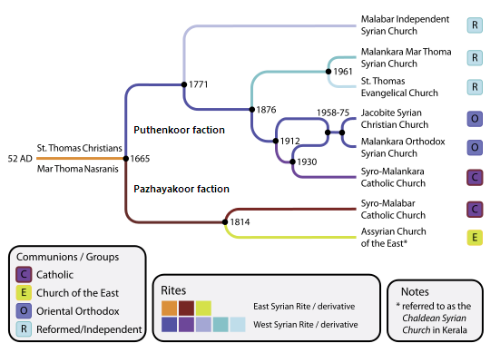
 
For your information, the Syro-Malabar and Syro-Malankara are not churches but break away factions that merged with the Roman catholic Church in the past and allowed to retain their eastern rite. Yes, I belong to Latin rite in the Roman Catholic church which I continue to attend and my wife as well as other members of her church are allowed to attend and receive Holy communion in our church.

My wife’s church is the Malankara Orthodox Syrian church whose Metropolitan signed an agreement with our Pope in June 1984 (interchurchfamilies.org/journal/94su06.shtm). Because of this agreement I could easily obtain written dispensation from my Bishop.

My wife’s church also has separate agreements with Protestant churches for using their ‘church premises’; this is because they have few ‘church premises’ to cater to the needs of their sizable flock. By virtue of this agreement our wedding could be solemnised in a Protestant cathedral.

The only objection came from my mother who insisted that the church must venerate Mother Mary. To our pleasant surprise the Protestant cathedral had a large picture of Mother Mary at a prominent place inside the church.
Actually there are two eastern Catholic Churches sui iuris, the Syro-Malabar and Syro-Malankara, in addition to the related Orthodox and ecclesial communities. Perhaps that is what you mean.

 
Actually there are two eastern Catholic Churches sui iuris, the Syro-Malabar and Syro-Malankara, in addition to the related Orthodox and ecclesial communities. Perhaps that is what you mean.

http://upload.wikimedia.org/wikiped.../500px-St_Thomas_Christians_divisions.svg.png
The two churches categorised as ‘C’ - catholic in the wikipedia tree are factions that completely merged with the RCC but retain eastern rite and identity. They are not independent churches.
 
The two churches categorised as ‘C’ - catholic in the wikipedia tree are factions that completely merged with the RCC but retain eastern rite and identity. They are not independent churches.
Tell that to their Major Archbishops…

What you are claiming hasn’t been true for over two decades.

And their major archiepiscopal sees have websites that will clearly tell you you are wrong.

GCatholic.com will, as well, if you know what you’re looking at there.
 
We, as Roman Catholics, are enrolled in a Byzantine Church and have been for several years. We are welcomed and treated as parishioners. However, we are not members of the Church. We cannot teach ECC, be officers of the Church or be counted as members for determining mission or church status. The reason we attend this church is that it is simply superior to surrounding Roman Churches. This might not be true in other areas should we ever move. The reason we don’t change rite is because the area we would move to doesn’t have a Byzantine Church near by. Also, we plan to be cremated. The Byzantine Church does not a a memorial liturgy and a body is required for a funeral liturgy. The body may be cremated after. The Roman Church provides for a memorial service where a body is not required.
The priest knows I was a catechist in the RC Archdiocese and has asked me to be a catechist in the UGCC parish. I’m still canonically Latin. Not sure what you meant by “we cannot teach ECC”, but if you mean catechists, we certainly can.
 
The priest knows I was a catechist in the RC Archdiocese and has asked me to be a catechist in the UGCC parish. I’m still canonically Latin. Not sure what you meant by “we cannot teach ECC”, but if you mean catechists, we certainly can.
There’s a training program for catechists in the Ruthenian church… not allowed to teach it if you haven’t passed it. At least, that’s the last word I heard. It’s offered as a distance ed program, but it’s not free.
 
There’s a training program for catechists in the Ruthenian church… not allowed to teach it if you haven’t passed it. At least, that’s the last word I heard. It’s offered as a distance ed program, but it’s not free.
But being canonically Latin still wouldn’t prevent you from teaching, right? Its not like us catechists are ordained.
 
Tell that to their Major Archbishops…

What you are claiming hasn’t been true for over two decades.

And their major archiepiscopal sees have websites that will clearly tell you you are wrong.

GCatholic.com will, as well, if you know what you’re looking at there.
Churches are not defined on the basis of having a website. Thousands of catholic parishes have their own website and their parish names often end with the word ‘church’. Yet they are mere parishes and not independent churches.
 
The two churches categorised as ‘C’ - catholic in the wikipedia tree are factions that completely merged with the RCC but retain eastern rite and identity. They are not independent churches.
I belive I understand what you mean, not independent because they are in full communnion with the Bishop of Rome, therefore incorporated into the Catholic Church. Even though part of the Catholic Church, there are 23 ritual Churches. We see this in the eastern cannon law:

CCEO Canon 12
  1. The Christian faithful are bound by an obligation in their own patterns of activity always to maintain communion with the Church.
  2. They are to fulfill with great diligence the duties which they owe to the universal Church and to their own Church sui iuris.
    CCEO Canon 27
    A group of Christian faithful united by a hierarchy according to the norm of law which the supreme authority of the Church expressly or tacitly recognizes as sui iuris is called in this Code a Church sui iuris.
So it is proper to call them a Church. Sui iuris means of their own laws.
 
It’s a potential barrier to getting into the program.
Well, I’m glad we don’t have such a thing in our Eparchy. Also, the priest and the bishop knows me well enough to know I can teach.
 
Status
Not open for further replies.
Back
Top