Rome's Challenge

  • Thread starter Thread starter Cruxis117
  • Start date Start date
Status
Not open for further replies.
John 10:35, the question was, “Can the Scriptures be broken?”

It is either “yes” or “no”.
Answered in Post 96.

Furthermore, you need to explain what you mean by “Broken” and by “Scripture”?

Do you mean the Law of Moses only? OT?NT?
 
… Tell me about “unless you eat my body and drink my blood you have no life in you.” …
Having been born/raised Roman Catholic many years and now being Seventh Day Adventist - Rome Believes:

"…that the bread and wine are truly his body and blood. …

… The Council of Rome (a local council), 1079, taught against Berengar that the Eucharist is truly the body and blood of Christ. …

Roman Catholics believe that the bread and wine become the real Body and Blood of Jesus Christ and remain such until the elements are entirely consumed. …

… Transubstantiation reflects Roman Catholic faith in the literalness of the words of the Bible. …

… the bread is his body; the wine is his blood. …

… faith is essential. Faith in what? …

… though the bread does not look, feel, taste like flesh; even though the wine does not look, feel, taste like blood. …

… Transubstantiation means the substance part of the bread and wine elements changes; but the accidental parts–sight, taste, smell, touch–do not. …" - Catholic Apologetics “org”; Eucharist, Lord’s Supper]

" … when the priest consecrates bread and wine, so that they become Christ’s body and Christ’s blood. …

… But in these two instances, the bread and wine of the Eucharist, the mind is not left to itself. By the revelation of Christ it knows that the substance has been changed, in the one case into the substance of his body, in the other into the substance of his blood. …

The accidents remain in their totality-for example, that which was wine and is now Christ’s blood still has the smell of wine, the intoxicating power of wine. …

… All we shall say here is that his body is wholly present … " [EWTN online; Frank J. Sheed; Taken from Theology for Beginners (c) 1981 by Frank J. Sheed, Chapter 18.]

**INTOXICATING: **"1 : poison; 2 a : to excite or stupefy by alcohol or a drug especially to the point where physical and mental control is markedly diminished b : to excite or elate to the point of enthusiasm or frenzy " [Merriam-Websters]

" …“As a result of transubstantiation, the species of bread and wine undoubtedly take on a new signification and a new finality, for they are no longer ordinary bread and wine but instead a sign of something sacred and a sign of spiritual food; but they take on this new signification, this new finality, precisely because they contain a new ‘reality’…For what now lies beneath the aforementioned species [that is, what is now the new substance of the elements] is not what was there before, but something completely different…the body and blood of Christ” (Mysterium Fidei 46 [1965]) …

as one says that the whole substance of the unconsecrated elements is changed into the whole substance of Christ–body, blood, soul, divinity–with only the appearances of bread and wine remaining … " [New Advent Online; Quick Questions]

"… for the whole substance of the bread is changed into the whole substance of Christ’s body, and the whole substance of the wine into the whole substance of Christ’s blood. Hence this is not a formal, but a substantial conversion; nor is it a kind of natural movement: but, with a name of its own, it can be called “transubstantiation.” … " [New Advent Online, Summa Theologica; Question 75]

"… Transubstantiation, however, is not a conversion simply so called, but a substantial conversion (conversio substantialis), inasmuch as one thing is substantially or essentially converted into another. …

… Transubstantiation differs from every other substantial conversion in this, that only the substance is converted into another — the accidents remaining the same — just as would be the case if wood were miraculously converted into iron, the substance of the iron remaining hidden under the external appearance of the wood. …" [New Advent Online; Real Presence; Subsection Transubstantiation]

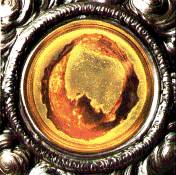
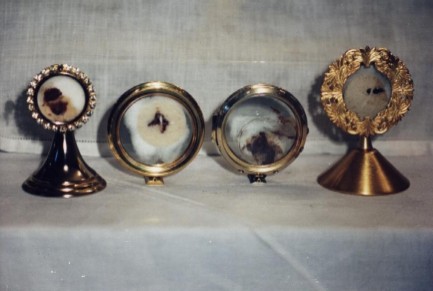
Pictures [bloody hosts, “purposefully failed”, sactioned officially by Rome as being of divine origin]:

http://www.najumaria.com/image/910516-2.jpg
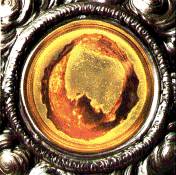


"Blanot, France – Mar 31, 1331
The Eucharist falls out of a woman’s mouth onto an altar rail cloth. The priest tries to recover the Host but all that remains is a large spot of blood the same size and dimensions as the wafer. …

… Bolsena-Orvieta, Italy
Again, a priest has difficulties believing in the Real Presence, and blood begins seeping out of the Host upon consecration. Because of this miracle, Pope Urban IV commissioned the feast of Corpus Christi, which is still celebrated today. …

… Lanciano, Italy – 8th cent A.D.
A priest has doubts about the Real Presence; however, when he consecrates the Host it transforms into flesh and blood. This miracle has undergone extensive scientific examination and can only be explained as a miracle. The flesh is actually cardiac tissue which contains arterioles, veins, and nerve fibers. The blood type as in all other approved Eucharistic miracles is type AB! Histological micrographs are shown. …" [Semperaltius]

 
[Blood and Body cont.]

Do you believe by faith the following to be true?:

“…Ambrose says (De Sacram. iv): “Although the figure of the bread and wine be seen, still, after the Consecration, they are to be believed to be nothing else than the body and blood of Christ.”…”

“…for the whole substance of the bread is changed into the whole substance of Christ’s body, and the whole substance of the wine into the whole substance of Christ’s blood. …” [Roman Catholic Online Summa Theologica]

Do you believe that Christ Jesus is the Passover?

Even if for mere outward appearance it is said that it is “Bread” and “Wine”, it is the actual Belief by faith in the heart which still condemns, for it is believed [by Roman Catholic faith] to be “nothing else than the body and blood of Christ” and “whole substance…into whole substance”. Outwardly it may not “cannibalism”, but inwardly by faith it is, and therefore sin.

The Blood:

All throughout the scriptures it is written over and over again, “…you shall not eat the blood…” and “Only ye shall not eat the blood; ye shall pour it upon the earth as water.” even as far back as Genesis: “But flesh with the life thereof, [which is] the blood thereof, shall ye not eat.” (Genesis 9:4). [Yet, at this point many will deny “cannibalism”, yet again, by Faith in Roman Catholic teaching on the Transubstantiation it is to be fully believed to be the actual “blood” and “body”. There are those even eating “miraculous bloody hosts”. Or look for the “bleeding hosts”, etc.] By Roman Catholic teaching, you must actually believe you are eating a dead corpse [sacrifice] of a dead man, a lifeless body, and also dead blood.

The “wine”:


The “wine” of the cup was to always be unleavened, unfermented (as in non-alcoholic), as it represented Jesus’ Purity (which would be the juice of the harvest, the juice of the grape, fruit of the vine):

“Seven days shall ye eat unleavened bread; even the first day ye shall put away leaven out of your houses: for whosoever eateth leavened bread from the first day until the seventh day, that soul shall be cut off from Israel.” (Exodus 12:15)

“Seven days shall there be no leaven found in your houses: for whosoever eateth that which is leavened, even that soul shall be cut off from the congregation of Israel, whether he be a stranger, or born in the land.” (Exodus 12:19)

“Unleavened bread shall be eaten seven days; and there shall no leavened bread be seen with thee, neither shall there be leaven seen with thee in all thy quarters.” (Exodus 13:7)

Thou shalt not offer the blood of my sacrifice with leaven; neither shall the sacrifice of the feast of the passover be left unto the morning.” (Exodus 34:25)

The phrase “fruit of the vine” is specifically used to emphasize that it was non-alcoholic “pure grape juice”, the very symbol of the purity of Christ Jesus:

“But I say unto you, I will not drink henceforth of this fruit of the vine, until that day when I drink it new with you in my Father’s kingdom.” (Matthew 26:29)

“Verily I say unto you, I will drink no more of the fruit of the vine, until that day that I drink it new in the kingdom of God.” (Mark 14:25)

“For I say unto you, I will not drink of the fruit of the vine, until the kingdom of God shall come.” (Luke 22:18)

Fermented grape (alcoholic content), represented sin, wickedness, rebellion, and corrupted doctrines:

“Babylon [hath been] a golden cup in the LORD’S hand, that made all the earth drunken: the nations have drunken of her wine; therefore the nations are mad.” (Jeremiah 51:7)

“And there followed another angel, saying, Babylon is fallen, is fallen, that great city, because she made all nations drink of the wine of the wrath of her fornication.” (Revelation 14:8)

Looking at Acts 15 in quoting OT commandments and rules for Christians to live by. “Abstain from blood”, and is even given in the context of worship - idols, fornication (which went along with pagan worship), “things strangled”. Each and every a clear commandment (directly found in the OT) given to any who would be a follower of God. Again, they will say, but it is not cannibalism, but yet again, by faith they believe it is actually “blood” and “body” [of the dead] whether outwardly for mere appearance sake it is not so.

The whole council in Acts 15, sanctified and approved by the Holy Spirit (“For it seemed good to the Holy Ghost, and to us,”), says, “But that we write unto them, that they abstain from pollutions of idols, and [from] fornication, and [from] things strangled, and [from] blood.”

This is binding upon all Christians.

Let us hear what Peter himself says on the matter of clean and unclean foods:

But as he which hath called you is holy, so be ye holy in all manner of conversation; - 1 Peter 1:15

Because it is written, Be ye holy; for I am holy. - 1 Peter 1:16 [Peter quoted Leviticus]

Sanctify yourselves therefore, and be ye holy: for I [am] the LORD your God. - Leviticus 20:7

God is clear:

Therefore I said unto the children of Israel, No soul of you shall eat blood… Leviticus 17:12;p

And ye shall be holy unto me: for I the LORD [am] holy… Leviticus 20:26;p

The Blood of the Sacrifice was NEVER to be eaten/consumed… always to be poured upon the ground. You who beleive that you eat of the flesh of the dead and the blood of the dead … it is an abomination to Jesus Christ…
 
[Blood and Body cont.]

John Chapter 6,

It is the spirit that quickeneth; the flesh profiteth nothing: the words that I speak unto you, [they] are spirit, and [they] are life.- John 6:63

As the living Father hath sent me, and I live by the Father: so he that eateth me, even he shall live by me.- John 6:57

Labour not for the meat which perisheth, but for that meat which endureth unto everlasting life, which the Son of man shall give unto you: for him hath God the Father sealed. - John 6:27

What is this “meat which endureth”?

Jesus answered and said unto them, This is the work of God, that ye believe on him whom he hath sent. - John 6:29

And this is the will of him that sent me, that every one which seeth the Son, and believeth on him, may have everlasting life: and I will raise him up at the last day. - John 6:40

Verily, verily, I say unto you, He that believeth on me hath everlasting life. - John 6:47

However, many of the crowd simply did not want to believe in Jesus as the Messiah, the Son of God, being God, the I AM (especially as the only way) without some great sign, even though a little earlier they had all just been fed and been full physically from so very little bread and fish. They did not want to understand that “He came down from Heaven” and said, "Is not this…the son of Joseph?" They did not want to take Jesus on faith. Jesus pointed out that even those who had been fed from miraculous manna [wafers] from heaven, all had still died [and are still dead to this day], but those who believed on Him, the True manna, would live forever, neither thirst, nor hunger.

And Jesus said unto them, I am the bread of life: he that cometh to me shall never hunger; and he that believeth on me shall never thirst. - John 6:35

I am that bread of life. John 6:48

This is that bread which came down from heaven: not as your fathers did eat manna, and are dead: he that eateth of this bread shall live for ever. - John 6:58

Not as their fathers who ate flakes, wafers of manna.

Jesus was speaking of Himself as the Messiah and Saviour (not an unbiblical “transubstantiation”):

This is the bread which cometh down from heaven, that a man may eat thereof, and not die. - John 6:50

Notice how Jesus Himself lives, “by the Father”, and so likewise we, also, by Him:

As the living Father hath sent me, and I live by the Father: so he that eateth me, even he shall live by me.- John 6:57

Jesus makes it abundantly clear that His words are Spirit:

It is the spirit that quickeneth; the flesh profiteth nothing: the words that I speak unto you, [they] are spirit, and [they] are life.- John 6:63

Peter, himself, acknowledges that Jesus has the Words of Life because that He is the Messiah:

Then Simon Peter answered him, Lord, to whom shall we go? thou hast the words of eternal life. - John 6:68

Jesus makes known who did not have eternal life and why they did not, it was because they belived not on Him, as the Christ, even though they had seen Him and the works He performed:

But I said unto you, That ye also have seen me, and believe not. - John 6:35

And the entirety of the chapter of John 6 is summed up in this one verse:

And we believe and are sure that thou art that Christ, the Son of the living God. - John 6:69

The ideology of transubstantiation is nowhere in the text. It is focusing on who is “the Christ, the Son of the living God” and who believed “on Him” as the Christ and who did not.

It is Belief in Christ Jesus as the “Son of the living God”, the Messiah, the Christ, God manifest in the flesh, the sent of the Father, the Saviour, etc that is the focus. And this is life eternal, that they might know thee the only true God, and Jesus Christ, whom thou hast sent. - John 17:3

We are to “eat” and “drink” His words, for they are spirit.

The flesh profits nothing.

Behold the Lamb of God which taketh away the sin of the world.

But flesh with the life thereof, [which is] the blood thereof, shall ye not eat. Genesis 9:4; [It shall be] a perpetual statute for your generations throughout all your dwellings, that ye eat neither fat nor blood. Leviticus 3:17; Moreover ye shall eat no manner of blood… Leviticus 7:26;’ [Leviticus 17:11,12,13, 19:26; Deuteronomy 12:16,23-25, 15:23; 1 Samuel 14:34; Acts 15:20,29, etc]

The Hebrew word for “eat” in these passages is “'akal” “אכל” and it means “eat, consume, devour, destroy by eating” (Strong’s Concordance).

Christ Jesus is in Heaven right in the Most Holy Place before the Ark and interceeding now as our High Priest and Advocate [Book of Hebrews, etc], not in a “wafer” kept in a “bag” or in a “golden remonstrance” to be removed and place in them again at the will and sufferance of men.

“…Roman Catholics believe that the bread and wine become the real Body and Blood of Jesus Christ and remain such until the elements are entirely consumed …” [Catholic Apologetics “org”; Eucharist, Lord’s Supper]

They who have eyes to see, let them see, and they who have ears to hear let them hear.
 
Roman Catholicism worships among the tombs of dead men and of bones and all unclean things…

“The teaching of the Catholic Church with regard to the veneration of relics is summed up in a decree of the Council of Trent (Sess. XXV), which enjoins on bishops and other pastors to instruct their flocks that “the holy bodies of holy martyrs and of others now living with Christ—which bodies were the living members of Christ and ‘the temple of the Holy Ghost’ (1 Corinthians 6:19) and which are by Him to be raised to eternal life and to be glorified are to be venerated by the faithful, for through these [bodies] many benefits are bestowed by God on men, so that they who affirm that veneration and honour are not due to the relics of the saints, or that these and other sacred monuments are uselessly honoured by the faithful, and that the places dedicated to the memories of the saints are in vain visited with the view of obtaining their aid, are wholly to be condemned, as the Church has already long since condemned, and also now condemns them.””, “Where relics were used the ceremony of translating and depositing them under the altar formed a notable feature of the dedication rite (cf. “Ordo of St. Amand” in Duchesne, “Christian Worship”, London, 1903, Appendix; “Ordo of Verona” in Bianchini, ed., “Lib. Pont.”, III)” [Relics, Roman Catholic Online Encyclopedia]

“Before the restoration, relics of the saints were sealed into the top of the altar. These original relics, as well as others, many from churches in the diocese that have been closed, were placed in a new container and carried in procession to the sanctuary and were cemented into the floor in front of the altar. Placing relics under the altar is in keeping with the ancient practice of building churches over tombs of martyrs.” [Roman Catholic Herald Archives - Dedication Rite]

“The tradition in the Roman liturgy of placing relics of martyrs or other saints beneath the altar should be preserved, if possible.” “Rite of Dedication of a Church and an Altar, Introductions”; PDF; Chapter 2, Dedication of a Church, Section II, No. 5; note: see GIRM no. 266]

The Bible declares that GOD made a clear distinction to keep worship separate from that which is dead, for Death is an enemy:

And whosoever toucheth one that is slain with a sword in the open fields, or a dead body, or a bone of a man, or a grave, shall be unclean seven days. (Numbers 19:16)

And the LORD said unto Moses, Speak unto the priests the sons of Aaron, and say unto them, There shall none be defiled for the dead among his people: (Leviticus 21:1)

And when they shall say unto you, Seek unto them that have familiar spirits, and unto wizards that peep, and that mutter: should not a people seek unto their God? for the living to the dead? (Isaiah 8:19)

Which remain among the graves, and lodge in the monuments, which eat swine’s flesh, and broth of abominable [things is in] their vessels; (Isaiah 65:4)

And they shall come at no dead person to defile themselves: but for father, or for mother, or for son, or for daughter, for brother, or for sister that hath had no husband, they may defile themselves. (Ezekiel 44:25)

Those who worship in Cathedrals, worship among dead mens bodies and bones and blood, among corpses and tombs and all uncleanness… you worship in beautified mausoleums… your Cathedral altars consecrated with the bones of the dead…
 
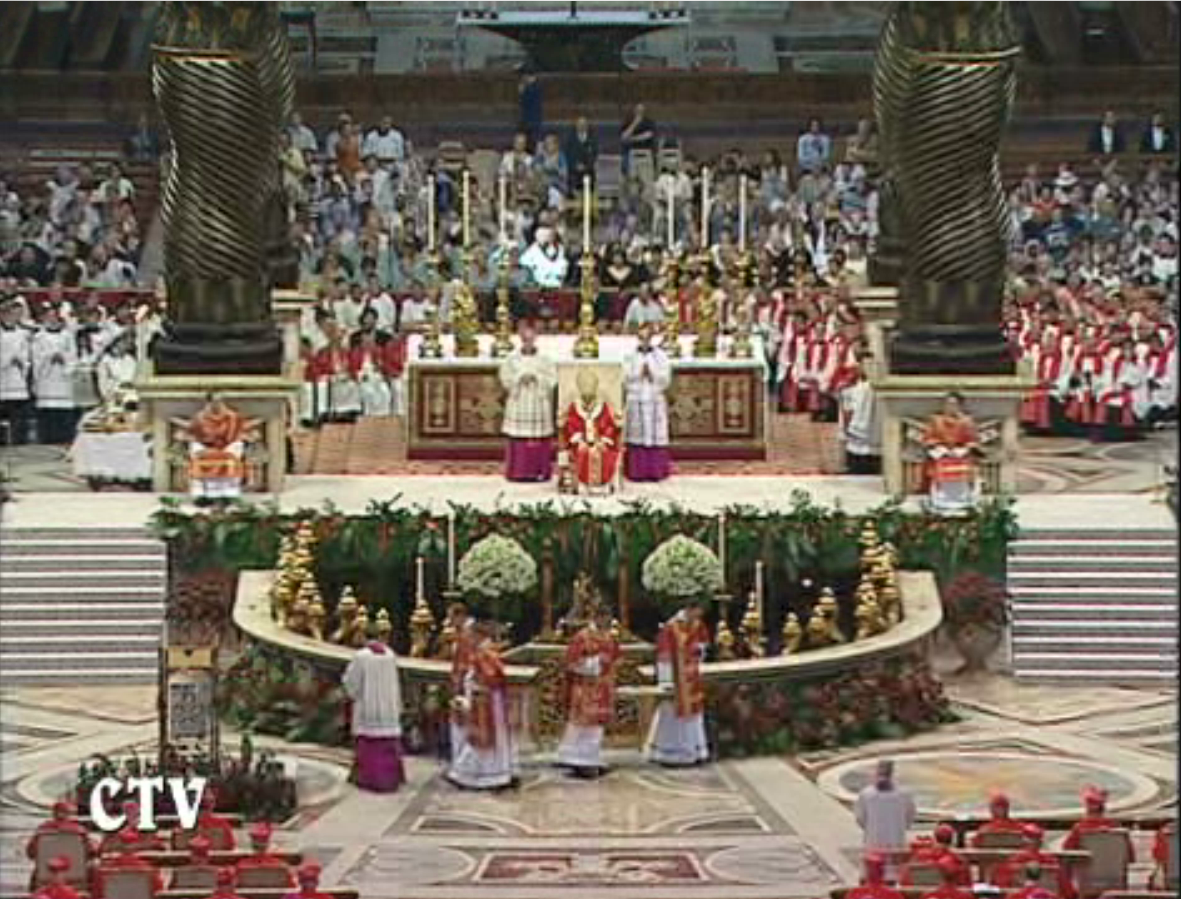
A picture is worth how many words?


In this picture, please notice carefully where the ‘pope’ is sitting. We will notice that he is sitting on a Great White Throne [as Latin: “Vicarius Christi”, “in the place of Christ”], High Up above everyone else. Surrounding, and on each side of, this Great White Throne are Two Golden Angels [like unto the Cherubim], just as was there were two on the Ark surrounding the Shekinah Glory of GOD who rested above “the Ark of the Covenant” [representing the very Throne of GOD] in “the Most Holy Place” of the True Sanctuary. Notice also very carefully the ‘four living creatures’ surrounding him, along with the congregation before him. They have replaced the Heavenly with an earthly. They are not entered in by Faith with Christ Jesus into the Heavenly Most Holy Place, but place their faith in that which is done on earth. The Truth has been “cast down” to “the ground”…

…whatsoever is not of faith is sin… and sin is the transgression of the law…

…yet here is another which claims supreme and plenary authority in the matter of “morals and faith”.

There is a whole lot more to the “sanctuary” they have on earth… an antichristian [Greek: AntiChrist; “in the place of Christ”] sanctuary, highpriest, priests and its services…

[URL='http://4.bp.blogspot.com/_71ZPiLxOVfU/SkeboUApWTI/AAAAAAAADlI/IyTInKSYX9g/s1600/VesperPeterPaul8.jpg']


Jesus Christ is calling all out of this system of worship, for it is not of faith. Christ Jesus says, “Follow me…” and He is ascended into Heaven as our Great High Priest and ministers there in the Heavenly Sanctuary:

But Christ being come an high priest of good things to come, by a greater and more perfect tabernacle, not made with hands, that is to say, not of this building; Hebrews 9:11

How much more shall the blood of Christ, who through the eternal Spirit offered himself without spot to God, purge your conscience from dead works to serve the living God? Hebrews 9:14 not by men, nor mary, nor any other, and He was “once offered” for all, Christ Jesus offered Himself through the eternal [Holy] Spirit without spot unto God the Father]

[It was] therefore necessary that the patterns of things in the heavens should be purified with these; but the heavenly things themselves with better sacrifices than these. Hebrews 9:23

For Christ is not entered into the holy places made with hands, [which are] the figures of the true; but into heaven itself, now to appear in the presence of God for us: Hebrews 9:24

Jesus Christ, wants everyone to know what He has done, is doing even now in the Heavenly , and will yet do for you and I. But this system on earth is hiding and shrouding His ministry above and casting it to the ground…

He is coming again soon, “without sin unto salvation”:

So Christ was once offered to bear the sins of many; and unto them that look for him shall he appear the second time without sin unto salvation. Hebrews 9:28

And where must you look? Where must He come out of? In order to blot out sins, what must be done first? Search the scriptures… Leviticus 16, begin there.

What will your choice be, now that you have seen? Will you choose to continue to believe in the service below by men, or in the Heavenly one above by Christ Jesus himself, but it cannot, and is even impossible, to be both. Choose ye this day whom ye will serve, and follow by faith.

Remember, it was Christ Jesus who came down to earth, stepped down from His Throne in glory, came down, down, down… stepping lower, condescending to become a man, after the flesh, “of the seed of David” and “Abraham”, to save us. His love has been shown… it was shown upon the Cross at Calvary…

**He saved others; himself he cannot save. **If he be the King of Israel, let him now come down from the cross, and we will believe him. Matthew 27:42

What statements in contrast to the faith of the Son of God, Jesus Christ. He chose to remain upon that Cross until death to save us, and not save Himself. His love is eternally manifested. Should He have chosen to come down from that Cross, all of us would be lost and without hope. But now He is risen, He is not here, and is ascended into the Heavenly, the True Tabernacle, which the Lord pitched and not man, to minister there on our behalf…

…come out of her my People, says Jesus… that ye be not partakers of her plagues… for she was given space to repent and she will not…

Read the Books of Hebrews, Leviticus 16, Daniel and Revelation…

**What shall be shown next? There is a great deal more … **
 
Now, please notice the 7 Golden Candlesticks, where the ‘pope’ is sitting in front of, and minstering before and where they are located. Just as there was the 7 Golden Branch Candlestick [representing CHRIST JESUS the Light of the World] in the Holy Place of the True Sanctuary. Christ Jesus in the Heavenly is no longer in the Holy Place…:


According to all that I shew thee, [after] the pattern of the tabernacle, and the pattern of all the instruments thereof, even so shall ye make [it]. Exodus 25:9

And look that thou make [them] after their pattern, which was shewed thee in the mount. Exodus 25:40

Who serve unto the example and shadow of heavenly things, as Moses was admonished of God when he was about to make the tabernacle: for, See, saith he, [that] thou make all things according to the pattern shewed to thee in the mount. Hebrews 8:5

The Heavenly Ministry of Christ Jesus, look into Revelation, see Him walking among the 7 Golden Candlesticks, but moves from there after a period of time… He is no longer in the Holy Place…

Men have “cast down” the truth to “the ground”…

What shall be shown next? There is a great deal more…
 
I did not see a “yes” or “no”. Until there is… “…And he said unto them, Neither tell I you by what authority I do these things.”
Your question has been responded too…you just did not like the response…the truth is you do not want to respond because you cannot answer…that is why you deflect the question.

As pointed out, when those words were spoken, there was no scripture as you know it today. So, you have to explain which scripture and was is meant by broken.

Otherwise, you are just babbling like a pagan…unless you can lay your foundation first.
 
(U) It would “sitteth in” [English: in; Greek: heis; towards or among] “the Temple of God” [1 Corinthians 3:16-17, 6:19; 2 Corinthians 6:16], “shewing himself that he is God”, ruling over the people of God [2 Thessalonians 2:4], claiming to be of God, yet it is a “son of perdition” [2 Thessalonians 2:3], just as “Judas” was [John 17:12], coming in “sheeps clothing, but inwardly they are ravening wolves” [Mark 7:15]

Who opposeth and exalteth himself above all that is called God, or that is worshipped; so that he as God sitteth in the temple of God, shewing himself that he is God. [2 Thessalonians 2:4]

It would “as God sitteth in the temple of God”.

“Sitteth” in, towards/among “the Temple of God”. In a previous study we have already seen that “the Temple of God” is not a “building” of brick and mortar in the physical modern day land of Israel/Palestine, but rather it is a people, JESUS CHRIST’s people, the Christians:
**
Know ye not that ye are the temple of God, and [that] the Spirit of God dwelleth in you? [1 Corinthians 3:16]**

1 Corinthians 3:9,16,17, 6:9; 2 Corinthians 6:16; Ephesians 2:21; 1 Peter 2:5; Revelation 3:12; John 2:21

However, besides a mere physical manifestation of this papal position simply sitting upon a “White Throne”, there is ever so much more to this “sitteth”, for this particular power would “…as God sitteth in the temple of God, shewing himself that he is God”:

It shall be shown that the position of the pope “as God sitteth” over the “temple of God” in “ex cathedra” [Latin: “from the Chair” or “throne” (Thronos))], is in “all things” of “doctrine” and “faith and morals”:

“Cathedra; (1) The chair or throne (thronos) of a bishop in his cathedral church, on which he presides at solemn functions. … A good idea of the arrangement may be had from the catacomb frescoes representing Christ seated on a throne surrounded by the apostles … By a definition “ex cathedra” is meant a formal infallible decision of the pope, obligatory on all the faithful. …” [Roman Catholic Online Encyclopedia; “C”; “Cathedra”]

"The chief church of a diocese, in which the bishop has his throne (cathedra) and close to which is his residence; it is, properly speaking, the bishop’s church, wherein he presides, teaches, and conducts worship for the whole Christian community. The word is derived from the Greek kathedra through the Latin cathedra, throne, elevated seat. In early ecclesiastical literature it always conveyed the idea of authority. … the cathedra was the principal symbol of authority. … The word cathedra, so expressive in the language of antiquity, has gradually been replaced in liturgical usage, by throne (thronus) or seat (sedes). … … Metaphors apart, the bishop receives his cathedral as his “title” (titulus) or right; he is its governor (rector) and its head. He should take possession of it by a solemn entrance into his episcopal city and by the ceremony of enthronement (inthronisatio) as prescribed in the Roman Pontifical and the “Caeremoniale Episcoporum”, (I, c. ii) in so far, at least, as custom will permit.” [Roman Catholic Online Encyclopedia; “C”: “Cathedral”] -

“Literally “from the chair”, a theological term which signifies authoritative teaching and is more particularly applied to the definitions given by the Roman pontiff. Originally the name of the seat occupied by a professor or a bishop, cathedra was used later on to denote the magisterium, or teaching authority. The phrase ex cathedra occurs in the writings of the medieval theologians, and more frequently in the discussions which arose after the Reformation in regard to the papal prerogatives. But its present meaning was formally determined by the Vatican Council, Sess. IV, Const. de Ecclesiâ Christi, c. iv: “We teach and define that it is a dogma Divinely revealed that the Roman pontiff when he speaks ex cathedra, that is when in discharge of the office of pastor and doctor of all Christians, by virtue of his supreme Apostolic authority, he defines a doctrine regarding faith or morals to be held by the universal Church, by the Divine assistance promised to him in Blessed Peter, is possessed of that infallibility with which the Divine Redeemer willed that his Church should be endowed in defining doctrine regarding faith or morals, and that therefore such definitions of the Roman pontiff are of themselves and not from the consent of the Church irreformable.”” Roman Catholic Online Encyclopedia; “E”; “Ex Cathedra”] -

Let us see that closer, one more time…

**"“from the chair” … signifies … authoritative teaching given by the Roman Pontiff … when he speaks ex cathedra … in discharge of the office of pastor and doctor of all Christians, by virtue of his supreme … authority … is possesed of that infallibility … in defining doctrine … in faith or morals … are of themselves and not … irreformable." **[quoted/sourced above]

“Morals” deals with God’s Divine and Spiritual Law, especially his Ten Commandments.

For sin is the transgression of the Law [1 John 3:4].

In speaking also of “Faith”, in what we are to truly “believe”.

For whatsoever is not of Faith is sin [Romans 14:23].

This ‘papal position’ claims power over Divine Spiritual Law and Faith and to interpret, change, alter, modify, abrogate, even to dispense with all things, etc, even as we shall see, the very precepts of CHRIST JESUS HIMSELF, determing itself “faith and morals” [of salvation and sin].
 
Antichristos; ἀντίχριστος : “1) the adversary of the Messiah” [Strong’s] and also “the adversary of the Messiah…especially that which is at work in false teachers who have come from the bosom of the church and are disseminating error…” [Thayer’s] and also “…can mean either “against Christ” or “instead of Christ”… What the Apostle says of him so closely resembles what he says of the first beast in Rev. 13, and what the Apostle Paul says of the Man of Sin in 2 Thess. 2., that the same person seems to be in view in all these passages, rather than the second beast in Rev. 13, the false prophet; for the latter supports the former in all his Antichristian assumptions.” [Vine’s]

Anti; ἀντί :“1) over against, opposite to, before; 2) for, instead of, in place of (something); a) instead of; b) for; c) for that, because; d) wherefore, for this cause” [Strong’s] and also "1) over against, opposite to, before; 2) indicating exchange, succession, for, instead of, in the place of (something), … e) of succession to the place of another; 3) as a prefix it denotes a) opposite, over against; b) mutual efficiency of two; c) requittal; d) hostile opposition; e) official substitution, instead of" [Thayer’s] and also “…instead of, in the place of, in the room of…” [Vine’s]

Christos; Χριστός: “Christ = “anointed”; 1) Christ was the Messiah, the Son of God; 2) anointed” [Strong’s] and also “anointed” [Thayer’s] and also “anointed, translates as ‘Messiah’” [Vine’s] which speaks of Jesus, “the Christ”.

Therefore “AntiChrist” means that “which is in the place of or instead of Christ” so “opposing Christ”.

“Antichrist (Greek Antichristos). … The word Antichrist occurs only in the Johannine Epistles; but there are so-called real parallelisms to these occurrences in the Apocalypse, in the Pauline Epistles, and less explicit ones in the Gospels and the Book of Daniel. …” [Roman Catholic Online Encyclopedia; “A”; Antichrist]

“…anti … (in the place of…)…” [Roman Catholic Online Encyclopedia; “S”; Sacrifice]

"(Latin Vicarius Christi).

A title of the pope implying his supreme and universal primacy, both of honour and of jurisdiction, over the Church of Christ. …" [Roman Catholic Online Encyclopedia; “V”; Vicar of Christ]

"Vicar

(Latin vicarius, from vice, “instead of”) …" [Roman Catholic Online Encyclopedia; “V”; Vicar]

**Greek: Anti (in the place of, instead of) Christos (Christ, Anointed)

Latin: Vicarius (in the place of, instead of) Christi (Christ, Anointed)**

Does Rome’s definition of the “Vicarius Christi” and also “Vicar of Jesus Christ on earth” and “Vicarius Filii Dei” actually mean that the Pope “stands in the place [takes the place] of Jesus Christ [the Son of God] on Earth”?

Yes it does.

“…It will be enough, however, to refer to the evidence contained in the epistles of St. Ignatius, Bishop of Antioch, himself a disciple of the Apostles. In these epistles (about A.D. 107) he again and again asserts that the supremacy of the bishop is of Divine institution and belongs to the Apostolic constitution of the Church. He goes so far as to affirm that the bishop stands in the place of Christ Himself. …” [Roman Catholic Online Encyclopedia; “C”; Church]

“…Supreme Pontiff, Vicar of Jesus Christ on earth…” [Roman Catholic Online Library; Church Documents; Ad Sinarum Gentem (1954); Point 11.]

“…We, indeed, to all men are the Vicar of Christ, the Son of God…” [Roman Catholic Online Library; Church Documents; In Plurimis (1888); Point 2.]

“But since We hold upon this earth the place of God Almighty, …” “The Great Encyclical Letters of Pope Leo XIII”, Encyclical Letter June 20, 1894]

“All names which in the scriptures are applied to Christ, by virtue of which it is established that he is over the church, all the same names are applied to the Pope.” [Cardinal Robert Bellarmine; Disputationes de Controversiis; Tom. 2, “Controversia Prima,” Bk 2; Chp 17, (1628 ed.) Vol. 1, pp. 266-translated]

In Latin: “Secundo probatur ratione, in Scripturis fundata; nam omnia nomina, quae in Scripturis tribuuntur Christo, unde constat eum esse supra Ecclesiam, eadem omnia tribuuntur Pontifici.”

“The Pope is of so great dignity and so exalted that he is not a mere man…the pope’s excellence and power are not only about heaven, terrestrial and infernal things, but he is also above angels…He is of such great dignity and power that he occupies one and the same tribunal with Christ…the Pope is as it were God on earth, sole sovereign of the faithful of Christ, chief of kings, having plenitude of power.” [Lucius Ferraris, “Prompta Bibliotheca…", “Papa, Article II”, - “Concerning the extent of Papal dignity, authority, or dominion and infallibility“]

“…Ut sicut Beatus Petrus in terris vicarius Filii Dei fuit constitutus, ita et Pontifices eius successores…” …as the blessed Peter in the vicar of the Son of God on earth was appointed, so the Pontiffs his succesors, and…"] [Prompta Bibliotheca Vol. 6, “Papa”, Article 2; pg 41 → ]
 
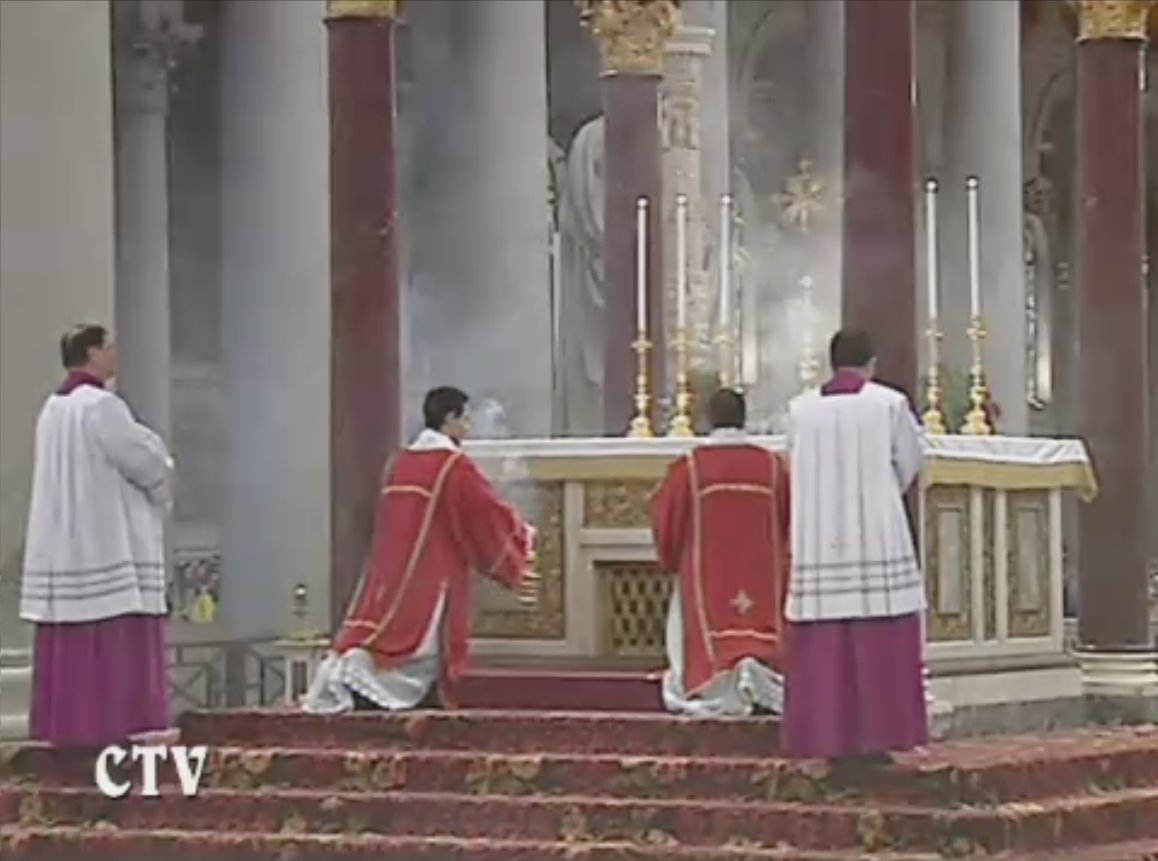
Please notice also the Altar and Incense, and it being ministered, by Roman Catholic ‘Priests’ and the Roman Catholic ‘Highpriest’, just as there was the “Altar of Incense” in the Holy Place of the True Sanctuary, the True Tabernacle which was ministered unto:


(Please Note: This uploaded content is no longer available.)

(Please Note: This uploaded content is no longer available.)


Do you not yet know, that Christ Jesus hath Ascended? and that He went “up” to prepare for us that place? Yes, Christ Jesus is indeed in Heaven, but what has He been doing there for you and I this whole time? He has told us in His word and shown us in type…

Now of the things which we have spoken [this is] the sum: We have such an high priest, who is set on the right hand of the throne of the Majesty in the heavens; Hebrews 8:1

And this work of the candlestick [was of] beaten gold, unto the shaft thereof, unto the flowers thereof, [was] beaten work: according unto the pattern which the LORD had shewed Moses, so he made the candlestick. Numbers 8:4

A minister of the sanctuary, and of the true tabernacle, which the Lord pitched, and not man. Hebrews 8:2

The True Sanctuary and Service is in Heaven… being done by CHRIST JESUS in the Heavenly, and HE even now stands in the Most Holy Place, as our Great High Priest before the FATHER… “Look Up…”, says scripture, “for your redemption draweth nigh…”. Look up into the Heavenly by Faith, and not on earth in the works of men, for it cannot save, cannot help, cannot cleanse “from” sin [Matthew 1:21]… by Faith…

Did you not know that by the power of CHRIST JESUS through the HOLY SPIRIT and Faith that you can be “overcomers” of all temptation and sin, you can be victorious in this world by HIM… HE is even now cleansing HIS people! Look by Faith, into the Heavenly and unto your Creator and Redeemer and the one whom you love…

…there is no more need for the shadow and type… look up, by Faith, unto the Real and Substance!

**What shall be shown next? There is a great deal more … **
 
That is an incorrect understanding of the Seventh Day Adventist position.
Would you then posit that the Seventh-day Adventist Church holds that Jesus Christ completely fulfilled the Mosaic law and that Christians are not bound by it any longer?

Yes or no is good, you set that standard
 
Antichristos; ἀντίχριστος : “1) the adversary of the Messiah” [Strong’s] and also "the adversary of the Messiah…especially that which is at work in false teachers who have come from the bosom of the church and are disseminating error…"c) requittal; d) hostile opposition; e) official substitution, instead of" [Thayer’s] and also “…instead of, in the place of, in the room of…” [Vine’s]

]

[LOR]

"Vicar

(Latin vicarius, from vice, “instead of”) …" [Roman Catholic Online Encyclopedia; “V”; Vicar]

Greek: Anti (in the place of, instead of) Christos (Christ, Anointed)

Latin: Vicarius (in the place of, instead of) Christi (Christ, Anointed)

Does Rome’s definition of the “Vicarius Christi” and also “Vicar of Jesus Christ on earth” and “Vicarius Filii Dei” actually mean that the Pope “stands in the place [takes the place] of Jesus Christ [the Son of God] on Earth”?

Yes it does.

on earth was appointed, so the Pontiffs his succesors, and…"]
[Prompta Bibliotheca Vol. 6, “Papa”, Article 2; pg 41 → ]

Karl Keating handled a lot of this in Catholicism and Fundamentalism. I believe most of it originates from Lorraine Boettner (a Sunday worshipping Presbyterian, despite being a supreme anti-Catholic) and The Great Controversy, an imbecilic screed penned by none other than E.G. White
 
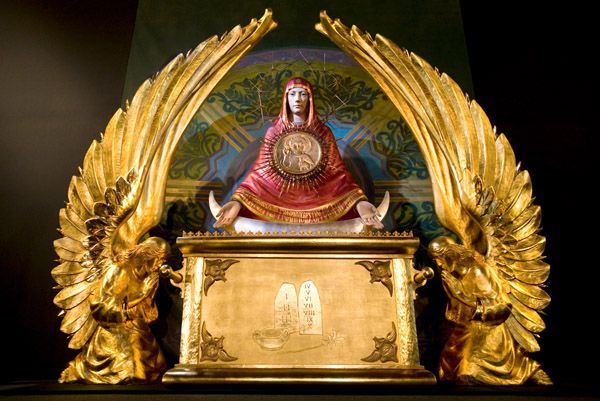
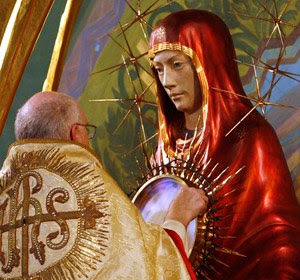
Who else is also placed between the Two Cherubims? The Roman Catholic ‘mary’, exalted to the position of where God dwells, ABOVE the Ark and Mercy Seat [though it is claimed ‘she’ is the ARK, this can be shown to be false, and also shown who ‘she’ really is], representing the very Throne of God, but this particular “messenger of Light” is not the Biblical Mary, who is the lowly handmaid, bond-slave, servant of the LORD, but in further study we will see from the Highest Official Roman Catholic Statements who this “messenger of Light” really is, and also what ‘she’ ‘herself’ has to say of ‘her’ own accord later…

http://www.sanctuaryofthedivinemercy.org/resources/headers/default-header.jpg

…for now…

"…paid honor to her with lavish generosity; temples and basilicas built to her glory with regal splendor…" [ADIUTRICEM (Benefactress) (On The Rosary); ENCYCLICAL OF POPE LEO XIII ON THE ROSARY; SEPTEMBER 5, 1895]
**
Revelation 14:6-12…

Saying with a loud voice, Fear God, and give glory to him; for the hour of his judgment is come: and worship him that made heaven, and earth, and the sea, and the fountains of waters. Revelation 14:7**

**
… “the LORD made heaven and earth, the sea, and all that in them [is]” Exodus 20:11. …“the Seventh Day the Sabbath of the LORD thy God”**

Yet, the Roman Catholic ‘mary’ of La Salette says,

**“I gave you six days to work; I kept the seventh for myself, and no one wishes to grant it to me. …” ** ‘she’ speaks of ‘sunday’, the first day…]

And when the Roman Catholic Rosary is recited and repeated it is said it is, "…as though they were listening to the very voice of the Blessed Mother explaining the mysteries and conversing with them at length…" [ON THE ROSARY; MAGNAE DEI MATRIS; Encyclical of Pope Leo XIII promulgated on September 8, 1892.]

Do you want to know who that voice actually is?

"…the Most August Virgin Mary … this Divine Mother… Yet our manner of praying to the Blessed Virgin has something in common with our worship of God, so that the Church even addresses to her the words with which we pray to God: "Have mercy on sinners." …
… the heavenly choirs, “above whom the Holy Mother of God is exalted.” …” [AUGUSTISSIMAE VIRGINIS MARIAE (August Virgin Mary); ENCYCLICAL OF POPE LEO XIII ON THE CONFRATERNITY OF THE HOLY ROSARY; SEPTEMBER 12, 1897]

"… 8. The power thus put into her hands is all but unlimited. How unerringly right, then, are Christian souls when they turn to Mary for help as though impelled by an instinct of nature, confidently sharing with her their future hopes and past achievements, their sorrows and joys, commending themselves like children to the care of a bountiful mother. How rightly, too, has every nation and every liturgy without exception acclaimed her great renown, which has grown greater with the voice of each succeeding century. Among her many other titles we find her hailed as “our Lady, our Mediatrix,”[3] “the Reparatrix of the whole world,”[4] “the Dispenser of all heavenly gifts.”[5] … " [ADIUTRICEM (Benefactress) (On The Rosary); ENCYCLICAL OF POPE LEO XIII ON THE ROSARY; SEPTEMBER 5, 1895]

"…who is placed on the highest summit
of power and glory in Heaven…" **[ON DEVOTION OF THE ROSARY; SUPREMI APOSTOLATUS OFFICIO; ENCYCLICAL OF POPE LEO XIII SEPTEMBER 1, 1883]
**


No scripture reveals Mary was ‘assumed into Heaven’, and the Apostle John wrote nothing of it, he outliving her.
 
Roman Catholic sources say, “…At the same time, it must be confessed that we do not possess any authentic documents bearing directly on Mary’s post-Pentecostal life. …” **[Roman Catholic Online Encyclopedia; The Blessed Virgin Mary; subsection Post-pentecostal life of Mary] **

“…Regarding the day, year, and manner of Our Lady’s death, nothing certain is known. …” [Roman Catholic Online Encyclopedia; “A”; “Assumption Of Mary”; subsection “The Fact Of The Assumption”]

Regarding the feast of ‘mary’: **"St. John of Damascus (P.G., I, 96) thus formulates the tradition of the Church of Jerusalem:

…that her tomb, when opened, upon the request of St. Thomas, was found empty; wherefrom the Apostles concluded that the body was taken up to heaven. … Regarding the origin of the feast we are also uncertain. It is more probably the anniversary of the dedication of some church than the actual anniversary of Our Lady’s death. That it originated at the time of the Council of Ephesus, or that St. Damasus introduced it in Rome is only a hypothesis. …" [Roman Catholic Online Encyclopedia; “A”; “Assumption of Mary”]**

Roman Catholic theology continues claiming that ‘Mary’ offered Jesus:

"…“the central message regards the spirit of responsibility with which the Kingdom of God is to be accepted: responsibility toward God and toward humanity.” The perfect model of this attitude is found in the heart of the Virgin Mary, “who, receiving the most precious of gifts, Jesus himself, offered him to the world with great love." - [Official Roman Catholic Fides Press; Agenzia Fides - Palazzo “de Propaganda Fide”]

"…even when literature
and tradition are silent…" **[ON THE ROSARY; OCTOBRI MENSE; Encyclical of Pope Leo XIII promulgated on September 22, 1891.]
**
The Bible never says that Mary ‘offered’ Jesus, for it states clearly in John 3:16 that God the Father ‘gave’ Jesus and Jesus ‘gave’ of Himself (John 6:51, 10:15).

In Hebrews 9:14 we read:

How much more shall the blood of Christ, who through the eternal Spirit offered himself without spot to God, purge your conscience from dead works to serve the living God? Hebrews 9:14

Listen closely, for much depends on this… “…Thus as no man goeth to the Father but by the Son, so no man goeth to Christ but by His Mother. … Mary is this glorious intermediary; she is the mighty Mother of the Almighty…” [ON THE ROSARY; OCTOBRI MENSE; Encyclical of Pope Leo XIII promulgated on September 22, 1891.]

Will you “go to her”?: “…Go to her, you who are crushed by material misery, defenseless against the hardships of life and the indifference of men. Go to her, you who are assailed by sorrows and moral trials. Go to her, beloved invalids and infirm, you who are sincerely welcomed and honored at Lourdes as the suffering members of our Lord. Go to her and receive peace of heart, strength for your daily duties, joy for the sacrifice you offer.”, ““Amid dangers, difficulties, and doubts, think of Mary, invoke Mary’s aid… If you follow her, you will not stray; if you entreat her, you will not lose hope; if you reflect upon her, you will not err; if she supports you, you will not fall; if she protects you, you will not fear; if she leads you, you will not grow weary; if she is propitious, you will reach your goal…” Second Homily on the Missus est: PL CLXXXIII, 70-71.”…” [Roman Catholic Online Encyclopedia; Le Pelerinage de Lourdes; Encyclical Warning Against Materialism; His Holiness Pope Pius XII; Promulgated on July 2, 1957]

Do you want JESUS CHRIST or this “messenger of Light” [search the scriptures]…

http://cleansingfiredor.com/wp-content/uploads/2011/06/mary_sculpture.jpg


Why will you not go directly to Christ Jesus? Why do you allow another in the way? Priests, bishops and cardinals and popes and ‘mary’? There is a whole train of people in your way…

The LORD hath appeared of old unto me, [saying], Yea, I have loved thee with an everlasting love: therefore with lovingkindness have I drawn thee. Jeremiah 31:3

"Come unto me, all [ye] that labour and are heavy laden, and I will give you rest." Matthew 11:28

“But Jesus said, Suffer little children, and forbid them not, to come unto me: for of such is the kingdom of heaven.” Matthew 19:14

Whosoever will come after me, let him deny himself, and take up his cross, and follow me. Mark 8:34

Do you follow JESUS or another on earth?, do you know where HE is in Heaven and what HE is doing right now for you, for HE has left it for you in HIS Word because HE loves you “SO” [John 3:16] much: My sheep hear my voice, and I know them, and they follow me: John 10:27

"…I go to prepare a place for you. …" [John 14:2]
 
Moderators normally are not supposed to comment, but I will this time.
Hats off :tiphat: to our apologists.
As usual, when backed into a corner, a few go off the deep end.
Ya did a great job!👍
 
Though I appreciate the discussion, I still don’t understand the point of Rome’s Challenge. It’s supposed to be some “Catholic support” for the Sabbath worship of the SDA. Thus, why or how can I explain why this “Catholic Support” is misused or incorrect?
 
Status
Not open for further replies.
Back
Top