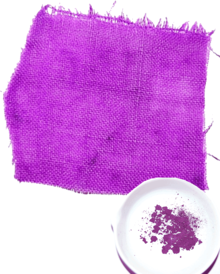
Muted purple? The Latin says “Color rosaceus” which English, French, Spanish and Italian all translate as Rose…
It does indeed say color rosaceus. However we have to remember that the rubric was written at a time before artificial chemical dyes, and when there were not the rainbow of color of hybridized roses we have today existed. The roses of the day did not have the fuller petals or color range, pink roses are in fact a very new variety. The SCR had to deal with Purple and Rose in the early 20th century as the new dyes were producing various shades of purple not seen in the past, and Rose became a pink cloth used by many vestment manufactures, who were also ignoring other rubrics. (i.e. the lining of the vestment is supposed to be the same color as the vestment itself, which was rarely followed for reasons of “Style”)
The SCR came out with a decectorial which covered what Roman Purple was, and Rose, defining it as a Muted Purple, It may take some time to find the actual citation.
Fortescue, and O’Connell both mention it. O’Connell in the three volume “The Mass” commentary on the Liturgy. I can’t put my hand on the Fortescue, just now, so I can’t say for sure if it is in the most recent edition, or if it was in the earlier editions before J.B. was to collaborate and update his books.
As an aside the SCR also deemed that Black vestments must use the new artificial Black dyes as prior to the advent of the new chemical dyes dark brown and very dark blue natural dyes were tolerated because the natural dyes did not produce true black. I have a brown tunicle, dalmatic, deacon’s stole and two maniples that I found at the Marche aux Puces in Paris, the partial set dates from around the 1820’s which got me interested in the whole issue of what colors are permitted. It would seem that if I was in the parish which the brown set was originally used, and the rest of the set was there, they could be used there and only there even today.
While on the subject of black (or very dark blue and dark brown) at one point in the early middle ages (according to Schuster and Jungmann both) Black was used during Lent, and Purple of any shade was rare, and reserved to bishops as it was very difficult to dye any cloth purple, since the dye was derived from a conch like mollusk found in the waters of the Eastern Mediterranean.



 Yes, our priest wore rose vestments with purple trim. As Laetare means “rejoice,” the more festive color is allowed, and a small display of flowers are permitted also. This rejoicing Sunday which occurs in the midst of Lent is a reminder of the Easter to come, the promise of spring, and most importantly, the promise of Jesus’ resurrection. Rejoice in Him always!