Sacred Images: A Not-So-Short History

  • Thread starter Thread starter patrick457
  • Start date Start date
Status
Not open for further replies.
P

patrick457

Guest
This is mainly taken from another thread, which I will continue here because it has somewhat derailed the original topic there. What we’ll be looking at here is the whole issue of the veneration of images in the early centuries. Let’s start first with the origins of Christian art itself.

The earliest images which we could definitively identify as Christian appeared somewhere about AD 200. We don’t know for sure where the genesis of Christian art lies: according to the older view, it originated in Rome, but the predominant view today favors the East. At least. recent archaeological discoveries at Dura-Europos in Syria 1920 (specifically, the house church dating ca. AD 235) have lent support to the view that Christian art originated there. The earliest surviving specimens of Christian art, however, do derive predominantly from the catacombs of Rome.

Other exceptions to the Roman-Italian dominance of extant pre-Constantinian Christian art, aside from the Dura-Europos house church, include the Cleveland marble sculptures (ca. 3rd century), which are assumed to have come from a family tomb in Asia Minor. Possible 3rd century frescoes have also been found in catacombs in North Africa and Thessalonica. Additionally, many surviving examples of early Christian relief sculpture on sarcophagi (coffins) may have been produced by ateliers in Gaul, although the influence of Roman workshops is apparent in their technique and style.

It seems that the lack of Christian images during the first two and a half centuries can be traced not so much to the ban in the OT against graven images per se, but to a natural association in the early Christian mind of images and image-making with pagan religion and the whole pagan way of life. Already by the mid-3rd century, however, we have evidence in Christian literature of changing attitudes and by the next century, religiously meaningful paintings began to occur in Christian contexts.

http://img822.imageshack.us/img822/9039/hart311.png
The house church at Dura-Europos
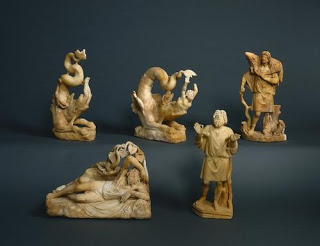

The Cleveland marbles


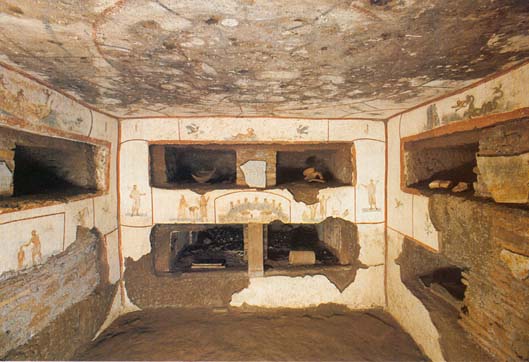
The Cubiculum of the Sacraments in the Catacomb of Callixtus, Rome


The Capella Graeca in the Catacomb of Priscilla, Rome


The Cubiculum of the Velatii in the Catacomb of Priscilla, Rome

http://images2.bridgemanart.com/cgi-bin/bridgemanImage.cgi/400wm.DGA.4735320.7055475/232195.jpg
Mother and child, from the Cubiculum of the Velatii

http://timothyryanlaferney.files.wordpress.com/2012/10/picture-1.png?w=267
Christ as Helios/Sol Invictus, detail of a vault mosaic in the Mausoleum of the Julii, Vatican (mid-late 3rd century)

http://img856.imageshack.us/img856/6428/sarcmariaantiqua.jpg
Sarcophagus from Santa Maria Antiqua, c. AD 270
One thing noticeable about most of these artworks is their funereal nature. Almost all existing pre-mid-4th century artwork was specificially created to decorate tombs or coffins. In fact, most surviving specimens can be grouped into two basic types: catacomb frescoes and the relief sculpture on sarcophagi. These, however, are by no means the only pieces of art that would have existed back then: documentary sources from the period reveal that Christians built or converted buildings or parts of buildings for their assemblies, and that they owned liturgical implements as well as scripture books. Unfortunately, these examples of material culture have been lost or destroyed over the centuries, perhaps even during the percecution of the 3rd and early 4th centuries. Another thing about them is how ambiguous they are: early Christian art were open to different layers of interpretation. In fact, they don’t even seem to be ‘Christian’ at all: they could very well be depictions of pagan or Jewish motifs. (For example, note the Christ-as-Sol Invictus mosaic above.) They are so simplified, almost schematic, indicating only the minimum necessary to call to the viewer’s mind the Biblical themes illustrated. Often they are no more than ciphers or pictographs. And the biblical texts also were abridged so that only essentials had to be represented.

The early Christians did not set out to produce an original or magnificent kind of art, but merely an art which would satisfy the needs of religious worship. Poverty, persecution, the need to remain in hiding, as well as religious and moral requirements outweighed aesthetic considerations and put magnificence out of the question. The earlest works were designed to meet practical needs and thus became symbolical and illustrative. It was an art in which beauty and harmony were not pursued for their sake, but reflected the preoccupations of people chiefly nterested in religious and moral matters.
 
We have noted the changing attitudes of Christians toward art by this time, something that is paralleled amongst the Jews. Jews in the second Temple period firmly avoided any figural depictions whatsoever, which is perhaps caused by a number of factors, such as a reaction against Hellenization in the wake of the Maccabean revolt, and as a way of establishing a unique ‘Jewish’ identity. However, after the Bar Kochba revolt of AD 132-135, Jews began to embrace art once more, as evidenced by the 2nd century synagogue in Dura-Europos, as well as later Byzantine-era synagogues in Palestine. Again, there are a number explanations for the reintroduction of figural representation (which are not necessarily mutually exclusive), such as increasing Hellenization, increasing minority status which made the need the accomodation to the outside world more pressing, the slow decline of paganism and the perception that images are not really a threat to Jews and Judaism after all.

http://img805.imageshack.us/img805/4856/q8545955.png
Interior of Dura-Europos synagogue

http://cojs.org/cojswiki/images/thu...jpg/300px-Hamat_Tiberias_Synagogue_Mosaic.jpg
Mosaic floor from Hamat Tiberias synagogue (late 4th century)


Mosaic floor from Beth Alpha synagogue (6th century)

The early Christians, living in a Hellenistic Roman culture, drew on the artistic techniques and motifs of that culture, and only introduced such changes as worship and conditions of life demanded. Not all the achievements of Greece and Rome were emulated, however: sculpture, which had so prominent a place in ancient civilization, declined and almost disappeared. The most important early Christian art forms were instead painting and mosaic.
 
Constantine’s legalization of Christianity in 313 and its declaration as the state religion of the Empire by Theodosius in 380, of course, brought with it huge changes to popular culture, including art. Until then Christian art was more of a folk art which derived its style and much of its iconography from popular Roman art (although usually executed more crudely), but from this point grand Christian buildings built under imperial patronage (the basilicas) brought a need for Christian versions of Roman elite and official art to accomodate the wealthy newcomers to the faith, of which mosaics in churches in Rome are the most prominent surviving examples. While in earlier times, art was more the preserve of the laity - with some of the authorities even clamoring against their use for fear of idolatry - now it was ‘officially’ appropriated and sanctioned. Christians are now more free than in earlier centuries to express themselves via art.

Large-scale sculpture was not popular, but relief sculpture on sarcophagi and ivory carvings and book covers continued to be produced. The walls of churches were decorated with paintings or mosaics expressing Christian themes to instruct the faithful. Painting also illustrated liturgical books and other manuscripts. In fact, it seems to have been a Christian innovation to put mosaics on the wall and use them for sacred subjects; previously the technique had essentially been used for floors and walls in gardens.


Mosaic, Hinton St Mary, Dorset (early 4th century)


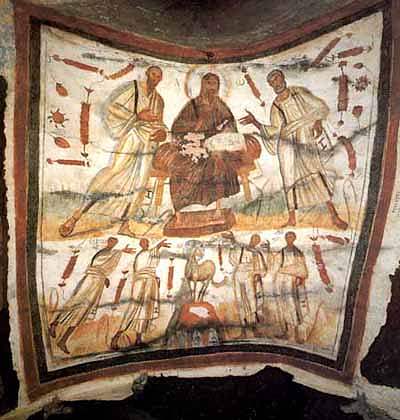
Christ between Peter and Paul, Catacomb of Saints Marcellinus and Peter, Rome (4th century)

http://upload.wikimedia.org/wikipedia/commons/thumb/8/83/Santa_Costanza._Mosaic_del_S.VII%E2%80%9CTraditio_Legis%E2%80%9D.JPG/640px-Santa_Costanza._Mosaic_del_S.VII%E2%80%9CTraditio_Legis%E2%80%9D.JPG
Christ giving the law to Peter and Paul (traditio legis), Santa Costanza, Rome (4th century)

http://www.catholiccourier.com/task...fm?fileid=65524BBD-C6CA-5E57-61F4040A8A1F39F6
Christ as Good Shepherd with medallions of Sts. Paul, Peter, Andrew and John, Catacombs of St. Thecla, Rome (4th century)


The sarcophagus of Junius Bassus (mid-4th century)


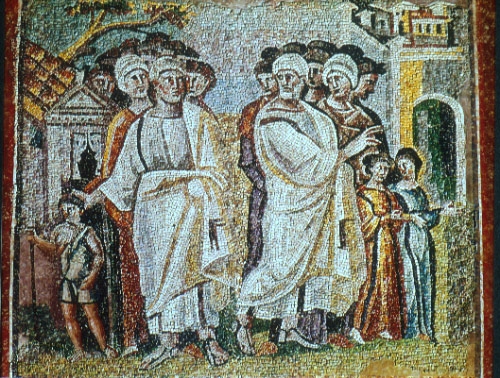
The parting of Lot and Abraham, Santa Maria Maggiore, Rome (ca. 432-440)

http://upload.wikimedia.org/wikiped...-CottonGenesisFragment26vAbrahamAndAngels.JPG
Abraham and the three visitors, Cotton Genesis (5th-6th century)

Christian art was caught up in, but did not originate, the shift in style away from the classical tradition inherited from Ancient Greek art to a less realist and otherworldly hieratic style, the start of medieval art. Christian art by this time had developed into a more abstract, simplified artistic expression, the ideal of which was not so much physical beauty as spiritual feeling. The human figures thus became types rather than individuals and often had large, staring eyes, “the windows of the soul.” Symbols were frequently used, and compositions were flat in order to concentrate and clearly visualize the main idea. (We can see here the origin of the Eastern icon.)
 
We shift here to focus on the veneration of sacred images, the origins of which is quite unclear. is quite unclear. Eusebius, writing in the 4th century, speaks about portraits of Jesus, Peter and Paul being made during their lifetimes and venerated by their contemporaries (Church History 7.18).

Since I have mentioned this city I do not think it proper to omit an account which is worthy of record for posterity. For they say that the woman with an issue of blood, who, as we learn from the sacred Gospel, received from our Saviour deliverance from her affliction, came from this place, and that her house is shown in the city, and that remarkable memorials of the kindness of the Saviour to her remain there. For there stands upon an elevated stone, by the gates of her house, a brazen image of a woman kneeling, with her hands stretched out, as if she were praying. Opposite this is another upright image of a man, made of the same material, clothed decently in a double cloak, and extending his hand toward the woman. At his feet, beside the statue itself, is a certain strange plant, which climbs up to the hem of the brazen cloak, and is a remedy for all kinds of diseases. They say that this statue is an image of Jesus. It has remained to our day, so that we ourselves also saw it when we were staying in the city. Nor is it strange that those of the Gentiles who, of old, were benefited by our Saviour, should have done such things, since we have learned also that the likenesses of his apostles Paul and Peter, and of Christ himself, are preserved in paintings, the ancients being accustomed, as it is likely, according to a habit of the Gentiles, to pay this kind of honor indiscriminately to those regarded by them as deliverers.

It is of course possible to dismiss this as a late anachronism, but it is equally possible that there may be a grain of truth behind this story. A negative attitude would seem to be out of place since as far as we know, portraits of Christ and the apostles were neither common nor particularly venerated in Eusebius’ time. (The cult of the veneration of images, starting with that of Christ, would only become increasingly common and widespread from the second half of the 6th century onwards.) It would be wrong to see in his text a reflection of the state of affairs that he himself knew from what he observed around him and all the more so since he himself was not too fond of images.

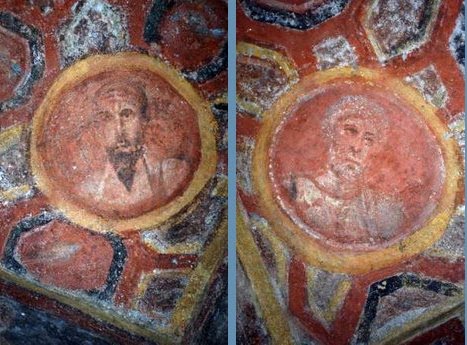
(Incidentally, I should note here the fact that the portrayals of Peter and Paul have been remarkably consistent since early Christian times. Note in the pictures in the last posts how Peter is almost always this bearded man with the full head of hair, while Paul is this balding guy with a long-ish pointy beard. The Old Catholic Encyclopedia says:

With the exception of St. Peter and St. Paul, according to Wilpert, the Apostles show no specially individualistic traits, some are portrayed with beard, some without, but merely for the sake of variety. The two chief Apostles, on the other hand, are always easily recognized and are of marked individuality. St. Peter appears as a man of great energy, with a short, thick beard, and close cut, curly hair, which in the earlier frescoes is partly, in the later wholly, gray. St. Paul is represented as the Apostle of intellect, bald, and with long, pointed beard, dark brown in colour. With slight changes this type of the two Apostles was always represented in cemeterial frescoes, mosaics, and sculptured sarcophagi, and in fact persists to the present day. Indeed so familiar were Roman Christians with the conventional appearances of their favourite Apostles that, save in a few cases, the artists never thought it necessary to inscribe their names underneath their pictures, even when represented with other saints whose names are given. From this persistence of type Wilpert regards it as probable that, if the Romans did not actually possess portraits of Sts. Peter and Paul, at least a tradition existed as to their general appearance, and that catacomb representations of them conform to this tradition. The historian Eusebius informs us that he had heard of “likenesses of the Apostles Peter and Paul” as well as of Our Lord, being preserved in paintings (Church History VII.16).)


http://gbgm-umc.org/umw/corinthians/images/peterpaul.jpg

 
We are more likely to interpret correctly the passage of Eusebius if we consider it in connection with the story from the apocryphal Acts of John (ca. mid-to-late 2nd-3rd century) about John’s newly-converted disciple Lycomedes having a portrait painted of the apostle for private veneration. It should be added that the veneration shown it took the usual forms of the time: the portrait was placed on a table covered with a cloth, it was crowned with flowers, and two candles and altar were placed before it. John, upon knowing what Lycomedes had done, gives a discourse disapproving of portraiture and forbids the veneration of portraits and of a representation of himself. In spite of this, the fact remains that Lycomedes saw nothing wrong in possessing a portrait of his spiritual father, the apostle, or even in devoting to it a certain cult of veneration.

There is also the ambiguity of John not rejecting Lycomedes’ explanation that the painting helps keep his presence and teachings constantly before him. Instead, John focuses on another point: he convinces Lycomedes to forget about his physical appearance and instead paint a picture based on his words and on the palette of virtues that Jesus painted on the human soul: the art of preaching and restoring souls replaces painting. He calls his disciple’s eagerness and attachment for art “childish and imperfect,” but it is by no means a total condemnation of painting. His strongest remark is his criticism of Lycomedes’ possession of “a dead likeness of the dead,” but it apparently does not sway Lycomedes: the icon is a powerful substitute for the real man.


One of the Fayum mummy portraits from Egypt
The apocryphon and Eusebius are unanimous in attributing this use to the portrait and its veneration to the first generation of Christians, who were accustomed to reverence their benefactors by a cult devoted to their portraits. It is probable that the first generations of Christians, if they did possess representations of Christ, the apostles, or martyrs, saw no wrong in surrounding them with material symbols of respect in memory of the person portrayed. In doing so, they were conforming to the usages of the social milieu to which they belonged (where for example, funerary portraits and masks were used mainly for commemorative, but also for cultic functions). More especially, it was customary at the time for the disciples of a great man, the founder of a religious sect or of a school of philosophy, to possess and also venerate his portrait. St. Irenaeus (Adversus haereses 1.23.4), and Eusebius (Letter to Constantia) purports that the disciples of Simon Magus did so; and we learn it also for Mani, the founder of Manichaeism (from the same text of Eusebius and from other testimony). It was probably later that clergy, fearing a tendency to idolatry, opposed the practice and forbade not only the cult of veneration but funerary portraits themselves.
 
The earliest images which we could definitively identify as Christian appeared somewhere about AD 200. …
It seems that the lack of Christian images during the first two and a half centuries can be traced not so much to the ban in the OT against graven images per se, but to a natural association in the early Christian mind of images and image-making with pagan religion and the whole pagan way of life. Already by the mid-3rd century, however, we have evidence in Christian literature of changing attitudes and by the next century, religiously meaningful paintings began to occur in Christian contexts.
As I noted to you in the other post, there is some documentary evidence (prior to your dates) of more ancient Christian imagery (it seems you are focusing on preserved artifact evidence, but I don’t think you should discount documentary evidence). Irenaeus talks about image-making as a virtue prior to the dates you are recording here, and Tertullian mentioned that Christians have imagery when writing in the early 3rd century.
 
As I noted to you in the other post, there is some documentary evidence (prior to your dates) of more ancient Christian imagery (it seems you are focusing on preserved artifact evidence, but I don’t think you should discount documentary evidence). Irenaeus talks about image-making as a virtue prior to the dates you are recording here, and Tertullian mentioned that Christians have imagery when writing in the early 3rd century.
There are two main ways that early Christians dealt with ‘pagan’ stuff: they either rejected them or appropriated them. On the one hand, Tertullian, Origen, Eusebius of Caesarea, and St. Epiphanius of Salamis opposed image-making, usually because of its close association with idolatry (apparently taking a page from Plato’s objections to art, which saw it as being removed from the ‘truth’ and appealing more to the lower, sensuous part of our nature and the passions); on the other hand, the Cappadocian fathers of the 4th century, such St. Gregory of Nyssa or St. John Chrysostom, mention Christian images in terms other than those of their educational value, acknowledging that images have the power to evoke a strong sense of emotion to the viewer.

The scathing tone of Tertullian’s attack against Christian artists in his On Idolatry seems to imply that he wrote against well-established habits and that by 200, the Church was already accustomed to tolerate images as well as their makers. The treatise does not so much deal with idolatry but with a more limited question: can an artist, a maker of images and likenesses, be a Christian? Tertullian denies this passionately. But at the same time, he must acknowledge that artists are not only admitted into the Church but into the priesthood as well. Tertullian did not bother to make a difference between an idol and an image: since every likeness, even that of an animal, might become the object of idolatry, it was mere sophistry to introduce a distinction between the two. His advice for an image-making Christian: give up art entirely and be a simple workman instead.
 
The scathing tone of Tertullian’s attack against Christian artists in his On Idolatry seems to imply that he wrote against well-established habits and that by 200, the Church was already accustomed to tolerate images as well as their makers. The treatise does not so much deal with idolatry but with a more limited question: can an artist, a maker of images and likenesses, be a Christian? Tertullian denies this passionately. But at the same time, he must acknowledge that artists are not only admitted into the Church but into the priesthood as well. Tertullian did not bother to make a difference between an idol and an image: since every likeness, even that of an animal, might become the object of idolatry, it was mere sophistry to introduce a distinction between the two. His advice for an image-making Christian: give up art entirely and be a simple workman instead.
Tertullian also mentions that the Catholics had images on their chalices, in the Montanist essay De Pudicitia. In chapter 7, he says, “You can begin with those parables, wherein the lost sheep is spoken about, searched for by its pastor and brought back on his shoulders. Even the images themselves on your chalices may be adduced, if possibly by them any light can be shed upon the interpretation of this sheep, whether it will with regard to restoration be applicable to a Christian sinner or to a pagan.” In chapter 10 he also mentions that the Catholics have carved the Shepherd of Hermas on their chalices: “I should admit you were right, if the tract, called ‘Pastor’, which only stands up for the adulterers, had deserved to be taken up in the Holy Writ… [And] perhaps [you are] supported by that pastor, which you have carved on your chalice, even this one dishonouring the Christian sacrament…”
 
Tertullian also mentions that the Catholics had images on their chalices, in the Montanist essay De Pudicitia. In chapter 7, he says, “You can begin with those parables, wherein the lost sheep is spoken about, searched for by its pastor and brought back on his shoulders. Even the images themselves on your chalices may be adduced, if possibly by them any light can be shed upon the interpretation of this sheep, whether it will with regard to restoration be applicable to a Christian sinner or to a pagan.” In chapter 10 he also mentions that the Catholics have carved the Shepherd of Hermas on their chalices: “I should admit you were right, if the tract, called ‘Pastor’, which only stands up for the adulterers, had deserved to be taken up in the Holy Writ… [And] perhaps [you are] supported by that pastor, which you have carved on your chalice, even this one dishonouring the Christian sacrament…”
Yes. The thing about Tertullian is that his charge is not so much ‘idolatry’ but ‘laxism’ on the bishop’s part for allowing this. And BTW, he was actually stricter than Jewish rabbis of the time: the rabbis, for commercial reasons, accepted that Jewish artist-merchants could make images of pagan gods for their pagan clients. For the rigorist Tertullian, for any Christian to engage in image-making is out of the question. An image becomes an idol by its very making; the only way to make it non-idolatrous is to destroy it.
 
In the anti-image camp, there’s also Clement of Alexandria, who formulated a rigorist interpretation of the ban against images and a certain disdain for the material world. (All in true Platonist fashion, I guess. ;)) In certain passages (Exhortation to the Heathen 4; Stromata 5.5), Clement seems to have excluded the making of all images, even quoting the Sibyl alongside Scripture to prove his point. He alludes to Pythagoras’ injunction to not wear a ring or have the figure of a deity on it and links it to the command against graven images, using it as prooftext for his idea that Christianity is superior to pagan religion, because it is older, by virtue of the philosophers actually learning from Moses (Clement counts Israelite Yahwism as a part of Christianity here).

How then does he deal with God’s seeming inconsistency in the OT, banning images at one point and commanding them in another? He does so by doing what the Alexandrian school does best, by transforming the cherubim on the Ark of the Covenant into allegory (Stromata 5.6):

And those golden figures, each of them with six wings, signify either the two bears, as some will have it, or rather the two hemispheres. And the name cherubim meant much knowledge. But both together have twelve wings, and by the zodiac and time, which moves on it, point out the world of sense. It is of them, I think, that Tragedy, discoursing of Nature, says:—

Unwearied Time circles full in perennial flow,
Producing itself. And the twin-bears
On the swift wandering motions of their wings,
Keep the Atlantean pole.

And Atlas, the unsuffering pole, may mean the fixed sphere, or better perhaps, motionless eternity. But I think it better to regard the ark, so called from the Hebrew word Thebotha, as signifying something else. It is interpreted, one instead of one in all places. Whether, then, it is the eighth region and the world of thought, or God, all-embracing, and without shape, and invisible, that is indicated, we may for the present defer saying. But it signifies the repose which dwells with the adoring spirits, which are meant by the cherubim.

For He who prohibited the making of a graven image, would never Himself have made an image in the likeness of holy things. Nor is there at all any composite thing, and creature endowed with sensation, of the sort in heaven. But the face is a symbol of the rational soul, and the wings are the lofty ministers and energies of powers right and left; and the voice is delightsome glory in ceaseless contemplation. Let it suffice that the mystic interpretation has advanced so far.​

In The Instructor (3.11), Clement seems to have softened his stance somewhat, if he did not simply recognize, as Tertullian did, a special category of images (yes, Tertullian’s stance on images was also quite inconsistent):

And let our seals be either a dove, or a fish, or a ship scudding before the wind, or a musical lyre, which Polycrates used, or a ship’s anchor, which Seleucus got engraved as a device; and if there be one fishing, he will remember the apostle, and the children drawn out of the water. For we are not to delineate the faces of idols, we who are prohibited to cleave to them; nor a sword, nor a bow, following as we do, peace; nor drinking-cups, being temperate.

Many of the licentious have their lovers engraved, or their mistresses, as if they wished to make it impossible ever to forget their amatory indulgences, by being perpetually put in mind of their licentiousness.


It’s hard to know what you think is unresolved, Patrick. Your statements always seem so backed up by evidence and they usually line up with some aspect of Catholic teaching. I will say that your collections have been immensely helpful to my own study of the Fathers. Here’s something I wrote in which I used some of your material: In the study of the Church Fathers, the third century is a difficult period of study, because there are not many orthodox third-century writers whose material we have a lot of. We have a lot from Tertullian, Origen, and Clement of Alexandria, but they weren’t completely orthodox. [Some examples of that are omitted because Catholic Answers only wants me to post 6000 characters.]]

So in some ways it is difficult to pick one’s way through all this and find what the faithful Catholics of the third century believed about their faith. In particular, all three of these writers opposed the veneration of images, and Protestant writers use that against Catholics who still venerate images today.

BTW, one shouldn’t infer from all of this that Origen and Tertullian and Clement were 100% bad. Very much of their content is very good. In fact, when they’re not heretical, their explanations are, usually, not just good, but very good, so we can still, usually, use their writings for support of our doctrines, as long as it’s not on a matter they taught heresy about. Most of their stuff lines up with what the Christians of the time believed.

That all said, these writers can be used in defense of images in several ways.

Even though in several famous passages Clement of Alexandria forbid any use of images, he made room in his prohibition to allow for some images, in which he reflects the influence of Catholic practice. The Instructor 3.11: “And let our seals be either a dove, or a fish, or a ship scudding before the wind, or a musical lyre, which Polycrates used, or a ship’s anchor, which Seleucus got engraved as a device; and if there be one fishing, he will remember the apostle, and the children drawn out of the water.”

Tertullian mentions that Catholics in his day had images on their chalices, in the Montanist essay De Pudicitia. In chapter 7, he says, “You can begin with those parables, wherein the lost sheep is spoken about, searched for by its pastor and brought back on his shoulders. Even the images themselves on your chalices may be adduced, if possibly by them any light can be shed upon the interpretation of this sheep, whether it will with regard to restoration be applicable to a Christian sinner or to a pagan.” In chapter 10 he also mentions that the Catholics have carved the Shepherd of Hermas on their chalices: “I should admit you were right, if the tract, called ‘Pastor’, which only stands up for the adulterers, had deserved to be taken up in the Holy Writ… [And] perhaps [you are] supported by that pastor, which you have carved on your chalice, even this one dishonouring the Christian sacrament…”

He also made a comment that can be used in favor of images in Against Marcion: “No man will love the picture of his wife without taking care of it, and honoring it and crowning it. The likeness partakes with the reality in the privileged honor.” "[And] no honor is to be attributed to the image of anything which is itself unworthy of honor. As the natural state is, so will the likeness be.” – (Book V Chapter 18, Book III Chapter 10) This teaching is prophetic of what would later be insisted on by other Church Fathers: the honor paid to an image passes on to the person it portrays.

Finally, Origen, in Contra Celsus, Book VIII, Chapter 30, referring to Christian saints, says, “we commit [their] bodily organs with due honors to the grave, because it is not right that the dwelling-place of the rational soul should be cast aside anywhere without honor, like the carcasses of brute beasts; and so much the more when we believe that the respect paid to the body redounds to the honor of the person who received [it] from God.” This is the same principle by which we honor the images of saints. Because the respect paid to the image redounds to the honor of the person who received that likeness from God.

Another pro-image passage is in chapter 17 of Contra Celsus Book VIII, where Origen says, “in taking upon them the image of Him who has created them, [Christians] do raise within themselves a statue like to what the Most High God Himself desires. And as among statuaries there are some who are marvellously perfect in their art…while others make inferior statues…in the same way there are some who form images of the Most High in a better manner and with a more perfect skill… But by far the most excellent of all these throughout the whole creation is that image in our Savior who said, My Father is in Me.”

That is a metaphor that speaks of statues and images in a positive way. One could be charged with taking it out of context, though, because in the next chapter Origen concludes this line of thought with these words: “And, in general, we see that all Christians strive to raise altars and statues as we have described them…not of a lifeless and senseless kind and not to receive greedy spirits intent upon lifeless things, but to be filled with the Spirit of God who dwells in the images of virtue of which we have spoken, and takes His abode in the soul which is conformed to the image of the Creator.” – There he seems to guard his words so that no one infers that he thought statues and images are okay, but even so his words contribute to our understanding of how images can be a good thing.
There are no real questions in this thread (yet), only ramblings. Threads aren’t only for asking unresolved questions, although I will probably do so one of these days in a different occasion. 😛 Thanks for the quote anyway - it really helps! 🙂
 
Status
Not open for further replies.
Back
Top