Sacrilege or not?

  • Thread starter Thread starter Lost4words
  • Start date Start date
Status
Not open for further replies.
But is the religious dialogue supposed to happen in the context of Catholic liturgy? In a Catholic funeral?

 
Which leaves (at least) my original questions unanswered: What is the goal of dialogue?
I would say to live together in harmony and in respect of differences.

In 2009 at the World Oblate Congress, the undersecretary of the Commission gave an excellent talk on specifics. I would have to dig up my notes but essentially it takes place on many levels. At our level it is mostly about being good neighbours, collaborating on community projects, and perhaps even praying together. Doctrinal dialogue occurs at the level of theologians.
But is the religious dialogue supposed to happen in the context of Catholic liturgy? In a Catholic funeral?
It was after the liturgy, and as a sign of respect. I honestly don’t see the problem.
Also, let’s face it, a requiem mass is stunningly beautiful. I can’t imagine doing it any other way.
And which of course it is, even in the OF. Our schola has chanted more than one OF funeral in Gregorian chant. Every time a monk of our abbey passes on, the funeral is an OF requiem Mass in Gregorian chant
 
Last edited:
I have no doubts that the OF requiem is beautiful (especially since parts of it can be in the vernacular). But the loss of the Dies Irae is a major blow to it. In my humble opinion, it is one of the most hauntingly beautiful pieces of music ever written. A true momento mori for the congregation, and a true plead of mercy to the Judge for the deceased soul. That said, I also don’t mind it’s placement in the Office of the OF!
 
You’re getting the story through second hand sources.

I’ve been to funerals where a eulogy was permitted before the deceased is taken out of the Church. It isn’t supposed to happen, but often the celebrant permits it to avoid hurt feelings.

Perhaps the wording of the prayers were not anything contrary to the Catholic faith and the celebrant permitted it. Maybe the deceased was Asian with Buddhist relatives?

You don’t really know, maybe the woman doesn’t have the story straight. That happens.
 
Our schola sings it at OF funerals on request, after the official liturgy. I’m not that fond of it myself, but do use in the Office for the last week of OT, the end of the month of the dead.
 
Person who died, as stated before, was a staunch Catholic.

Daughter in law from Thailand…Buddhist. Married UK guy. I know the family.
 
Last edited:
I’m thinking about all the ironies here. Was there any Gregorian chant in this particular funeral? Hard to know – maybe. But undoubtedly Buddhist chant stole the show. Why do I get the sense that the people most in favor of Buddhist chant, would be least in favor of Gregorian chant? I could be wrong, of course.
 
Byzantine chanting is worlds apart from Buddhism. We are Catholics in full communion with the Holy See.

Btw, PJPII was half-Ukrainian - on his mother’s side - and his parents were crowned (i.e. married) in the Ukrainian Greek Catholic Church.
 
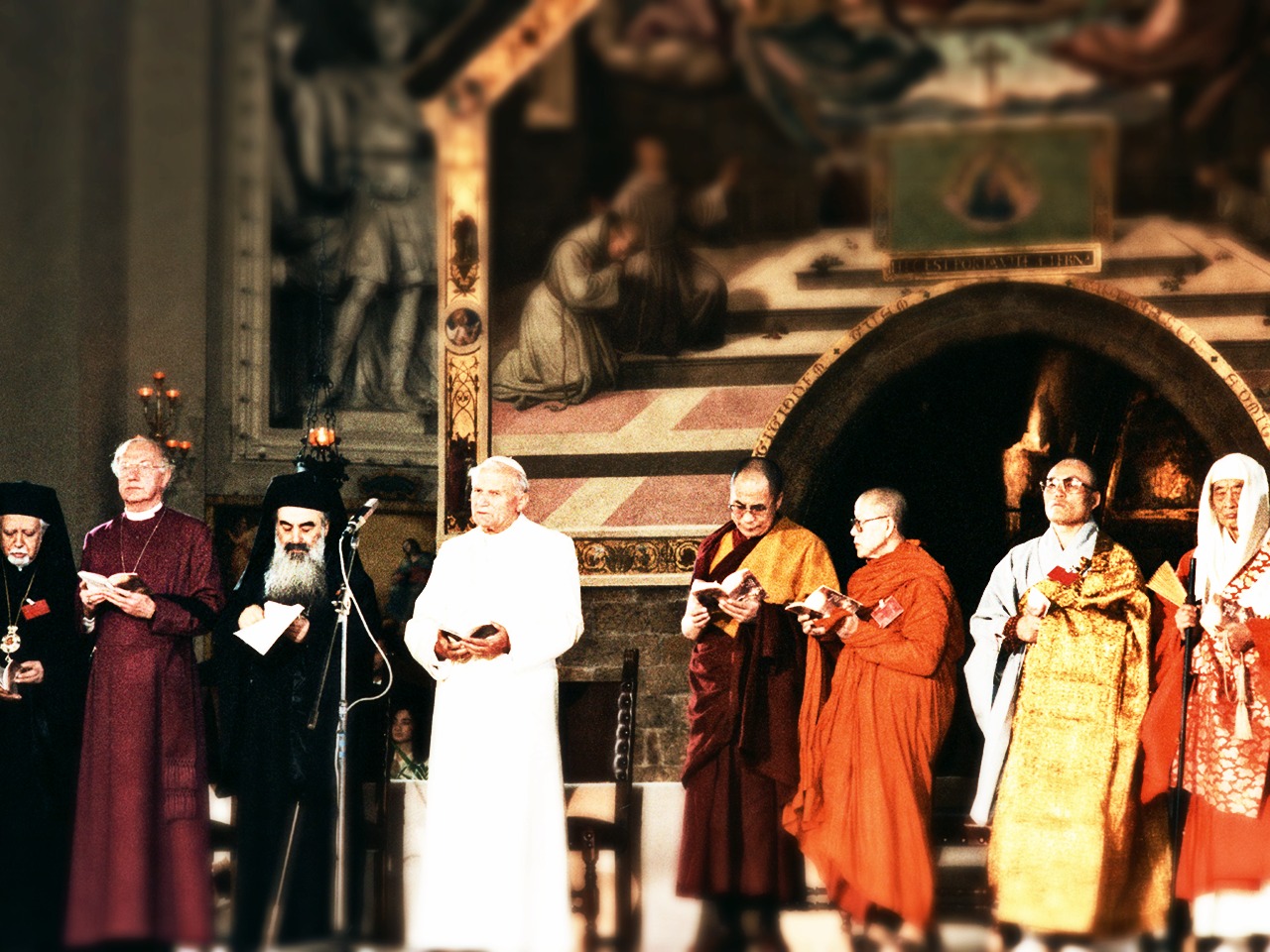
Ironically that photo illustrates an article called “Remembering the sacrilege of Assisi I, Thirty years later”.
Bringing us back to the OP’s term: “sacrilege”!


A highlight:
Nevertheless, the worst enormity of the ecumenical movement has not yet been touched on. In this case, exceptionally, the guilt does not belong to the Second Vatican Council, nor to Paul VI. It is found in the perversion introduced into the ecumenical movement by John Paul II, who turned it from a search for Christian unity to a general convergence of world religions. Several times in his reign this false direction led him into shocking associations with paganism. Thus, during his visit to India in February 1982, he allowed a Hindu priestess to impose the mark of Telak on him, and another a few days later to smear sacred ashes on his forehead in a Hindu ritual. In 1995, in Australia, he conducted the beatification Mass of Mary of the Cross McKillop, at which the penitential rite was replaced by a ritual taken from aboriginal fire worship.
But don’t worry - - it’s all cool in the name of Dialogue!
 
Last edited:
Yeah, that’s great, but was it in the context of a liturgy? As part of (or immediately after) the Holy Sacrifice of the Mass? I think it was part of a rather bland sounding “prayer service”.
 
Last edited:
Yes, I know. I was reacting to the OP saying, “No context needed. Inside a Catholic church is just plain wrong.”
 
Let all come inside a Catholic Church to pray; believers, seekers, and all the rest.

They might get a Son-burn and begin a journey to Christ.

Let all who seek be filled,
Deacon Christopher
 
taking the catholic pulse :crazy_face:
 
Last edited:
A funeral Mass is not an ecumenical prayer service. If there is Buddhist chanting desired by the family at the very least let it not be done in connection with Mass. Plenty of other times and places.

It is world’s apart from allowing a eulogy as a kindness to relatives. A eulogy is not antithetical to what is supoised to be the source and summit of our faith.
 
Last edited:
Do we know exactly when the Buddhist chants happened? I don’t believe we do.
 
“the monks then were allowed to chant (in their own language ‘Thai’) by the coffin, in front of the altar with everyone present. Then, the coffin was taken out of the church.”(Bold and Italics are mine). Quoted from post #23

ETA - IMO, it should not have occurred at any time within the Church. It took place in front of the Altar, so being a Catholic funeral I assume this was at the front of the Church - not even down the back near the entrance doors! This chanting is part of a Buddhist ritual for their deceased I assume. It is not the same as them joining in our prayers for the deceased, but instead bringing in their rituals into our Sacred Place.

Can anyone imagine a Catholic Priest being allowed to incense and sprinkle with Holy Water the coffin/bier of the deceased within a Buddhist temple during their ceremony???

I have no problem with the dil wanting to give or express her faith beliefs regarding the passing of her mil, but outside of the Church is the proper place.

This was not some shared ecumenical prayer service after all. ( I’ve attended those before when they were held in my Cathedral - prayers said in union with Christians of other Faiths. Which I don’t see any problem with).
 
Last edited:
Status
Not open for further replies.
Back
Top