St. Elizabeth of Hungary
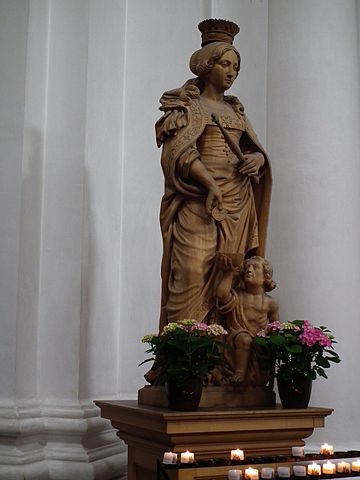
Also called St. Elizabeth of Thuringia, born in Hungary, probably at Pressburg, 1207; died at Marburg, Hesse, 17 November (not 19 November), 1231.
She was a daughter of King Andrew II of Hungary (1205-35) and his wife Gertrude, a member of the family of the Counts of Andechs-Meran; Elizabeth’s brother succeeded his father on the throne of Hungary as Bela IV; the sister of her mother, Gertrude, was St. Hedwig, wife of Duke Heinrich I, the Bearded, of Silesia, while another saint, St. Elizabeth (Isabel) of Portugal (d. 1336), the wife of the tyrannical King Diniz of that country, was her great-niece.
In 1211 a formal embassy was sent by Landgrave Hermann I of Thuringia to Hungary to arrange, as was customary in that age, a marriage between his eldest son Hermann and Elizabeth, who was then four years old. This plan of a marriage was the result of political considerations and was intended to be the ratification of a great alliance which in the political schemes of the time it was sought to form against the German Emperor Otto IV, a member of the house of Guelph, who had quarrelled with the Church. Not long after this the little girl was taken to the Thuringian court to be brought up with her future husband and, in the course of time, to be betrothed to him.
The court of Thuringia was at this period famous for its magnificence. Its centre was the stately castle of the Wartburg, splendidly placed on a hill in the Thuringian Forest near Eisenach, where the Landgrave Hermann lived surrounded by poets and minnesingers, to whom he was a generous patron. Notwithstanding the turbulence and purely secular life of the court and the pomp of her surroundings, the little girl grew up a very religious child with an evident inclination to prayer and pious observances and small acts of self-mortification. These religious impulses were undoubtedly strengthened by the sorrowful experiences of her life.
In 1213 Elizabeth’s mother, Gertrude, was murdered by Hungarian nobles, probably out of hatred of the Germans. On 31 December, 1216, the oldest son of the landgrave, Hermann, who Elizabeth was to marry, died; after this she was betrothed to Ludwig, the second son. It was probably in these years that Elizabeth had to suffer the hostility of the more frivolous members of the Thuringian court, to whom the contemplative and pious child was a constant rebuke. Ludwig, however, must have soon come to her protection against any ill-treatment. The legend that arose later is incorrect in making Elizabeth’s mother-in-law, the Landgravine Sophia, a member of the reigning family of Bavaria, the leader of this court party. On the contrary, Sophia was a very religious and charitable woman and a kindly mother to the little Elizabeth.
The political plans of the old Landgrave Hermann involved him in great difficulties and reverses; he was excommunicated, lost his mind towards the end of his life, and died, 25 April, 1217, unreconciled with the Church. He was succeeded by his son Ludwig IV, who, in 1221, was also made regent of Meissen and the East Mark. The same year (1221) Ludwig and Elizabeth were married, the groom being twenty-one years old and the bride fourteen. The marriage was in every regard a happy and exemplary one, and the couple were devotedly attached to each other. Ludwig proved himself worthy of his wife. He gave his protection to her acts of charity, penance, and her vigils, and often held Elizabeth’s hands as she knelt praying at night beside his bed. He was also a capable ruler and brave soldier. The Germans call him St. Ludwig, an appellation given to him as one of the best men of his age and the pious husband of St. Elizabeth.
They had three children: Hermann II (1222-41), who died young; Sophia (1224-84), who married Henry II, Duke of Brabant, and was the ancestress of the Landgraves of Hesse, as in the war of the Thuringian succession she won Hesse for her son Heinrich I, called the Child; Gertrude (1227-97), Elizabeth’s third child, was born several weeks after the death of her father; in after-life she became abbess of the convent of Altenberg near Wetzlar.
Shortly after their marriage, Elizabeth and Ludwig made a journey to Hungary; Ludwig was often after this employed by the Emperor Frederick II, to whom he was much attached, in the affairs of the empire. In the spring of 1226, when floods, famine, and the pest wrought havoc in Thuringia, Ludwig was in Italy attending the Diet at Cremona on behalf of the emperor and the empire. Under these circumstances Elizabeth assumed control of affairs, distributed alms in all parts of the territory of her husband, giving even state robes and ornaments to the poor. In order to care personally for the unfortunate she built below the Wartburg a hospital with twenty-eight beds and visited the inmates daily to attend to their wants; at the same time she aided nine hundred poor daily. It is this period of her life that has preserved Elizabeth’s fame to posterity as the gentle and charitable chételaine of the Wartburg. Ludwig on his return confirmed all she had done. The next year (1227) he started with the Emperor Frederick II on a crusade to Palestine but died, 11 September of the same year at Otranto, from the pest. The news did not reach Elizabeth until October, just after she had given birth to her third child. On hearing the tidings Elizabeth, who was only twenty years old, cried out: “The world with all its joys is now dead to me.”
CONTINUED BELOW


