Saint of the day and Feast days-Part 2

  • Thread starter Thread starter odhiambo
  • Start date Start date
Status
Not open for further replies.
“When we come to the public service of God, we come as it were in a formidable body, to do violence to him, and to storm heaven by prayer; and this violence is most pleasing to God”
St Irenaeus.
 
June 29

Today is the Feast day of
Saint Peter and Saint Paul
Among many other saints.
 
Saints Peter and Paul
Founders of the see of Rome.


On this day, we remember two great apostles, two very important men in the life of the Church, who helped to mould her.
Peter was chosen by the Lord to be leader of the Church and tasked with preaching the Gospel, especially among the Jewish Community. Paul, on the other hand, was the chosen instrument of God, to spread his Word to the Gentiles, to you and me. These two men are our ancestors in faith, the ones who have passed on to us the message of Salvation of the Lord.
May they be blessed for ever!
 
Saint Peter the Apostle.
Also known as Simon Peter or Cephas, (“the Rock”)
The First Pope
Prince of the Apostles and
Founder, with Saint Paul, of the see of Rome.


Saint Peter was born at Bethsaida near Lake Tiberias (the Sea of Galilee?) His name was Simon. His father was Jonah. He had a brother named Andrew.
Simon had married and settled in Capernaum. Together with his brother, he earned his living fishing until, through his brother Andrew, the Lord called him from being a “ fisherman” (and a diciple of John the Baptist) to “become a fisher of men” (Lk 5:9.) Jesus gave him the name Kepha, Aramaic for “rock”. When Peter later declared his faith in Jesus as “the Christ, the Son, and the Living God” (Mt.16:16), Jesus declared him “Blessed” and stated unequivocally, the all important statement: “upon this rock I will build my Church, and the gates of Hades will not prevail against it. I will give you the keys of the kingdom of Heaven; whatever you bind on earth shall be bound in heaven, and whatever you loose on earth shall be loosed in heaven” (Mt.16:17-19).
After the Resurrection, Peter was among the first to whom the Lord appeared, and after the Ascention of the Lord, we see Peter everywhere takin a leading role. It is he who is named first in the group of apostles in the upper room awaiting the coming of the Holy Spirit on Pentecost Day. It was Peter who took the initiative and presided over the election of Matthias to the ranks of the apostles to replace Judas who had betrayed Jesus. It was he who first addressed the jeering crowd on Pentecost day and was instrumental in adding to the Church on that eventful day, about three thousand people. It is Peter again who is recorded to have performed the first miracle of healing in the Christian Church by healing the lame man at the Temple gate. Peter became the first Pope and ruled the Church wisely and bravely for the rest of his days on the earth.
Almost all that we know of the later life of Saint Peter, is derived from the Acts of the Apostles. From this Book of the New Testament, we learn of a violent persecution under Herod Agrippa I, around the year 43. We learn that Herod killed James, the brother of John with the sword and then arrested Peter. Peter was miraculously released by an angel and subsequently travelled to either Anthioch or Rome.
Peter was martyred in Rome during the reign of Emperor Nero, probably in 64. According to an old tradition, he was confined in the Marmertine prison where the church of San Pietro in Carcere now stands. He was condemned to death by crucifixion. He asked that he be crucified head downwards because he felt himself unworthy to die as his Master did.
Accordingly, Peter was crucified upside down on the Vatican Hill. He was also buried on Vatican Hill. Excavations under Saint Peter’s Basilica have unearth what is considered his tomb and his relics are now enshrined under the high alter of Saint Peter’s.
In liturgical art, Saint Peter is depicted as an elderly man holding a key and a book. His symbols include an inverted cross, a boat ( for the barque of Christ), and a cock ( for the triple denial of Christ).

Saint Peter,
Pray for us!

Ref:
1: Our Sunday Visitor Encyclopedia Of Saints.
By Matthew Bunson, Stephen Bunson, Margaret Bunson:

2: Saint Companions for Each Day
By A.J.M. Mausolfe
And J.K. Mausolfe.

3: Saints For All.
Lives of Saints For Every Week.
A Paulines Publication Africa.
 
Saints Peter and Paul
Founders of the see of Rome.


On this day, we remember two great apostles, two very important men in the life of the Church, who helped to mould her.
Peter was chosen by the Lord to be leader of the Church and tasked with preaching the Gospel, especially among the Jewish Community. Paul, on the other hand, was the chosen instrument of God, to spread his Word to the Gentiles, to you and me. These two men are our ancestors in faith, the ones who have passed on to us the message of Salvation of the Lord.
May they be blessed for ever!
St Paul tops the list of my favourite saints although St Thérèse of Lisieux seems to want that position badly. I chose St Paul to be my favourite saint. St Thérèse is more of a feeling–a sentiment than a choice.

St Paul was in the forefront of promoting Christianity. He suffered more than any other apostle although we often don’t notice it. Below is a passage of Paul narrating his sufferings. I have come across it a couple of times before but it’s only recently that I really heed it.

2 Corinthians 11:23-28 (RSV-CE)
23 Are they servants of Christ? I am a better one – I am talking like a madman – with far greater labors, far more imprisonments, with countless beatings, and often near death.
24 Five times I have received at the hands of the Jews the forty lashes less one.
25 Three times I have been beaten with rods; once I was stoned. Three times I have been shipwrecked; a night and a day I have been adrift at sea;
26 on frequent journeys, in danger from rivers, danger from robbers, danger from my own people, danger from Gentiles, danger in the city, danger in the wilderness, danger at sea, danger from false brethren;
27 in toil and hardship, through many a sleepless night, in hunger and thirst, often without food, in cold and exposure.
28 And, apart from other things, there is the daily pressure upon me of my anxiety for all the churches.
I wish we me especially :)] refer to such a passage for motivation when we encounter “hardship” and “daily pressure”–which would probably be nothing as compared to what the saints and martyrs encountered.

PS: I wished this was one of the readings today.
 
Saint Paul
Apostle of the Gentiles
Martyr

Paul is said to be one of the greatest missionaries, mystics and theologians in the history of the Church. He was born in the city of Tarsus, Cilicia (Now Turkey), of the Jewish tribe of Benjamin. His Hebrew name was Saul and he was a Roman citizen. He was a well read man, having studied Jewish law as well as Greek and Latin. He was raised as a Pharisee and so was his father before him. He was sent to Jerusalem to learn the Torah, and was lucky enough to be taught by none other than the famed Jewish rabbi, Gamaliel. In Jerusalem, young Saul developed strong ties before going back to Tarsus around the time Jesus was starting His public ministry. Saul was a tent maker by profession.
Back in Tursus, Saul must have come to learn about the new sect of the Nazarenes, as the early followers of Jesus were called a few years after the Crucifixion. He became a dedicated opponent of the new Church and was not just present at the martyrdom of Saint Stephen, the First Martyr, but guarded the robes of those who stoned him and was “consenting to his execution”
After the execution of the protomartyr, Saul set out for Damascus to carry out the persecutions of the Nazarenes and on the way he underwent his renowned conversion. Blinded by the light which he understood to be Jesus Christ Himself. He was taken to Damascus and sat for three days in darkness. He was then baptized by Ananias and his sight restored. Paul then left the city to spend several years in Arabia in prayer and meditation.
He returned to Damascus and started preaching the Faith. He met with such heated resistance that he had to make a secret escape from the city by being lowered down the city wall in a basket.
He then went to Jerusalem where he met with Saint Peter and other Apostles. With the aid of Barnabas, he was able to convince them all of his sincerity. After preaching in Cilicia and Caesarea (modern Israel), Paul embarked on the first of his great missionary journeys in about the year 45.
Joined by Barnabas and Mark, Paul sailed to Cyprus Asia Minor, establishing Christian communities in Antioch, Pisidia, Iconium and elsewhere. It was not at all easy going for him. He was even stoned and left for dead by a mob; but the seed he planted also found fertile ground.
About the year 50, he set out on his second missionary journey with Silas. This time, he went to Asia Minor, then to Macedonia, Greece then on to Corinth where he stayed for a year.
His third missionary Journey started around the year 55.
On his return to Jerusalem, Paul was attacked by the Jews and saved from certain death by the Roman soldiers. He was charged by the Sanhedrin with bringing Gentiles into the Temple. He then applied as a Roman citizen, to be sent to Caesarea for trial before the governor.
He spent two years in prison and when the trial was finally held, he appealed to Rome. He was sent by ship to Caesar under Roman guard, but was shipwrecked at Malta.
When he finally reached Rome and was tried, he was acquitted.
His remaining years are obscure. It is believed he travelled to several places including Syria, Palestine. He was arrested once more and taken back to Rome where he was placed in close confinment.
He was martyred about the year 65-67, most likely by beheading, at the command of the Emperor Nero. The site of his martyrdom is believed to be on the left bank of the Tiber in Rome. He was then said to have been burried in a cemetery on the Via Ostia owned by a Christian named Lucina. In later years, a basilica of Saint Paolo Fuori le Mure( Saint Paul Outside the Wall) was built.
In liturgical art, Paul is portrayed with a sword or a book, and his symbol is the book and the sword.
Saint Paul,
Pray for us!
 
Throughout his missionary travels, Paul wrote extensively. About a third of the New Testament is composed of this letters.
His writings are:
Romans.
First and Second Corinthians.
Galatians
Ephesians
Philippians
Colossians
First and Second Thessalonians
First and Second Timothy
Titus and Philemon.
Paul was imprisoned, shipwrecked, beaten, flogged, stoned and left for dead, banished and finally martyred for his faith.
There is so much to learn from Him.
Saint Paul,
Pray for us!
 
June 30

Today the Church commemorates
The First Martyrs of the Church of Rome.
 
The First Martyrs of the Church of Rome.

In the early years of the infant Church, persecution of Christians kept breaking out in one place or another in the vast Roman Empire.
There were several major persecutions as follows:
The First Persecution began under Emperor Nero in the year 64 A.D.
The Second Persecution was under Emperor Domitian in 95 A.D.
The Third Persecution occurred 12 years later under Emperor Trajan in 107 A.D
The Fourth Persecution was under Emperor Hadrian in the year 135 A.D.
The Fifth Persecution was under Emperor Marcus Aurelius in 180 A.D.
The Sixth Persecution was that under Emperor Septimus Severus in 222 A.D
The Seventh Persecution was that under Emperor Decius in 250 A.D
The Eight Persecution was under Emperor Valarian in 257 A.D
The Last of the persecution of Christians occurred under Emperor Dioclatian in 303 A.D
At long, long last, after some 250 years of trial and severe testing, the Church began to enjoy relative peace and calm and fruitful growth from the year 314 A.D when Emperor Constantine the Great proclaimed Christianity the official religion of the Roman Empire by his famous decree, the Edict of Milan
Some of the martyrs that we are commemorating today are mentioned in the Canon of the Mass, specifically in Eucharistic Prayer I

During the First persecution, that of the emperor Nero in the year 64, many of the Early Christians suffered terrible tortures and martyrdom. Christians were put into animal skins and hunted, brutally attacked and burnt alive. Others were given to wild animals in the arena as a way of entertaining people. Today we remember all these martyrs who gave up their lives for Christ, Our Saviour.
This day is important to us Catholics because we should never forget that, as had been observed by Tertullian, the “the blood of the martyrs is the seed of the Church,” On this day, we should remember that our Faith is not something to partake of only when the going is good but rather that it is the most important part of us, more dear to us than life itself. Lastly, we should never forget that even we could some day be called upon to bear witness as they did. Should that day materialise, will I be counted among the martyrs?
Happy First Martyrs of the Church of Rome Memorial

Saints in the Canon

Ref:1:
Saint Companions for Each Day

By A.J.M. Mausolfe

And J.K. Mausolfe.

2: Saints of the Liturgical Year
A Paulines Publication

 
June has passed, July is here with us.
The month of July is dedicated to
The Precious Blood of Our Lord Jesus.
 
The Feast of the Sacred Heart of Jesus

The Feast of the Sacred Heart of Jesus is a moveable feast. Its date depends on the date of Easter Sunday. It is celebrated 19 days after Pentecost Sunday, which falls on the 50th day of Easter. This year, 2011, the solemnity falls on this day, July 1, 2011. July 1 in the Old Roman Calender was also the Feast of the Most Precious Blood.

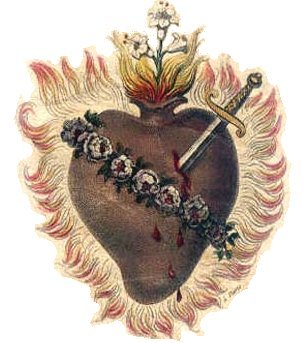
Devotion to the Sacred Heart of Jesus in the Church is deep rooted. In many Catholic Churches, if not all, one will invariably see the familiar image of the Sacred Heart of Jesus depicted as Jesus with His Heart exposed at the chest, usually aflame and surrounded by the crown of thorns. Sometimes He is depicted holding the Divine Sacred Heart in His hand.
On this day, we give special honor and worship to the Sacred Heart of Jesus, in reparation for our sins and the sins of the world.

In the devotion to the Sacred Heart, two things must always be uppermost in our minds and hearts: they are, Christ;s Heart of flesh and Christ’s love for us.
In honoring the Heart of Christ,
The imagery of the Heart of Jesus aflame underscores the fact that nothing can stop the love of the Heart of Jesus for us. This love of Christ for us was the moving force of all that He suffered for us in Nazareth, on the Cross, in giving Himself in the Blessed Sacrament, etc.
This great love that Jesus poured on us is met by rejection and hatred. Thus, the great undying love of Jesus for us and our rejection and hatred by such heresies as Arianism, Gnosticism, and Calvinism, etc.is symbolically depicted by the flame and the wound in the heart.
This same, loving Sacred Heart was also pierced on the Cross by a lance,by one of the soldiers and blood and water gushed out. This is symbolic of the founding of the Church for our salvation.
The Sacred Heart of Jesus, therefore represents and recalls His Love for us.
Devotion to the Sacred Heart as we know it today, began about the year 1672. On repeated occasions, Jesus appeared to Saint Margaret Mary Alacoque, a Visitation nun in her convent in rural France at Paray le Monial. To her, Jesus revealed how He wanted us to observe the devotion to His Heart.

He asked to be honored in the symbol of His Heart of flesh. He asked for acts of reparation; for frequent Communion. Communion on the First Friday of the month of which today is one, and the keeping of the Holy Hour in front of the Blessed Sacrament.
Saint Margaret Mary suffered contempt from many people who refused to believe the authenticity of the visions. She was, however, believed by the chaplain of the convent, Saint Claude de la Colombiere and with his assistance, the devotion spread and was eventually approved by the Church.

Sacred Heart of Jesus,
I place my trust in Thee!
 
**Promises of Jesus to St. Margaret Mary:
**
  1. I will give them all the graces necessary for their state of life.
  2. I will establish peace in their families.
  3. I will console them in all their troubles.
  4. They shall find in My Heart an assured refuge during life and especially at the hour of their death.
  5. I will pour abundant blessings on all their undertakings.
  6. Sinners shall find in My Heart the source of an infinite ocean of mercy.
  7. Tepid souls shall become fervent.
  8. Fervent souls shall speedily rise to great perfection.
  9. I will bless the homes where an image of My Heart shall be exposed and honored.
  10. I will give to priests the power of touching the most hardened hearts.
  11. Those who propagate this devotion shall have their names written in My Heart, never to be effaced.
  12. The all-powerful love of My Heart will grant to all those who shall receive Communion on the First Friday of nine consecutive months the grace of final repentance; they shall not die under my displeasure, nor without receiving their Sacraments; My heart shall be their assured refuge at that last hour.
 
**Prayer to Saint Margaret Mary:
**
O Holy Visitandine, to hear your name is to recall the Sacred Heart Devotion, especially as practiced on First Fridays and in making reparation for sins. From early youth you dedicated yourself to Jesus and you exhibited fervent love for him in the Eucharist. You became his chosen vessel to spread the devotion to the Sacred heart which has done wonders in modern times. Make all of us realize ever more Christ’s words: “Behold this Heart that has so greatly loved people.” Amen.
 
July 2

Today we celebrate the
**Feast of the Immaculate Heart of Mary

**

 
**Feast of the Immaculate Heart of Mary.
**
Luke 2:19: But Mary kept all these words, pondering them in her heart.
Luke 2:35: And thy own soul a sword shall pierce, that, out of many hearts thoughts may be revealed.
Luke 2:51: And he went down with them and came to Nazareth and was subject to them. And his mother kept all these words in her heart.

What do we mean when we speak of Mary’s Immaculate Heart?
We believe as the Church teaches us that Mary was immaculately conceived, that is, conceived without original sin. We believe that her heart was immaculately created to be the temple of God in accordance with His Plan. After her birth, Mary chose to remain without sin
“Biblically, the heart of a person symbolizes the total person, the soul, the intellect, the memory, the core of the being, the life force, the interior life, as well as the material and corporal heart”
The physical heart as we know is a vital organ, one of the first in the body to “begin to live and the last to be stilled in death”. The heart is the seat of love, hatred, joy, sadness fear and every kind of passion. The spiritual heart is the one we share with God. It is believed to contain , among others, our will and spirit.

“Create in me a pure heart, O God, and renew a steadfast spirit within me.” Psalm 51:10
Mary’s Immaculate Heart is a heart overflowing with love. It is a heart that reflects the grace of God, which is then showered upon us her children.

Devotion to the Immaculate Heart of Mary.
Just as devotion to the Sacred Heart of Jesus is only a form of devotion to the adorable Person of Jesus, so also is devotion to the Immaculate Heart of Mary but a special form of devotion to Mary. It focuses on Mary’s love for God and encourages our emulating her humility, gratitude, obedience, and adoration.

Our Lady, seat of Wisdom…Pray for us.
Immaculate and Sorrowful Heart of Mary….Pray for us.
 
Note:
Devotion to the Sacred Heart of Jesus focuses mostly on His divine love for mankind and encourages our humility, gratitude, obedience, and adoration.
Devotion to the Immaculate Heart of Mary focuses on Mary’s love for God and encourages our emulating her humility, gratitude, obedience, and adoration.
 
July 3

Today is the Feast day of
Saint Thomas
Among Many other Saints
 
Saint Thomas
Apostle and Martyr


Thomas was most likely born in Galilee. His Aramaic surname, “te’oma”, translated " Didymus in Greek, meaning the “twin”. He was a fisherman with no educational background. He was called by Jesus to be one of the twelve Apostles, although we do not know where or when this happened.
Saint Thomas is mentioned in the Bible in three notable moments.
First, we are given a glimpse of his great love for Jesus at the time when he was ready to accompany Jesus to the house where Lazarus had just died. The other apostles feared being stoned by the Jews in Judea but Thomas proclaimed himself ready to die with Christ, saying on the way to Bethany, " Let us also go to die with him" John 11:16
Next, it was his declaration at the Last Supper: " Lord, we do not know where you are going, so how can we know the way?",
that prompted Christ to say:
" I am the Way, the Truth and the Life. No one comes to the Father , except through me.“John 14:5-6.
Finally , Thomas gave rise to the expression “Doubting Thomas” for his refusal to believe in the Lord’s Resurrection, when told of it by the other disciples.
When Jesus appeared to the disciples a second time, however, Thomas was present and he made the now renown act of faith: " My Lord and my God!” John 20:28. In so doing, Thomas became the first to acknowledge explicitly, the divinity of Christ.

Little is known with certainty about the missionary activities of Saint Thomas after the dispersal of the Apostles.
From Ecclesiastical History, Eusebius of Caesarea reportedly asserted that Thomas preached in Parthia in the East. He is also believed to have landed in Kerala( india) in AD 52.
It was here in India that Thomas was stabbed to death with a spear in 72, while in prayer on a hill in Mylapore, near Madras.
He was buried near the place where he died.
His relics were later moved to Edessa, Mesopotamia and later still the relics were moved to Ortona, Italy and to Portugal.
Saint Thomas was declared the Apopstle of India by Paul the VI on July 3 1972.
He was precongregationally canonized.

Saint Thomas,
Pray for us!
 
July 4

Today is the Feast day of
Saint Elizabeth of Portugal
Among many other saints.

 
Status
Not open for further replies.
Back
Top