Saint of the day and Feast days-Part 2

  • Thread starter Thread starter odhiambo
  • Start date Start date
Status
Not open for further replies.
August 20
Today is the Feast day of
Saint Bernard of Clairvaux
Among many other Saints

 
Saint Bernard of Clairvaux
Abbot and Doctor of the Church.


Bernard was born into the French nobility. He was born at Fontaines les Dijon, the family castle near Dijon, Burgundy in 1090. His father was Tescelin Sorrel and his mother, Aleth de Montbard daughter of the lord of Montbard… He was the third son in a family of seven children.
The siblings were all well educated. Bernard was sent to study at Chatillon. His youth was spent rather frivolously. When he was 17 years old, his mother died. He had been greatly attached to his mother and her death influenced him deeply. In 1112, following her death, he left the School of Chatillon-sur-Seine. He persuaded thirty one of his friends and relatives, including four of his brothers, to go with him to Citeaux which had been founded in 1098. This was the first Cistercian monastery which observed a strict interpretation of the Benedictine rule. They were welcomed by the abbot, Saint Stephen Harding. His spiritual growth was rapid in this surroundings.
In 1115, Bernard was sent with 12 monks to found a Cistercian house at Langres with him as abbot. At first, there were difficulties with other monks because of his strict disciplines and austerities. His obvious holiness however, soon attracted many disciples. The name of the monastery was changed from Vallee d’Absinthe to Clairvaux which means “Valley of light”. The monastery would in future become the mother house of the 68 Cistercian monasteries established by its monks. As his reputation for learning and wisdom spread, Bernard soon became involved in matters outside the monastery. He became one of the most powerful influences in Europe, consulted by both popes and rulers. In 1130, he supported the legitimacy of Pope Innocent II’s election against the claims of antipope Anacletus II and successfully led the struggle that led to Innocent being accepted as Pope.
In 1140, Bernard began preaching in public and soon he was regarded with awe because of the eloquence of his preaching and the miracles attributed to him. He was acclaimed as the greatest preacher of his time.
In 1145,the papal legate asked Bernard to go to Languedoc in southern France to combat the Albigensian heresy.
Bernard roused all of Europe to the Second Crusade, headed by Emperor Conrad III and LouisVII of France. The Crusade however, ended in disaster and was a big disappointment to Bernard. He blamed the failure on the wickedness and lack of dedication of the crusaders.
In 1153, Bernard left Clairvaux to go and negotiate a peace deal between the duke of Lorraine and the inhabitants of Metz which had been attacked by the duke. He was stricken on his return and died at Clairvaux Abbey on 20 August 1153.
Bernard is considered by many to be the second founder of the Cistercians.
He was canonized on 1170 by Pope Alexander III and declared Doctor of the Church in 1830.

Saint Bernard of Clairvaux,
Pray for us!
 
Saint Bernard of Clairvaux’s writing include the following:
1: De Diligendo Dei
2: Commentary on the Song of Songs.
3: Treaties on the Love of God- De amore Dei
4: “De Consideratione” (“On Consideration”), addressed to Pope Eugenius III.
5 And others.
More than 300 sermons were recorded as well as 500 letters , all demonstrating his devotion to the BVM and the Infant Jesus.
For his brilliance and contribution to theology, Saint Bernard of Clairvaux was called “the Mellifluous Doctor”
 
A person who prays carelessly, and yet expects his prayers to be heard, is like a man who pours bad grains into a mill, but expects to receive good flour in return…
St Bernard.
 
From a sermon by Saint Bernard, abbot
I love because I love, I love that I may love

Love is sufficient of itself, it gives pleasure by itself and because of itself. It is its own merit, its own reward. Love looks for no cause outside itself, no effect beyond itself. Its profit lies in its practice. I love because I love, I love that I may love. Love is a great thing so long as it continually returns to its fountainhead, flows back to its source, always drawing from there the water which constantly replenishes it. Of all the movements, sensations and feelings of the soul, love is the only one in which the creature can respond to the Creator and make some sort of similar return however unequal though it be. For when God loves, all he desires is to be loved in return; the sole purpose of his love is to be loved, in the knowledge that those who love him are made happy by their love of him.

The Bridegroom’s love, or rather the love which is the Bridegroom, asks in return nothing but faithful love. Let the beloved, then, love in return. Should not a bride love, and above all, Love’s bride? Could it be that Love not be loved?

Rightly then does she give up all other feelings and give herself wholly to love alone; in giving love back, all she can do is to respond to love. And when she has poured out her whole being in love, what is that in comparison with the unceasing torrent of that original source? Clearly, lover and Love, soul and Word, bride and Bridegroom, creature and Creator do not flow with the same volume; one might as well equate a thirsty man with the fountain.

What then of the bride’s hope, her aching desire, her passionate love, her confident assurance? Is all this to wilt just because she cannot match stride for stride with her giant, any more than she can vie with honey for sweetness, rival the lamb for gentleness, show herself as white as the lily, burn as bright as the sun, be equal in love with him who is Love? No. It is true that the creature loves less because she is less. But if she loves with her whole being, nothing is lacking where everything is given. To love so ardently then is to share the marriage bond; she cannot love so much and not be totally loved, and it is in the perfect union of two hearts that complete and total marriage consists. Or are we to doubt that the soul is loved by the Word first and with a greater love?
 
… For when God loves, all he desires is to be loved in return; the sole purpose of his love is to be loved, in the knowledge that those who love him are made happy by their love of him…
It is true that the creature loves less because she is less. But if she loves with her whole being, nothing is lacking where everything is given. To love so ardently then is to share the marriage bond; she cannot love so much and not be totally loved…
:amen:
 
Saint Pius X.
Pope
Also known as:
Joseph Sarto, Giuseppe Melchior Sarto and
Pope of the Blessed Sacrament.


The great Pope’s name was Giuseppe Melchior Sarto. He was born on 2 June 1835 at Riese near Trevino in Italy. He was the second of ten children. His father was a postman named Giovanni Battista Sarto and his mother Margherita Sanson was a seamstress.
He was educated locally in Riese and in Castelfranco. When he realized his calling was to be a priest, he entered the seminary in Padua in 1850. Eight years later in 1858, he was ordained. He then spent several years as a curate in the parish of Tombole, then a rapid rise within the Church heirachy.
He was pastor of Salzano in 1867.
Canon of the cathedral of Treviso in 1875.
Chancellor of the diocese of Treviso in 1878
Provost of the same cathedral in 1879. Bishop of Mantua 1884.
As bishop, he proved himself when he took over this diocese whose seminary had been closed and the faithful lax and demoralized. He reopened the seminary, restored Catholic influence and brought the populace back to the Church., successfully reviving the formerly run down diocese.
In recognition of his success, Pope Leo XIII, made him a cardinal and patriarch of Venice in 1893. He held this post for ten years.
When Pope Leo XIII died in 1903, Cardinal Sarto was chosen pope on August 4 1903. He was not the favorite candidate for Pope. The front runner was Cardinal Rampolla whose nomination was vetoed by Austria. Given the circumstance as stated, Giuseppe was reluctant to accept his elevation to pontiff, but reconsidered on the insistence of the other cardinals. Thus, Giuseppe Melchior Sarto became the 257th pope. He took the name Pius X and adopted the motto **“instaurare omnia in Christo” **meaning “to restore all things in Christ”
He became known as the pope who loved the Holy Eucharist, or “ the Pope of frequent Communion” This was because he encouraged everyone to receive Jesus as often as they could. He also made a law permitting young children to receive Holy Communion. Before that time, boys and girls had to wait many years before they could start receiving the Eucharist.
Throughout his pontificate, Pope Pius was concerned with the heresy of modernism which he denounced as “the summation of all heresies“. He went further and
also denounced it in his encyclicals ***Lamentabilis sane exitu ***of 1907 and Pascendi dominici gregis also of 1907. The Pope also demanded an oath against modernism by every priest.
Although Pope Pius X put a great deal of effort into preventing the outbreak of a global war, World War 1 erupted only days before his death on 20 August 1914 at Vatican City. He died from natural causes. He was buried under the altar of the chapel of the Presentation, in Saint Peter’s basilica.
He was beatified on 3 June 1951 by Pope Pius XII and canonised on 29 May 1954 by Pope Pius XII.
Pope Saint Pius X.
Pray for us!
 
**
“Experience teaches that the man who exercises a frequent and rigid censorship over his thoughts, words and action, is better capable of hating and avoiding evil and of cultivating earnestly what is good”
**

St Pius X
 
August 22
Today we commemorate
The Queenship of the BVM.

This momorial of Our Lady, also known as Our Lady, Queen of the Angels and
Our Lady, Queen of Heaven, was established in 1954 by Pope Pius XII in his encyclical Ad caeli reginam, at the end of the Marian Year.
The memorial was instituted to highlight Mary’s Spiritual motherhood and “Queenship”.She is Queen of the world, Queen of the angels and Queen of heaven. It is linked to the Feast of the Assumption which was celebrated seven days ago. In association with Christ, Our Lord and King, Mary interceeds for us from heaven and looks after us. She encourages us to live our Christian life to the full and , like her, to be true witnesses of God in our lives.

From Saints of the Liturgical Year.
A Paulines Publication.
 
“Mary is the all–blessed one… She sees God… perfectly, though she understands only in proportion to her faith: “Blessed are you because you believed.” Mary possesses God, the Supreme Good who contains every good… Mary’s conformity to the will of God was total. Mary enjoys God. She… has a very special place in paradise: more perfect than that of the other saints because she is the Queen”
Blessed James Alberione.
From Feast of all Saints
 
August 23
Today is the Feast of
Saint Rose of Lima
Among many other Saints.
 
Saint Rose of Lima.
Rose was born on 20 April 1586 at Lima, the capital of Peru. Her parents were poor immigrants from Puerto Rico. She was christened Isabella de Santa Maria de Flores but the beauty of her infant face earned for her the title of Rose, which stuck…
At an early age Rose helped support her impoverished family through her exquisite lace and embroidery work. She worked hard day and night.
As she grew older, Rose became more and more beautiful and was much and openly admired. Her parents wanted her to marry but she resisted their wish. All she wanted was to dedicate herself to the Lord. From fear of becoming vain, she cut off her hair and blistered her face with pepper to ruin her complexion in the hope that she would no longer be attractive.
Rose next step was to became a Dominican tertiary taking Saint Catherine of Siena as her model. She lived as a recluse in a shack in the garden, leading an austere life of prayer, fasting and severe mortification.
She started to experience mystical gifts and visions of such an extraordinary nature that a commission of priests and doctors were appointed to examine her. They reported that her experiences were of supernatural origin.
Her holiness drew people to her and her garden became the spiritual centre of the city.
When her health failed, Rose accepted the help of Don Gonzalo de Massa and his wife to take care of her and she spent the last three years of her life in their home in Lima and died there on 24 August 1617.
She was canonized on. 2 April 1671 by Pope Clement X.
She is patroness of South America.
You can also read about this sanint here.
Saint Rose of Lima,
Pray for us!
 
“Let all men know that grace comes after tribulation. Let them know that without the burden of afflictions it is impossible to reach the height of grace… This is the only true stairway to paradise, and without the cross they can find no road to climb to heaven”
St. Rose
From Holy Spirit Interactive
 
August 24
Today is the Feast day of
Saint Bartholomew.
Among many other Saints.
 
Saint Bartholomew.
Apostle and Martyr.

He is also known as Bartolomé and Nathanael bar Tolomai.
Bartholomew, whose name means “Son of Tolomai or Talmai”, was from Cana in Galilee. He was also one of the Twelves Apostles. His other name was Nathanael and this is the name with which he is identified in John. He became a disciple of Jesus when his friend Philip invited him to ‘come and meet the Lord’. When Jesus saw him, He called him an “Israelite….in whom there is no deceit!” We therefore know that Nathaniel was a very honest and sincere man.
After Pentecost, Bartholomew, like the other apostles, went out and preached the Gospel to the masses.
It is believed that he preached in India and Armenia where he was flayed alive at Albanopolis, and then beheaded by the order of King Astyages.
His relics are at Saint Bartholomew-on-the-Tiber Church in Rome, Italy, and in the cathedral in Canterbury, England.

Saint Bartholomew,
Pray for us!
 
August 25
Today is the Feast day of
Saint Louis King of France
Among many other Saints
 
Saint Louis IX
King of France

Louis was born on April 25, 1214 at Poissy, France. He was the son King Louis VIII of France and Queen Blanche ( Blanche of Castile). He was raised in a pious manner by his mother. It is said that when Prince Louis was small, his mother hugged him saying: “I love you, my dear son, as much as a mother can love her child, but I would rather see you dead at my feet than ever to have you commit a mortal sin.”
Louis never forgot those words.
His father died in 1226 when he was 12 years old. His mother became regent until he reached his majority.
Louis was reportedly, a remarkable king, deeply religious and a model of prayer, kindness and compassion.
He married Margaret, the daughter of count Raymund Berenger of Provence in 1224 and they were blessed with eleven children.
Saint Louis ruled his country well, fought many just wars and won many of them including the defeat he handed King Henry III of England at Taillebourg in 1242.
He led two Crusades. The first was in 1248 and captured Damietta in 1249. Unfortunately, he suffered a disastrous defeat at the hands of the Saracens at El Mansura in 1250 and was taken prisoner. He ransomed himself and his men. He then went to the Holy Land where he stayed until 1254 when his mother died. He returned to France then.
In 1270, Louis started off on his second Crusade. He contracted typhoid soon after landing in Tunisia. He died there near Tunis on 25 August 1270 .
His relics were in the Basilica of Saint Denis, Paris, France but were destroyed in 1793 during the French Revolution.
Louis was canonized in 1297 by Pope Boniface VIII.
The Saint was noted for his justice, charity and personal piety. He founded many religious and educational institutions.
He is said to be one of the greatest of all French Kings
Saint Louis,
Pray for us!
 
“Be kindhearted to the poor, the unfortunate and the afflicted. Give them as much help and consolation as you can.”
St. Louis
From Holy spirit interactive
 
August 26

Today is the Feast day of
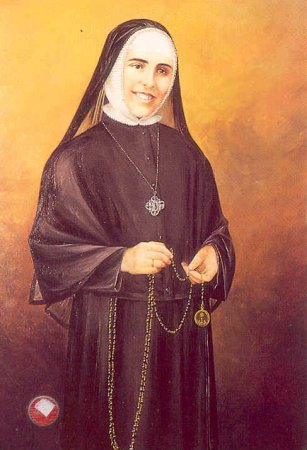
Blessed Mary of the Angels Ginard Martí
Among many Saints and Blesseds.

 
Status
Not open for further replies.
Back
Top