Saint of the day and Feast days-Part 2

  • Thread starter Thread starter odhiambo
  • Start date Start date
Status
Not open for further replies.
Saint Burchard of Würzburg.
Burchard was born in England, date of birth is not known. He became a Benedictine priest and was ministering in Wessex, England. About the year 732, he went as a missionary to Germany and served under Saint Boniface. It was Saint Boniface who consecrated him the first bishop of Würzburg. In 749, Bishop Burchard was sent to Rome by the Frankish King, Pepin the Short. His mission in Rome was to secure the approval of Pope Saint Zachary of Pepin’s accession to the Frankish throne. He was successful in this mission.
Burchard founded the abbey of Saint Andrew in Würzburg. About the year 753, he resigned the bishopric. He retired to a monastery in Hamburg, Germany where he spent the last years of his life.
He died on February 2, 754 in Germany. He was buried at Mount Saint Mary or Old Wurzburg.
His canonization was Pre-Congregation
He is the Patron Saint of Würzburg, Germany.
Saint Burchard of Würzburg,
Pray for us!
 
October 15
Today is the Memorial of
Saint Agileus,
Among many other Saints.
 
**Saint Agileus
Martyr.
**
Saint Agileus was a Christian who lived in North Africa. He was martyred in the city of Carthage in the year 300, during the local persecutions of Christians. Saint Augustine reportedly preached a sermon in his honor on his birthday.
This was all the information I could find on this martyr.
Saint Agileus,
Pray for us!
 
October 16
Today is the Memorial of
Saint John the Dwarf
Among many other Saints.
 
**Saint John
Hermit and
Miracle Worker.
**
John was born around the year 339 in Egypt, in a region known as Basta, situated in Lower Egypt. His family was poor but pious. Because of his small stature, John was nicknamed “Kolobos” which I understand, is Greek for 'dwarf". When still a young man of 18, John retired to the desert of Skeet in Upper Egypt. He dug for himself an underground cave where he lived a solitary life before becoming a disciple of Saint Poemen. Apart from his short stature, John was, reportedly, also short tempered and conceited; that is, at first. As he grew in holiness, however, he became gentle and humble. From SQPN, we read that
"As a test of his new humble obedience, his director ordered him to water a walking staff stuck in the sand; John did so. It later blossomed, and John referred to it as the “tree of obedience”.
Around the year 395, John fled the desert because of invading Berbers. He lived for years as a hermit on Mount Queolzum ( Qulazum)
near the current city of Suez. He died there.
Saint John,
Pray for us!
 
October 16
Today is the Memorial of
Saint John the Dwarf
Among many other Saints.
A small mistake .😃
The Memorial for this Saint is actually tomorrow.
What is done is done, however. 😃
Will post today’s Saint tomorrow.:D:D
 
A small mistake .😃
The Memorial for this Saint is actually tomorrow.
What is done is done, however. 😃
Will post today’s Saint tomorrow.:D:D
:tsktsk:

(Don’t worry too much. I made a mistake too. December 3rd 1965 I believe…)

Saint John,
Pray for us anyways!
 
A small mistake .😃
The Memorial for this Saint is actually tomorrow.
What is done is done, however. 😃
Will post today’s Saint tomorrow.:D:D
Don’t forget that whenever you make a post, it’s either a day early or late for some due to the different time zones. So someone in maybe New Zealand would have said, wow, you got the day right this time around. 😉
 
Don’t forget that whenever you make a post, it’s either a day early or late for some due to the different time zones. So someone in maybe New Zealand would have said, wow, you got the day right this time around. 😉
True.
For me she’s always a day early.
 
October 17
Let us remember today
Blessed Gerald
Among many Saints and Blesseds
His Memorial day is October 16
 
Blessed Gerald.
Gerald was born in Lombardy, Italy. He joined the Cistercians at the monastery of Fossanuova. He was later named abbot of this monastery. In 1170,Gerald became abbot of Clairvaux. He was killed by one of the monks at Igny when he was visiting there.
His canonization is pending.
Blessed Gerald,
Pray for us!
 
October 18
Today is the Memorial of
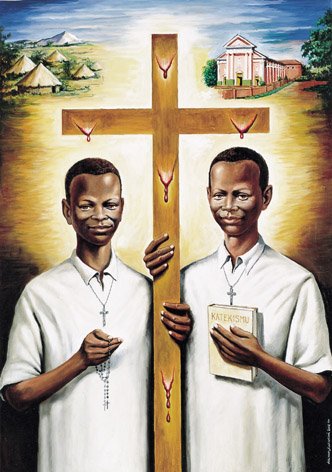
Blessed Daudi Okelo and
Jildo Irwa

Among many other Saints and Blesseds

 
Blesseds Daudi Okelo and
Jildo Irwa
Martyrs.

Daudi Okelo and Jildo Irwa were two young catechists from Uganda at the beginning of the 20th century. They belonged to the Acholi tribe, a subdivision of the larger Luo grouping whose members today live mostly in the North of Uganda, but they are also present in Southern Sudan, Kenya, Tanzania and Congo.
These two young men were martyred in the years immediately following the foundation of the mission of Kitgum by the Comboni Missionaries in 1915.
 
Blessed Daudi Okelo
Also known as David Okelo.

David was born around the year 1902 at Payira, a village between Gulu and Kitgum in Northern Uganda, East Africa. His parents, Lodi and Amona, were pagans. From the age of 14-16, David was a catechumen, receiving the instructions necessary before baptism. On June1, 1916, David was baptized by Father Cesare Gambaretto, receiving his First Holy Communion on the same day. He was confirmed on 15 October 1916. After some time, David was enrolled as a catechist.
At the beginning of 1917, Antonio, the catechist in charge of a village called Paimol, died. David went to Father Cesare, then superior at the mission of Kitgum, offering to take Antonio’s place. He was duly appointed and it was decided that he needed to go with an assistant to help him with the mission ahead. A young man named Jildo Irwa was chosen for this role. Paimol was some 80 kilometers away and security in the area was not good as there were sporadic instances of slave traders and gangs of raiders visiting the area. When warned about these incidences, David reportedly answered: "I am not afraid to die. Jesus, too, died for us!” Thus, towards the end of 1917, the two were in Paimol rearing to go.
David immediately began his work by assembling children who were willing to take religious instruction. First thing early morning, he would beat the drum to summon the catechumens to prayers. He taught them simple prayers and the questions and answers catechism which was repeated over and over in a sing song manner, the better to memorize the lessons. In this way, the basics; the A,B,Cs of the Faith was taught to the children. After the morning sessions, David would go out to the villages from which his charges were coming and he would offer to help their parents to look after the cattle or work in the fields.
At sunset, there were evening prayers which included the Rosary. To close the evening prayers, a hymn to Our Lady was always sung. Sundays, being a Holy Day, the service was longer and other catechumens and catechists from around the area would all come and join in the service. Unfortunataly, there were people who were not happy with what David was doing and they decided to put an end to it all. There had been some unease but nothing happened until 18 October 1918.
On that day, in the thick of night, some raiders, said to be a mix of Moslems and witchdoctors, went to the hut which David shared with his assistant. They entered the building and demanded that he gave up teaching catechism to the children. He refused. He was then dragged out of the hut and fatally speared. He was not yet even 20 years old. The place of his death has been called “Wi Polo”, which means “In Heaven”.
His body which had been left where he had died , was disposed of later by unknown people. Some years later, his remains were collected and placed in the mission church at Kitgum, at the foot of the altar of the Sacred Heart.
David was pronounced venerable on 23 April 2002 by Pope John Paul II. He was beatified on 20 October 2002 by Pope John Paul II
Canonization is pending.
Ifyou have information relevant to the canonization of Blessed Daudi, contact:
Bishop’s House
P.O. Box 200
Gulu, Uganda
Blessed Daudi Okelo,
Pray for us!
 
Blessed Jildo Irwa
Jildo Irwa was born around 1906 in the village of Bar Kitoba, Kitgum in northern Uganda. He belonged to the Acholi tribe same as Blessed David Okelo. His mother was called Ato and his father, Okeny. Both were pagans but would later convert to Christianity. Jildo was said to be a very gentle person.
He was baptized on 6 June 1916, at the age of eleven by Father Cesare Gambaretto. He received his First Holy Communion on the same day and was confirmed on 15 October 1916.
In 1917, when an assistant chatechist was needed to accompany Blessed David Okelo to a new location, Jildo had spontaneously and very willingly offered to be that assistant.
On the morning of their martyrdom Jildo reportedly had this to say to David who was warning him about a possible attack,** “Why should we be afraid? We have done nothing wrong to anyone; we are here only because Father Cesare sent us to teach the word of God. Do not fear!”**
He repeated the same words to their killers. They were telling him to stop teaching the catechism.
** “We have done nothing wrong”, he told them in tears.** He too was speared and knifed to death at the same place now known as " Wi Polo" or " In Heaven" He was beatified on 20 October 2002 by Pope John Paul II
Canonization is pending .
Blessed Jildo Irwa,
Pray for us!
 
October 19
Today is the Feast Day of
Blessed Jerzy Popiełuszko
Among many other Saints and Blesseds.
 
Blessed Jerzy Popiełuszko.
Priest and Martyr

Jerzy was born on 14 September 1947 in the village of Okopy in Poland. It was the feast of Holy Cross Day. His parents Marianna and Wladyslaw Popiełuszko, were farmers. He was their fourth child. (From other accounts, he was their third child, out of five children). He was baptized in his parish church in Suchowola, two days following his birth. He was given the baptismal name of Alfons. Although the family was poor, they were devout Catholics and raised all their children with profound love of God and the Church. In 1954, Alfons started elementary school in Suchowola, and continued his education in the local high school.
He was reportedly an avarage, rather shy student but likeable. He served as an alter boy, getting up at 5 am every morning irrespective of the weather, and going to serve at Mass. After his First Holy Communion, he was confirmed in in 1956.
Even as a high school student, Jerzy knew that he wanted to become a priest but kept this to himself because of the prevailing political conditions which was definitely against the Catholic Church.
After his graduation from high school in 1965, he entered the Seminary of Warsaw and changed his name to Jerzy.
After just one year of study in the seminary, he was drafted into the army.
Drafting seminarians was part of the government’s campaign against the Church. He served in a unit were the recruits were indoctrinated against the Church. He boldly defied the army and rallied colleagues, urging them to resist the attempts to turn them from their faith. For this, he was severely punished. The savage punishments metet out to him and which he bravely endured, took a toll on his health; He suffered ill health the rest of his life as a direct consequence.
In1968, Jerzy resumed his studies for the priesthood. He was ordained with many other deacons on May 28, 1972 by Cardinal Stefan Wyszynski.
For about six years after his ordination, Father Jerzy served as a curate or rather, parish priest, in a number of parishes. One day, in 1978, while saying Mass, he collapsed. To help him recover faster, he was assigned a seemingly less strenuous ministry, the chaplaincy at the student University Church of Saint Anne in Warsaw. He was to be in charge mainly of medical students. He dedicated himself fully to this ministry with the students.
The position of a chaplain of medical personnel in Warsaw was officially entrusted to him in February 1979.
In May 1980, Father Popieluszko was given new assignment to Saint Stanislaus Kostka Church in Warsaw as a resident priest, in theory only required to assist in parish duties.
August of that same year saw the birth of Solidarity, an anti-Communist trade union movement. The movement was for peaceful social change.
One Sunday, of 31 August 1980, when the entire country was on strike, workers from the Warsaw Steel plant, who were on strike in support of the shipyards in Gdansk, sent a delegation to Cardinal Stefan Wyszynski requesting that a priest say Mass for them. The only priest who was available was Father Popieluszko. He went and said Mass at the plant.
This was the beginning of his ministry among workers. He worked closely with them, celebrated Mass, heard their confessions and preached the Word of God to them.
Later he was chosen by the workers as their chaplain at the plant.
Most of the common people were solidly behind the trade union movement which saw a steady rise in membership to some 10 million strong…
Please continue at the next post.
 
Blessed Jerzy Popiełuszko.
……In February 1982, marshal law was declared in Poland to suppress opposition.
Father Popieluszko started to celebrate Mass on the last Sunday of every month for freedom of Poland. He called it:
“Mass for Poland and for those suffering for her”
These Masses were attended by tens of thousands of people coming from near and far.
The communist leaders did not like this. They started to intimidate him: his home was broken into, not once but twice; he was constantly being followed by the secret police, stopped or questioned and even arrested on trumped up charges. Complaints were also made to the Bishop that his sermons were political. The priest was clear in his message that people of faith have a moral duty to resist evil, asking, “Whose side will you take? The side of good or the side of evil? Truth or falsehood? Love or hatred?.
Father Jerzy preached against revenge and the use of violence. He told his listeners about the importance of praying not only for those who are oppressed but also for those who oppress the people. He referred to the Solidarity movement as the ‘patriotic struggle to reinstate human dignity.
Among the tens of thousands of Poles listening to the voice of this brave, young priest were government agents. The secret police threatened and pressured him to stop, but he ignored them.
From 1983 the persecution of Father Popieluszko became a matter of course.
He was frequently called to police headquarters for interrogations, spent many nights in prison, his car was vandalized, his apartment was broken into again and the authorities even planted subversive literature and bomb making materials in his apartment.
On October 13, 1984, an unsuccessful attempt was made on his life. Father Popieluszko understood the danger he was in. He told his colleagues he was convinced that what he was doing was just and he was ready for everything.
One week later, on October 19, 1984, he was due to celebrate Mass at the northern town of Bydgoszcz. He was warned that doing so would have “serious consequences” He went anyway. He celebrated Mass after which he led the people in meditation on the Sorrowful Mysteries of the Holy Rosary. His conclusion to the reflections was reportedly his last public words:
“In order to defeat evil with good, in order to preserve the dignity of man, one must not use violence. It is the person who has failed to win on the strength of his heart and his reason who tries to win by force… Let us pray that we may be free from fear and intimidation, but above all from lust for revenge and violence.”
Government security agents who were in that congregation followed the priest and his driver on their way back. On a lonely stretch of road they stopped the car, arrested, gagged and bound the driver and put him in the unmarked police car. They savagely beat up Father Popieluszko with clubs and fists until he was senseless. Then they gagged him; secured his mouth and nose with tape; tied him with ropes around his neck and ankles such that if he attempted to moved his feet, the rope would tighten around his neck. Stones were tied to his feet. The priest was put in the boot of the car and driven to a reservoir on the Vistula River. He was removed from the boot and Hurled into the Reservoir.
Meanwhile the driver managed to escape and reported the incident to the local priest and to church authorities.
The body of Father Popieluszko was retrieved ten days later from the Wloclawek Reservoir. It was covered with deep cut wounds. His face was unrecognizable, his jaw, nose, mouth and skull were reportedly smashed. He was identified by his brother from a birthmark on the side of his chest. One of the doctors who performed the post mortem said that he had never seen such violent injuries. There was reportedly blood in his lungs and his kidneys and intestines were all messed up as a result of the savage beating he got.
Father Popieluszko was buried at Saint Kostka’s Church, Warsaw, Poland
His funeral was attended by a million people. Pope John Paul II and leaders from throughout the world have prayed at his grave.
He was beatified on 6 June 2010 by Pope Benedict XVI. His canonization is pending.
If you have information relevant to the canonization of Blessed Jerzy, contact
Rev. Tomasz Kaczmarek
Kosciol Sw. Stanislawa Kostki
ul. Hozjusza 2
01-565 Warszawa, POLAND
For more, please refer to the given link written by a friend and classmate of his, Fr. Jan Kolodynski
Blessed Fr. Jerzy Popieluszko
Blessed Jerzy Popiełuszko,
Pray for us!

 
Status
Not open for further replies.
Back
Top