Saint of the day and Feast days-Part 2

  • Thread starter Thread starter odhiambo
  • Start date Start date
Status
Not open for further replies.
Pope St. Pius V. . .

“Was Master of novices and prior of several Dominican houses, working for stricter adherence to the Order‘s Rule. Inquisitor in Como and Bergamo, Italy. Commissary general of the Roman Inquisition in 1551. On 4 September 1556 Michele was consecrated Bishop of Nepi e Sutri, Italy against his will. Inquisitor in Milan and Lombardy in 1556. Created cardinal on 15 March 1557, and Grand inquisitor on 14 December 1558.”

“He fasted, did penance, passed long hours of the night in meditation and prayer, traveled on foot without a cloak in deep silence, or only speaking to his companions of the things of God.”

“. . . it was he who defeated the project of Maximilian II, Emperor of Germany, to abolish ecclesiastical celibacy. On the death of Pius IV, he was, despite his tears and entreaties, elected pope, to the great joy of the whole Church.”

“As pontiff he practiced the virtues he had displayed as a monk and a bishop. His piety was not diminished, and, in spite of the heavy labours and anxieties of his office, he made at least two meditations a day on bended knees in presence of the Blessed Sacrament. In his charity he visited the hospitals, and sat by the bedside of the sick, consoling them and preparing them to die. He washed the feet of the poor, and embraced the lepers.”

"It is related that an English nobleman was converted on seeing him kiss the feet of a beggar covered with ulcers. He was very austere and banished luxury from his court, raised the standard of morality, laboured with his intimate friend, St. Charles Borromeo, to reform the clergy, obliged his bishops to reside in their dioceses, and the cardinals to lead lives of simplicity and piety. "

“. . . the great thought and the constant preoccupation of his pontificate seems to have been the struggle against the Protestants and the Turks. In Germany he supported the Catholics oppressed by the heretical princes. In France he encouraged the League by his counsels and with pecuniary aid. In the Low Countries he supported Spain. In England, finally, he excommunicated Elizabeth, embraced the cause of Mary Stuart, and wrote to console her in prison.”

“He worked incessantly to unite the Christian princes against the hereditary enemy, the Turks.”

"He supported the Knights of Malta, sent money for the fortification of the free towns of Italy, furnished monthly contributions to the Christians of Hungary, and endeavoured especially to bring Maximilian, Philip II, and Charles I together for the defence of Christendom. In 1567 for the same purpose he collected from all convents one-tenth of their revenues. In 1570 when Solyman II attacked Cyprus, threatening all Christianity in the West, he never rested till he united the forces of Venice, Spain, and the Holy See.

He sent his blessing to Don John of Austria, the commander-in-chief of the expedition, recommending him to leave behind all soldiers of evil life, and promising him the victory if he did so. He ordered public prayers, and increased his own supplications to heaven.

On the day of the Battle of Lepanto, 7 Oct., 1571, he was working with the cardinals, when, suddenly, interrupting his work opening the window and looking at the sky, he cried out, with supernatural radiance, “A truce to business; our great task at present is to thank God for the victory which He has just given the Christian army”.

“And so it was, far away, the great victory had occurred.”

He burst into tears when he heard of the victory, which dealt the Turkish power a blow from which it never recovered. In memory of this triumph he instituted for the first Sunday of October the feast of the Rosary, and added to the Litany of Loreto the supplication “Help of Christians”.

He was hoping to put an end to the power of Islam by forming a general alliance of the Italian cities Poland, France, and all Christian Europe, and had begun negotiations for this purpose when he died of gravel, repeating “O Lord, increase my sufferings and my patience!”
  • various sources
 
Pope St. Pius V. . .

“Was Master of novices and prior of several Dominican houses, working for stricter adherence to the Order‘s Rule. Inquisitor in Como and Bergamo, Italy. Commissary general of the Roman Inquisition in 1551. On 4 September 1556 Michele was consecrated Bishop of Nepi e Sutri, Italy against his will. Inquisitor in Milan and Lombardy in 1556. Created cardinal on 15 March 1557, and Grand inquisitor on 14 December 1558.”

“He fasted, did penance, passed long hours of the night in meditation and prayer, traveled on foot without a cloak in deep silence, or only speaking to his companions of the things of God.”

“. . . it was he who defeated the project of Maximilian II, Emperor of Germany, to abolish ecclesiastical celibacy. On the death of Pius IV, he was, despite his tears and entreaties, elected pope, to the great joy of the whole Church.”

“As pontiff he practiced the virtues he had displayed as a monk and a bishop. His piety was not diminished, and, in spite of the heavy labours and anxieties of his office, he made at least two meditations a day on bended knees in presence of the Blessed Sacrament. In his charity he visited the hospitals, and sat by the bedside of the sick, consoling them and preparing them to die. He washed the feet of the poor, and embraced the lepers.”

"It is related that an English nobleman was converted on seeing him kiss the feet of a beggar covered with ulcers. He was very austere and banished luxury from his court, raised the standard of morality, laboured with his intimate friend, St. Charles Borromeo, to reform the clergy, obliged his bishops to reside in their dioceses, and the cardinals to lead lives of simplicity and piety. "

“. . . the great thought and the constant preoccupation of his pontificate seems to have been the struggle against the Protestants and the Turks. In Germany he supported the Catholics oppressed by the heretical princes. In France he encouraged the League by his counsels and with pecuniary aid. In the Low Countries he supported Spain. In England, finally, he excommunicated Elizabeth, embraced the cause of Mary Stuart, and wrote to console her in prison.”

“He worked incessantly to unite the Christian princes against the hereditary enemy, the Turks.”

"He supported the Knights of Malta, sent money for the fortification of the free towns of Italy, furnished monthly contributions to the Christians of Hungary, and endeavoured especially to bring Maximilian, Philip II, and Charles I together for the defence of Christendom. In 1567 for the same purpose he collected from all convents one-tenth of their revenues. In 1570 when Solyman II attacked Cyprus, threatening all Christianity in the West, he never rested till he united the forces of Venice, Spain, and the Holy See.

He sent his blessing to Don John of Austria, the commander-in-chief of the expedition, recommending him to leave behind all soldiers of evil life, and promising him the victory if he did so. He ordered public prayers, and increased his own supplications to heaven.

On the day of the Battle of Lepanto, 7 Oct., 1571, he was working with the cardinals, when, suddenly, interrupting his work opening the window and looking at the sky, he cried out, with supernatural radiance, “A truce to business; our great task at present is to thank God for the victory which He has just given the Christian army”.

“And so it was, far away, the great victory had occurred.”

He burst into tears when he heard of the victory, which dealt the Turkish power a blow from which it never recovered. In memory of this triumph he instituted for the first Sunday of October the feast of the Rosary, and added to the Litany of Loreto the supplication “Help of Christians”.

He was hoping to put an end to the power of Islam by forming a general alliance of the Italian cities Poland, France, and all Christian Europe, and had begun negotiations for this purpose when he died of gravel, repeating “O Lord, increase my sufferings and my patience!”
  • various sources
Pope St. Pius V,
Pray for us!
 
6 May

Today is the day we commemorate the attempted martyrdom of
** Saint John the Apostle**
in the year 95 in Rome.

 
**Saint John before the Latin Gate.
**
John, as we know, was the younger brother of the apostle James. The two ware sons of Zebedee ,a fisherman of Galilee. Their mother’s name was Salome who is believed to be a sister of Jesus’ mother Mary. Remember in the Bible how this holy woman, driven by the love of her two sons, approached Jusus and pleaded for them?

Here is the relevant quatation:

“Then the mother of the sons of Zebedee approached him with her sons and did him homage, wishing to ask him for something.
He said to her, “What do you wish?” She answered him, “Command that these two sons of mine sit, one at your right and the other at your left, in your kingdom.”
Jesus said in reply, “You do not know what you are asking. Can you drink the cup that I am going to drink?” They said to him, “We can.”
He replied, “My cup you will indeed drink, but to sit at my right and at my left, this is not mine to give but is for those for whom it has been prepared by my Father.”
(Matt. 20:20-23).

“My cup you will indeed drink…” Jesus assured them. From this reply, it seems that the two brothers were both destined to die myrtrs . James, was the first of the apostles to die and he was martyred as Jesus had predicted. During the reign the Roman emperor Domitian(81-96), John was living in Ephesus. He had moved there shortly before the destruction of Jerusalem by the Romans in 70 A.D. One day, by order of the Roman emperor Domitian, John was apprehended, bound and brought in chains to Rome. He was condemned to die a most horrible death. He was to be taken to the Latin Gate and thrown into a large pot of boiling oil.
John was not afraid, on the contrary, he welcomed the sentence. Did his Beloved Master not tell him how it would end with him? He was ready and willing.
He was cruelly scourged first, then seized and thrown into the pot of boiling oil. Then behold, a miracle! The Saint did not die. He stepped out of the death pot more refreshed than when he had been hurled in!

One would have thought that this miracle would have made a believer of anyone, but no, not Emperor Domitian, the man who “was the first of the emperors to deify himself during his lifetime by assuming the title of “Lord and God””. He exiled Saint John to the small Greek Island of Patmos.
“Because I proclaimed God’s Word and gave testimony to Jesus”(Rv. 1:9)

Saint John,
Pray for us!
 
St. John is my favorite apostle.

'And he said to them: You are from beneath, I am from above. You are of this world, I am not of this world.

Therefore I said to you, that you shall die in your sins. For if you believe not that I am he, you shall die in your sin.’

John 8:23-24

‘Love not the world, nor the things which are in the world. If any man love the world, the charity of the Father is not in him.’

1 John 2:15

‘For all that is in the world is the concupiscence of the flesh and the concupiscence of the eyes and the pride of life, which is not of the Father but is of the world. And the world passeth away and the concupiscence thereof: but he that doth the will of God abideth for ever.’

1 John 2:16-2:17

‘In the beginning was the Word, and the Word was with God, and the Word was God.’

John 1:1
 
St. John is my favorite apostle.

'And he said to them: You are from beneath, I am from above. You are of this world, I am not of this world.

Therefore I said to you, that you shall die in your sins. For if you believe not that I am he, you shall die in your sin.’

John 8:23-24

‘Love not the world, nor the things which are in the world. If any man love the world, the charity of the Father is not in him.’

1 John 2:15

‘For all that is in the world is the concupiscence of the flesh and the concupiscence of the eyes and the pride of life, which is not of the Father but is of the world. And the world passeth away and the concupiscence thereof: but he that doth the will of God abideth for ever.’

1 John 2:16-2:17

‘In the beginning was the Word, and the Word was with God, and the Word was God.’

John 1:1
Same for me Shin!

Every Friday night at Adoration I read the ‘Last Gospel’ from my 1962 Missal.
It helps me to contemplate on how Jesus is present at the beginning, on the cross, on the altar, all through human history, and also on His throne in heaven. All at the same “time”. As I adore Him in the Blessed Sacrament I am joining myself with the heavenly hosts as we praise Him together: Sanctus, sanctus, sanctus…

Saint John, thank-you for your instruction, your gospel and your inspiration.
Saint John, ora pro nobis.
 
Truly St. John – there is no better, for everything… for meditation, for depth…

Words do not suffice. 😃

And you can see some of St. John, in St. John of the Cross.

Do you like meditations and mystical spiritual works similar to St. John’s works Reginator?
 
Truly St. John – there is no better, for everything… for meditation, for depth…

Words do not suffice. 😃

And you can see some of St. John, in St. John of the Cross.

Do you like meditations and mystical spiritual works similar to St. John’s works Reginator?
:o:o:o
I probably would like similar works … but I’ve never bothered to try to find any.
(Not much of a saint so far…):o
 
May 7

Today is the Feast day of
Saint Stanislaus
Among many other saints
 
Saint Stanislaus of Szczepanów ( 1030-1078)
Bishop, Martyr.


Also known as
Saint Stanisław or
Saint Stanislas,

Stanisław was born on July 26, 1030 in a village in southern Poland. He was the only son of noble and pious parents. The parents were advanced in age before they had him and he was born in answer to their prayers. To show their gratitude to God for prayers answered, Stanislas’s parents educated him for the Church at a cathedral school in the then capital city of Poland. He was duly ordained a priest and when the Bishop of Cracow died later in 1072, Stanisław was elected his successor. He accepted the office reluctantly and only because the Pope wished it. Boleslas II was then King of Poland. Stanislas encouraged him to establish Benedictine monasteries to aid in the Christianisation of Poland. All was well at first but soon, there was conflict. The exact details of the events of the struggle are uncertain. Apparantly the King “outraged the whole kingdom by carrying off the wife of one of his nobles”

No one, except the Saint rebuked the King.
“Having commended the matter to God, he went down to the palace and openly rebuked the king for his crime against God and his subjects, and threatened to excommunicate him if he persisted in his sin”

Now, as it happened, the Bishop had purchased for the diocese a piece of land from a man named Piotr (?Paul ?Peter) who had since died. In retaliation for the public rebuke and to slander the name of the Saint, the King forced the nephews of the deceased to swear that their uncle had never been paid for the land bought by the bishop for the Church. Stanislas found himself alone in truth, all having forsaken him. Undaunted, he promised the King that within three days, he would bring the dead owner of the land, to whom he had given the money, to witness for him.
The King and the court laughed at the request, but he granted him the three days. Stanislas turned to his God and Master. He spent the three days in ceaseless prayers and tears, entreating God to come to his rescue. On the material day, the third day, he dressed in full bishop’s regalia, went with a procession to the cemetery where Paul had been buried three years earlier. He had Paul’s grave dug up until his remains were discovered. Then, before a multitude of witnesses, Stanisłas bade Paul rise, and, behold, Paul arose!

The risen man was brought before King Bolesław to testify on Stanisław’s behalf. The dumbfounded court heard Paul reprimand his relatives and testify that Stanisłas had indeed paid for the land. Unable to give any other verdict, the King dismissed the suit against the Bishop.
The dead man was once more laid to rest as he preferred to live on the other side.

After this incident, the King repented , for a while, and behaved as was expected of him. Soon, however he was back to his old ways. The Bishop’s remonstrations fell on deaf ears. Consequently, the Bishop excommunicated King Bolesław. This did not go down well with the King who now sought to kill him.

On May 8, 1079, (? April 11 1079) Stanislas was celebrating Mass at the chapel of Saint Michael in Cracow. The King sent three of his knights to execute him, Each in turn came out, saying they had been scared by a light from heaven. King Boleslav the Bold then “rushed in and slew the Saint at the altar with his own hand”
He was 48 years old…

Stanislaus was canonized by Pope Innocent IV in 1253.
He is the Patron Saint of Poland.

Saint Stanislaus,
Pray for us!
 
I loved reading about Saint Stanislaus. Notice the three days he requested before the stunning miracle.🙂
 
May 8
Today we commemorate
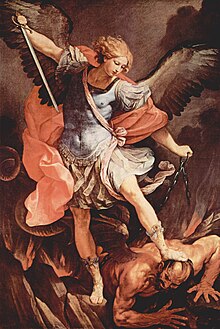
The Apparition of St. Michael the Archangel.

 
The Apparition of St. Michael the Archangel.

Saint Michael, whose name means Who is like God, is the prince of the faithful Angels; the leader of those angels who remained faithful to God following Lucifer’s revolt .We as Christians, look on Saint Michael as the guardian and protector of God’s Holy Church. In the same way that he opposed Satan in the celestial war, he is now ranked against him here on earth as Satan is the sworn enemy of the Church.

A number of apparitions of Saint Michael have been recorded., for instance, we are told that he made a dramatic appearance over the mausoleum of Emperor Hadrian( r 117-138) in Rome, in answer to an appeal during an outbreak of plaque. The plaque stopped and ever since, the mausoleum has been called the castel Sant’Angelo in his honor.

Another apparition is that which occurred to Saint Ausbert, bishop of Avranches in France. led to the construction of Mont-Saint-Michel in the sea, a famous site of pilgrimage.

The apparition of Saint Michael, that we are celebrating today, commemorates the appearance of the Archangel to a man called Gargan in the year 492 in Southern Italy.
It so happened that one day Gargan had taken his cattle to pasture along the countryside near Mount Gargano. For no apparent reason, one of the bulls bolted off and hid in a cave on the mountain. To try and scare it out of the cave, an arrow was shot into the cave but it boomeranged and wounded the archer!
Following this extraordinary occurrence, the people went to consult the bishop of the region. He ordered three days of fasting and prayers. After three days, the Archangel Saint Michael appeared to the bishop. He explained that the cave where the bull had taken refuge was under his protection, and that God wanted it to be consecrated under his name and in honor of all the Holy Angels.
This was duly accomplished.

Today’s feast day was thus instituted by the Church in honor of Saint Michael the Archangel, to thank God for His goodness for availing to us his protection.

Saint Michael the Archangel,
defend us in battle.
Be our protection against the wickedness and snares of the devil.
May God rebuke him, we humbly pray;
and do Thou, O Prince of the Heavenly Host -
by the Divine Power of God -
cast into hell, satan and all the evil spirits,
who roam throughout the world seeking the ruin of souls.
Amen.

I smiled when I read the following about Saint Michael from SQPN:

“Born
Code:
* wasn’t
Died
* hasn’t":)
 
9 May

Today is the Feast day of
Saint Gregory of Nazianzus
Among many other Saints.
 
Saint Gregory of Nazianzus
The Younger,
Doctor of the Church


Gregory is one of the saints we have come to know who are “born in a family of saints. ( Remember Saint Basil ? )

He was born at Arianzus, in Asia Minor, present day Turkey. in 325(? 330) He was one of three children born to Saint Gregory the Elder, Bishop of Nazianzus , and Saint Nonna, a daughter of Christian parents. Saint Caesarius was his brother and Saint Gorgonia his sister, a family of saints.

Gregory first studied at Caesarea in Cappadocia where he met and became firm friends with Saint Basil. Later he went to study in Caesarea in Palestine, to Alexandria in Egypt and finally to the highly esteemed University of Athens in Greece where he studied Law and other subjects. At Athens Gregory and Basil, who had parted at Caesarea, met again, and renewed their earlier friendship.

After completing his studies, Gregory returned home to Nanziazus.
On returning home, both he and his friend Basil decided to devote their lives completely to the service of God as hermits. In 362, however, Gregory’s father insisted on ordaining him to priesthood and did so practically against his will. Gregory then wrote a thesis on the priestly office whch became an inspiration to countlass others.

He was named the Bishop of Sasima in 372, but he remained at Nanzianzus to assist his now aged father.

The city of Constantinople ( Now Istanbul) had for many years been the stronghold of the Arian heresy. In 379, the few remaining faithful Catholics, invited Saint Gregory there to go and spearhead the fight against Arianism.

“After much hesitation he gave his consent, proceeded to Constantinople early in the year 379, and began his mission in a private house which he describes as “the new Shiloh where the Ark was fixed”, and as "an Anastasia, the scene of the resurrection of the faith ". Not only the faithful Catholics, but many heretics gathered in the humble chapel of the Anastasia, attracted by Gregory’s sanctity, learning and eloquence; and it was in this chapel that he delivered the five wonderful discourses on the faith of Nicaea – unfolding the doctrine of the Trinity while safeguarding the Unity of the Godhead – which gained for him, alone of all Christian teachers except the Apostle St. John, the special title of Theologus or the Divine. He also delivered at this time the eloquent panegyrics on St. Cyprian, St. Athanasius, and the Machabees, which are among his finest oratorical works”

From Catholic on Line.

In 380, Emperor Theodosius had the Arian Patriach exiled and replaced with Gregory. After just a few months as Patriac of Constantinople, Gregory resigned and retired to his native town,

where he died in 390.
Saint Gregory of Nazianzus,
Pray for us!
 
‘I hold that the choice of a state of life is so important that it decides, for the remainder of our lives, whether our conduct shall be good or bad.’

St. Gregory Nazianzus

‘As a fish cannot swim without water, and as a bird cannot fly without air, so a Christian cannot advance a single step without Christ.’

St. Gregory Nazianzus
 
May 10

Today is the Feast day of
Saint Antoninus
Among many other saints.
 
**Saint Antoninus
Archbishop of Florence.
**

Antonius was born on 1 March 1389 at Florence in Italy. His given name was Antonius Pierozzi. He was the only child born to his parents, Nicholas Pierozzi and Thomassina.
The Pierozzi Family was prominent and of a high social standing in Florence.
The Saint was of small stature and this earned him the nickname of Little Antony by which he was known.
When Antonius was fifteen years old; he applied for admission to the Dominican Order at
Fiesole. The Superior told him that for him to be admitted, he had to learn by heart the whole of the Canon Law. We are talking here of several hundred pages of text to be memorised! The Superior never thought for a moment that he would be taken seriously, besides he only told Antonius to memorise the Canon Law to test his resolve, never imagining that in just one year, Antonius would be back.

But he came back, after spending the year in study, Antonius was able to recite the Canon Law.
So it was that Antonius was admitted to the Dominican Order at the age of sixteen. He was the very first to receive the habit for the Convent of Fiesole which was about to be constructed by Blessed John Dominic.
He was sent to Cortona with Fra Angelico and Fra Bartolommeo
to make his novitiate under Blessed Lawrence of Ripafratta. After completing his year in the novitiate, he returned to Fiesole.

Once ordained, Antonius filled several important posts in the Order. He served as superior of several Dominican monasteries and was elected provincial of the order. In 1436, he founded San Marco Convent in Florence and attended the Council of Florence-Ferrara from 1438 to 1445. In 1446, quite against his will, he was appointed archbishop of Florence. Pope Pius II also appointed him as a reformer of the Roman court.
Saint Antonius was called “ the Counselor” because of his vast knowledge of canon law. He was the author of several treatises, including the Summa Theologiae Moralis.
Saint Antonius was the beloved of his people of Florence who called him “the People’s Prelate” because of the care he gave the poor and the suffering, especially at a time when there was a series of earthquakes, famines and plaques.

Antonius died on 2 May 1459 at Florence, Italy
He was canonized on 31 May 1523 by Pope Adrian VI
He is invoked against fever

Saint Antonius,
Pray for us!
 
When Antonius was fifteen years old [he] was able to recite the Canon Law.
So it was that Antonius was admitted to the Dominican Order at the age of sixteen
. He was the very first to receive the habit for the Convent of Fiesole which was about to be constructed by Blessed John Dominic.
He was sent to Cortona with Fra Angelico and Fra Bartolommeo
to make his novitiate under Blessed Lawrence of Ripafratta. After completing his year in the novitiate, he returned to Fiesole.

Once ordained, Antonius filled several important posts in the Order.


Saint Antonius was called “ the Counselor” because of his vast knowledge of canon law. He was the author of several treatises, including the Summa Theologiae Moralis.
So Saint Antonius was intelligent and made great contributions to the Faith. This could be, for many people, a cause for great pride, or possibly a lessening in love for others. (-- I say that because with an increase in learning I tend to be that way).
But Saint Antonius was also very much concerned, I would guess MORE concerned, with loving people rather than just teaching people:
Saint Antonius was the beloved of his people of Florence who called him “the People’s Prelate” because of the care he gave the poor and the suffering, especially at a time when there was a series of earthquakes, famines and plaques.
Antonius died on 2 May 1459 at Florence, Italy
He was canonized on 31 May 1523 by Pope Adrian VI
He is invoked against fever
Saint Antonius,
Pray for us!
Saint Antonius,
Pray for us!
 
Status
Not open for further replies.
Back
Top