
Server lifting the celebrant's dalmatic during incensing and elevations?

  • Thread starter Thread starter EphelDuath
  • Start date Start date
Status
Not open for further replies.
E

EphelDuath

Guest
Hello all, I was wondering if you could tell me about the origin and symbolism behind the alter server (or subdeacon or deacon?) lifting up the backside of the celebrant’s dalmatic while he is incensing the Gospel and offerings, and while he is elevating the Host and Chalice? I can’t seem to find anything about it in writing. Perhaps there’s a term for it that I’m unaware of.
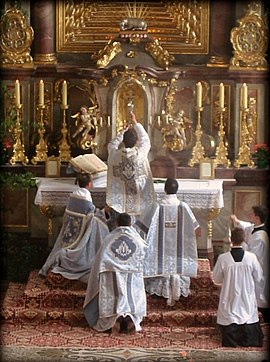


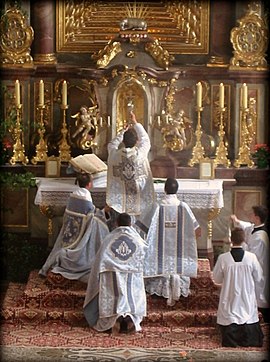

 
Hello all, I was wondering if you could tell me about the origin and symbolism behind the alter server (or subdeacon or deacon?) lifting up the backside of the celebrant’s dalmatic while he is incensing the Gospel and offerings, and while he is elevating the Host and Chalice? I can’t seem to find anything about it in writing. Perhaps there’s a term for it that I’m unaware of.

http://upload.wikimedia.org/wikiped...entina_002.jpg/270px-Missa_tridentina_002.jpg

http://upload.wikimedia.org/wikiped...jpg/220px-Messe_mit_Wandlungskerze_Beuron.jpg

http://upload.wikimedia.org/wikiped...right.jpg/348px-Simone_Martini_044_bright.jpg
I think it is simply a relic of the time when Priests wore very heavy brocaded Gothic chasubles (like in the last two pictures). They literally had difficulty lifting their arms for the elevations without help supporting the weight of the chasubles.

It really makes little sense with the “Fiddle backs” normally worn for the EF.

God Bless
 
I think it is simply a relic of the time when Priests wore very heavy brocaded Gothic chasubles (like in the last two pictures). They literally had difficulty lifting their arms for the elevations without help supporting the weight of the chasubles.

It really makes little sense with the “Fiddle backs” normally worn for the EF.

God Bless
And further, in those days there was a rubric forbidding the priest to have his arms bared in the Mass, so heavy chasubles that draped over the arms (of the conical variety) would pull back the sleeves of the alb and cassock/habit, hence the lift by the deacon or the acolyte.

-ACEGC
 
Well, first things first, it’s not a dalmatic, it’s called a chasuble, the dalmatic is worn by the deacons.

The lifting, has to do with the fact that prior to the roman style"fiddlebacks" chasubles, most chasubles draped over the arms of the celebrant as well, so it would make sense to have the other ministers help by lifiting the chasuble at the elevation. As far as I can tell there is no theological symbolism that became attached to it over the years. As someone mentioned the fiddlebacks being sleeveless don’t really need the help, but since all styles of chasubles may be worn at the EF, it’s good the the rubric is still there in case if the celebrant decided to use a heavy gothic stye chasuble.
 
Well, first things first, it’s not a dalmatic, it’s called a chasuble, the dalmatic is worn by the deacons.

The lifting, has to do with the fact that prior to the roman style"fiddlebacks" chasubles, most chasubles draped over the arms of the celebrant as well, so it would make sense to have the other ministers help by lifiting the chasuble at the elevation. As far as I can tell there is no theological symbolism that became attached to it over the years. As someone mentioned the fiddlebacks being sleeveless don’t really need the help, but since all styles of chasubles may be worn at the EF, it’s good the the rubric is still there in case if the celebrant decided to use a heavy gothic stye chasuble.
There is a Church in our city that celebrates the Traditional Latin Mass. I have gone there a couple times and noticed that when the priest would elevate the host there would be someone that lifted the back of his vestment. I wondered what that was about. Thanks!🙂
 
Status
Not open for further replies.
Back
Top