Seven deadly sins

  • Thread starter Thread starter Crown_of_Stars
  • Start date Start date
Status
Not open for further replies.
C

Crown_of_Stars

Guest
I know what they are, of course, but are they classified as “mortal” or “venial”? I’ve always thought “deadly” meant death of the soul, which is mortal. I know, also, that for any of these seven sins to be mortal, they need the three things which make them mortal. But aside from that, are they called “deadly” because, for the most part, it means they are mortal?
 
The Catholic Church maintains that seven vices in particular lead to breaking one or more of the Ten Commandments. These particular bad habits are called the seven deadly sins because, according to Catholicism, they’re mortal sins — sins that kill the life of sanctifying grace.
 
I’ve heard that most of them are mortal, but (I think) they are called deadly because they lead to other sins. I am not sure about gluttony or pride. Overeating a little is usually a venial sin, but when it affects others, like eating too much and you can’t pay the bills or when you stuff yourself and you deny your children food when they are starving, it becomes grave matter. I know Pride is the most serious sin, but I am not sure if it could be a mortal sin or not.
 
My SD explained they are not exactly “sins” but “sinful tendencies.” They are the character traits that give us the basis we need to fall into certain types of sin.

Like it isn’t a sin to be an “angry person” but it is a sin to behave angrily during an “angry state.” I say that though I don’t know if Fr. Barron or my old SD would have worded it that way. But it would seem to make sense kind of like it’s not a sin to have SSA, until it’s acted upon.

I took a really interesting class on it, designed by Fr. Robert Barron, that used the mountain Purgatorio, from Dante’s writings.

The mountain has certain sins in certain categories, as they go up. Really it was fascinating.

Here’s the diagram of the mountain:
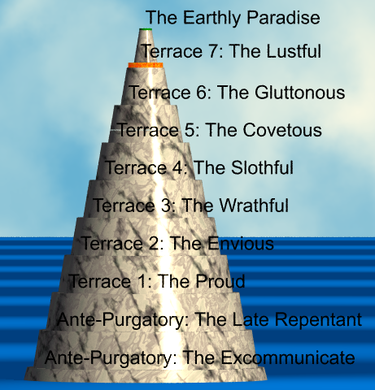

Note that the first three terraces are “perverted love,” which are directed toward actual harm of others. Pride, Envy, Anger.

The next one illustrates “deficient love,” which is: Sloth

The top three are from “excessive (or disordered) love,” Covetousness, Gluttony, and Lust.

To me, the funny thing is that ones with pride and anger (whereas pride is at the root of all the other vices) love to make public condemnation of those whose sins are at the “top” of the mountain. 😛

MS
 
I’ve heard that most of them are mortal, but (I think) they are called deadly because they lead to other sins. I am not sure about gluttony or pride. Overeating a little is usually a venial sin, but when it affects others, like eating too much and you can’t pay the bills or when you stuff yourself and you deny your children food when they are starving, it becomes grave matter. I know Pride is the most serious sin, but I am not sure if it could be a mortal sin or not.
Overeating “a little” is not gluttony. Gluttony, by definition is eating to excess, to the detriment of your health, and with greedy, obsessive actions.

Pride also, in the case of deadly sins is one of excessive pride. Being too proud to do the right thing, not pride in an accomplishment or a child.

The sin committed by satan is envy. He was envious of humans, envious of Jesus, and indeed envy draws us near to bad behavior on so many levels. Vanity contributes to this as well.
 
Great responses so far.

What we now know as the seven deadly sins came in part from the observations of the Desert Fathers of the 3rd and 4th century, especially Evagrius of Pontus. He compiled what he observed as the eight thoughts which can lead to sin, and wrote a treatise, Antirrhetikos (Talking Back), using passages of Sacred Scripture to combat and respond to these eight thoughts.

His list included: Gluttony, Fornication, Love of Money, Sadness, Anger, Listlessness, Vainglory and Pride. These eight were refined and combined into our seven deadly sins

According to Evagrius: ** “For us the entire struggle will take place through the thoughts that approach us from each of these eight demons. But I have written and quoted for each of the thoughts an answer from the Holy Scriptures that is able to cut it off.”**
 
Status
Not open for further replies.
Back
Top
