Shape of the universe

  • Thread starter Thread starter billcu1
  • Start date Start date
Status
Not open for further replies.
I stand corrected.
As to the dimension of a circle, from mathworld.wolfram.com/Dimension.html
See why/how selective quoting is wrong:
The dimension of an object is a topological measure of the size of its covering properties. Roughly speaking, it is the number of coordinates needed to specify a point on the object. For example, a rectangle is two-dimensional, while a cube is three-dimensional. The dimension of an object is sometimes also called its “dimensionality.”

A circle requires two dimensions: x & y or r & theta or & rho & phi, depending on your coordinate choice (and there are many more coordinate systems to choose from: hyperbolic, parabolic, elliptic, bipolar, and so on). The surface of a circle, i.e. a 1-sphere, requires only a single dimension, the angle theta or phi, to define a unique point (again, within the range 0 to tau).
If you are familiar with the general theory of gravity, gravity is an effect of the warping of a 3D space into a 4th dimension. If you look at the world dynamically, you get a space-time of 4 dimensions, warped into a 5th dimension to produce gravity.
I am well aware of the theory of general relativity that you are incorrectly referring to as ‘general theory of gravity,’ hence my ability to inform you of your errors. Gravity is not an effect of ‘warping 3D space into a 4th dimension;’ it is an effect of the warped space-time manifold (warped due to mass) in all four dimensions and it does not produce a random fifth dimension.
Note also that general relativity was designed to eliminate gravity from the field equations by considering the geometry of the four dimensions
 
A circle requires two dimensions: x & y or r & theta or & rho & phi, depending on your coordinate choice (and there are many more coordinate systems to choose from: hyperbolic, parabolic, elliptic, bipolar, and so on). The surface of a circle, i.e. a 1-sphere, requires only a single dimension, the angle theta or phi, to define a unique point (again, within the range 0 to tau).
I think we are getting closer.
a circle, i.e. a 1-sphere, requires only a single dimension
I think we are speaking of slightly different objects. You are looking at a circle embedded in a plane. I am looking at the circle alone. In my thinking, the only thing I would need to specify a point on the circle is the arc-length, or angle. In your embedding, as you say, you need R and Theta. If the circle is embedded in space, you might need X,Y,Z. (3 d circle?)
I am well aware of the theory of general relativity that you are incorrectly referring to as ‘general theory of gravity,’ hence my ability to inform you of your errors. Gravity is not an effect of ‘warping 3D space into a 4th dimension;’ it is an effect of the warped space-time manifold (warped due to mass) in all four dimensions and it does not produce a random fifth dimension.
Note also that general relativity was designed to eliminate gravity from the field equations by considering the geometry of the four dimensions
Here you have switched gears. You are looking at space as self referencing, like I was doing with the circle. Rather than space embedded in a higher dimension. So, if you are willing to forgo Euclidean space (as you must if the space is not embedded) then your 3-4D space works. If you wish to embed space in a euclidean coordinate system, higher dimensions are needed.

I believe a non-euclidean space (Like the 2-dimensional surface of the earth-latitude-longitude) can (at least locally) be embedded in a higher dimensional euclidean space (Like the surface of a 3d-spheroid we call planet earth (x,y,z as viewed from space)).

So this finally brings us to the question of a euclidean, spherical, or hyperbolic universe.

PS… since I don’t know your background, or the background of those reading this, I try to avoid jargon. Which means I cannot be technically accurate in all that I say.
 
I think we are getting closer.
I think we are speaking of slightly different objects. You are looking at a circle embedded in a plane. I am looking at the circle alone. In my thinking, the only thing I would need to specify a point on the circle is the arc-length, or angle. In your embedding, as you say, you need R and Theta. If the circle is embedded in space, you might need X,Y,Z. (3 d circle?)
The n-sphere itself is, by definition, the surface of an n+1-dimensional manifold. A circle is a 1-sphere (because you need 1 coordinate to define the surface of the circle) but is a 2D manifold (because it requires 2 coordinates to specify the exact position of the object). You are ignoring the physical reality of the all-important manifold by considering only the surface of the manifold.

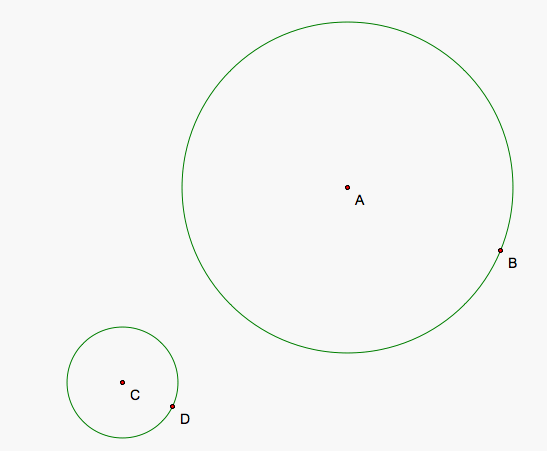
Just look at these two circles (click here if the image does not appear):

In your thinking, these circles effectively have the same radius because you are only considering the surface to be important. I believe that this is an incorrect view of reality.
Here you have switched gears. You are looking at space as self referencing, like I was doing with the circle. Rather than space embedded in a higher dimension. So, if you are willing to forgo Euclidean space (as you must if the space is not embedded) then your 3-4D space works. If you wish to embed space in a euclidean coordinate system, higher dimensions are needed.
The three-dimensional space that we exist in is “embedded” on the surface of a 4D manifold, the fourth dimension being time–as an aside, I do not think of space as “embedded” in time, more that they are a single, inseparable manifold. I can always return to the spatial position I was at at time t=t[sub]0[/sub] at some finite time later, but I can never return to time t=t[sub]0[/sub] once I t>t[sub]0[/sub], hence time being the surface of the 3-sphere we live in.

And this is true for any coordinate system you want, Cartesian, spherical, hyperbolic, etc.
I believe a non-euclidean space (Like the 2-dimensional surface of the earth-latitude-longitude) can (at least locally) be embedded in a higher dimensional euclidean space (Like the surface of a 3d-spheroid we call planet earth (x,y,z as viewed from space)).
See, now you are understanding the physical nature of what mathematics is separating (or has separated), except that it is not restricted to non-euclidean space.

Earth is a 2-sphere because we really only need the latitude and longitude to define our position–not exactly true because earth is not a perfect sphere but rather bumpy and oblate, but close enough. However, earth itself is a 3D object (independent of your frame of reference in viewing it) and we merely live on the surface of it.
So this finally brings us to the question of a euclidean, spherical, or hyperbolic universe.
WMAP showed that the curvature of space is zero with a 0.4% margin of error, indicating a Euclidean manifold.
PS… since I don’t know your background, or the background of those reading this, I try to avoid jargon. Which means I cannot be technically accurate in all that I say.
I have a PhD in astrophysics.
 
The n-sphere itself is, by definition, the surface of an n+1-dimensional manifold. A circle is a 1-sphere (because you need 1 coordinate to define the surface of the circle) but is a 2D manifold (because it requires 2 coordinates to specify the exact position of the object). You are ignoring the physical reality of the all-important manifold by considering only the surface of the manifold.
Quite right. For I do not consider the manifold as a physical reality. Only the all important object (circle). For example, we live in a locally non-euclidean space (near a star or a planet) hence gravity. So by the bending of space-time light does not travel in euclidean lines, but follows geodesics. The ‘reality’ is the 3+1 dimensional space we live in, not the higher dimensional manifold in which it is embedded.

So flatlanders (If you are familiar with the story) would live in flatland even if flatland were a sphere and not a ball (ie 2d as opposed to a 2d surface of a 3d object)
They could determine that their 2d space was embedded in a 3d space by carefully measuring triangle lengths and angles. But their reality, is flatland
Just look at these two circles (click here if the image does not appear):
http://jwilson.coe.uga.edu/EMAT6680Su06/Swanagan/Assignment7/BSAssign7apic1.gif
In your thinking, these circles effectively have the same radius because you are only considering the surface to be important. I believe that this is an incorrect view of reality.
The difference in radius can be discovered by measuring the arc length. But, as I am looking at such an object, I can never distinguish a circle from a box from an ellipse. For, by itself, topologically, there is no difference. The objects are homeomorphically identical. (forgive the jargon)
The three-dimensional space that we exist in is “embedded” on the surface of a 4D manifold, the fourth dimension being time–as an aside, I do not think of space as “embedded” in time, more that they are a single, inseparable manifold. I can always return to the spatial position I was at at time t=t[sub]0[/sub] at some finite time later, but I can never return to time t=t[sub]0[/sub] once I t>t[sub]0[/sub], hence time being the surface of the 3-sphere we live in.
I would either include time as part of the space we live in or just consider spacial dimension. That’s why I warped us into the 5th dimension. (Age of aquarius and all that)

And I don’t think we want to go the wormhole route. So what you say here, agreed.
And this is true for any coordinate system you want, Cartesian, spherical, hyperbolic, etc.

See, now you are understanding the physical nature of what mathematics is separating (or has separated), except that it is not restricted to non-euclidean space.

Earth is a 2-sphere because we really only need the latitude and longitude to define our position–not exactly true because earth is not a perfect sphere but rather bumpy and oblate, but close enough. However, earth itself is a 3D object (independent of your frame of reference in viewing it) and we merely live on the surface of it.

WMAP showed that the curvature of space is zero with a 0.4% margin of error, indicating a Euclidean manifold.
Cool. So the Cosmological Constant may be zero! Of course, locally (especially near black holes) it’s far far far from Euclidean.

By the way, math does not usually describe physical objects, it only aproximates them. So you may sometimes be conflating math and physics.
I have a PhD in astrophysics.
Congratulations. Must love math AND science. I just went with math, didn’t want to take a biology class (required for physics majors). PhD… Applied Math…
 
Alberti and Evan, I’m just a lowly psychology professor trying to follow this fascinating dialogue you’re having. Although I was required to take statistics courses for psychology, both math and physics are my betes noires.
 
Quite right. For I do not consider the manifold as a physical reality. Only the all important object (circle). For example, we live in a locally non-euclidean space (near a star or a planet) hence gravity. So by the bending of space-time light does not travel in euclidean lines, but follows geodesics. The ‘reality’ is the 3+1 dimensional space we live in, not the higher dimensional manifold in which it is embedded.
The 3+1 dimensional space we live in is the 4D manifold. There is no higher dimension that we live in (unless you buy into string theory that posits 7, 11, or 23 dimensions, most of which are dimensions of energy and not space or time).
So flatlanders (If you are familiar with the story) would live in flatland even if flatland were a sphere and not a ball (ie 2d as opposed to a 2d surface of a 3d object)
They could determine that their 2d space was embedded in a 3d space by carefully measuring triangle lengths and angles. But their reality, is flatland
I have never read the short story, but I am aware of it.
The difference in radius can be discovered by measuring the arc length. But, as I am looking at such an object, I can never distinguish a circle from a box from an ellipse. For, by itself, topologically, there is no difference. The objects are homeomorphically identical. (forgive the jargon)
While they may be homeomorphically identical, they are definitely different objects! And, though I understand the technical jargon, it sounds like crazy talk to say that there is no difference between the three shapes. This why I argue that the manifold is more important than the surface of the manifold.
I would either include time as part of the space we live in or just consider spacial dimension. That’s why I warped us into the 5th dimension. (Age of aquarius and all that)
And I don’t think we want to go the wormhole route. So what you say here, agreed.
And here is why you are wrong: I can move around to different spatial coordinates all I want and I can always return to the original starting spatial coordinates. However, I can never return to the time I once was. This is why I keep saying that time is the surface of the 4D manifold so that we live on a 3-sphere.

Wormholes are not much more than science fiction. Sure it exists as an asymptotic solution to the Schwartzschild metric, but it requires negative energy which is a physical impossibility–and not negative in the sense that the potential difference between two reference points can be negative, truly negative in the sense that E=mc^2 is negative. Scalar values cannot be negative in reality, only as an idea on a piece of paper or in someone’s brain.
Cool. So the Cosmological Constant may be zero! Of course, locally (especially near black holes) it’s far far far from Euclidean.
Well, not exactly. “The” cosmological constant, Lambda, that most people talk about is the one due to energy and is usually described by the parameter Omega[sub]Lambda[/sub] = Lambda / rho[sub]crit[/sub] (the ratio of the energy density due to Lambda and the critical energy density of the universe) where rho[sub]crit[/sub]=3H[sup]2[/sup]/(8piG) with H the Hubble constant and G the gravitational constant; this value of Omega[sub]Lambda[/sub] is 0.73.

If the curvature is zero, then the cosmological constant due to curvature, designated by Omega[sub]k[/sub], is actually 1.
By the way, math does not usually describe physical objects, it only aproximates them. So you may sometimes be conflating math and physics.
Physics describes reality and utilizes mathematics to relate quantities. Mathematics just finds new ways to describe numbers. If mathematicians had any notion of physical reality, they would be physicists :p:D
Congratulations. Must love math AND science. I just went with math, didn’t want to take a biology class (required for physics majors). PhD… Applied Math…
My undergrad university required physics majors to take “another lab science,” which was either biology or chemistry. I opted for chemistry because I did not like biology when I had it in HS. I did get a Math minor, though I sometimes wish I had gone for a Comp Sci minor instead as most of what I do as a physicist is programming; my number theory & topology courses have proven to be of no use to me now. Even my Advanced Diff Eq course was a joke, though I was expecting to really need that one; I learned only one thing in the 16 week course: if I have a point inside a circle, I can draw another circle that encloses the point and does not overlap with the first circle.

 
I recently read about the universe and did a elementary study of Hawking and the big bang theory. I viewed Prometheus for the 3rd time and decided to research the likelihood of the existence of alien life forms.

I was shocked at the sheer size of the universe, 90B light years or so. There are a billion galaxies or more even. It does seem that we’re alone in the universe as the nearest galaxy is too many light years away. This is sad because we’ll only visit it in the unlikely event that we create a space craft that can travel through wormholes.

I have trouble believing the big bang theory as I do not understand how the universe could have been created from a big bang alone. What came before the BB? Hawking says God could not have existed before the BB because time didn’t exist. I do not believe this. I don’t see how the BB could have happened with out a God. He did seem to leave room open for the existence of a God, but saying that he didn’t violate the rules of nature. But how does hawking know what God does?
 
I will try my best…

I personally dislike the name 3-sphere because it can lead people to the wrong conclusion. A 3-sphere is a four-dimensional object and should be called a 4-sphere, but since mathematicians are mathematicians, they consider only the unit radius and thus reduce the dimensionality by one.
Thank for your clarification of the 3-sphere.

Could you elaborate a bit more on the Poincare conjecture? Why is it a conjecture? What specifically is Poincare getting at?
 
And I understand that the Poincare conjecture is no longer a conjecture. It’s been proven by Perelman. But what does all this mean - for mathematics and for cosmology?

I don’t hope to understand Ricci flows but is it possible to step down the voltage here - and allow us perhaps a peek?
 
Thank for your clarification of the 3-sphere.

Could you elaborate a bit more on the Poincare conjecture? Why is it a conjecture? What specifically is Poincare getting at?
The Poincare conjecture is a hypothesis that says that every closed 3-manifold (a 3D object) is homeomorphic (has the same topology) to a 3-sphere. It was called a conjecture for the last 100 years or so, and probably will continue to be called a conjecture even though it is solved.

I have no answer as to what Poincare was getting at in asking the problem.
And I understand that the Poincare conjecture is no longer a conjecture. It’s been proven by Perelman. But what does all this mean - for mathematics and for cosmology?

I don’t hope to understand Ricci flows but is it possible to step down the voltage here - and allow us perhaps a peek?
I do know it means that there is one less Millennium Prize to be awarded (though Perelman declined the prize). As to specifics for the different fields, I cannot tell you. Sorry 😊
 
The Poincare conjecture is a hypothesis that says that every closed 3-manifold (a 3D object) is homeomorphic (has the same topology) to a 3-sphere. It was called a conjecture for the last 100 years or so, and probably will continue to be called a conjecture even though it is solved.
Thanks for the info.

If every closed 3-manifold is homeomorphic to a 3-sphere, then this might, as I understand it, be relevant to a discussion of the shape of our universe.

I’ve heard there’s a nice book by Donal O’Shea on the Poincare Conjecture that addresses this issue.
 
Status
Not open for further replies.
Back
Top