
Should we replace Reconciliation Rooms with confessionals?

  • Thread starter Thread starter phil19034
  • Start date Start date
Status
Not open for further replies.
P

phil19034

Guest
Should parishes without confessionals consider bringing them back and removing the reconciliation room?

Reason: confessionals can be built where there is no physical access between confessor and confessee. They are basically in different rooms.

For people who prefer face to face, a sliding door could be created to allow for that and seats plus kneelers could be installed for people who cannot kneel.

My thought is that it places the confessional back in the “open” and could protect priests from false sexual assault accusations and young people from any remaining predatory priests.

Thoughts?
 
Should parishes without confessionals consider bringing them back and removing the reconciliation room?

Reason: confessionals can be built where there is no physical access between confessor and confessee. They are basically in different rooms.

For people who prefer face to face, a sliding door could be created to allow for that and seats plus kneelers could be installed for people who cannot kneel.

My thought is that it places the confessional back in the “open” and could protect priests from false sexual assault accusations and young people from any remaining predatory priests.

Thoughts?
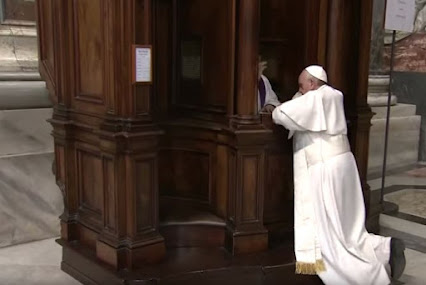
I like the Confessionals that I’ve seen in Rome, such as this one where the Holy Father went to Confession. It would allow for the option of face-to-face or behind the screen, while maintaining some physical barrier. After all, this is why confessionals were designed - not to give anonymity. I think this style could be modified to include a seat.

This is definitely better than some glass-walled Reconciliation Rooms that I’ve seen pictures of.

Some might object that there is a lack of privacy with this style confessionals, and I suppose that there is a point if you have become used to a certain amount of complete privacy, but in the Byzantine Church we confess out in the open. We just learn to keep our voices down, and others learn to discretely move to the back of the Church.

 
Most of the confession rooms I’ve seen have had glass doors and/or large glass windows so that the penitent, whether kneeling or sitting, is visible from the outside. In these cases, I’m not sure an old-fashioned confessional would offer any more protection in the scenarios you listed.

Personally, I don’t have a preference as long as I have the opportunity to confess face to face. For some reason, I just feel more comfortable when I can see my confessor.
 
Some might object that there is a lack of privacy with this style confessionals, and I suppose that there is a point if you have become used to a certain amount of complete privacy, but in the Byzantine Church we confess out in the open. We just learn to keep our voices down, and others learn to discretely move to the back of the Church.
I vividly recall two instances of that: one was in St Alexander Nevsky Cathedral in Sofia in 1981 and the other in a tiny Serbian Orthodox church in Ctinje (Montenegro) some years later. In both instances people (including visitors) were in the churches, and all stayed discreetly away from the priest and penitent.
 
I read somewhere that it (used to be) a pious custom for the faithful to cover an ear while passing by the confessional - regardless of whether or not it was occupied or they could actually hear anything. A good custom to bring back.
 
Just buy a decorative room divider. Done.
At our Church we have 2 chairs for face to face confessions then a small divider (like the one you listed above) with a kneeler on the other side if you want to confess behind a screen. It works just fine.
 
Just buy a decorative room divider. Done.

overstock.com/Worldstock-Fair-Trade/Decorative-Screens/Fabric,/material,/6642/subcat.html

A couple of dollars and problem solved. Why go through the cost of construction? Give the money to St Vincent de Paul instead.

-Tim-
a decorative room divider doesn’t protect a priest from a false sexual assault claim, nor does it protect a young child or teen from a predatory priest (if there is one still around a parish)

My point of using the physical confessional is that it not only allows the confessee to use the screen or face to face; but it also can protect both the priest and young child.

Parishes have youth protection in place where no child can be alone with anyone… the reconciliation room seems to be the only potential place that would violate that.

NOTE: I’m NOT implying that I do not trust our priests. But I do think it might be a prudent thing to do to protect both our priests and kids.

Plus: I have heard of people who do not take their children to confession, nor encourage it, due to the Reconciliation Rooms at their parish. They don’t like the idea of their kid being in room alone with a priest (no matter how much they might respect their priest). Most don’t want to take the chance, even if there is less than a 1% chance of something happening. So, I’m wondering if the confessionals (with the option to open the screen for people who like face to face) come back, would confessions increase (especially among the young)?

Thoughts?
 
My thoughts are that the people who don’t take their kids to confession don’t go often themselves. Just an excuse on their part, and the result is that their children don’t grow close to the sacraments.
 
At our Church we have 2 chairs for face to face confessions then a small divider (like the one you listed above) with a kneeler on the other side if you want to confess behind a screen. It works just fine.
We just built a partial wall with a grille. Only the priest’s feet can be seen from the open door. You walk in and either kneel at the grille for an anonymous confession or go past the wall and sit facing Father. The door is solid although putting in a glass panel has been discussed.

Personally, I’d rather a confessional like they had when I was growing up. Father’s section was closet-like with a door; the penitent’s sections on either side were curtained for privacy. I don’t particularly care if people see me going to confession but I think having the physical barrier between penitent and confessor just makes the most sense in this day and age. Most of the churches I visited in Europe had confessionals where the penitent was in full view but physically separated from the confessor who was sometimes visible and sometimes fully enclosed.

Some priests are resistant to the idea. In a diocesan meeting when this topic was being discussed, the idea of installing reconciliation rooms with glass doors to meet “safety” issues was proposed. I brought up confessionals as a means of both safety and anonymity and one priest said he couldn’t properly counsel and absolve someone unless it was face to face. Bishop didn’t disagree with him. So much for the canon law requirement that confessionals with fixed grilles be available.
 
Just an observation…I visit several parishes within my area, and find that the parishes with the " old style confessional boxes" almost always have a line of penitents waiting to go to confession and the more modern reconciliation rooms don’t.
 
Just an observation…I visit several parishes within my area, and find that the parishes with the " old style confessional boxes" almost always have a line of penitents waiting to go to confession and the more modern reconciliation rooms don’t.
👍
 
While I accept the points that the OP is making with regard to the more traditional style confessional being essentially two rooms, I also agree with others who have said that this doesn’t necessarily mean that there will be less accusations of “misconduct” against priests. Most reconciliation rooms now appear to have a glass door, which makes the interaction between confessor and penitent quite visible, while being reasonably sound-proof.

However, my preference is for the more traditional style confessional. My experience of reconciliation rooms - while I do use them from time to time - is that they can become counselling rooms rather than confessionals. I am not saying that this is inevitable (or, for that matter, that people don’t sometimes use traditional confessionals for counselling), but I have seen people going in to these rooms for a “friendly chat” with the priest, while a long queue forms outside! Perhaps if there are clear parameters set - i.e. that these rooms are for the sacrament of confession primarily - they can retain their dignity as “reconciliation rooms”; but, given the option, I will always choose the traditional confessional.
 
My experience of reconciliation rooms - while I do use them from time to time - is that they can become counselling rooms rather than confessionals. I am not saying that this is inevitable (or, for that matter, that people don’t sometimes use traditional confessionals for counselling), but I have seen people going in to these rooms for a “friendly chat” with the priest, while a long queue forms outside!
My pastor must tend to agree with you. One of our confessionals is a two room affair (more room and glass doored closet). There is a penitent side with a kneeler and grill and then the priest’s side that has two chairs incase one wants to do face to face confession. During Lent, Father has a sign on the priest’s side that says something like:

“Due to the high number of penitents, Father is not available for face to face confessions. Please use the Penitent’s side of the confessional.”

He has also mentioned in the past that if someone needs spiritual counseling to make an appointment with him or the parochial vicar rather than seeking prolonged counseling in the confessional. This is in contrast to a priest at a previous parish that always did confessions in the “cry room” and would start each confessions saying “what did you want to tell Jesus today”.

It is unavoidable that some confessions will take longer, but I do think that face to face tends to encourage more of an extended dialog that is not a required part of the sacrament.
 
I read somewhere that it (used to be) a pious custom for the faithful to cover an ear while passing by the confessional - regardless of whether or not it was occupied or they could actually hear anything. A good custom to bring back.
Probably wouldn’t be a bad custom to bring back. I know our reconciliation rooms that have glass insets in the doors are not always sound proof. I remember one time being in line and a I did not move forward after the two penitents before me has already gone in. A kind older lady told me that I could move forward, but I told her that where I was I could almost hear what people said so I needed to stay back to protect the previous people’s privacy.
 
Just an observation…I visit several parishes within my area, and find that the parishes with the " old style confessional boxes" almost always have a line of penitents waiting to go to confession and the more modern reconciliation rooms don’t.
I’ve noticed that two
 
Our parish has old style confessionals, but they are more modern in structure. Completely soundproof, well lit, priest and penitent separated by a grille with sliding door on the priest’s side and with curtain on both sides. Neither can see the other. No windows, thankfully; I don’t like windows in confessionals. Priest and penitent are effectively in separate rooms. There is a chair for those who would like to sit instead of kneel. Face to face is theoretically possible if both priest and penitent independently slide their curtains back, but no one does that. The confessions are essentially anonymous. And yes, we usually have a line.
 
In my experience queues for confession are linked to times when people are available - so lunchtime works better in an inner city parish than a suburban one.

Returning to the topic, privacy is about more than just not being able to be overheard; the sacrament of reconciliation is a deeply personal and intimate experience and so it’s understandable IMHO that people would prefer to use booths / “traditional” confessionals rather than a glass fronted room. To put it another way, there’s a reason why hospital beds have curtains. However, I also think that it’s important to respect and preserve the penitent’s right to chose how they wish to receive the sacrament - that is, face to face or screened. I think that the best way to achieve both of these is to utilise traditional booths, but with a window of opaque glass in them - one side for face to face and the other for scenned with the priest in between.
 
Status
Not open for further replies.
Back
Top