Shroud of Turin?

  • Thread starter Thread starter Just_One_Touch
  • Start date Start date
Status
Not open for further replies.
That is a ridiculous comment to make. You are stating the Shroud is proven as true while not even the Church has declared that. Interesting that you know better than the Church. There is no evidence to show the Shroud is the burial cloth of Christ. In fact there is plenty of evidence to show it is not. It was made using a camera obscura in the Middle Ages.
While the shroud has not been proven, neither is it disproven.

The camera obscura is a tool used by painters, and even critics admit that there is no paint or residue thereof on the shroud.

ICXC NIKA
 
That is a ridiculous comment to make. You are stating the Shroud is proven as true while not even the Church has declared that. Interesting that you know better than the Church. There is no evidence to show the Shroud is the burial cloth of Christ. In fact there is plenty of evidence to show it is not. It was made using a camera obscura in the Middle Ages.
And you’re stating that the Shroud is proven false when there is still a lot of unresolved questions. 😉
 
And you’re stating that the Shroud is proven false when there is still a lot of unresolved questions. 😉
You didn’t read my wording carefully. I neither said it was true nor false.
I’m saying the weight of evidence is in favour of it being a hoax.

To the other poster please watch the documentary on the Shroud where it is demonstrated how to make the Shroud using a camera obscura and only materials available in the middle ages. Paint was not used.
 
You didn’t read my wording carefully. I neither said it was true nor false.
I’m saying the weight of evidence is in favour of it being a hoax.
Okay, like?
To the other poster please watch the documentary on the Shroud where it is demonstrated how to make the Shroud using a camera obscura and only materials available in the middle ages. Paint was not used.
Now you’ve got me curious. Which documentary was it?
 
To the other poster please watch the documentary on the Shroud where it is demonstrated how to make the Shroud using a camera obscura and only materials available in the middle ages. Paint was not used.
While the Shroud’s image is photographic, it would be impossible for it to have been made with a camera obscura. If the photographer used a model, that would mean he made a perfectly anatomically correct cast or model and also just splashed on blood, even though the bloodstains on the Shroud are exactly the same as they would be in real life. If he used a body, how would he stop it from decaying and stop the rigor mortis from wearing off? And why didn’t anybody notice its presence?
 
Of possible interest: the book, “Relics” by Joan Carroll Cruz.

She discusses the shroud and the nails.
 
Okay, what we can say about the Shroud by now is that:

1.) It is a rectangular piece of cloth, measuring approximately 4.4 × 1.1 m (14.3 × 3.7 ft), woven in a three-to-one herringbone twill composed of flax fibrils.

2.) Its most distinctive characteristic is the faint, yellowish image of a front and back view of a naked man with his hands folded across his groin. The two views are aligned along the midplane of the body and point in opposite directions. The front and back views of the head nearly meet at the middle of the cloth.

3.) It bears what looks reddish brown stains that are said to be blood. In addition to this, serum stains - invisible to the naked eye - have also been reported to be visible under ultraviolet photography. The blood on the Shroud purportedly showed a serum separation, visible as a lighter ring around a darker center.

4.) A very thin (180-600 nanometers thick, is thinner than most bacteria), clear polysaccharide residue coats the outermost-topmost fibers of the cloth. In places, that residue has changed into a caramel-like substance. And it is the brownish-yellowish color, here and there, that makes up the image we see. The images reside on sections of fibers that are at the surface or within one or two fibers deep from the surface: the image is actually thus very fragile.

5.) By contrast, there is no image below the ‘blood’ stains, which might suggest that the stains were formed before the image. We know this because there is no image under the stains: these acted to inhibit the image formation mechanism.

6.) A second, faint face has been purportedly found at the back of the cloth in 2006. Like the image at the front, the back image is thin and superficial - unlike the blood.

7.) Some factors of the Shroud is also being investigated, such as its three-dimensional properties and whatnot.

Well, I won’t repeat the Shroud’s undisputed history but just link here.
 
Ok, I apologize for saying that the Shroud is true. But there is a lot of evidence that it could be!
  1. Mark on the side. There is proof of water only running from this mark.
  2. 3-D. The image of the shroud posesses 3-D qualities, which couldn’t be forged.
  3. Blood. Probably obvious.
As for the wrist theory, I had never seen that page linked by patrick, so yes, my theory is proven false.
 
Ok, I apologize for saying that the Shroud is true. But there is a lot of evidence that it could be!
  1. Mark on the side. There is proof of water only running from this mark.
  2. 3-D. The image of the shroud posesses 3-D qualities, which couldn’t be forged.
  3. Blood. Probably obvious.
As for the wrist theory, I had never seen that page linked by patrick, so yes, my theory is proven false.
You first have to get past the dating problem. The tests conducted so far only date it to the Middle Ages. Okay so we get people saying the bits tested must have been corrputed by fire or whatever. The bottom line is that the cloth is not dated to the time of Christ.
By the way the 3-D qualities are producted using the camera obscura.

The point I am making is that you should not be so loose with the word “proof”. There is no proof its authentic. From all the books I have read about the Shroud and the documentaries on it I have not read or seen anything that convinces me it is genuine. Let’s get past the dating problem then we might have something to talk about.
 
That is a ridiculous comment to make. You are stating the Shroud is proven as true while not even the Church has declared that. Interesting that you know better than the Church. There is no evidence to show the Shroud is the burial cloth of Christ. In fact there is plenty of evidence to show it is not. It was made using a camera obscura in the Middle Ages.
It was made using a camera obscura in the Middle Ages? Source for this?

Here is Pope John Paul II writing about the Holy Shroud.

vatican.va/holy_father/john_paul_ii/travels/documents/hf_jp-ii_spe_24051998_sindone_en.html

Peace,
Ed
 
You first have to get past the dating problem. The tests conducted so far only date it to the Middle Ages. Okay so we get people saying the bits tested must have been corrputed by fire or whatever. The bottom line is that the cloth is not dated to the time of Christ.
By the way the 3-D qualities are producted using the camera obscura.

The point I am making is that you should not be so loose with the word “proof”. There is no proof its authentic. From all the books I have read about the Shroud and the documentaries on it I have not read or seen anything that convinces me it is genuine. Let’s get past the dating problem then we might have something to talk about.
Aren’t more tests either underway or upcoming in the future?
 
Aren’t more tests either underway or upcoming in the future?
There is a “push” for new testing but no date as far as I know has been set.

Just a bit on authenticity: No alternative “duplication” of the Shroud has successfully reproduced all of the Shroud’s anomalies, i.e., its photographic negativity, its three-dimensionality, its micro-fibre staining. Individual traits have been duplicated, but not every single anomaly. Until that happens, it cannot be honestly said that the Shroud has been successfully duplicated. This does not make the Shroud “authentic”, whatever that may mean, but it does show that the Shroud’s image production is still unknown.

Even if the Shroud is totally duplicated, that would only show that in one particular set of conditions, the cloth image can be reproduced. It would not mean that we have identified the actual method or methods that produced the original image.

New testing is required for the simple reason that the last test was botched. Sloppy science is sloppy science. The inventor of the TAMS test himself protested the shoddiness of the test conditions. And now it has been found that the piece of cloth tested was not even original to the Shroud, and had been exposed to contamination. Of course, image-bearing portions of the cloth have not been tested because cutting such a sample would be to “desecrate” a purportedly holy object. Therefore, relying on the last test as a deciding factor is unsound.

See the following on this subject:

factsplusfacts.com/
 
There are a few arguments that further carbon testing would be impossible due to repairs.
 
You first have to get past the dating problem. The tests conducted so far only date it to the Middle Ages. Okay so we get people saying the bits tested must have been corrputed by fire or whatever. The bottom line is that the cloth is not dated to the time of Christ.
Have you considered the possibility of the C-14 sample being taken from an ‘anomalous’ area of the cloth?
By the way the 3-D qualities are producted using the camera obscura.
Again, like?
 
You must have a couple hundred of these in the Vatican basement. Dust them off and cut/paste.
Oh yeah, I think they’re in that gigantic supercomputer just beside the folder that lists the names of each and every Protestant in the whole world. Hey, Jack T. Chick said that it exists. 😃 :rolleyes:
 
Have you considered the possibility of the C-14 sample being taken from an ‘anomalous’ area of the cloth?

Again, like?
I don’t understand the comment “Again, like”.

As for the dating, the testing which has been done dates the cloth only to the Middle Ages.
It is simply speculation for anyone to suggest the piece of cloth was somehow “anomalous” and corrupted the dating test. Anything is possible. However the outcry about corrupt testing seems to come from anyone who wants to believe the Shroud is genuine and they cannot accept a test showing its not old enough. The cloth tested may well have been a good sample and gave a correct dating.
What we do know is that the tests done so far date the cloth to the Middle Ages.
As a Catholic I don’t care if the Shroud is genuine or not. It has no bearing on my faith.
 
You first have to get past the dating problem. The tests conducted so far only date it to the Middle Ages. Okay so we get people saying the bits tested must have been corrputed by fire or whatever. The bottom line is that the cloth is not dated to the time of Christ.
By the way the 3-D qualities are producted using the camera obscura.

The point I am making is that you should not be so loose with the word “proof”. There is no proof its authentic. From all the books I have read about the Shroud and the documentaries on it I have not read or seen anything that convinces me it is genuine. Let’s get past the dating problem then we might have something to talk about.
But there are problems with the dating. Radio carbon dating dates it to the middle ages but radiocarbon dating can’t explain why there are pollen grains on the shroud of plants that grew in the Palestine area in the first century. Then there is the whole radio carbon dating debate as to whether it is indeed as accurate as some want to believe. It makes some basic assumptions which may or may not be true. Then there is the possible addition of carbon elements due to the fire that the shroud was exposed to which could affect the dating results. Also there are questions as to whether the part tested was part of the original shroud or part of the repair work done in the middle ages. So the jury, I’m afraid, is still out as far as the shroud’s authenticity. One thing that has not been addressed though is that the image on the shroud is fading. How does this affect the various theories of how the image was made? I haven’t seen this aspect discussed anywhere.


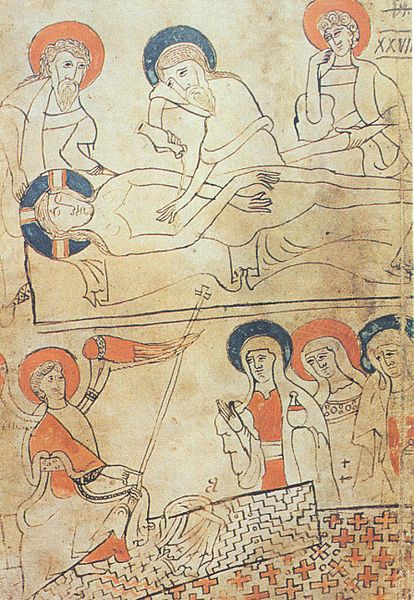
The Pray Codex is a collection of medieval manuscripts originally discovered by Hungarian Jesuit historian György Pray in 1770, and later named after him. It is the first known example of continuous prose text in Hungarian. The codex is kept in the National Széchényi Library of Budapest.

One of the most prominent documents within the codex is the Funeral Sermon and Prayer (Hungarian: Halotti beszéd és könyörgés), an old handwritten Hungarian text dating to 1192-1195. Its importance of the Funeral Sermon comes from that it is the oldest surviving Hungarian, and Finno-Ugric text. Aside from this the Codex also features a missal, an Easter mystery play, songs with musical notation, laws from the time of Coloman of Hungary (1074-1116) and the annals, which list the Hungarian kings. There are five illustrations contained within this codex. One of these (above) depict the burial of Jesus and the women discovering the empty tomb.

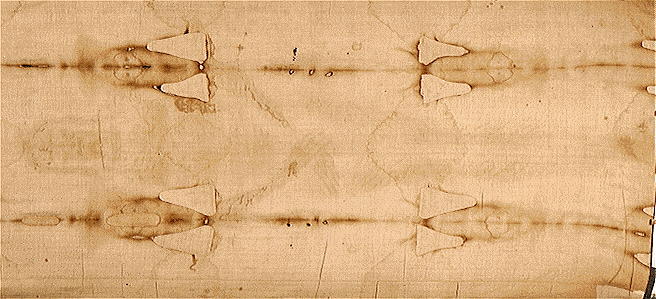
The official results of the 1988 C-14 tests gave a date of AD 1260-1390 with 95% confidence. Judging from the Funeral Sermon, the Pray Codex itself can be dated from around the late 12th century at the earliest (somewhere between 1192-1195). If the illustration on the codex is reliable evidence for the Shroud - which proponents say it is - this pushes its existence at least 70 or so years before the earliest possible date the C-14 gives (AD 1260).


http://img24.imageshack.us/img24/605/codexc.jpg

http://img535.imageshack.us/img535/8939/dorsalp.jpg
 
Roman Catholic Doctrine Vs. The Doctrinal Teaching of the Word of God

Eternal life is a merited reward [1821, 2010]. - Roman Catholicism
Eternal life is the free gift of God (Romans 6:23)

No one can know if he will attain eternal life [1036, 2005] - Roman Catholicism
The believer can know that he has eternal life by the Word of God (1 John 5:13)

The Roman Catholic Church is necessary for salvation [846]. - Roman Catholicism
There is salvation in no one but the Lord Jesus Christ, “for there is no other name under heaven that has been given among men, by which we must be saved” (Acts 4:12)

Purgatory is necessary to atone for sin and clean the soul [1030-1031]. - Roman Catholicism
Purgatory does not exist. Jesus made purification for sins on the cross (Hebrews 1:3)

Mary was preserved from all stain of original sin from the first instant of her conception (the doctrine of the Immaculate Conception) [490-492].
Mary, a descendant of Adam, was born in sin (Psalm 51:5; Romans 5:12)

Mary is the Mother of the Church [963, 975]. - Roman Catholicism
Mary was the earthly mother of Jesus ( John 2:1)

The Magisterium is the authoritative teacher of the Church. [85-87]. - Roman Catholicism
The Holy Spirit is the authoritative teacher of the church (John 14:26; John 16:13, I John 2:27)

The pope, as the Bishop of Rome, is the successor of Peter [882, 936] - Roman Catholicism
Peter had no successor, nor was he a pope.

The pope is infallible in his authoritative teaching [891]. - Roman Catholicism
God alone is infallible (Numbers 23:19)

Scripture and Tradition together are the Word of God [81, 85, 97, 182]. - Roman Catholicism
Scripture is the Word of God (John 10:35, 2 Timothy 3:15-17, 2 Peter 1:20-21). Tradition is the words of men (Mark 7:1-13).

The sacrificial work of redemption is continually carried out through the Sacrifice of the Mass. [1364,1405, 1846]. - Roman Catholicism
The sacrificial work of redemption was finished when Christ gave His life for us on the cross (Ephesians 1:7, Hebrews 1:3).

God desires that consecrated bread and wine be worshiped as divine. [1378-1381] - Roman Catholicism
God forbids the worship of any object, even t hose intended to represent Him (Exodus 20:4-5, Isaiah 42:8)

Justification is lost through mortal sin [1033, 1855, 1874] - Roman Catholicism
Justification cannot be lost. Those whom God justifies will be saved from the wrath of God (Romans 5:8-9).

Justification is furthered by sacraments and good works [1212, 1392, 2010] - Roman Catholicism
Justification is the imputation of the perfect righteousness of God (2 Corinthians 5:21). In Christ the believer has been made complete (Colossians 2:10).

Salvation is attained by cooperating with grace through faith, good works, and participation in the sacraments [183, 1129, 1815, 2002]. - Roman Catholicism
Salvation is attained by grace through faith apart from works (Ephesians 2:8-9). Good works are the result, not the cause, of salvation (Ephesians 2:10).

Mary, “the All-Holy,” lived a perfectly sinless life [411, 493]. - Roman Catholicism
Mary was a sinner; God alone is sinless (Luke 18:19, Romans 3:23, Revelation 15:4).

Mary was a virgin before, during, and after the birth of Christ [496-511]. - Roman Catholicism
Mary remained a virgin until after the birth of Jesus (Matthew 1:25). Later she had other children (Matthew 13:55-56, Psalm 69:8).

Each Sacrifice of the Mass appeases God’s wrath against sin [1371, 1414]. - Roman Catholicism
The once-for-all sacrifice of the cross fully appeased God’s wrath against sin. (Hebrews 10:12-18).

The Bishops, with the Pope, as their head, rule the universal church. [883, 894-896]. - Roman Catholicism
Christ, the head of the body is the Head of the Church. (Colossians 1:18).

The faithful receive the benefits of the cross in fullest measure through the Sacrifice of the Mass [1366, 1407]. - Roman Catholicism
Believers receive the benefits of the cross in fullest measure in Christ through faith (Ephesians 1:3-14).

God has exalted Mary in heavenly glory as Queen of Heaven and Earth [966]. She is to be praised with special devotion [971, 2675]. - Roman Catholicism
The name of the Lord is to be praised, for He alone is exalted above heaven and earth (Psalm 148:13). God commands, “You shall have no other gods before Me.” (Exodus 20:3).

Mary is the co-mediator to whom we can entrust all our cares and petitions 9 968-970, 2677] - Roman Catholicism
Christ Jesus is the one mediator to whom we can entrust all our cares and petitions (1 Timothy 2:5, John 14:13-14, 1 Peter 5:7).

Mary is the co-redeemer, for she participate with Christ in the painful act of redemption [618, 964, 968, 970]. - Roman Catholicism
Christ alone is the Redeemer, for He alone suffered and died for sin (1 Peter 1:18-19).

The sacrifice of the cross is perpetuated in the Sacrifice of the Mass [1323, 1382] - Roman Catholicism
The Sacrifice of the cross is finished (John 19:30).

Indulgences dispensed by the Church for acts of piety release sinners from temporal punishment [1471-1473]. - Roman Catholicism
Jesus releases believers from their sins by His blood. (Revelation 1:5).

The Magisterium has the right to define truth found only obscurely or implicitly in revelation. [66, 88, 2035, 2051]. - Roman Catholicism
No one has the right to go beyond what is written in Scripture (1 Corinthians 4:6, Proverbs 30:5-6).

Scripture and Tradition together are the Church’s supreme role of faith [80, 82]. - Roman Catholicism
Scripture is the church’s rule of faith (Mark 7:7-13, 2 Timothy 3:16-17).

 
Status
Not open for further replies.
Back
Top