Shroud of Turin?

  • Thread starter Thread starter Just_One_Touch
  • Start date Start date
Status
Not open for further replies.
There is also an analysis of the weave of the cloth which places it in 1st century Palestine.

That is from two sources, which may or may not be on-line. Need to check that out, but will make a note here.

There are other indicators as well that place it in 1st Century Palestine.

C-14 dating is subject to many different factors that can cause the dating process to become corrupted. One example: the cloth was badly mishandled over the centuries. And there is “finger grease” along the edges. Another factor is the “sampling location” … where in the cloth that the samples were taken from is important; edge location versus fold location versus mid-fabric location. You don’t want to damage the image in any way, but at the same time you don’t want to do a C-14 test of fabric contaminated with newer bits that were introduced centuries after the cloth was made. Not all locations will test the same.
 
I don’t understand the comment “Again, like”.

As for the dating, the testing which has been done dates the cloth only to the Middle Ages.
It is simply speculation for anyone to suggest the piece of cloth was somehow “anomalous” and corrupted the dating test. Anything is possible. However the outcry about corrupt testing seems to come from anyone who wants to believe the Shroud is genuine and they cannot accept a test showing its not old enough. The cloth tested may well have been a good sample and gave a correct dating.
What we do know is that the tests done so far date the cloth to the Middle Ages.
As a Catholic I don’t care if the Shroud is genuine or not. It has no bearing on my faith.
“The cloth tested may well have been a correct sample”.

The sample testing was by no means “a good sample”. That’s documented.

“The cloth tested may well have been a correct sample”… may well have been? That’s not good science, and it is plainly contradicted by the fact of sloppy test conditions.

The testing itself was condemned by the inventor of the test, especially regarding the number of testing laboratories, which was significantly cut.

Nor is it “speculation” that the cloth itself is anomalous. You didn’t read what I said. I called the cloth itself anomalous. I did not call the **tested piece ** anomalous. I said that it was a skewed sample, not from the main cloth, and exposed to contaminants.

That any criticism of the test conditions is a purely subjective objection from those who are so weak minded that they “need” to believe in the cloth’s authenticity is itself speculation, as well as a form of lazy uncharity.

Anyone interested can find out how the test and the test sample were skewed, along with much other information at:

factsplusfacts.com/
 
“The cloth tested may well have been a correct sample”.

The sample testing was by no means “a good sample”. That’s documented.

“The cloth tested may well have been a correct sample”… may well have been? That’s not good science, and it is plainly contradicted by the fact of sloppy test conditions.

The testing itself was condemned by the inventor of the test, especially regarding the number of testing laboratories, which was significantly cut.

Nor is it “speculation” that the cloth itself is anomalous. You didn’t read what I said. I called the cloth itself anomalous. I did not call the **tested piece ** anomalous. I said that it was a skewed sample, not from the main cloth, and exposed to contaminants.

That any criticism of the test conditions is a purely subjective objection from those who are so weak minded that they “need” to believe in the cloth’s authenticity is itself speculation, as well as a form of lazy uncharity.

Anyone interested can find out how the test and the test sample were skewed, along with much other information at:

factsplusfacts.com/
Seems you are squirming and are one of these people who will not believe anything that might suggest the Shroud is not authentic.
The weight of evidence is more in favour of it being hoax than it being real.
Unless it can be dated to the time of Christ then its a waste of time discussing other issues relating to it.

As I said earlier it should anyway not have an impact on a person’s faith. Sacred Scripture, Sacred Tradition and The Magesterium provide EVERYTHING required for a Catholic to be complete and the way to be saved.
Anyone desperate for the Shroud to be authentic is in a pretty weak and shakey way with their faith.
 
Seems you are squirming and are one of these people who will not believe anything that might suggest the Shroud is not authentic.
The weight of evidence is more in favour of it being hoax than it being real.
Unless it can be dated to the time of Christ then its a waste of time discussing other issues relating to it.

As I said earlier it should anyway not have an impact on a person’s faith. Sacred Scripture, Sacred Tradition and The Magesterium provide EVERYTHING required for a Catholic to be complete and the way to be saved.
Anyone desperate for the Shroud to be authentic is in a pretty weak and shakey way with their faith.
I disagree. I think the scientific community is now convinced that the sample used for the radio carbon dating was not representative of the original cloth. Discounting this element the remaining evidence points to a cloth of the first century. However, what cannot be proven is whether this is the burial shroud of Jesus. All we can say is that the image is of a man who shows the evidence of wounds consistant with crucifixion. The problem is that the Romans crucified a lot of men in Palestine in the first century to include Jesus. Which one of these men is the image on the cloth?

One more thing here. I don’t recall anyone saying that it is necessary for the shroud to be authentic for their faith to be strong. That statement is a red herring and I think an apology is in order.
 
Seems you are squirming and are one of these people who will not believe anything that might suggest the Shroud is not authentic.
The weight of evidence is more in favour of it being hoax than it being real.
Unless it can be dated to the time of Christ then its a waste of time discussing other issues relating to it.

As I said earlier it should anyway not have an impact on a person’s faith. Sacred Scripture, Sacred Tradition and The Magesterium provide EVERYTHING required for a Catholic to be complete and the way to be saved.
Anyone desperate for the Shroud to be authentic is in a pretty weak and shakey way with their faith.
Seems you are squirming and are one of these people who will not believe anything that might suggest the Shroud is authentic.

Your avoidance of the issue is plain, as you have obviously not researched the topic well enough to realize that the carbon testing was skewed.

Moreover, you have offered nothing but repetitious opinion, whereas I have explained why the testing was skewed and have at least twice posted a link to a url in which these matters are exactingly examined.

“Anyone desperate for the Shroud to be authentic is in a pretty weak and shakey way with their faith”.

No one here, including me, is “desperate” for Shroud authenticity. Quite the contrary. It’s simply a matter of facts: the fact that the Shroud as a whole is anomalous, that no attempted reproduction of the Shroud has ever duplicated all of its attributes, that the carbon testing was botched. No faith issues are involved here, and your suggestion that those who disagree with you are shakey and weak is just another example of your scandal-mongering rudeness, as well as your lazy attempt to avoid the requisite research. It’s all really simply just a matter of facts - facts which in your own desperation, you are afraid to confront.
 
The C-14 dating is corrupted.

The shroud went through a fire in the Middle Ages, and the Poor Clare nuns did repairs on the cloth. They dyed the cloth with the root of some plant to make it look like the rest of the shroud. Another thing on authenticity:

I remember seeing something called the “Hymn of the Pearl” that has a line that translates like this:

Suddenly,
I saw my image on my [burial] garment
like in a mirror

Myself and myself through myself
[or myself facing outward and inward]

As though divided, yet one likeness

Two images
but one likeness of the King of kings]

The hymn was written around the 500s.
 
I’ve noticed that the nail holes on the man pictured on the shroud are in his wrists. This comes in conflict with John 19:36, which states, “not a bone of him shall be broken.” If you know simple anatomy, you realize that there is no way that someone can pound nails into someone’s wrists without breaking some bones. Anybody else have any other ideas?
If I were to nail a 170 lb. person to a tree, I’d use a block of wood on a spike and set the nail in the space between the two bones (ulna & radious) on the arm.

google.com/imgres?imgurl=http://www.worsleyschool.net/science/files/skeleton/skeleton.gif&imgrefurl=http://www.worsleyschool.net/science/files/skeleton/page.html&h=550&w=417&sz=48&tbnid=BOZEcy9vXL0yRM:&tbnh=133&tbnw=101&prev=/images%3Fq%3Dskeletal%2Bbones&zoom=1&q=skeletal+bones&usg=__wayzKW9j_nYZ6JuF7nKJCfYPW_M=&sa=X&ei=pTuaTerwO8zTgQfYgdHLCA&ved=0CCMQ9QEwBQ
 
Truth or otherwise of the Shroud I cant say but what I can say is I watched a very good documentary recently which clearly demonstrated that they could not have chosed a worse site to take a sample as the place they took the sample from was an area that had been repaired in the middle ages and showed clearly how the dating came out as it did.

It was the first time the scientific community had a clear reason they could all see as possably true for the error.

but here is a link I read which was very interesting regarding the various blood stains; from a late 20th century pathologist studies on the image. Decide for yourself

crucifixion-shroud.com/experimental_studies_in_crucifix.htm

do not read the forensic and clinical knowledge of the practice of crucifixtion unless you have a poor imagination or a weak sense of empathy.

😦
 
… demonstrated that they could not have chosed a worse site to take a sample as the place they took the sample from was an area that had been repaired in the middle ages and showed clearly how the dating came out as it did.
I’ve seen those reports as well.

Specialists in ancient fibers have said that the carbon dated pieces came from an attachment that was healed (glued) into the original Shroud.

The spliced together end piece fiber strands are an almost undetectable repair.

shroudstory.com/faq/turin-shroud-faq-05.htm
Al Adler had found large amounts of aluminum in yarn segments from the radiocarbon sample, up to 2%, by energy-dispersive x-ray analysis.
I found that the radiocarbon sample was uniquely coated with a plant gum (probably gum Arabic), a hydrous aluminum oxide mordant (the aluminum found by Adler), and Madder root dye (alizarin and purpurin).
Nothing similar exists on any other part of the Shroud.
The photomicrograph shows several fibers from the center of the radiocarbon sample in water. The gum is swelling and slowly detaching from the fibers. Many red alizarin/mordant lakes can be seen, and yellow dye is in solution in the gum. Several cotton fibers are visible, a situation unique to the Raes and radiocarbon samples.
The radiocarbon sampling area had been dyed to match the old part of the cloth. The sample chosen for dating was totally invalid for determining the true age of the Shroud.
 
I remember seeing something called the “Hymn of the Pearl” that has a line that translates like this:
The Hymn of the Pearl is a passage of the apocryphal work Acts of Thomas, presented in that work as a hymn Thomas recites while praying for himself and fellow prisoners. Some scholars believe the hymn antedates the Acts, as it only appears in one Syriac manuscript and one Greek manuscript of the Acts of Thomas. The hymn, as it comes down to us, has a rather Gnostic tone according to some experts - there is a theory that the author may have been the 2nd-century Syriac Gnostic Bardaisan (Bardesanes) or someone connected to him due to some parallels between his life and that of the hymn, though there is no exact agreement as to what tradition, gnostic or otherwise, produced this hymn.

Some supporters of the Shroud’s authenticity do connect the image and the hymn because of certain enigmatic lines found in the poem.

To summarize, the hymn tells the story of a boy, son of “the king of kings” and “the mistress of the East,” who is sent to Egypt to retrieve a pearl guarded a “loud-breathing serpent.” Before leaving, the parents take off his royal robes from him, with a bargain that he would wear them again and be heir in the kingdom along with his brother, the crown prince, should he succeed in his mission. With a burden precious yet light, he makes off for Egypt and established himself in the neighborhood of the serpent. During the quest, he is seduced by the Egyptians - who noted that he was not their countryman - and as a consequence, forgets his origin, his family and his mission.

His parents perceived what had befallen him, and a letter is then sent to remind him of his past. When the boy receives the letter, he remembers his mission, retrieves the pearl - he puts the serpent to sleep by naming the names of his father, brother and mother like a sort of trinitarian formula - and returns back triumphant to his father’s kingdom. When the boy is finally near his home, his parents send him the royal robes which he cast off upon embarking his mission:

And my bright robe, which I had stripped off,
and the toga that was wrapped with it,

from Rantha and Reken(?)
my parents had sent thither

by the hand of their treasurers,
who in their truth could be trusted therewith.

And because I remembered not its fashion,–
for in my childhood I had left it in my father’s house,–

on a sudden, when I received it,
the garment seemed to me to become like a mirror of myself.

I saw it all in all,
and I to received all in it,

for we were two in distinction
and yet gain one in one likeness.

And the treasurers too,
who brought it to me, I saw in like manner

to be two (and yet) one likeness,
for one sign of the king was written on them (both),

of the hands of him who restored to me through them
my trust and my wealth,

my decorated robe, which
was adorned with glorious colors,

with gold and beryls
and rubies and agates

and sardonyxes, varied in color.
And it was skillfully worked in its home on high,

and with diamond clasps
were all its seams fastened;

and the image of the king of kings
was embroidered and depicted in full all over it,

and like the stone of the sapphire too
its hues were varied.

And I saw also that all over it
the instincts of knowledge were working,

and I saw too that it was preparing to speak.

I heard the sound of its tones,
which it uttered with its…, (saying):

"I am the active in deeds,
whom they reared for him before my father;

and I perceived myself,
that my stature grew according to his labors.
"

And in its kingly movements
it poured itself entirely over me,

and on the hand of its givers
it hastened that I might take it.

And love urged me too run
to meet it and receive it;

and I stretched forth and took it.
With the beauty of its colors I adorned myself,

and I wrapped myself wholly in my toga
of brilliant hues.

I clothed myself with it, and went up to the gate
of salutation and prostration;

I bowed my head and worshipped the majesty
of my father who sent me,–

for I had done his commandments,
and he too had done what he promised,–

and the gate of his…,
I mingled with his princes,

for he rejoiced in me and received me,
and I was with him in his kingdom,

and with the voice of…
all his servants praised him.

And he promised that to the gate too
of the king of kings with him I should go,

and with my offering and my pearl
with him should present myself to our king.

 
The C-14 dating is corrupted.

The shroud went through a fire in the Middle Ages, and the Poor Clare nuns did repairs on the cloth. They dyed the cloth with the root of some plant to make it look like the rest of the shroud. Another thing on authenticity:

I remember seeing something called the “Hymn of the Pearl” that has a line that translates like this:

Suddenly,
I saw my image on my [burial] garment
like in a mirror

Myself and myself through myself
[or myself facing outward and inward]

As though divided, yet one likeness

Two images
but one likeness of the King of kings]

The hymn was written around the 500s.
Thank you AB99, it’s a nice poem (and I don’t usually do poems).

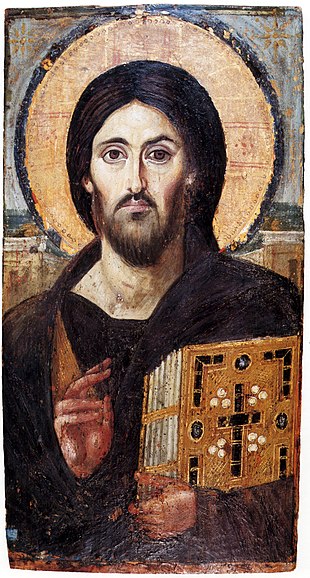
As long as we’re doing early references, what about the Christus Pantocrator? (Do a web search; I’ve no web page from which to post pix else I’d do it).

This is an icon painted around 600, located near Athens, of the face of our LORD.

The face matches the face from the shroud at more than 300 data points.

God Bless and ICXC NIKA.
 
Thank you AB99, it’s a nice poem (and I don’t usually do poems).

As long as we’re doing early references, what about the Christus Pantocrator? (Do a web search; I’ve no web page from which to post pix else I’d do it).

This is an icon painted around 600, located near Athens, of the face of our LORD.

The face matches the face from the shroud at more than 300 data points.

God Bless and ICXC NIKA.
That was an icon of the Pantocrator, one of the earliest surviving icons and one of the oldest known icons of this genre, in encaustic on panel in the 6th or 7th century AD. It survived the period of destruction of images during the Iconoclastic disputes by being preserved in the remote desert of the Sinai, in Saint Catherine’s Monastery, where it can still be found today. The gessoed panel, finely painted using a wax medium on a wooden panel, had been coarsely overpainted around the face and hands at some time around the thirteenth century. It was only when the overpainting was cleaned in 1962 that the ancient image was revealed to be a very high quality icon, probably produced in Constantinople.


A French Shroud scholar named Paul Vignon purportedly identified a number of common characteristics visible in many early artistic pictures of Jesus which he proposes traces their origins to the Shroud (most especially in Eastern iconography), dubbed the Vignon Markings.
 
Its irrelevant what anyone says. The bottom line is that the tests to date show the cloth only dates to the Middle Ages. Until that is overcome nothing else matters.

I also agree with one of the posters who said that the Shroud anyway can NEVER be proven to be the burial cloth of Christ.
The best that could ever be proven is that the cloth dates to the time of Christ. Beyond that it is simply down to believing its the burial cloth of Christ or not.
 
Its irrelevant what anyone says. The bottom line is that the tests to date show the cloth only dates to the Middle Ages. Until that is overcome nothing else matters.

I also agree with one of the posters who said that the Shroud anyway can NEVER be proven to be the burial cloth of Christ.
The best that could ever be proven is that the cloth dates to the time of Christ. Beyond that it is simply down to believing its the burial cloth of Christ or not.
No it is not irrelevant. It would be irrelevant if I said it or if someother “layman” had said it but when you have acknowledged experts saying it and they are backing up what they are saying with hard evidence then it is very relevant. And while science itself could never tell us if this was indeed the burial cloth of Jesus then the fact that it has been revered for centuries as the actual cloth carries weight. That does not mean we should base our faith on it but it is a relic and should be treated and respected as such.
 
Last night I watched the current Shroud of Turin program on EWTN.

I’m a rather firm believer in the Bethlehem Star dating of Jesus death on April 3, 33. I also knew that the Shroud has the outlines of flowers on the cloth and I began wondering how on April 3, there would be so many blooming flowers available. (I live in Nebraska and we don’t have many available flowerings on plants in April / May).

Temperatures today in Israel on April 5, 2011 are in the 60s. weather.noaa.gov/weather/current/LLBG.html

Yearly weather pattern temperatures in Jerusalem are here:
inisrael.com/tour/weather/index.html

I also found this interesting information concerning three types of flowers on the Shroud.
Recently Professor Avinoam Danin, botany expert at the Hebrew University of Jerusalem, publicized the findings of his studies on specific traces of pollen found on the Shroud.
As the author of “Botany of the Shroud - History of Floral Images on the Shroud of Turin”, he explains that hundreds of plant images are imprinted on the fabric of the Shroud. These images help to determine where and when those flowers were placed on the cloth.

Danin particularly focused his attention on three plants: the Zigofillum dumosum, a desert plant found mainly in Israel, Sinai and Jordan, the Sistus creticus, and the Gundel turneforti.
And he concluded that “the area where the three fresh plants chosen as indicators could be collected and placed on the Shroud next to the body of a crucified man can only be one place in the world, that of the area between Jerusalem and Hebron.”
As for the flowering time, he notes that “March and April are the months of the year when dozens of the plants identified on the Shroud are flowering”.
The research that Professor Danin put forth demonstrated that it was those fresh flowers that bloom and live only in these places that were placed on the Shroud, and confirm the specific use of that time and area for the custom of placing flowers on the bodies of the dead.
This botanical data, added to the many other conclusions of scientific research, helps to confirm the authenticity of the sacred shroud that wrapped the body of Jesus of Nazareth, who was crucified, died and was buried in this city of Jerusalem.
 
sciencedaily.com/releases/1999/08/990803073154.htm
Another plant seen in a clear image on the Shroud is of the Zygophyllum dumosum species, according to the paper. This is a native plant with an unusual leaf morphology, displaying paired leaflets on the ends of leaf petiole of the current year during the beginning of winter.
Gundelia tournefortii and Zygophyllum dumosum coexist in a limited area, according to Danin, a leading authority on plants of Israel. The area is bounded by lines linking Jerusalem and Hebron in Israel and Madaba and Karak in Jordan. The area is anchored toward the Jerusalem-Hebron zone with the addition of a third species, Cistus creticus, identified as being placed on the Shroud through an analysis of pollen and floral imaging.
“This combination of flowers can be found in only one region of the world,” Danin stated. “The evidence clearly points to a floral grouping from the area surrounding Jerusalem.”
Danin stated that the evidence revealing these species on the Shroud suggests that they were placed with the body prior to the process that caused the formation of images on the cloth. According to Danin, his findings corroborate the following sequence of events:
  • Laying the body on the linen;
  • Placing flowering plants and other objects along with the body;
  • Folding the cloth over the body;
  • Initiation of the process that caused the formation of the images.
Images of Capparis aegyptia flowers, which display a distinctive pattern during daylight hours, have also been seen on the Shroud. The process of buds opening ceases when the flowers are picked and no water is supplied. The images of these flowers on the Shroud suggest they were picked in the Judean Desert or the Dead Sea Valley between 3 and 4 p.m. on the day they were placed on the Shroud.
The images of the flowers on the Shroud are also depicted in art of the early centuries, according to the upcoming publication. Early icons on some 7th century coins portray a number of flower images that accurately match floral images seen on the Shroud today, according to PIOT analysis by the Whangers. The researchers suggest that the faint images on the Shroud were probably clearer in earlier centuries.
Botanical investigation of the Shroud began with Max Frei’s 1973 observations of pollen grains on the Shroud, which he sampled by means of sticky tape. Frei took a second set of 27 sticky tape samples from the Shroud during the scientific study in 1978. In 1979 he took 46 sticky tape samples from the Sudarium of Oviedo. In 1983 faint floral images on the Shroud linen were noted by O. Scheuermann, and subsequently in 1985 by the Whangers. Botanist Avinoam Danin began collaborating with Shroud researchers Alan and Mary Whanger in 1995. They were joined by Israeli pollen expert Uri Baruch in 1998. Frei’s Shroud botanical collections were acquired in 1994 by the Council for Study of the Shroud of Turin (CSST) and became the resource for this study which analyzed 313 pollen grains.
 
No it is not irrelevant. It would be irrelevant if I said it or if someother “layman” had said it but when you have acknowledged experts saying it and they are backing up what they are saying with hard evidence then it is very relevant. And while science itself could never tell us if this was indeed the burial cloth of Jesus then the fact that it has been revered for centuries as the actual cloth carries weight. That does not mean we should base our faith on it but it is a relic and should be treated and respected as such.
How is it a relic? Be careful what you say. It is not proven to be anything and the Church has neither said it is genuine nor said it is a relic.
 
I’ve noticed that the nail holes on the man pictured on the shroud are in his wrists. This comes in conflict with John 19:36, which states, “not a bone of him shall be broken.” If you know simple anatomy, you realize that there is no way that someone can pound nails into someone’s wrists without breaking some bones. Anybody else have any other ideas?
You must remember too, the Romans were very good at peforming crucifixions. They did not invent it,but only perfected it and knew exactly how to position one and where to drive the nails.
 
You must remember too, the Romans were very good at peforming crucifixions. They did not invent it,but only perfected it and knew exactly how to position one and where to drive the nails.
Exactly. And nails driven in the palms would tear out (apparently).
 
Status
Not open for further replies.
Back
Top