
R
raumzeitmc2
Guest
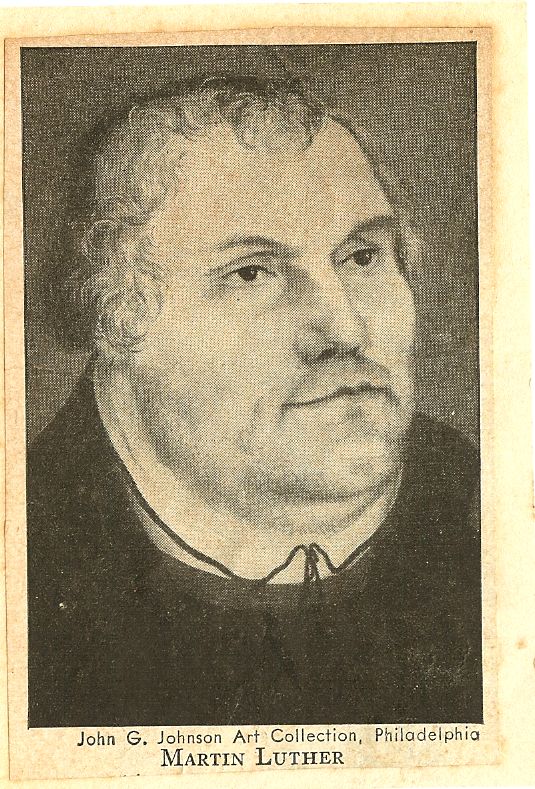
So what do you make of this?He [Heinrich Denifle] used a series of portraits in his first edition to show how the thin, ascetic scholar and monk [Luther] became obese and unattractive; the last of his portraits, he noted, was surprisingly bestial’, though the fact that it was made of the reformer after his death, and possibly after decomposition had set in, should have minimized his astonishment.” V.H.H. Green, Luther and the Reformation (New York: G.P.Putnum’s Sons, 1964) 193-195.
Martin Luther, from the John G. Johnson Art Collection, Philadelphia.
And did the reformers never distort the truth?I have a deep bias against those who distort the truth.
I don’t see how one can even begin to compare Denifle with the likes of Dave Hunt (or Jack Chick)!!I could say the same about Dave Hunt’s critique of Roman Catholicism, “A Woman Rides The Beast”: Even if he erred here and there, and even if some of his conclusions and interpretations have been rejected by some, the fact still remains that his work on Catholicism does contain a great deal of valuable information. But out of respect for Catholicism, I publically repudiate Mr. Hunt’s work as biased and flawed. It would insult Roman Catholics if I quoted it.
Here’s what I posted. As you can see, it had nothing to do with Denifle.Make up your mind, earlier you said: * “I haven’t had a chance to really look through more recent editions for the context of the quote because, well because, I only have so much time! I will however, next time I get a chance, do a bit of checking around.”* So either you did or you didn’t when you started posting Luther snippets mined from Denifle.
“I am compelled to confess it; my doctrine has produced many scandals.”
In, Charles of Europe, Dominic Bevan Wyndham Lewis, New York, Coward-McCann, 1931, p. 213.
The reference at the bottom of p. 213 gives as the source of this quote the Wittenberg edition of Luther’s Latin Works (Opera Lutheri., edit. Wittenberg), II, 281.
Omnium Operum Reverendi Domini Martini Lutheri
worldcat.org/search?q=ti%…1&qt=next_page
As I’m sure you are aware, the Wittenberg edition is the earliest edition of Luther’s Works, and is therefore quite rare. I haven’t had a chance to really look through more recent editions for the context of the quote because, well because, I only have so much time! I will however, next time I get a chance, do a bit of checking around.
The only ‘context’ I was referring to was that which was contained in my post, namely:Your quoting someone else quote Luther, while I went and read and quoted LW 39.Amazing. When I say context, I mean what Luther said in the treatise he wrote it in, along with all the other things he said in that same treatise. You apparently mean, * let’s look at Denifle.* Amazing, simply amazing.
‘The body demands a woman and has need of the same.’ p. 9
‘Chastity is not in our power. All are created for marriage. God does not permit that one be alone.’ p. 9.
“It was this teaching that good works, even at their best, are sins, and even that a just man sins in all good works.” p. 24.
"Though Luther praises virginity as a ‘rare and noble gift,’ yet, as we have earlier heard him say, nobody posses it.
“Then does the flowing ensue and the secret sin, which St. Paul, 1 Cor. 6:9, (Gal. V, 19) calls uncleanness and luxury. And, to speak out grossly, for the sake of miserable necessity, if the flowing is not into the flesh, it will be into one’s shirt (“Fließet es nicht in das Fleisch, so fließet es ins Hemd.”)” p. 123.
Then what did he mean when he said, “Chastity is not in our power. All are created for marriage. God does not permit that one be alone?”We can discuss Luther’s views of chastity another time. Luther held that genuine purity was a supernatural gift given to only a few.
As if there was no "gross immorality " among the reformers!!! But Denifle was at great pains to point out the hypocrisy, which might explain a few things…“Chasteness” during the Reformation period often was little more a monk with abstinence from marriage, while gross immorality went on anyway.

Perhaps a thread focusing strictly on the moral character of the reformers?

I’m not psychoanalyzing you; but you do seem threatened by Denifle. Yet if he’s so discredited, as you maintain, surely he would be easy enough to refute.I don’t appreciate being psychoanalyzed on a discussion board. I can spot this method of argumentation quite easily: argument weak, move on to attacking the person making the argument.
Now who’s doing the attacking? I’m not tying to shock or vilify anyone or keep them ignorant of “the real facts.”The real problem is serious Catholic scholarship has long abandoned your approach to Luther, yet you champion it. Yes, our culture loves the Jerry Springer approach: say shocking things about a person, vilify them, and keep everyone ignorant of the real facts.
Denifle is hardly my only source, but he is a source. Still, I’m happy enough to forget him for the moment.Fortunately, Catholic scholarship has moved beyond this approach, I suggest you do as well. If you need a list of respectable Catholic scholarship on Luther, I’d be happy to provide it for you.
Now earlier you mentioned Joseph Lortz. I have some comments of his regarding Luther which I’ll post next time (though you probably won’t approve of what he says either).

