
St Kliment Pope of Rome

  • Thread starter Thread starter Volodymyr
  • Start date Start date
Status
Not open for further replies.
V

Volodymyr

Guest
It may be of interest to American Catolics the fate of the Moskow Church of St. Kliment, Pope of Rome. This Church dedicated to one of first bishops of Rome was used as storehouse for Lenin Library and has only now been returned to Orthodoxy church. Now it is not been well taken care of, but will soon be. It can be a place of common veneration for Orthodox and Catolic peoples in Moskow.

(Please Note: This uploaded content is no longer available.)
 
Thanks for posting, especially the picture.

Btw, in English he’s St. Clement.
 
beautiful, when was this built?
It may be of interest to American Catolics the fate of the Moskow Church of St. Kliment, Pope of Rome. This Church dedicated to one of first bishops of Rome was used as storehouse for Lenin Library and has only now been returned to Orthodoxy church. Now it is not been well taken care of, but will soon be. It can be a place of common veneration for Orthodox and Catolic peoples in Moskow.

http://pravoslavie.ru/sas/image/100147/14744.p.jpg
 
This church of St. Clement (corrected orthographia) Pope of Rome in Moscow was built between 1762 and 1769. Architect was certain Pietro A Trezini who designed in 1742 but was absent during construction, having returned to his native country. Such temple is typical baroque architecture with cubic base and crowned with traditional five domes but more typical of churches of Leningrad/Peter.

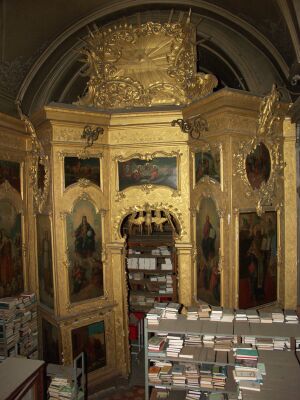
Fortunately because was used as library storage site, the five of seven ikonostas are not damaged but well preserved becaus of the temperature controls microclimate in the storage.
Two more pictures - one with book storage, and one at beginning restoration of ikonostas:


the icons are western, was these icons approved by the russian church?
This church of St. Clement (corrected orthographia) Pope of Rome in Moscow was built between 1762 and 1769. Architect was certain Pietro A Trezini who designed in 1742 but was absent during construction, having returned to his native country. Such temple is typical baroque architecture with cubic base and crowned with traditional five domes but more typical of churches of Leningrad/Peter.

Fortunately because was used as library storage site, the five of seven ikonostas are not damaged but well preserved becaus of the temperature controls microclimate in the storage.
Two more pictures - one with book storage, and one at beginning restoration of ikonostas:

http://www.rusk.ru/images/2007/6893.jpg

http://www.rusk.ru/images/2007/6892.jpg
 
The icons of these ikonostas are western, were these icons approved by the russian church?
Oh, Dear friend, I wish all ikons in churches of Holy Rus’ were of Novgorod, Pskov or Byzantine style. But beginning with Peter the Great, in particular, western so-called realism came into ikon painting and was supported by Tsars - and they had money to build churches. So there are many baroque churches with western influenced ikons. I say so-called realism because traditional ikons may have more “realism” view of holy saints in heaven. Such Western realistism is better for landscapes - where painter know what should look like. Heaven he does not really know its appearance.
 
I was thinking of asking for pictures of the inside, so you read my mind (btw, orthography is a correct word, but usually one says “corrected spelling”).

You’ll also see, besides the Western wanna-be art (Western Captivity), the “All Seeing Eye” over the Royal Doors. Along with Westernization came the Masons.
 
Oh, Dear friend, I wish all ikons in churches of Holy Rus’ were of Novgorod, Pskov or Byzantine style. But beginning with Peter the Great, in particular, western so-called realism came into ikon painting and was supported by Tsars - and they had money to build churches. So there are many baroque churches with western influenced ikons. I say so-called realism because traditional ikons may have more “realism” view of holy saints in heaven. Such Western realistism is better for landscapes - where painter know what should look like. Heaven he does not really know its appearance.
I find the mix interesting, albeit they are not true icons in their fullest sense…I have an Russian icon that is somewhat Western myself. At first, I disliked the more Western icons, but I have grown to like them a bit more. I still prefer the Byzantine style ones, though, as they preserve the true meaning of Orthodoxy…

Prayers and petitions,
Alexius:cool:
 
I was thinking of asking for pictures of the inside, so you read my mind (btw, orthography is a correct word, but usually one says “corrected spelling”).

You’ll also see, besides the Western wanna-be art (Western Captivity), the “All Seeing Eye” over the Royal Doors. Along with Westernization came the Masons.
Yes, I have also seen a few icons that incorporate the All-Seeing Eye." Would a priest still bless them?
 
i dont know what you mean, but the All Seeing Eye you are referring came to the masons, has a replica in Mt. Athos monastery

link below
sacredsites.com/europe/greece/images/AthosEye.jpg

Almisry;3125542]I was thinking of asking for pictures of the inside, so you read my mind (btw, orthography is a correct word, but usually one says “corrected spelling”).

You’ll also see, besides the Western wanna-be art (Western Captivity), the “All Seeing Eye” over the Royal Doors. Along with Westernization came the Masons.
 
I would say, they preserve the style of the Byzantine Rite and not Orthodoxy such as Western style images was also significant in miracles involving Eastern Orthodox saints.
I find the mix interesting, albeit they are not true icons in their fullest sense…I have an Russian icon that is somewhat Western myself. At first, I disliked the more Western icons, but I have grown to like them a bit more. I still prefer the Byzantine style ones, though, as they preserve the true meaning of Orthodoxy…

Prayers and petitions,
Alexius:cool:
 
i dont know what you mean, but the All Seeing Eye you are referring came to the masons…
If you look at the first picture with the bookshelf, you’ll see above the iconostasis a golden/brass color rectangular image. If you look closely at that, you’ll see the design…
 
I would say, they preserve the style of the Byzantine Rite and not Orthodoxy such as Western style images was also significant in miracles involving Eastern Orthodox saints.
Yes, you are correct. I think St. Seraphim of Sarov had a miracle occur with his Western style icon…
 
i dont know what you mean, but the All Seeing Eye you are referring came to the masons, has a replica in Mt. Athos monastery

link below
sacredsites.com/europe/greece/images/AthosEye.jpg

Almisry;3125542]I was thinking of asking for pictures of the inside, so you read my mind (btw, orthography is a correct word, but usually one says “corrected spelling”).

You’ll also see, besides the Western wanna-be art (Western Captivity), the “All Seeing Eye” over the Royal Doors. Along with Westernization came the Masons.
yes, that’s it.
 
Beautiful, and while an earlier poster made a note that the common English spelling of Kliment is Clement, I believe that was to clarify for other persons who may not realize this is the same name. There is nothing incorrect about your using different spellings of words here that are correct as you use them at your home, such as Moskow instead of Moscow. “The Church breathes with two lungs” and sometimes the lungs spell things differently.

Thank you for the pictures and the history lessons.
 
Beautiful, and while an earlier poster made a note that the common English spelling of Kliment is Clement, I believe that was to clarify for other persons who may not realize this is the same name. There is nothing incorrect about your using different spellings of words here that are correct as you use them at your home, such as Moskow instead of Moscow. “The Church breathes with two lungs” and sometimes the lungs spell things differently.

Thank you for the pictures and the history lessons.
Actually “Kliment” would be the usual transliteration of the Russian - though as noted above, the English is “Clement.” Part of the issue here is simply the use of different alphabets as well as different pronunciations. “Moscow” presents certain other issues as a transliteration of the Russian would be “Moskva” which is also the Russian pronunciation (or close enough). “Moscow” as pronounced in English is a novelty probably due to the use of “w” for “v” in several Slavic languages that use the Latin alphabet. Perhaps someone here knows the derivation of “Moscow”?
 
Here is ikon:

(Please Note: This uploaded content is no longer available.)
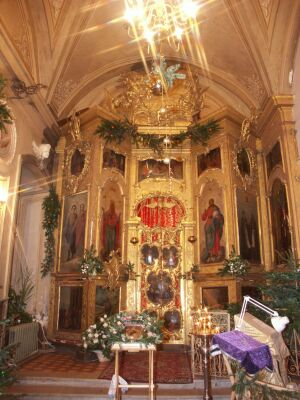
Also Moskva is uncertain etiology. May perhaps be finish, perhaps old Slavonic. Meaning is not known. If Finish - means Bear or Cow River.
 
Status
Not open for further replies.
Back
Top