Studies and Meditations on this Sundays Scripture Readings: July 21, 2013

  • Thread starter Thread starter Fidelis
  • Start date Start date
Status
Not open for further replies.
F

Fidelis

Guest
The Lord said to her in reply, “Martha, Martha, you are anxious and worried about many things. There is need of only one thing. Mary has chosen the better part and it will not be taken from her.”

To help us prepare for this coming Sunday, here are the readings, studies and reflections for this coming Sunday’s Scripture readings.** This Sunday is the 16th Sunday in Ordinary Time.
**
Here are the Scripture readings from the U.S. Catholic bishops website.

My own weekly study on the Sunday Readings can be found here at my website.

Here are three short audio reflections on the readings by Sister Ann Shields, Dr. Scott Hahn, and Fr. Robert Barron.

Scripture scholar Fr. Francis Martin’s video meditations on the Sunday Scripture readings can be found here.

The Navarre Bible Commentary for each reading can be viewed here.

Further study resources for the Readings: St. Charles Borromeo Bible Study can be found here, Catholic Matters can be found here, the Catena Aurea (“Golden Chain”) of St. Thomas Aquinas can be found here, and the Haydock Commentary can be found here.

Please consider supporting those who provide these free resources.

Discussion, questions and charitable comments are always welcome. Have a blessed week!

http://www.easterngiftshop.com/media/ecom/prodlg/MaryMartha Email.jpg
 
Navarre Bible Commentary

First Reading: From: Genesis 18:1-10a

The Apparition of God at Mamre​

[1] And the Lord appeared to him (Abraham) by the oaks of Mamre, as he sat at the door of his tent in the heat of the day. [2] He lifted up his eyes and looked, and behold, three men stood in front of him. When he saw them, he ran from the tent door to meet them and bowed himself to the earth, [3]and said, “My lord, if I have found favor in your sight, do not pass by your servant. [4] Let a little water be brought, and wash your feet, and rest yourselves under the tree, [5] while I fetch a morsel of bread, that you may refresh yourselves, and after that you may pass on–since you have come to your servant.” So they said, “Do as you have said.” [6] And Abraham hastened into the tent to Sarah, and said, "Make ready quickly three measures of fine meal, knead it, and make cakes. [7] And Abraham ran to the herd, and took a calf, tender and good and gave it to the servant, who hastened to prepare it. [8] Then he took curds, and milk, and the calf which he had prepared, and set it before them; and he stood by them under the tree
while they ate.

Isaac’s Birth is Promised​

[9] They said to him, “Where is Sarah your wife?” And he said, “She is in the tent.” [10a] The Lord said, “I will surely return to you in the spring, and Sarah your wife shall have a son.”

Commentary:

18:1-19:38. These two episodes–God’s appearance to Abraham at Mamre and the destruction of Sodom–form a single account. Once again we can see the sort of relationship that obtains between God and Abraham; this time, what is emphasized is not just the promise of a son for Sarah, but also the patriarch’s intercession on behalf of Sodom and Gomorrah. This intercession saves Lot and his family (cf. 19:29). Thus, Abraham is already a blessing for all the descendants of Lot. This narrative is quite colorful, and includes some curious little details–making it one of the most popular passages in the story of the patriarchs.

18:1-15. This new appearance of God to Abraham is somewhat mysterious: the three men stand for God. When Abraham speaks to them, sometimes he addresses them in the singular (as if there were one person there: cf. v. 3), and sometimes in the plural (as if there were three: cf. v. 4). That is why some Fathers interpreted this appearance as an early announcement of the mystery of the Holy Trinity; others, following Jewish tradition (cf. Heb 13:2) take these personages to be angels. The sacred text says that one of the three men (Yahweh, apparently) stays with Abraham (cf. v. 22), while the other two, who are referred to as angels, go to Sodom (cf. 19:1). Although the early chapters of Genesis do not expressly talk about the creation of angels, that creation can be read into the word “heavens” in Gen 1:1: “at the beginning of time, God created out of nothing both types of creatures, spiritual and corporeal, that is, angelic and earthly,” says Lateran Council IV (“De Fide Catolica”). In Holy Scripture angels are mentioned as being servants and messengers of God, and, despite the way they are sometimes described, such as in this passage, they should be understood as being purely spiritual, personal and immortal creatures, endowed with intelligence and will. “Angels have been present since creation (cf. Job 38:7, where the angels are called ‘sons of God’) and throughout the history of salvation, announcing this salvation from afar or near and serving the accomplishment of the divine plan: they closed the earthly paradise (cf. Gen 3:24); protected Lot (cf. Gen 19); saved Hagar and her child (cf. Gen 21:17); stayed Abraham’s hand (cf. Gen 22.11); communicated the law by their ministry (cf. Acts 7:53); led the people of God (cf. Ex 23:20-23); announced births (cf. Judg 13) and callings (cf. Judg 6:11-24; Is 6:6); and assisted the prophets (cf. 1 Kings 19:5), just to cite a few examples. Finally, the angel Gabriel announced the birth of the Precursor and that of Jesus himself (cf. Lk 1:11-26)” (“Catechism of the Catholic Church”, 332).

In the general context of Genesis, this episode points up the new situation created by the Covenant. God speaks to Abraham directly, as he spoke to Adam before he committed sin. Abraham, for his part, receives God through his hospitality, and God again promises that Sarah will have a son (now specifying when the child will be born). “Because Abraham believed in God and walked in his presence and in covenant with him (cf. Gen 15:6; 17:1-2), the patriarch is ready to welcome a mysterious Guest into his tent. Abraham’s remarkable hospitality at Mamre foreshadows the annunciation of the true Son of the promise (cf. Gen 18:1-15; Lk 1:26-38). After that, once God has confided his plan, Abraham’s heart is attuned to his Lord’s compassion for men and he dares to intercede for them with bold confidence (cf. Gen 18:16-33)” (ibid., 2571).

18:6. The measure mentioned here, a “seah” (pl. “seim”) is a measure of dry grain (cf. 1 Sam 25:18; 2 Kings 7:1, 16, 18) which was probably a third of an ephah, that is, about seven liters or two gallons.

18:10. “In the spring”; this could also be translated as “next year”. Literally, “the time of life”, which some interpret as “the time of a woman’s pregnancy”, that is, nine months.
 
Navarre Bible Commentary

Second Reading: From: Colossians 1:24—2:3

St. Paul’s Response to His Calling​

[24] Now I (Paul) rejoice in my sufferings for your sake, and in my flesh I complete what is lacking in Christ’s afflictions for the sake of His body, that is, the Church, [25] of which I became a minister according to the divine office which was given to me for you, to make the word of God fully known, [26] the mystery hidden for ages and generations but now made manifest to His saints. [27] To them God chose to make known how great among the Gentiles are the riches of the glory of this mystery, which is Christ in you, the hope of glory. [28] Him we proclaim, warning every man and teaching every man in all wisdom, that we may present every man mature in Christ.

Commentary:
  1. Jesus Christ our Lord perfectly accomplished the work the Father gave Him to do (cf. John 17:4); as He said Himself when He was about to die, “It is finished”, it is accomplished (John 19:30).
From the point onwards objective redemption is an accomplished fact. All men have been saved by the redemptive death of Christ. However, St. Paul says that he completes in his flesh “what is lacking in Christ’s afflictions”; what does he mean by this? The most common explanation of this statement is summarized by St. Alphonsus as follows: “Can it be that Christ’s passion alone was insufficient to save us? It left nothing more to be done, it was entirely sufficient to save all men. However, for the merits of the Passion to be applied to us, according to St. Thomas (“Summa Theologiae”, III, q. 49, a. 3), we need to cooperate (subjective redemption) by patiently bearing the trials God sends us, so as to become like our Head, Christ” (St. Alphonsus, “Thoughts on the Passion”, 10).

St. Paul is applying this truth to himself. Jesus Christ worked and strove in all kinds of ways to communicate His message of salvation, and then He accomplished the redemption by dying on the Cross. The Apostle is mindful of the Master’s teaching and so he follows in His footsteps (cf. 1 Peter 2:21), takes up his cross (cf. Matthew 10:38) and continues the task of bringing Christ’s teaching to all men.

Faith in the fact that we are sharing in the sufferings of Christ, [Pope] John Paul II says, gives a person “the certainty that in the spiritual dimension of the work of Redemption HE IS SERVING, like Christ, THE SALVATION OF HIS BROTHERS AND SISTERS. Therefore he is carrying out an irreplaceable service. In the Body of Christ, which is ceaselessly born of the Cross of the Redeemer, it is precisely suffering permeated by the spirit of Christ’s sacrifice that is THE IRREPLACEABLE MEDIATOR AND AUTHOR OF THE GOOD THINGS which are indispensable for the world’s salvation. It is suffering, more than anything else, which clears the way for the grace which transforms human souls. Suffering, more than anything else, makes present in the history of humanity the force of the Redemption” (“Salvifici Doloris”, 27).

26-27. The “mystery”, now revealed, is God’s eternal plan to give salvation to men, both Jews and Gentiles, making all without distinction co-heirs of glory and members of a single body which is the Church (cf. Ephesians 3:6), through faith in Jesus Christ (cf. Romans 16:25-26).

In Christ, who has brought salvation to Gentile and Jew, the “mystery” is fully revealed. His presence in Christians of Gentile origin is in fact a very clear manifestation of the supernatural fruitfulness of the “mystery” and an additional ground for Christians’ hope. Thanks to this presence people who do not form part of Israel are enable to attain salvation. Previously subject to the power of darkness and slaves of sin (verses 13-14), they have now died to sin through Baptism (cf. Romans 6:2-3) and Christ, through grace, dwells in their hearts (on the salvific “mystery”, cf. notes on Ephesians 1:13-14 and Ephesians 1:9, and “Introduction to the Letters of St. Paul” in “The Navarre Bible: Romans and Galatians”, pages 32-33).

In His infinite love Christ lives in us through faith and grace, through prayer and the Sacraments. Also, “He is present when the Church prays and sings, for He has promised `where two or three are gathered in My Name, there am I in the midst of them’ (Matthew 18:20)” (Vatican II, “Sacrosanctum Concilium”, 7).

"Christ stays in His Church, its Sacraments, its liturgy, its preaching–in all that it does. In a special way Christ stays with us in the daily offering of the Blessed Eucharist …]. The presence of Christ in the host is the guarantee, the source and the culmination of His presence in the world.

“Christ is alive in Christians”. Our faith teaches that man, in the state of grace, is divinized–filled with God. We are men and women, not angels. We are flesh and blood, people with sentiments and passions, with sorrows and joys. And this divinization affects everything human; it is a sort of foretaste of the final resurrection" ([St] J. Escriva, “Christ Is Passing By”, 102-103).

28: “In all wisdom”: St. Paul is exhorting and teaching each and every one, communicating wisdom, the true teaching of Jesus Christ. The text clearly shows St. Paul’s conviction that he is a faithful transmitter of teachings revealed by God. Possessed of such wisdom he is confident that he can lead his disciples to Christian perfection.

 
Navarre Bible Commentary

Gospel Reading: From: Luke 10:38-42

Martha and Mary Welcome Our Lord​

[38] Now as they went on their way, He (Jesus) entered a village; and a woman named Martha received Him into her house. [39] And she had a sister called Mary, who sat at the Lord’s feet and listened to His teaching. [40] But Martha was distracted with much serving; and she went to Him and said, “Lord, do You not care that my sister has left me to serve alone? Tell her then to help me.” [41] But the Lord answered her, “Martha, Martha, you are anxious and troubled about many things; [42] one thing is needful. Mary has chosen the good position, which shall not be taken away from her.”

Commentary:

38-42. Our Lord was heading for Jerusalem (Luke 9:51) and His journey took Him through Bethany, the village where Lazarus, Martha and Mary lived–a family for whom He had a special affection, as we see in other passages of the Gospel (cf. John 11:1-14; 12:1-9).

St. Augustine comments on this scene as follows: “Martha, who was arranging and preparing the Lord’s meal, was busy doing many things, whereas Mary preferred to find her meal in what the Lord was saying. In a way she deserted her sister, who was very busy, and sat herself down at Jesus’ feet and just listened to His words. She was faithfully obeying what the Psalm said: `Be still and know that I am God’ (Psalm 46:10). Martha was getting annoyed, Mary was feasting; the former coping with many things, the latter concentrating on one. Both occupations were good” (“Sermon”, 103).

Martha has come to be, as it were, the symbol of the active life, and Mary that of the contemplative life. However, for most Christians, called as they are to sanctify themselves in the middle of the world, action and contemplation cannot be regarded as two opposite ways of practising the Christian faith: an active life forgetful of union with God is useless and barren; but an apparent life of prayer which shows no concern for apostolate and the sanctification of ordinary things also fails to please God. The key lies in being able to combine these two lives, without either harming the other. Close union between action and contemplation can be achieved in very different ways, depending on the specific vocation each person is given by God.

Far from being an obstacle, work should be a means and an occasion for a close relationship with our Lord, which is the most important thing in our life.

Following this teaching of the Lord, the ordinary Christian should strive to attain an integrated life–an intense life of piety and external activity, orientated towards God, practised out of love for Him and with an upright intention, which expresses itself in apostolate, in everyday work, in doing the duties of one’s state in life. “You must understand now more clearly that God is calling you to serve Him IN AND FROM the ordinary, material and secular activities of human life. He waits for us every day, in the laboratory, in the operating room, in the army barracks, in the university chair, in the factory, in the workshop, in the fields, in the home and in all the immense panorama of work. Understand this well: there is something holy, something divine, hidden in the most ordinary situations, and it is up to each of you to discover it …]. There is no other way. Either we learn to find our Lord in ordinary, everyday life, or else we shall never find Him. That is why I can tell you that our age needs to give back to matter and to the most trivial occurrences and situations their noble and original meaning. It needs to restore them to the service of the Kingdom of God, to spiritualize them, turning them into a means and an occasion for a continuous meeting with Jesus Christ” ([St] J. Escriva, “Conversations”, 114).
 
This is the first time I really dug into the Catena Aurea–that’s really a cool resource. Thanks for posting this.
 
Pope: Like Martha and Mary, Christians need contemplation and service

In the last Angelus before leaving for Rio de Janeiro, where tomorrow World Youth Day begins - which he calls “the Week of Youth” - Pope Francis speaks of the Gospel of Luke: “Prayer that fails to become concrete action towards our brothers who are poor, sick, in need of help, is a sterile and incomplete prayer."…


Vatican City (AsiaNews) - Christians, whether they are lay, religious or ordained, need contemplation and service, prayer and “action”. Because without either of these factors all prayer becomes sterile and leads us nowhere: “If we do not work for our brothers and sisters in need, we cannot see the Lord and even in ecclesiastical service we need - as Saint Benedict says - prayer and action”. In the last Angelus from St Peter’s Square before leaving for Rio, which will host “Youth Week”, the Pope continues his commentary of the Gospels.

"Dear brothers and sisters, this Sunday we continue our reading of the tenth chapter of Luke’s Gospel. Today0s passage is that of Martha and Mary. Both offer hospitality to the Lord who is passing, but they do it in a different way. Mary places herself at Jesus’ feet, listening, Martha, who allows herself to become absorbed by the things to prepare, and it is so busy that she turns to Jesus and says, “Lord, do you not care that my sister has left me by myself to do the serving? Tell her to help me”. And Jesus answers gently scolding her, “Martha, Martha, you are anxious and worried about many things. There is need of only one thing”.

According to Francis, "it is important to understand that this is not the contrast between two attitudes: listening to the word of the Lord, contemplation, and practical service to others. They are not two opposing attitudes, but, on the contrary, both are two essential aspects to our Christian life aspects that should never be separated, but lived in profound unity and harmony. " But then he continued, “why is Marta rebuked, even if gently, by Jesus? Because she considered essential only what she was doing, because she was too self-absorbed and preoccupied by things by doing”. "For a Christian, the works of service and charity are never detached from the main source of all our actions: listening to the Word of the Lord, being - like Mary - at the feet of Jesus, in the attitude of the disciple. And this is why Marta is reprimanded. "

This reflection resulted on Luke’s Gospel does not stop at that historical period or the circle of the disciples of the living Christ: "Even in our Christian life dear brothers and sisters, prayer and action are always deeply united. A prayer that does not lead to concrete action towards the poor, sick, in need of help, is a sterile and incomplete prayer. " But the Pope added with equal force "when we pay more attention to doing in the service of the Church, when we give more weight to objects, functions, structures, and forget the centrality of Christ, when we do not reserve time for dialogue with Him in prayer, we risk serving ourselves and not God present in the poor. St. Benedict summed up the lifestyle that he indicated to his monks in two words: “ora et labora,” prayer and work. It is from contemplation, a strong friendship with the Lord that the ability to live and bring the love of God, his mercy, and his compassion towards others is born in us. And our merciful action toward our brother brings us toward the Lord, so that we see the Lord in our poor brother. "

…]

Source: AsiaNews.it

 
Pope Emeritus Benedict XVI on this Sunday’s Gospel
From a homily delivered Sunday, 18 July 2010

Dear Brothers and Sisters,

We are now in the heart of summer, at least in the northern hemisphere. This is the period in which schools are closed and the greater part of the holidays are concentrated. Even the pastoral activities in parishes are reduced and I myself have suspended the Audiences for a while. It is therefore a favourable time to give priority to what is effectively most important in life, that is to say, listening to the word of the Lord. We are also reminded of this by this Sunday’s Gospel passage with the well known episode of Jesus’ visit to the house of Martha and Mary, recounted by St Luke (10: 38-42).

Martha and Mary are two sisters; they also have a brother, Lazarus, but he does not appear on this occasion. Jesus is passing through their village and, the text says, Martha received him at her home (cf. 10: 38). This detail enables us to understand that Martha is the elder of the two, the one in charge of the house. Indeed, when Jesus has been made comfortable, Mary sits at his feet and listens to him while Martha is totally absorbed by her many tasks, certainly due to the special Guest.

We seem to see the scene: one sister bustling about busily and the other, as it were, enraptured by the presence of the Teacher and by his words. A little later Martha, who is evidently resentful, can no longer resist and complains, even feeling that she has a right to criticize Jesus: “Lord, do you not care that my sister has left me to serve alone? Tell her then to help me”. Martha would even like to teach the Teacher! Jesus on the other hand answers her very calmly: “Martha, Martha”, and the repetition of her name expresses his affection, “you are anxious and troubled about many things; only one thing is needful. Mary has chosen the good portion, which shall not be taken away from her” (10: 41-42). Christ’s words are quite clear: there is no contempt for active life, nor even less for generous hospitality; rather, a distinct reminder of the fact that the only really necessary thing is something else: listening to the word of the Lord; and the Lord is there at that moment, present in the Person of Jesus! All the rest will pass away and will be taken from us but the word of God is eternal and gives meaning to our daily actions.

Dear friends, as I said, this Gospel passage is more than ever in tune with the vacation period, because it recalls the fact that the human person must indeed work and be involved in domestic and professional occupations, but first and foremost needs God, who is the inner light of Love and Truth. Without love, even the most important activities lose their value and give no joy. Without a profound meaning, all our activities are reduced to sterile and unorganised activism. And who, if not Jesus Christ, gives us Love and Truth? Therefore, brothers and sisters, let us learn to help each other, to collaborate, but first of all to choose together the better part which is and always will be our greatest good.

Source: Streets Of Gold

http://localtvwiti.files.wordpress.com/2013/02/s019514894.jpg?w=400
 
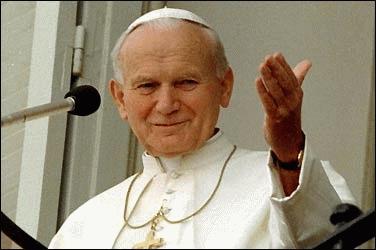
*Pope John Paul II had some thoughts on this Sunday’s Gospel during his Angelus message on July 18, 2004:
*
On this Sunday, the liturgy once again proposes for our meditation the Gospel episode of Jesus’ visit to the house of Martha and Mary (cf. Lk 10: 38-42). While Martha is totally taken up with household tasks, Mary is seated at the Master’s feet listening to his word. Christ affirms that Mary “has chosen the good portion, which shall not be taken away from her” (Lk 10: 42).

Listening to the Word of God is the most important thing in our lives. Christ is always in our midst and desires to speak to our hearts. We can listen to him by meditating with faith on Sacred Scripture, by recollection in private and communal prayer, by silent meditation before the Tabernacle, from which he speaks to us of his love.

Christians, especially on Sundays, are called to meet and listen to the Lord. This happens most completely through participation in Holy Mass, during which Christ prepares the banquet of the Word and of the Bread of Life for the faithful. But other moments of prayer and reflection, of rest and brotherhood, can also be profitably combined to make the Lord’s Day holy.

When, through the action of the Holy Spirit, God takes up his dwelling in the heart of the believer, it becomes easier for him/her to serve the brethren.

 
Status
Not open for further replies.
Back
Top