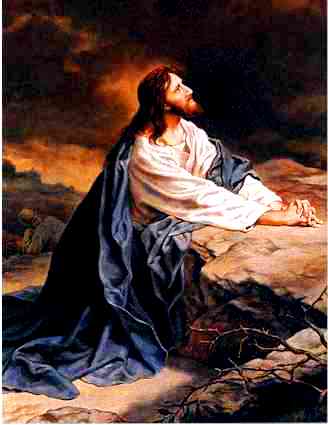
**From the Navarre Bible Commentary
Gospel Reading - From: Luke 11:1-13
The Our Father
--------------**
[1] He (Jesus) was praying in a certain place, and when He ceased, one of His disciples said to Him, “Lord, teach us to pray, as John taught His disciples.” [2] And He said to them, “When you pray, say: `Our Father, hallowed be Thy name. Thy Kingdom come. [3] Give us each day our daily bread; [4] and forgive us our sins, for we ourselves forgive every one who is indebted to us; and lead us not into temptation.’”
Effective Prayer
[5] And He (Jesus) said to them (the disciples), “Which of you who has a friend will go to him at midnight and say to him, ‘Friend, lend me three loaves; [6] for a friend of mine has arrived on a journey, and I have nothing to set before him’; [7] and he will answer from within, ‘Do not bother me; the door is now shut, and my children are with me in bed; I cannot get up and give you anything’? [8] I tell you, though he will not get up and give him anything because he is his friend, yet because of his importunity he will rise and give him whatever he needs. [9] And I tell you, Ask, and it will be given to you; seek, and you will find; knock, and it will be opened to you. [10] For every one who asks receives, and he who seeks find, and to him who knocks it will be opened. [11] What father among you, if his son asks for a fish, will instead of a fish give him a serpent; [12] or if he asks for an egg, will give him a scorpion? [13] If you then, who are evil, know how to give good gifts to your children, how much more will the Heavenly Father give the Holy Spirit to those who ask Him!”
Commentary:
1-4. St. Luke gives us a shorter form of the Lord’s Prayer, or Our Father, than St. Matthew (6:9-13). In Matthew there are seven petitions, in Luke only four. Moreover, St. Matthew’s version is given in the context of the Sermon on the Mount and specifically as part of Jesus’ teaching on how to pray; St. Luke’s is set in one of those occasions just after our Lord has been at prayer–two different contexts. There is nothing surprising about our Lord teaching the same thing on different occasions, not always using exactly the same words, not always at the same length, but always stressing the same basic points. Naturally, the Church uses the longer form of the Lord’s Prayer, that of St. Matthew.
“When the disciples asked the Lord Jesus,
Teach us to pray', He replied by saying the words of the Our Father’, thereby giving a concrete model which is also a universal model. In fact, everything that can and must be said to the Father is contained in those seven requests which we all know by heart. There is such simplicity in them that even a child can learn them, but at the same time such depth that a whole life can be spent meditating on their meaning. Isn’t that so? Does not each of those petitions deal with something essential to our life, directing it totally towards God the Father? Doesn’t this prayer speak to us about
our daily bread', forgiveness of our sins, since we forgive others’ and about protecting us from
temptation' and delivering us from evil?’” ([Pope] John Paul II, “General Audience”, 14 March 1979).
The first thing our Lord teaches us to ask for is the glorification of God and the coming of His Kingdom. That is what is really important–the Kingdom of God and His justice (cf. Matthew 6:33). Our Lord also wants us to pray confident that our Father will look after our material needs, for “your Heavenly Father knows that you need them all” (Matthew 6:32). However, the Our Father makes us aspire especially to possess the goods of the Holy Spirit, and invites us to seek forgiveness (and to forgive others) and to avoid the danger of sinning. Finally the Our Father emphasizes the importance of vocal prayer. “
Domine, doce nos orare. Lord teach us to pray!' And our Lord replied: When you pray say: “Pater noster, qui es in coelis”… Our Father, who art in Heaven…’. What importance we must attach to vocal prayer!” ([St] J. Escriva, “The Way”, 84).
- Jesus often went away to pray (cf. Luke 6:12; 22:39ff). This practice of the Master causes His disciples to want to learn how to pray. Jesus teaches them to do what He Himself does. Thus, when our Lord prays, He begins with the Word “Father!”: “Father, into Thy hands I commit My spirit” (Luke 23:46); see also Matthew 11:25; 26:42, 53; Luke 23:34; John 11:41; etc.). His prayer on the Cross, “My God, My God,…” (Matthew 27:46), is not really an exception to this rule, because there He is quoting Psalm 22, the desperate prayer of the persecuted just man.
Therefore, we can say that the first characteristic prayer should have is the simplicity of a son speaking to his Father. “You write:
To pray is to talk with God. But about what?' About what? About Him, about yourself: joys, sorrows, successes, failures, noble ambitions, daily worries, weaknesses! And acts of thanksgiving and petition: and love and reparation. In a word: to get to know Him and to get to know yourself: to get acquainted!’” ([St] J. Escriva, “The Way”, 91).
- “Hallowed be Thy name”: in this first petition of the Our Father “we pray that God may be known, loved, honored and served by everyone and by ourselves in particular.” This means that we want “unbelievers to come to a knowledge of the true God, heretics to recognize their errors, schismatics to return to the unity of the Church, sinners to be converted and the righteous to persevere in doing good.” By this first petition, our Lord is teaching us that `we must desire God’s glory more than our own interest and advantage." This hallowing of God’s name is attained “by prayer and good example and by directing all our thoughts, affections and actions towards Him” (“St. Pius X Catechism”, 290-293).
Continued below…