The text once more recalls the Exodus (cf. Heb 3:16-18; 4:1-2; 9:18-20; 10:19-22). Christians are making their way to heaven, their lasting homeland, their true place of rest, just as the ancient Israelites made their way out of Egypt and crossed the desert to reach the land promised to their forefathers.
However, despite this parallel there are differences: the Old Covenant, although it did include expressions and promises of joy and jubilation, was set in an atmosphere of religious fear and trembling; whereas the New Covenant is full of joy and exultation, although in the midst of suffering.
“It is a question …] of the glorious and supernatural joy, prophesied for the new Jerusalem redeemed from the exile and loved with a mystical love by God himself …]. Through the course of many centuries and in the midst of most terrible trials, these promises wonderfully sustained the mystical hope of ancient Israel. And it is ancient Israel that transmitted them to the Church of Jesus Christ, in such a way that we are indebted to ancient Israel for some of the purest expressions of our hymn of joy. And yet, according to faith and the Christian experience of the Holy Spirit, this peace which is given by God and which spreads out like an overflowing torrent when the time of ‘consolation’ comes, is linked to the coming and presence of Christ” (Paul VI, “Gaudete In Domino”, 2-3).
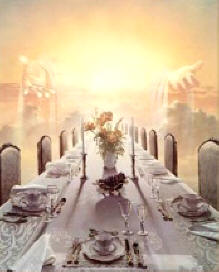
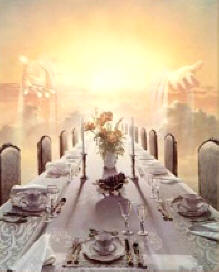
- The mention of Zion recalls the other mountain on which the Covenant was made (Sinai), as also the many prophetical texts which proclaimed that the Messiah’s reign would begin on Zion, his holy mountain (cf. Ps 2:6; Is 2:2-4:25:6; Zech 14:4). Thus, Mount Zion, the city of the living God, and the heavenly Jerusalem all mean the Church in triumph in heaven.
St Thomas emphasizes that part of eternal happiness in heaven consists in the vision of the heavenly assembly: “for in the glory of heaven there are two things which most cause the blessed to rejoice: enjoyment of the Godhead and the fellowship of the saints” (“Commentary on Heb., ad loc.”).
“Proceeding from the love of the eternal Father (cf. Tit 3:4), the Church was founded by Christ in time and gathered into one by the Holy Spirit (cf. Eph 1:3, 5, 6, 13-14, 23). It has a saving and eschatological purpose which can be fully attained only in the next life. But it is now present here on earth and is composed of men; they, the members of the earthly city, are called to form the family of the children of God in this present history of mankind and to increase it continually until the Lord comes” (Vatican II, “Gaudium Et Spes”, 40).
- “The assembly of the first-born who are enrolled in heaven”: the blessed, including the righteous of the Old Testament, the Apostles and all Christians who have attained the beatific vision. They are called first-born because, as in the case of the Patriarchs, they were the first to have faith; because, as in the case of the Apostles, it wasnthey who received Christ’s call initially, to pass it on to others; and, finally, because, as in the case of faithful Christians, they were chosen by God from among the pagans (cf. Rom 8:29; Phil 3:20; Col 1:18; Rev 1:S; 14:4). Their names are written in heaven (cf. Lk 10:20; Rev 2:17; 3:5; 13:8; 17:8).
- As Incarnate Word and High Priest, Jesus is the mediator of the New Covenant (cf. Heb 8:6; 9:15; 1 Tim 2:5; cf. Heb 2:17; 13:1; 7:25). The letter focuses for a moment on the most significant point in the alliance–the shedding of our Lord’s blood, which ratifies the Covenant and cleanses mankind (cf. Ex 24:8; Heb 9:12-14, 20; 10:19, 28-29; 13:20; 1 Pet 1:2). This blood “speaks more graciously than the blood of Abel”, “for the shedding of Christ’s blood was represented figuratively by the shedding of the blood of all the just there have been since the beginning of the world …]. Therefore, the spilling of Abel’s blood was a sign of this new spilling of blood. But the blood of Christ is more eloquent than that of Abel, because Abel’s called for vengeance whereas the blood of Christ claims forgiveness” (St Thomas Aquinas, “Commentary On Heb., ad loc.”). The confidence the blood of Christ gives us makes us feel happy to be sinners who, repentant, take refuge in his wounds.
“Sinners, says the Epistle, you are fortunate indeed, for after you sin you have recourse to the crucified Jesus, who shed all his blood so that he might stand as mediator to make peace between God and sinners, and win you forgiveness from him. If your evildoing shouts against you, the Redeemer’s blood cries aloud in your favor, and divine justice cannot but listen to what this blood says” (St Alphonsus, “The Love of Jesus Christ Reduced to Practice”, 3).