Study and Meditations on this Sunday's Scripture Readings: April 17, 2011

  • Thread starter Thread starter Fidelis
  • Start date Start date
Status
Not open for further replies.
F

Fidelis

Guest
To help us prepare for this coming Sunday, here are the readings, studies and reflections for this coming Sunday’s Scripture readings. This Sunday is Palm (or Passion) Sunday, and in this Sundays Gospel Reading we will hear about Jesus’ triumphant entry into Jerusalem, and his Passion and Crucifixion less than a week later.

Here are the Scripture readings from the U.S. Catholic bishops website.

My own weekly study can be found here under “Current Study”. Since this Sunday’s Gospel Reading is so long, I’ve chosen to focus instead on this Sunday’s Processional Gospel (read at the beginning of Mass) both for that Study and for this week’s thread. Many of the linked resources, however, will still address the Passion narrative.

Here are three audio reflections on the readings by Sister Ann Shields, Dr. Scott Hahn and Fr. Robert Barron.

Here are a pair of Catholic Bible study podcasts on the Gospel Reading, each about an hour long:

–Sisters of the Sorrowful Mother
–St. Martha’s Adult Faith Formation

The Navarre Bible Commentary for each reading can be viewed here.

Further study resources for the Readings: St. Charles Borromeo Bible Study can be found here, and Catholic Matters can be found here.

Discussion, questions and charitable comments are always welcome. Have a blessed Holy Week!
 
**1st Reading - Isaiah 50:4-7 **

Our first reading is from the third suffering servant song of the prophet Isaiah. This song describes how the suffering servant—the Messiah—accepts the role of suffering which the Father had designated for him. He is to preach the message of God’s mercy to men. Many will reject him and torture him, but God is on his side and he will not be moved from his resolute purpose by their insults and injuries.

Here is the 1st Reading as we will hear it this Sunday:
The Lord GOD has given me
a well-trained tongue,
that I might know how to speak to the weary
a word that will rouse them.
Morning after morning
he opens my ear that I may hear;
and I have not rebelled,
have not turned back.
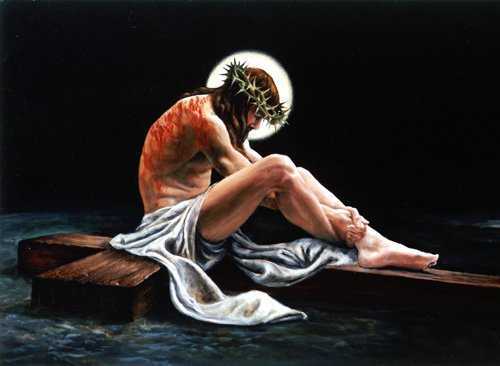
I gave my back to those who beat me,
my cheeks to those who plucked my beard;
my face I did not shield
from buffets and spitting.
The Lord GOD is my help,
therefore I am not disgraced;
I have set my face like flint,
knowing that I shall not be put to shame.
 
From the *Navarre Bible *commentary with Revised Standard Version-Catholic Edition (RSV-CE) text:
**
Third Song of the Servant of the Lord
-------------------------------------**
*[4] The Lord GOD has given me the tongue of those who are taught; that I may know how to sustain with a word him that is weary. Morning by morning he wakens, he wakens my ear to hear as those who are taught. [5] The Lord GOD has opened my ear, and I was not rebellious, I turned not backward. [6]I gave my back to the smiters, and my cheeks to those who pulled out the beard; I hid not my face from shame and spitting.
[7] For the LORD GOD helps me; therefore I have not been confounded; therefore I have set my face like a flint, and I know that I shall not be put to shame…*
** 50:4-9. **The second song dealt with the servant’s mission (cf. 49:6); the third song focuses on the servant himself. The term “servant” as such does not appear here, and therefore some commentators read the passage as being a description of a prophet and not part of the songs. Still, the context (cf. 50:10) does suggest that the protagonist is the servant. The poem is neatly constructed in three stanzas, each beginning with the words, “The Lord God” (vv. 4, 5, 7), and it has a conclusion containing that same wording (v. 9). The first stanza emphasizes the servant’s docility to the word of God; that is, he is not depicted as a self-taught teacher with original ideas, but as an obedient disciple. The second (vv. 5-6) speaks of the suffering that that docility has brought him, without his uttering a word of complaint. The third (vv. 7-8) shows how determined the servant is: if he suffers in silence, it is not out of cowardice but because God helps him and makes him stronger than his persecutors. The conclusion (v. 9) is like the verdict of a trial: when all is said and done, the servant will stand tall, and all his enemies will be struck down.
The evangelists saw the words of this song as finding fulfillment in Jesus–especially what the song has to say about the suffering and silent fortitude of the servant. The Gospel of John, for example, quotes Nicodemus’ acknowledgment of Christ’s wisdom: “Rabbi, we know that you are a teacher come from God; for no one can do these signs that you do, unless God is with him” (Jn 3:21). But the description of the servant’s sufferings was the part that most impressed the early Christians; that part of the song was recalled when they meditated on the passion of Jesus and how “they spat in his face; and struck him; and some slapped him” (Mt 26:67) and later how the Roman soldiers “spat upon him, and took the reed and struck him on the head” (Mt 27:30; cf. also Mk 15:19; Jn 19:3). St Paul refers to v. 9 when applying to Christ Jesus the role of intercessor on behalf of the elect in the suit pressed constantly against them by the enemies of the soul: “Who shall bring any charge against God’s elect?” (Rom 8:33).
St Jerome sees the servant’s docility as a reference to Christ: “His self-discipline and wisdom enabled him to communicate to us the knowledge of the Father. And he was obedient onto death, death on the cross; he offered his body to the blows they struck, his shoulders to the lash; and though he was wounded on the chest and on his face, he did not try to turn away and escape their violence” (“Commentarii In Isaiam”, 50, 4). This passage is used in the liturgy of Palm Sunday (along with Psalm 22 and St Paul’s hymn in the Letter to the Philippians 2:6-11), before the reading of our Lord’s passion.
 
From the 1859 Haydock Commentary with Douay-Rheims (DRV) text:
4 The Lord hath given me a learned tongue, that I should know how to uphold by word him that is weary: he wakeneth in the morning, in the morning he wakeneth my ear, that I may hear him as a master.*
Ver. 4. Weary. Isaias speaks in the name of Christ, whose words carried conviction and comfort along with them, John vi. 69., and vii. 46. (Calmet) — *Wakeneth. *Literally, “lifteth up.” Cynthius aurem—Vellit. (Ec. vi.) — Hear, or obey. (Haydock) — Christ preached more powerfully than Isaias, and continues to do so by his pastors. (St. Jerome) (Worthington)
*5 The Lord God hath opened my ear, and I do not resist: I have not gone back.
6 I have given my body to the strikers, and my cheeks to them that plucked them: I have not turned away my face from them that rebuked me, and spit upon me.
Ver. 6. Spit. The greatest indignity, Job xxx. 10., and Deuteronomy xxv. 9. Yet this was the treatment of our Saviour, Luke xviii. 31., and Matthew xxvi. 67. (Calmet) — “The great Grotius, (I wish he were great in explaining the prophets)” applies this to Jeremias. (Houbigant)
*
7 The Lord God is my helper, therefore am I not confounded: therefore have I set my face as a most hard rock, and I know that I shall not be confounded.*
**
Ver. 7.** *Rock. *Christ heard the accusations of his enemies unmoved, as the had not been afraid to blame the conduct of the Pharisees.
 
To help us prepare for this coming Sunday, here are the readings, studies and reflections for this coming Sunday’s Scripture readings. This Sunday is Palm (or Passion) Sunday, and in this Sundays Gospel Reading we will hear about Jesus’ triumphant entry into Jerusalem, and his Passion and Crucifixion less than a week later.

Here are the Scripture readings from the U.S. Catholic bishops website.

My own weekly study can be found here under “Current Study”. Since this Sunday’s Gospel Reading is so long, I’ve chosen to focus instead on this Sunday’s Processional Gospel (read at the beginning of Mass) both for that Study and for this week’s thread. Many of the linked resources, however, will still address the Passion narrative.

Here are three audio reflections on the readings by Sister Ann Shields, Dr. Scott Hahn and Fr. Robert Barron.

Here are a pair of Catholic Bible study podcasts on the Gospel Reading, each about an hour long:

–Sisters of the Sorrowful Mother
–St. Martha’s Adult Faith Formation

The Navarre Bible Commentary for each reading can be viewed here.

Further study resources for the Readings: St. Charles Borromeo Bible Study can be found here, and Catholic Matters can be found here.

Discussion, questions and charitable comments are always welcome. Have a blessed Holy Week!

http://timesandseasons.org/wp-content/uploads/2010/03/Triumphal-Entry-Anderson.jpg
Hi Fidelis.
I want to really thank you for availing to us these study resources.May the Lord reward you , as only He can.
I was not able to access St. Charles Borromeo Bible Study. Could you give the link again please?
Thanks and God Bless.
 
Other thoughts and commentary on the 1st Reading:
**4 The Lord GOD has given me a well-trained tongue: **A disciple’s tongue; taught by a master.
That I might know how to speak to the weary: The Israelites, weary from the Babylonian exile. His preaching will touch both friend and foe. The former will be moved to listen and obey—the latter will grow stronger in their opposition.
**a word that will rouse them. Morning after morning: ** His was a daily task, a difficult task.
**he opens my ear that I may hear: **The servant must first be a disciple, prayerfully receiving God’s word, before he can presume to teach others. The suffering people are deaf to the saving Word of God that is being spoken (or fulfilled) through their suffering. Within the Israelite community there are saintly men who obediently listen to God’s word and yearn to speak it to others (these are called the prophets). Jesus said: “The words that I speak to you I do not speak on my own. The father who dwells in me is doing his works” (John 14:10).
5 And I have not rebelled: He continued notwithstanding the difficulties.
**have not turned back.
6 I gave my back to those who beat me, my cheeks to those who plucked my beard; My face I did not shield from buffets and spitting:** Like the prophets before him, the servant is ignored and even maltreated. Literally fulfilled in the scourging of Christ at the pillar, the mocking of the Roman soldiers and the insults in presence of Caiphas (see Mt. 26: 67-68).
7 The Lord GOD is my help, therefore I am not disgraced: The word in the Hebrew for “disgraced” has the same root as “buffet” in the preceding verse and provides strong contrast. The Lord himself is the source of his strength.
**I have set my face like flint: **No insult or suffering would weaken his resolve (see Ez. 3:8, when God promises the same strength to Ezekiel).
knowing that I shall not be put to shame: A phrase which is frequent in prophetic preaching to denote steadfastness. It is all the more effective here in describing a face covered with spittle.
All their insults and injuries (even crucifixion) will be in vain. He will triumph in the end.
 
Catechism of the Catholic Church paragraph referencing Isaiah 50:4-7
**713 **The Messiah’s characteristics are revealed above all in the "Servant songs."82 These songs proclaim the meaning of Jesus’ Passion and show how he will pour out the Holy Spirit to give life to the many: not as an outsider, but by embracing our "form as slave."83 Taking our death upon himself, he can communicate to us his own Spirit of life.
Code:
82. Cf. Isa 42:1-9; cf. Mt 12:18-21; Jn 1:32-34; then cf. Isa 49:1-6; cf. Mt 3:17; Lk 2:32; finally cf. Isa 50:4-10 and Isa 52:13-53:12.
Code:
83. Phil 2:7.
 
A meditation on the 1st reading for practical application from Catholic Matters:
**APPLICATION: **The sufferings and crucifixion of our divine Lord in his humanity are the Christian’s source of strength and encouragement in his daily struggles against the enemies of God and of his own spiritual progress. Because of our earthly bodies, and because of the close grip that this world of the senses has on us, to keep free from sin and to keep close to God on our journey to heaven is a daily struggle for even the best among us. But we have the example before our eyes, the example of our true brother. He was one of ourselves, the truly human Christ. He not only traveled the road before us and made the journey to heaven possible for us, but he is with us every day, close beside us, to encourage and help us on the way.
We need to remind ourselves daily of this. We have the crucifix in our Christian homes, on our rosary beads, on our altars, on the very steeples of our churches. These crucifixes are not ornaments, but stark reminders that our Savior’s path to heaven led through Calvary and through all that preceded Calvary. They are also stern reminders to us that the carrying of our crosses on the road to heaven is not an unbearable burden for us, but an essential aid to our progress. When you are tried by temptations, when you are tested by bodily pain or mental suffering, worried to death perhaps by the bodily needs of yourself or your family or by the disobedience and insults of ungrateful children, stop and think on the Leader and his humiliations and sufferings. He came to open the road to heaven for us, to make us all sons of God, to preach the message of divine forgiveness and mercy to mankind. What did he get in return? He was scourged, tied to a pillar, spat upon and insulted, jeered at and mocked. He was nailed to a cross on Calvary between two thieves!
How light is my cross in comparison, how easy my Calvary. But he was sinless; his obedience, as man, to the Father was perfect. Can we or should we complain, we whose life up to now has often been far from perfect? Stop, listen to today’s lesson.
 
2nd Reading - Philippians 2:6-11

Our second reading has been called “The Christ Hymn” because of the distinctive qualities of this passage. It has a rhythmic character and a use of parallelism which have led to the view that Paul is quoting a hymn composed independently of Philippians (possibly originally in Aramaic). The hymn has a basic twofold structure: verses 6-8 describe Christ’s abasement; while verses 9-11, His exaltation. He who was God, humbled himself to become a man like us, hiding his divine glory but receiving it back at his resurrection. Because of this, everyone must confess and adore his equality in divine glory with his Father.

Here is the 2nd Reading as we will hear it this Sunday:
Christ Jesus, though he was in the form of God,
did not regard equality with God
something to be grasped.
Rather, he emptied himself,
taking the form of a slave,
coming in human likeness;
and found human in appearance,
he humbled himself,
becoming obedient to the point of death,
even death on a cross.
Because of this, God greatly exalted him
and bestowed on him the name
which is above every name,
that at the name of Jesus
every knee should bend,
of those in heaven and on earth and under the earth,
and every tongue confess that
Jesus Christ is Lord,
to the glory of God the Father.
 
From the Navarre Bible commentary with Revised Standard Version-Catholic Edition (RSV-CE) text:
**3-11. **Verse 3 exhorts us to see others as better than ourselves. Our Lord, although he was our superior in all respects, did not see his divinity as something to boast about before men (v. 6). In fact, he humbled himself and emptied himself (vv. 7-8), was not motivated by conceit or selfishness (cf. v. 3), did not look to his own interests (cf. v. 4), and “became obedient unto death” (v. 8), thereby carrying out the Father’s plan for man’s salvation. By reflecting on his example we shall come to see that suffering for Christ is a sign of salvation (cf. 1:28-29): after undergoing the sufferings of his passion and death, Christ was publicly exalted above all creation (cf. vv. 9-11).
Our Lord offers us a perfect example of humility. “The coming of our Lord Jesus Christ, the Scepter of God’s Majesty, was in no pomp of pride and haughtiness–as it could so well have been–but in self-abasement …]. You see, dear friends, what an example we have been given. If the Lord humbled himself in this way, what ought we to do, who through him have come under the yoke of his guidance?” (St Clement of Rome, “Letter to the Corinthians”, 13).
**
6-11. **In what he says about Jesus Christ, the Apostle is not simply proposing Him as a model for us to follow. Possibly transcribing an early liturgical hymn (and) adding some touches of his own, he is–under the inspiration of the Holy Spirit–giving a very profound exposition of the nature of Christ and using the most sublime truths of faith to show the way Christian virtues should be practiced.
This is one of the earliest New Testament texts to reveal the divinity of Christ. The epistle was written around the year 62 (or perhaps before that, around 55) and if we remember that the hymn of Philippians 2:6-11 may well have been in use prior to that date, the passage clearly bears witness to the fact that Christians were proclaiming, even in those very early years, that Jesus, born in Bethlehem, crucified, died and buried, and risen from the dead, was truly both God and man.
The hymn can be divided into three parts. The first (verses 6 and the beginning of 7) refers to Christ’s humbling Himself by becoming man. The second (the end of verse 7 and verse 8) is the center of the whole passage and proclaims the extreme to which His humility brought Him: as man He obediently accepted death on the cross. The third part (verses 9-11) describes His exaltation in glory. Throughout St. Paul is conscious of Jesus’ divinity: He exists from all eternity. But he centers his attention on His death on the cross as the supreme example of humility. Christ’s humiliation lay not in His becoming a man like us and cloaking the glory of His divinity in His sacred humanity: it also brought Him to lead a life of sacrifice and suffering which reached its climax on the cross, where He was stripped of everything He had, like a slave. However, now that He has fulfilled His mission, He is made manifest again, clothed in all the glory that befits His divine nature and which His human nature has merited.
The man-God, Jesus Christ, makes the cross the climax of His earthly life; through it He enters into His glory as Lord and Messiah. The Crucifixion puts the whole universe on the way to salvation.
Jesus Christ gives us a wonderful example of humility and obedience. “We should learn from Jesus’ attitude in these trials,” [St.] Monsignor Escriva reminds us. "During His life on earth He did not even want the glory that belonged to Him. Though He had the right to be treated as God, He took the form of a servant, a slave (cf. Philippians 2:6-7). And so the Christian knows that all glory is due God and that he must not use the sublimity and greatness of the Gospel to further his own interests or human ambitions.
“We should learn from Jesus. His attitude in rejecting all human glory is in perfect balance with the greatness of His unique mission as the beloved Son of God who becomes incarnate to save men” (“Christ Is Passing By”, 62).
Continued on the next post…
 
Hymn in Praise of Christ’s Self-Emptying
----------------------------------------

*[6] who, though He was in the form of God, did not count equality with God a thing to be grasped, [7] but emptied Himself, taking the form of a servant, being born in the likeness of men. *
**6-7. **“Though He was in the form of God” or “subsisting in the form of God”: “form” is the external aspect of something and manifests what it is. When referring to God, who is invisible, His “form” cannot refer to things visible to the senses; the “form of God” is a way of referring to Godhead. The first thing that St. Paul makes clear is that Jesus Christ is God, and was God before the Incarnation. As the “Nicene-Constantinopolitan Creed” professes it, “the only-begotten Son of God, born of the Father before time began, light from light, true God from true God.”
“He did not count equality with God as something to be grasped”: the Greek word translated as “equality” does not directly refer to equality of nature but rather the equality of rights and status. Christ was God and He could not stop being God; therefore, He had a right to be treated as God and to appear in all His glory. However, He did not insist on this dignity of His as if it were a treasure which He possessed and which was legally His: it was not something He clung to and boasted about. And so He took “the form of a servant”. He could have become man without setting His glory aside–He could have appeared as He did, momentarily, as the Transfiguration (cf. Matthew 17:1ff); instead He chose to be like men, in all things but sin (cf. verse 7). By becoming man in the way He did, He was able, as Isaiah prophesied in the Song of the Servant of Yahweh, to bear our sorrows and to be stricken (cf. Isaiah 53:4).
“He emptied Himself”, He despoiled Himself: this is literally what the Greek verb means. But Christ did not shed His divine nature; He simply shed its glory, its aura; if He had not done so it would have shone out through His human nature. From all eternity He exists as God and from the moment of the Incarnation He began to be man. His self-emptying lay not only in the fact that the Godhead united to Himself (that is, to the person of the Son) something which was corporeal and finite (a human nature), but also in the fact that this nature did not itself manifest the divine glory, as it “ought” to have done. Christ could not cease to be God, but He could temporarily renounce the exercise of rights that belonged to Him as God–which was what He did.
Verses 6-8 bring the Christian’s mind the contrast between Jesus and Adam. The devil tempted Adam, a mere man, to “be like God” (Genesis 3:5). By trying to indulge this evil desire (pride is a disordered desire for self-advancement) and by committing the sin of disobeying God (cf. Genesis 3:6), Adam drew down the gravest misfortunes upon himself and on his whole line (present potentially in him): this is symbolized in the Genesis passage by his expulsion from Paradise and by the physical world’s rebellion against his lordship (cf. Genesis 3:16-24). Jesus Christ, on the contrary, who enjoyed divine glory from all eternity, “emptied Himself”: He chooses the way of humility, the opposite way to Adam’s (opposite, too, to the way previously taken by the devil). Christ’s obedience thereby makes up for the disobedience of the first man; it puts mankind in a position to more than recover the natural and supernatural gifts with which God endowed human nature at the Creation. And so, after focusing on the amazing mystery of Christ’s humiliation or self-emptying (“kenosis” in Greek), this hymn goes on joyously to celebrate Christ’s exaltation after death.
Christ’s attitude in becoming man is, then, a wonderful example of humility. “What is more humble”, St. Gregory of Nyssa asks, “than the King of all creation entering into communion with our poor nature? The King of kings and Lord of lords clothes Himself with the form of our enslavement; the Judge of the universe comes to pay tribute to the princes of this world; the Lord of creation is born in a cave; He who encompasses the world cannot find room in the inn…; the pure and incorrupt one puts on the filthiness of our nature and experiences all our needs, experiences even death itself” (“Oratio I In Beatitudinibus”).
This self-emptying is an example of God’s infinite goodness in taking the initiative to meet man: “Fill yourselves with wonder and gratitude at such a mystery and learn from it. All the power, all the majesty, all the beauty, all the infinite harmony of God, all His great and immeasurable riches. God whole and entire was hidden for our benefit in the humanity of Christ. The Almighty appears determined to eclipse His glory for a time, so as to make it easy for His creatures to approach their Redeemer.” ([St] J. Escriva, “Friends of God”, 111).
Continued on the next post…
 
*[8]
And being found in human form He humbled Himself and became obedient unto death, even death on a cross. *
8. Jesus Christ became man “for us men and for our salvation”, we profess in the Creed. Everything He did in the course of His life had a salvific value; His death on the cross represents the climax of His redemptive work for, as St. Gregory of Nyssa says, “He did not experience death due to the fact of being born; rather, He took birth upon Himself in order to die” (“Oratio Catechetica Magna”, 32).

Our Lord’s obedience to the Father’s saving plan, involving as it did death on the cross, gives us the best of all lessons in humility. For, in the words of St. Thomas Aquinas, “obedience is the sign of true humility” (“Commentary on Phil., ad loc.”). In St. Paul’s time death by crucifixion was the most demeaning form of death, for it was inflicted only on criminals. By becoming obedient “unto death, even death on a cross”, Jesus was being humble in the extreme. He was perfectly within His rights to manifest Himself in all His divine glory, but He chose instead the route leading to the most ignominious of deaths.

His obedience, moreover, was not simply a matter of submitting to the Father’s will, for, as St. Paul points out, He made Himself obedient: His obedience was active; He made the Father’s salvific plans His own. He chose voluntarily to give Himself up to crucifixion in order to redeem mankind. “Debasing oneself when one is forced to do so is not humility”, St. John Chrysostom explains; “humility is present when one debases oneself without being obliged to do so” (“Hom. on Phil., ad loc.”).

Christ’s self-abasement and his obedience unto death reveals His love for us, for “greater love has no man than this, that a man lay down his life for his friends” (John 15:13). His loving initiative merits a loving response on our part: we should show that we desire to be one with Him, for love “seeks union, identification with the beloved. United to Christ, we will be drawn to imitate His life of dedication, His unlimited love and His sacrifice unto death. Christ brings us face to face with the ultimate choice: either we spend our life in selfish isolation, or we devote ourselves and all our energies to the service of others” ([St] J. Escriva, “Friends of God”, 236).

Concluded on the next post…
 
[9] Therefore God has highly exalted Him and bestowed on Him the name which is above every name, [10] that at the name of Jesus every knee should bow, in Heaven and on earth and under the earth, [11] and every tongue confess that Jesus Christ is Lord, to the glory of God the Father.
9-11. “God highly exalted Him”: the Greek compounds the notion of exaltation, to indicate the immensity of His glorification. Our Lord Himself foretold this when He said, “He who humbles himself will be exalted” (Luke 14:11).
Christ’s sacred humanity was glorified as a reward for His humiliation. The Church’s Magisterium teaches that Christ’s glorification affects his human nature only, for “in the form of God the Son was equal to the Father, and between the Begetter and the Only-begotten there was no difference in essence, no difference in majesty; nor did the Word, through the mystery of incarnation, lose anything which the Father might later return to Him as a gift” ([Pope] St. Leo the Great, “Promisisse Me Memini”, Chapter 8). Exaltation is public manifestation of the glory which belongs to Christ’s humanity by virtue of its being joined to the divine person of the Word. This union to the “form of a servant” (cf. verse 7) meant an immense act of humility on the part of the Son, but it led to the exaltation of the human nature He took on.
For the Jews the “name that is above every name” is the name of God (Yahweh), which the Mosaic Law required to be held in particular awe. Also, they regarded a name given to someone, especially if given by God, as not just a way of referring to a person but as expressing something that belonged to the very core of his personality. Therefore, the statement that God “bestowed on Him the name which is above every name” means that God the Father gave Christ’s human nature the capacity to manifest the glory of divinity which was His by virtue of the hypostatic union: therefore, it is to be worshipped by the entire universe.
St. Paul describes the glorification of Jesus Christ in terms similar to those used by the prophet Daniel of the Son of Man: “To Him was given dominion and glory and kingdom, that all peoples, nations and languages should serve His Kingdom, one that shall not be destroyed” (Daniel 7:14). Christ’s lordship extends to all created things. Sacred Scripture usually speaks of “heaven and earth” when referring to the entire created universe; by mentioning here the underworld it is emphasizing that nothing escapes His dominion. Jesus Christ can here be seen as the fulfillment of Isaiah’s prophecy about the universal sovereignty of Yahweh: “To Me every knee shall bow, every tongue shall swear” (Isaiah 45:23). All created things come under His sway, and men are duty-bound to accept the basic truth of Christian teaching: “Jesus Christ is Lord.” The Greek word “Kyrios” used here by St. Paul is the word used by the Septuagint, the early Greek version of the Old Testament, to translate the name of God (“Yahweh”). Therefore, this
sentence means “Jesus Christ is God.”
The Christ proclaimed here as having been raised on high is the man-God who was born and died for our sake, attaining the glory of His exaltation after undergoing the humiliation of the cross. In this also Christ sets us an example: we cannot attain the glory of Heaven unless we understand the supernatural value of difficulties, ill-health and suffering: these are manifestations of Christ’s cross present in our ordinary life. “We have to die to ourselves and be born again to a new life. Jesus Christ obeyed in this way, even unto death on a cross (Philippians 2:18); that is why God exalted Him. If we obey God’s will, the cross will mean our own resurrection and exaltation. Christ’s life will be fulfilled step by step in our own lives. It will be said of us that we have tried to be good children of God, who went about doing good in spite of our weakness and personal shortcomings, no matter how many” ([St] J. Escriva, “Christ Is Passing By”, 21).
 
From the 1859 Haydock Commentary with Douay-Rheims (DRV) text:
6 Who being in the form of God, thought it not robbery, to be himself equal to God:
**Ver. 6. **Who being in the form of God, (that is truly, properly, and essentially God from eternity, as the ancient Fathers here observed against the Arians) taking the form of a servant, (i.e. taking upon him our human nature) became truly a man, and as man the servant of God, but remaining always God as before, thought it not robbery, no injury to his eternal Father, to be equal, to be esteemed, and to declare himself equal to God, to be one thing with him: as on divers occasions he taught the people, as we have observed in the notes on St. John’s gospel, &c. (Witham)
7 But debased himself, taking the form of a servant, being made in the likeness of men, and in shape found as a man.
Ver. 7.* But debased himself*: divested himself of all the marks of greatness, for the love of mankind. The Greek text signifies, he made himself void; on which account Dr. Wells, instead of made himself of no reputation, as in the Protestant translation, has changed it into emptied himself; not but that the true Son of God must always remain truly God, as well as by his incarnation truly man, but that in him as man appeared no marks of his divine power and greatness. — Made to the likeness of men, not only as to an exterior likeness and appearance, but at the same time truly man by uniting his divine person to the nature of man. — In shape (or habit) found as a man: not clothed exteriorly only, as a man is clothed with a garment or coat, but found both as to shape and nature a man; and, as St. Chrysostom says, with the appearance of a sinful man, if we consider him persecuted by the Jews, and nailed to an infamous cross. (Witham)
*8 He humbled himself, becoming obedient unto death, even the death of the cross.
9 Wherefore God also hath exalted him, and hath given him a name which is above every name:*
Ver. 9. God…hath given him a name, &c. The name or word *Jesus represents the dignity of him who is signified by the name, and who is exalted even as man, above all creatures in heaven, earth, and hell; all which creatures either piously reverence him, or are made subject to him against their will, that every tongue may confess our Lord Jesus to be now, and to have been always, in the glory of his Father, equal to him in substance and in all perfections. (Witham)
*
10 That in the name of Jesus, every knee should bow of those that are in heaven, on earth, and under the earth;
Ver. 10. If we shew respect when the name of our sovereign is mentioned, may we not express our respect also at the name of Jesus; and if to his name, why not to his cross as well as to the throne of the king?
11 And that every tongue should confess that the Lord Jesus Christ is in the glory of God the Father.
 
Other thoughts and commentary on the 2nd Reading:
**6 Who, though he was in the form of God: **He was divine and did not cease to be divine when he became man.
**
did not regard equality with God something to be grasped: **Christ, who existed from before the creation of the world, did not exploit His divinity for selfish gain. In Jewish tradition being like God meant immunity to death (Wisdom 2:23).
**
7 Rather, he emptied himself, taking the form of a slave: ** In emptying Himself He rendered Himself powerless—exactly as a slave is powerless. He did not empty Himself of divinity, but of the status of glory to which He had a right and which would be restored at His exaltation. He did not let the divine glory appear. Instead his humanity, the same as that possessed by all men, was what was evident. He was a truly obedient servant (slave) of God however, as all men should be, but were not. This true obedience led him to the humiliating death on a cross (see Isaiah in first reading).
coming in human likeness: What is translated here as “human likeness” can mean “identical copy” or “mere resemblance”. Identical copy is most likely it brings out the contrast of the fully divine becoming fully human as well.
and found human in appearance: By being “human in appearance”, He came in human form.
8 he humbled himself: The selfless attitude of Christ, shown in His original disposition to take on the slavelike, mortal human condition, continues throughout His human history.
**
becoming obedient to death: ** Throughout His whole life, Christ lived out perfectly the demands of human existence before God. Death was not simply the terminal point of His obedience; it was the inevitable consequence of being both fully human and totally obedient in a world alienated from God.
even death on a cross: Crucifixion, the form of execution reserved for slaves and those who had totally forfeited all civil rights, marked the extremity of human abasement.
**9 Because of this, God greatly exalted him: **The self-denying act of Christ is matched by the active response of God. His obedience is rewarded, not in the sense that it forced God’s hand but that God in His fidelity moved to vindicate (justify) the one who had placed himself so totally at the divine disposition. Beyond the exaltation of all the just, Christ is given the unique status of lordship over the universe. By raising him from the dead on Easter morning God restored to him the glory of the divinity that he had hidden during his earthly life (see Eph. 1:21), and glorified his human nature.
**
and bestowed on him the name that is above every name: **Explicit mention of the name is held back until the end of the hymn, but the name is Kyrios (Lord) which came to be substituted for YHWH in Christian copies of the Septuagint Old Testament. If God has bestowed the name on him, Jesus bears it without cost to strict monotheism—there is only one God. Name stands for “person.” He is exalted to the right hand of the Father in his humanity as well as in his divinity, the chief place in heaven after God the Father.
**
10 that at the name of Jesus: Mention of Jesus now connotes the title and authority of universal Lord.
**
every knee should bend:
Isaiah 45:23. This hymn transfers to Christ the homage given to God alone.
of those in heaven and on earth and under the earth: The three levels of the universe according to ancient thought.
**11 and every tongue confess: ** See Isaiah 45:23. To proclaim their faith in the divinity of Christ the Savior. This is the basis of the Christian faith and the only hope of salvation for all.
**that Jesus Christ is Lord, to the glory of God the Father: **The climax of the hymn is the early Christian confession of faith (see 1 Corinthians 12:3; Romans 10:9). He who in selfless obedience took on the powerlessness of a slave now through divine commission and investiture holds universal lordship (see 1 Corinthians 3:21-23; Romans 14:9). His human nature also is sharing in the divine glory in heaven, the guarantee that our finite human nature can partake in some measure in this same divine glory if we have been his faithful brothers on earth.
 
Catechism of the Catholic Church paragraphs referencing Philippians 2:6-11 include:
201 To Israel, his chosen, God revealed himself as the only One: "Hear, O Israel: The LORD our God is one LORD; and you shall love the LORD your God with all your heart, and with all your soul, and with all your might."4 Through the prophets, God calls Israel and all nations to turn to him, the one and only God: "Turn to me and be saved, all the ends of the earth! For I am God, and there is no other… . To me every knee shall bow, every tongue shall swear. ‘Only in the LORD, it shall be said of me, are righteousness and strength.’"5
Code:
4. Deut 6:45.
Code:
5. Isa 45:22-24; cf. Phil 2:10-11.
**434 **Jesus’ Resurrection glorifies the name of the Savior God, for from that time on it is the name of Jesus that fully manifests the supreme power of the “name which is above every name”.27 The evil spirits fear his name; in his name his disciples perform miracles, for the Father grants all they ask in this name.28
Code:
27. Phil 2:9-10; cf. Jn 12:28.
Code:
28. Cf. Acts 16:16-18; 19:13-16; Mk 16:17; Jn 15:16.
**
449** By attributing to Jesus the divine title “Lord”, the first confessions of the Church’s faith affirm from the beginning that the power, honor and glory due to God the Father are due also to Jesus, because “he was in the form of God”,65 and the Father manifested the sovereignty of Jesus by raising him from the dead and exalting him into his glory.66
Code:
65. Cf. Acts 2:34-36; Rom 9:5; Titus 2:13; Rev 5:13; Phil 2:6.
Code:
66. Cf. Rom 10:9; 1 Cor 12:3; Phil 2:9-11.
**THE INCARNATION
461** Taking up St. John’s expression, “The Word became flesh”,82 the Church calls “Incarnation” the fact that the Son of God assumed a human nature in order to accomplish our salvation in it. In a hymn cited by St. Paul, the Church sings the mystery of the Incarnation:
Code:
    *Have this mind among yourselves, which is yours in Christ Jesus, who, though he was in the form of God, did not count equality with God a thing to be grasped, but emptied himself, taking the form of a servant, being born in the likeness of men. And being found in human form he humbled himself and became obedient unto death, even death on a cross.*83
Code:
82. Jn 1:14.
Code:
83. Phil 2:5-8; cf. LH, Saturday, Canticle at Evening Prayer.
472 This human soul that the Son of God assumed is endowed with a true human knowledge. As such, this knowledge could not in itself be unlimited: it was exercised in the historical conditions of his existence in space and time. This is why the Son of God could, when he became man, “increase in wisdom and in stature, and in favor with God and man”,101 and would even have to inquire for himself about what one in the human condition can learn only from experience.102 This corresponded to the reality of his voluntary emptying of himself, taking “the form of a slave”.103
Code:
101. Lk 2:52.
Code:
102. Cf. Mk 6:38; 8:27; Jn 11:34; etc.
Code:
103. Phil 2:7.
**
The agony at Gethsemani
612 **The cup of the New Covenant, which Jesus anticipated when he offered himself at the Last Supper, is afterwards accepted by him from his Father’s hands in his agony in the garden at Gethsemani,434 making himself “obedient unto death”. Jesus prays: "My Father, if it be possible, let this cup pass from me. . ."435 Thus he expresses the horror that death represented for his human nature. Like ours, his human nature is destined for eternal life; but unlike ours, it is perfectly exempt from sin, the cause of death.436 Above all, his human nature has been assumed by the divine person of the “Author of life”, the “Living One”.437 By accepting in his human will that the Father’s will be done, he accepts his death as redemptive, for "he himself bore our sins in his body on the tree."438
Code:
434. Cf. Mt 26:42; Lk 22:20.
Code:
435. Phil 2:8; Mt 26:39; cf. Heb 5:7-8.
Code:
436. Cf. Rom 5:12; Heb 4:15.
Code:
437. Cf. Acts 3:15; Rev 1:17; Jn 1:4; 5:26.
Code:
438. 1 Pet 224; cf. Mt 26:42.
Continued on the next post…
 
635 Christ went down into the depths of death so that "the dead will hear the voice of the Son of God, and those who hear will live."485 Jesus, “the Author of life”, by dying destroyed "him who has the power of death, that is, the devil, and [delivered] all those who through fear of death were subject to lifelong bondage."486 Henceforth the risen Christ holds “the keys of Death and Hades”, so that "at the name of Jesus every knee should bow, in heaven and on earth and under the earth."487
Code:
    *Today a great silence reigns on earth, a great silence and a great stillness. A great silence because the King is asleep. The earth trembled and is still because God has fallen asleep in the flesh and he has raised up all who have slept ever since the world began. . . He has gone to search for Adam, our first father, as for a lost sheep. Greatly desiring to visit those who live in darkness and in the shadow of death, he has gone to free from sorrow Adam in his bonds and Eve, captive with him - He who is both their God and the son of Eve. . . "I am your God, who for your sake have become your son. . . I order you, O sleeper, to awake. I did not create you to be a prisoner in hell. Rise from the dead, for I am the life of the dead."*488
Code:
485. Jn 5:25; cf. Mt 12:40; Rom 10:7; Eph 4:9.
Code:
486. Heb 2:14-15; cf. Acts 3:15.
Code:
487. Rev 1:18; Phil 2:10.
Code:
488. Ancient Homily for Holy Saturday: PG 43, 440A, 452C; LH, Holy Saturday, OR.
**713 **The Messiah’s characteristics are revealed above all in the "Servant songs."82 These songs proclaim the meaning of Jesus’ Passion and show how he will pour out the Holy Spirit to give life to the many: not as an outsider, but by embracing our "form as slave."83 Taking our death upon himself, he can communicate to us his own Spirit of life.
Code:
82. Cf. Isa 42:1-9; cf. Mt 12:18-21; Jn 1:32-34; then cf. Isa 49:1-6; cf. Mt 3:17; Lk 2:32; finally cf. Isa 50:4-10 and Isa 52:13-53:12.
Code:
83. Phil 2:7.
**Participation in Christ’s kingly office
908** By his obedience unto death,444 Christ communicated to his disciples the gift of royal freedom, so that they might “by the self-abnegation of a holy life, overcome the reign of sin in themselves”:445
Code:
    *That man is rightly called a king who makes his own body an obedient subject and, by governing himself with suitable rigor, refuses to let his passions breed rebellion in his soul, for he exercises a kind of royal power over himself. And because he knows how to rule his own person as king, so too does he sit as its judge. He will not let himself be imprisoned by sin, or thrown headlong into wickedness*.446
Code:
444. Cf. Phil 2:8-9.
Code:
445. LG 36.
Code:
446. St. Ambrose, Psal. 118:14:30:PL 15:1476.
1224 Our Lord voluntarily submitted himself to the baptism of St. John, intended for sinners, in order to "fulfill all righteousness."19 Jesus’ gesture is a manifestation of his self-emptying.20 The Spirit who had hovered over the waters of the first creation descended then on the Christ as a prelude of the new creation, and the Father revealed Jesus as his "beloved Son."21
Code:
19. Mt 3:15.
Code:
20. Cf. Phil 2:7.
Code:
21. Mt 3:16-17.
2812 Finally, in Jesus the name of the Holy God is revealed and given to us, in the flesh, as Savior, revealed by what he is, by his word, and by his sacrifice.75 This is the heart of his priestly prayer: "Holy Father . . . for their sake I consecrate myself, that they also may be consecrated in truth."76 Because he “sanctifies” his own name, Jesus reveals to us the name of the Father.77 At the end of Christ’s Passover, the Father gives him the name that is above all names: "Jesus Christ is Lord, to the glory of God the Father."78
Code:
75. Cf. Mt 1:21; Lk 1:31; Jn 8:28; 17:8; 17:17-19.
Code:
76. Jn 17:11,19.
Code:
77. Cf. Ezek 20:39; 36:20-21; Jn 17:6.
Code:
78. Phil 2:9-11.
 
A meditation on the 2nd Reading for practical application from Catholic Matters:
APPLICATION: As Christians we have no doubt as to the two natures of our Savior. He was the God-man. He humbled himself so low in order to represent us before his Father and by his perfect obedience (“even unto the death on a cross”) earn for us not only God’s forgiveness but a sharing in the divinity, through his being our brother but also the Son of God. These words of Paul, or rather of the early Christian hymn he is quoting, are for us today a consolation and an encouragement.
Surely every sincere Christian must be consoled by the thought of God’s infinite love for him, as shown in the Incarnation. We are not dealing with some distant, cold, legal God of justice who spends his time marking up our sins and failures against us. We are dealing with a loving Father who sent his own beloved Son to live among us and die for us in order to bring home to us the greatness of divine love. Could any human mind, even the minds of the greatest of this world’s philosophers, have invented such a humanly incredible story of true love? No, it was only in the infinite mind of God that such a proof of love could have its source.
What encouragement this should and does give to every sincere Christian. We know we are weak. We can and do sin often. We know we are mean and ungrateful and that we seldom stop to thank God for the love he has shown us. If we were dealing with a human, narrow-visioned God, we should have reason to despair, but when our Judge is the all- loving, all-merciful God how can even the worst sinner ever lose hope?
No, there is no place for despair in the Christian faith. But there is room for gratitude and confidence. We can never thank God sufficiently for all that he has done for us. Eternity itself will not be long enough for this, but we must do the little we can. Let us face this coming Holy Week with hearts full of thanks to God and to his divine Son for all they have done for us. When meditating on the passion of Christ on Good Friday let us look with gratitude and confidence on the Son of God who died on the cross in order to earn eternal life for us. He did not die to lose us but to save us. He has done ninety per cent of the work of our salvation. And, even as regards the remaining ten per cent that he asks us to do, he is with us helping us to do it. Could we be so mean and so foolish as to refuse the little he asks of us?
 
Gospel Reading: Matthew 21:1-11
*
As noted in the first post, this thread will be focusing on the Processional Gospel rather than the very lengthy Passion account.*
Code:
* The events related in this Sunday’s **Processional Gospel** reading takes place the Sunday before Holy Week. This Thursday, Jesus will institute the Holy Eucharist and the priesthood. On Friday he will be unjustly tried, tortured, and die upon the Cross for the sins of mankind. In exactly a week, he will rise gloriously from the grave, defeating Satan and death.

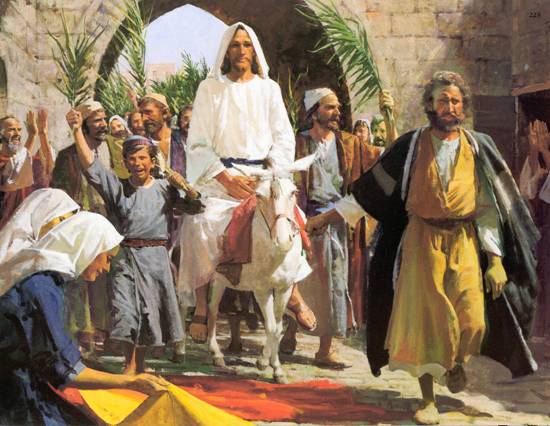
* Jesus now enters Jerusalem in triumph. Whereas he had previously entered the city quietly, he now does so publicly since his mission is almost completed.

* Jesus’ entry into Jerusalem recalls that of another king - King Solomon (see 1 Kings 1:32-49). Both are called “Son of David;” both ride a donkey (or mule); both were celebrated by a great crowd; both entries caused a commotion in the city.

* The crowd greets Jesus as a victorious king, sure that he will liberate Roman-occupied Israel in the manner foretold by the prophets (Zechariah 14:3-21). Their shouts of praise will turn into cries of condemnation, however, when Jesus turns out to be a different kind of king than the one they expect (Zechariah 9:9-10).
Here is the Processional Gospel Reading, as we will hear it at the opening of this Sunday’s Mass:
When Jesus and the disciples drew near Jerusalem
and came to Bethphage on the Mount of Olives,
Jesus sent two disciples, saying to them,
“Go into the village opposite you,
and immediately you will find an *** tethered,
and a colt with her.
Untie them and bring them here to me.
And if anyone should say anything to you, reply,
‘The master has need of them.’
Then he will send them at once.”
This happened so that what had been spoken through the prophet
might be fulfilled:
Say to daughter Zion,
“Behold, your king comes to you,
meek and riding on an ***,
and on a colt, the foal of a beast of burden.”
The disciples went and did as Jesus had ordered them.
They brought the *** and the colt and laid their cloaks over them,
and he sat upon them.
The very large crowd spread their cloaks on the road,
while others cut branches from the trees
and strewed them on the road.
The crowds preceding him and those following
kept crying out and saying:
“Hosanna to the Son of David;
blessed is the he who comes in the name of the Lord;
hosanna in the highest.”
And when he entered Jerusalem
the whole city was shaken and asked, “Who is this?”
And the crowds replied,
“This is Jesus the prophet, from Nazareth in Galilee.”
(Please Note: This uploaded content is no longer available.)
 
Status
Not open for further replies.
Back
Top