
Study and Meditations on this Sunday's Scripture Readings: May 8, 2011

  • Thread starter Thread starter Fidelis
  • Start date Start date
Status
Not open for further replies.
From the 1859 Haydock Commentary:
Christ’s resurrection: and manifestation of himself to his disciples.
13 And behold, two of them went that same day to a town which was sixty furlongs from Jerusalem, named Emmaus.
Ver. 13. St. Jerome thinks the Cleophas, one of the two disciples, was a citizen of Emmaus, and that he invited Jesus to take meat in his house. His house was afterwards changed into a church, which the same Father says existed in his time. Some think Cleophas was brother to St. Joseph; others, that he was husband of Mary, sister of the blessed Virgin Mary, and father of St. James the less. Both the Latins and Greeks keep the feast of St. Cleophas, and give him the name of an apostle. Usuard says he was martyred by the Jews. (Calmet)
*14 And they talked together of all these things which had happened.
15 And it came to pass, that while they talked and reasoned with one another, Jesus himself also drew near, and went with them.
16 But their eyes were held, that they should not know him.*
**Ver. 16. **But their eyes were held: either by our Saviour’s changing his features, or in what manner he pleased. (Witham)
*
17 And he said to them: What are these discourses that you hold one with another, as you walk, and are sad?
18 And the one, whose name was Cleophas, answering, said to him: Art thou alone a stranger in Jerusalem, that hast not known the things that have been done there in these days?*
**Ver. 18. ***Art thou alone a stranger in Jerusalem? *or, *art thou the only stranger in Jerusalem? *which was to signify, that every one must needs have heard of what had passed in regard to Jesus. (Witham)
*19 He said to them: What things? And they said to him: Concerning Jesus of Nazareth, who was a prophet, mighty in work and word, before God, and all the people:
20 And how our chief priests and rulers delivered him to be condemned to death, and crucified him.
21 But we hoped that it was he who should have redeemed Israel: and now, besides all this, to-day is the third day since these things were done.*
Continued on the next post…
 
Ver. 21. We hoped, &c. as if they had lost their former hopes, or now knew not what to hope for: but perhaps, as St. Augustine observes, they might use this caution speaking before a stranger. (Witham) — These two disciples were in the same error as the other Jews; who expected that the Messias would deliver them from subjection to strangers, and re-establish them in their ancient liberty. The cross and passion had been a subject of scandal and fall to them. They say, we did hope; as if their hopes were now at an end. What increased their diffidence was, that Christ had promised to rise again the third day, and some of the women had said that he really had risen. But they expected as public and glorious a manifestation of his resurrection, as his death had been ignominious and known to the whole world. Behold, now this is already the third day since these things are passed: if he had wished to manifest his power, he should have done it already. Thus the disciples reason, as if the third day were already past, and as if it were certain that he was not risen again. So difficult a thing is it to believe what we very ardently wish! (Calmet)
*22 Yea, and certain women also of our company, affrighted us, who, before it was light wereat the sepulchre,
23 And not finding his body, came, saying, that they had also seen a vision of Angels, who say that he is alive.
24 And some of our people went to the sepulchre, and found it so as the women had said; but him they found not.
25 Then he said to them: O foolish, and slow in heart, to believe in all the things which the prophets have spoken!
26 Ought not Christ to have suffered these things, and so to enter into his glory?
27 And beginning from Moses, and all the prophets, he expounded to them in all the Scriptures, the things that were concerning him.
28 And they drew nigh to the town whither they were going: and he made as though he would go farther.
29 But they constrained him, saying: Stay with us, because it is towards evening, and the day is now far spent. And he went in with them.
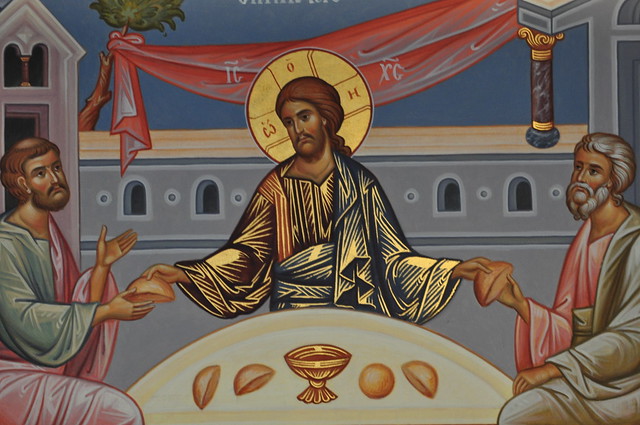
30 And it came to pass, whilst he was at table with them, he took bread, and blessed, and brake, and gave to them.*
**Ver. 30. **The ancient Fathers think our Saviour consecrated, on this occasion, and administered the Eucharist to the two disciples. In the Acts of the Apostles, this same term, breaking of bread, is explained without difficulty of the Eucharist. St. Luke seems fond of this manner of expression, to signify that sacrament. (Calmet)
*
31 And their eyes were opened, and they knew him: and he vanished out of their sight.
32 And they said one to the other: Was not our heart burning within us, whilst he was speaking in the way, and opened to us the Scriptures?
33 And rising up the same hour they went back to Jerusalem: and they found the eleven gathered together, and those that were with them,
34 Saying: The Lord is risen indeed, and hath appeared to Simon.
35 And they told what things were done in the way: and how they knew him in the breaking of the bread.*
 
Other thoughts and commentary on the Gospel Reading:
**13 Now that very day [the first day of the week]: **As attested in Luke 24:1, this is the first Easter Sunday.
**two of them: **It has been suggested that these two may be part of the seventy-two (seventy) sent out in pairs in Luke 10:1.
**
were going to a village seven miles from Jerusalem called Emmaus: **The location of the village is unknown today. The name means “hot spring”.
**14 and they were conversing about all the things that had occurred: **They must have found it hard to understand how Jesus, who had worked so many miracles and had even raised the dead to life, could allow his enemies to put him to death. The two have lost hope and have ceased to be journeying with Jesus. Their leader has been killed and they don’t know what to do. The Lucan theme of journey is predominant as an image for discipleship.
**15 And it happened that while they were conversing and debating, Jesus himself drew near and walked with them: **A third man joined them. They did not recognize him. Jesus had risen in his glorified body, entirely different from that laid in the tomb. He appeared in various visible forms—sometimes recognizable, to convince the Apostles of the truth of his resurrection, sometimes not recognizable, as on this occasion.
**16 but their eyes were prevented from recognizing him. **Throughout his gospel Saint Luke plays on the theme of seeing. Now he articulates this theme as he tells how the risen Christ opens the eyes of disciples to see His true meaning in God’s plan. But as this story narrates, the disciples’ eyes are only fully opened after they have shown hospitality to a stranger.
**17 He asked them, “What are you discussing as you walk along?” They stopped, looking downcast. **
Continued on the next post…
 
18 One of them, named Cleopas: From Eusebius (A.D. 263-339) we learn that Cleopas is the brother of Joseph, Jesus’ foster father and father of Symeon. Symeon succeeded James as Bishop of Jerusalem and after A.D. 70 led the Christians back to Jerusalem.
*
“After the martyrdom of James and the capture of Jerusalem which instantly followed, there is a firm tradition that those of the apostles and disciples of the Lord who were still alive assembled from all parts together with those who, humanly speaking, were kinsmen of the Lord—for most of them were still living. Then they all discussed together whom they should choose as a fit person to succeed James, and voted unanimously that Symeon, son of the Cleopas mentioned in the gospel narrative, was a fit person to occupy the throne of the Jerusalem see. He was, so it is said, a cousin of the Savior, for Hegesippus tells us that Cleopas was Joseph’s brother.”* [Eusebius, *The History of The Church (3.11)].

It has also been suggested that the second disciple in the narrative, who is not named, may be Mary, the wife of Cleopas, who is also mentioned in the Gospels. The names may not be important for salvation history, but the tradition brings out that the “brethren of Jesus”, his close relatives, did not completely reject Him.

**said to him in reply, “Are you the only visitor to Jerusalem who does not know of the things that have taken place there in these days?”

19 And he replied to them, “What sort of things?” They said to him, "The things that happened to Jesus the Nazarene, who was a prophet mighty in deed and word before God and all the people: **At most, Jesus had impressed these men as the expected prophet. They had not yet grasped Jesus’ divinity.
**
20 how our chief priests and rulers both handed him over to a sentence of death and crucified him.

21 But we were hoping that he would be the one to redeem Israel: **They had the Jewish idea of the Messiah—one who would give Israel a new earthly kingdom. They had lost all hope, now that he had been crucified.

Continued on the next post…
 
**and besides all this, it is now the third day since this took place.
22 Some women from our group, however, have astounded us: they were at the tomb early in the morning
23 and did not find his body; they came back and reported that they had indeed seen a vision of angels who announced that he was alive:** The story of the empty tomb had reached them before they left Jerusalem. But Christ was dead and, they thought, dead he would remain. Hence, all they had heard left them unimpressed, and they were returning home, thinking perhaps of the months and years they had “wasted” following Jesus. The faithful women disciples’ proclamation of the Easter gospel is resisted and does not open their eyes of faith.
**24 Then some of those with us went to the tomb: Peter and John (John 20:3-10)
and found things just as the women had described, but him they did not see."
25 And he said to them, “Oh, how foolish you are! How slow of heart to believe all that the prophets spoke!: **The stranger now chides them for not paying heed to the prophecies of the Old Testament concerning the Messiah.
**
26 Was it not necessary that the Messiah should suffer these things and enter into his glory?”: ** Because of sin which had entered the world and the wickedness of his contemporary enemies, Jesus had to die as a sinner and malefactor (for the sins of the world) and by his resurrection place the divine seal on his Messiahship and his true sonship of the Father. All this he proved to the two disciples, from the Old Testament prophecies.
27 Then beginning with Moses and all the prophets, he interpreted to them what referred to him in all the scriptures: Jesus begins His explanation with Genesis and the rest of the Pentateuch (tradition ascribes authorship of these books to Moses). What does positively contribute to faith is Jesus’ interpretation of His life as the fulfillment of all God’s promises from one end of the Scriptures to the other.
**28 As they approached the village to which they were going, he gave the impression that he was going on farther.
29 But they urged him, “Stay with us, for it is nearly evening and the day is almost over.” So he went in to stay with them: **Jesus was not play-acting, he really would have departed had He not been invited to stay. Out of true hospitality they constrained him to pass the night with them, and take a meal with them.
**30 And it happened that, while he was with them at table, he took bread, said the blessing, broke it, and gave it to them: **This is Eucharistic terminology. Jesus consecrated the Eucharist and in making Himself present in the Eucharist the two disciples saw the fulfillment of all the Old Testament covenants and prophesies as well as the New Testament promises. After all, this is what Jesus had just spent the day explaining to them. What a Bible study that must have been!
**31 With that their eyes were opened and they recognized him: The verb translated as “eyes were opened” occurs only eight times in the New Testament and in each case it always means a deeper understanding of revelation.
**
but he vanished from their sight:
The moment they recognized him he disappeared—again a proof that he was in his glorified body, not subject to the conditions of an earthly body.
**32 Then they said to each other, “Were not our hearts burning (within us) while he spoke to us on the way and opened the scriptures to us?”: ** They now remember how his conversation with them on the way had set their hearts afire with love for him and for the Father who had sent him.
**
33 So they set out at once and returned to Jerusalem: **Their despair was over and they returned to Jerusalem, to their vocation, placing themselves under the direction of the Apostles. They found the Apostles already convinced of the resurrection: “the Lord has risen indeed and has appeared to Simon.” Their story was only a confirmation of the acknowledged fact.
Notice that the two disciples are not at all upset at the loss (again) of their leader. In fact, they are anxious to tell the apostles of their discovery. They have discovered Jesus’ Real Presence in the Eucharist! The person-to-person physical presence of a visible Jesus is no longer necessary because He is indeed risen and is present in the word and in the sacrament.
**
where they found gathered together the eleven and those with them **
**
34 who were saying, “The Lord has truly been raised and has appeared to Simon!”: Jesus’ prayer (Luke 22:32) has been efficacious. Simon Peter has also been forgiven and is now empowered to strengthen his fellow Christians along the way.
**
35 Then the two recounted what had taken place on the way and how he was made known to them in the breaking of the bread.
 
Here are some questions on this Sunday’s Readings for personal study and reflection:
Code:
* The 1st Reading is from the first sermon preached by the Church after Pentecost (fifty days after the Resurrection of Jesus). What is the main message of the sermon, especially verses 22-33? What can we learn from the confidence with which the Apostles spoke the message?
Code:
* According to St. Peter in the 2nd Reading, what makes it possible to place our trust in God (verse 21)?
Code:
* In the Gospel Reading, what are the disciples talking about as they walk (see verses 19-24)? What tones of voice do you hear? What hopes are dashed? What plans might they be making? How do they react to the “stranger”?
Code:
* What Old Testament passages might the “stranger” have discussed with them in verses 25-27? Why did Jesus do a roundabout Bible study rather than just reveal his identity directly? Why did Jesus act as if he were going further?
Code:
* Where is your “road to Emmaus”—the place where Jesus surprised you recently? What happened? Did you urge him to stay? Why or why not?
Code:
* How well do you think you can explain the life, death, and Resurrection of Jesus Christ, and the way a person can come to know him? Who could you communicate these truths with today?
 
A reflection on the Sunday Readings from Dr. Scott Hahn at the St. Paul Center for Biblical Theology:

Emmaus and Us
We should put ourselves in the shoes of the disciples in today’s Gospel. Downcast and confused they’re making their way down the road, unable to understand all the things that have occurred.
They know what they’ve seen - a prophet mighty in word and deed. They know what they were hoping for - that He would be the redeemer of Israel. But they don’t know what to make of His violent death at the hands of their rulers.
They can’t even recognize Jesus as He draws near to walk with them. He seems like just another foreigner visiting Jerusalem for the Passover.
Note that Jesus doesn’t disclose His identity until they they describe how they found His tomb empty but “Him they did not see.” That’s how it is with us, too. Unless He revealed himself we would see only an empty tomb and a meaningless death.
How does Jesus make himself known at Emmaus? First, He interprets “all the Scriptures” as referring to Him. In today’s First Reading and Epistle, Peter also opens the Scriptures to proclaim the meaning of Christ’s death according to the Father’s “set plan” - foreknown before the foundation of the world.
Jesus is described as a new Moses and a new Passover lamb. He is the One of whom David sang in today’s Psalm - whose soul was not abandoned to corruption but was shown the path of life.
After opening the Scriptures, Jesus at table took bread, blessed it, broke it, and gave it to the disciples - exactly what He did at the Last Supper (see Luke 22:14-20).
In every Eucharist, we reenact that Easter Sunday at Emmaus. Jesus reveals himself to us in our journey. He speaks to our hearts in the Scriptures. Then at the table of the altar, in the person of the priest, He breaks the bread.
The disciples begged him, “Stay with us.” So He does. Though He has vanished from our sight, in the Eucharist - as at Emmaus - we know Him in the breaking of the bread.
 
From the Daily Scripture Reading & Meditation website:
"Did not our hearts burn while he opened to us the scriptures"
Scripture: Luke 24:13-35
**Meditation: **Why was it difficult for the disciples to recognize the risen Lord? Jesus’ death scattered his disciples and shattered their hopes and dreams. They had hoped that he was the one to redeem Israel. They saw the cross as defeat and could not comprehend the empty tomb until the Lord appeared to them and gave them understanding. Jesus chided the disciples on the road to Emmaus for their slowness of heart to believe what the scriptures had said concerning the Messiah. They did not recognize the risen Jesus until he had broken bread with them. Do you recognize the Lord in his word and in the breaking of the bread?
St. Augustine of Hippo (5th century) reflects on the dimness of their perception: “They were so disturbed when they saw him hanging on the cross that they forgot his teaching, did not look for his resurrection, and failed to keep his promises in mind” (Sermon 235.1). “Their eyes were obstructed, that they should not recognize him until the breaking of the bread. And thus, in accordance with the state of their minds, which was still ignorant of the truth (that the Christ would die and rise again”, their eyes were similarly hindered. It was not that the truth himself was misleading them, but rather that they were themselves unable to perceive the truth." (From The Harmony of the Gospels, 3.25.72) How often do we fail to recognize the Lord when he speaks to our hearts and opens his mind to us? The Risen Lord is ever ready to speak his word to us and to give us understanding of his ways. Do you listen attentively to the Word of God and allow his word to change and transform you?
*
“Lord Jesus Christ, open the eyes of my heart to recognize your presence with me and to understand the truth of your saving word. Nourish me with your life-giving word and with the bread of life.” *
 
From Presentation Ministries:
EMMAUS MASS

*“Were not our hearts burning inside us?” *—Luke 24:32

The pattern used by Jesus in the Emmaus walk is the pattern of the Mass: Notice the sequence of events Jesus uses as He walks to Emmaus with His disciples and then stays with them afterward. The Church follows the same pattern to this very day in the Mass:
  1. Liturgy of the Word. We listen intently to the Scriptures, so much so that our heart burns within us (Lk 24:32). We ask Jesus to open our minds to understand the Scriptures (Lk 24:45). During the homily, the significance of the Word is interpreted for us (see Lk 24:27).
  2. Liturgy of the Eucharist. When the banquet of the Word of God has been completed, Jesus breaks the bread. It is during the Eucharist that our eyes are especially opened to recognize Jesus present with us (Lk 24:31).
  3. At the conclusion of Mass, a word which means “sent,” we ourselves are sent forth to love and serve the Lord. The two disciples at Emmaus got the message. They immediately set out to announce the good news of Jesus to others (Lk 24:33). We are likewise sent forth.
We may enter Mass preoccupied (Lk 24:14) or downcast (Lk 24:18) like the disciples on the road to Emmaus before they encountered Jesus. We may enter Mass slow to believe (Lk 24:25). Yet even one Mass can catapult us into experiencing new, risen life in Jesus. Go to Mass as often as possible, even daily. Let Jesus set your heart ablaze with His risen life.

**Prayer: **Father, I decide today to center my life around the Mass.
**Promise: **“You will show me the path to life, fullness of joys in Your presence, the delights at Your right hand forever.” —Ps 16:11
Praise: Praise the risen Jesus, Who through His Word and Eucharist is with us always. Alleluia!
 
A meditation and questions from “The Word Among Us” magazine:
**Meditation: **Acts 2:14,22-33
“God raised this Jesus; of this we are all witnesses.” (Acts 2:32)
The resurrection of Jesus was at the heart of Peter’s message on Pentecost, and it became his mission statement for the rest of his life.
Two thousand years later, God still wants the resurrection to be at the heart of our faith. As the Catechism of the Catholic Church teaches: “The Resurrection of Jesus is the crowning truth of our faith in Christ, a
faith believed and lived as the central truth by the first Christian community; handed on as fundamental by Tradition; established by the documents of the New Testament; and preached as an essential part of the Paschal mystery along with the cross: Christ is risen from the dead!” (638).
Just as the apostles were first-century witnesses to the resurrection, God calls us to be twenty-first-century witnesses to the very same event. He wants us to be bold and steadfast as we testify to the transformation that Jesus’ resurrection has brought about in our own lives. Of course we should try to witness through our good deeds, but he also calls us to speak clearly, excitedly, and joyfully about the basis for our hope and our faith. And what is that basis? Christ has died. Christ is risen. Christ will come again!
Take time today to reflect on the concrete ways that the reality of Jesus’ resurrection has changed your life. How has it given you hope? Strength? Comfort? Peace? Try to boil it down into a couple of sentences. Make it into a proclamation of faith that you can announce to yourself and to the Lord every morning when you wake up. Make it the basis for your decisions as you go throughout the day. Ask the Holy Spirit how you can tell people about your faith and joy in the risen Lord.
Commit yourself to sharing the good news with at least one person this week. Then go out and do it!
“Praise to you, Jesus, my risen Savior! ‘You will show me the path to life, abounding joy in your presence, the delights at your right hand forever’ (Psalm 16:11).”
Questions for Reflection or Group Discussion
  1. In the first reading from Acts, Peter gives a powerful proclamation of the Gospel message in such a way that the listeners are “cut to the heart” (Acts 2:37). Where did Peter, in spite of being an uneducated fisherman, get such a gift? (Hint: Peter gives the answer in Acts 2:33.) If we believe that we as baptized Catholics have the ability to proclaim the Gospel through the power of the Spirit that dwells in us, what keeps us from sharing it with others? How can you overcome some of these obstacles?
  1. Notice in the responsorial psalm, how the psalmist keeps his mind and heart fixed on the Lord (“I set the Lord ever before me”) and the fruit of it (”with him at my right hand I shall not be disturbed”). What steps can you take to turn to the Lord more often during the day, even in the midst of your busyness?
  1. In the second reading from 1 Peter, we are reminded to “conduct yourself with reverence” because “you were ransomed from your futile conduct … with the precious blood of Christ” (1 Peter 1:17-19). Do you believe that reflecting more on what Jesus accomplished by shedding his blood on the cross for you can impact how you live out your day? Why or why not? Any examples?
  1. The Gospel reading describes the Emmaus Road encounter with Jesus by two of his disciples. Why do you think they did not recognize Jesus until “the breaking of bread” (an early Church term for the Eucharist)?
  1. Are you willing to spend time just prior to the start of Mass reading and reflecting on the Mass readings? If not, why not? Perhaps if you do, like the Emmaus Road disciples, your heart will burn as the Scriptures are read and explained at Mass.
  1. In the meditation, we hear these words: “Take time today to reflect on the concrete ways that the reality of Jesus’ resurrection has changed your life.” These words are followed in the meditation by these questions: “How has it given you hope? Strength? Comfort? Peace?” How would you answer these questions? Are you willing to share your answers with others as the opportunities arise? Why or why not?
  1. Take some time now and pray that you would experience more deeply the transforming power of the resurrection of Jesus. Use the prayer at the end of the meditation as the starting point.
 
Taste and See the Goodness of the Lord – A Meditation on the Gospel for the Third Sunday of Easter
By: Msgr. Charles Pope
In today’s gospel we encounter two discouraged and broken men making their way to Emmaus. The text described them as “downcast.” That is to say, their eyes are cast to the ground, their heads are hung low. Their Lord and Messiah has been killed; the one they had thought would finally liberate Israel. Yes, it is true, some women had claimed he was alive, but these disciples have discredited the reports and are now leaving Jerusalem. It is late in the afternoon. The sun is sinking low.
The men cannot see or understand God’s plan. They cannot “see” that he must be alive, just as they were told. They are quite blind as to the glorious things that have already happened, hours before. Their eyes are cast downward. And, in this, they are much like us, who also struggle to see and understand that we have already won the victory. Too easily we are downcast, our eyes cast downward in depression rather than upward in faith.
And how will the Lord give them (and us) vision? How will he enable them to see his risen glory? How will he encourage them to look up from their downcast focus and behold new life?
In effect, if you are prepared to “see” it, the Lord will celebrate Holy Mass with them. In the context of a sacred meal we call the Mass, he will open their eyes, and they will recognize him, they will see glory and new life.
Note that the whole gospel, not just the last part, is in the form of a Mass. There is a gathering, a penitential rite, a Liturgy of the Word, Intercessory prayers, a Liturgy of the Eucharist, and an Ite Missa est. And, in this manner of a whole Mass, they have their eyes opened to Him and to glory. They will fulfill the psalm which says: Taste, and see, the goodness of the Lord (Psalm 34:8).
Lets look at this Mass, which opens their eyes, and ponder how we too taste and see in every Mass.
**
Stage One: Gathering Rite -** The Curtain rises on this Mass with two disciples having gathered together on a journey: *Now that very day two of them were going to a village seven miles from Jerusalem called Emmaus *(Lk 24:13). We have already discussed above that they were in the midst of a serious struggle and are downcast. We only know one of them by name, Cleopas. Who is the other? If you are prepared to accept it, the other is you. So they (this means you, this means me) have gathered. This is what we do as the preliminary act of every Mass. We who are pilgrims on a journey come together on our journey.
It so happens for these two disciples that Jesus joins them: *And it happened that while they were conversing and debating, Jesus himself drew near and walked with them *(Luke 24:15). The text goes on to inform us that they did not recognize Jesus yet.
The Lord walks with us too – Now for us who gather at Mass it is essential to acknowledge by faith that when we gather together, the Lord Jesus is with us. For Scripture says, *For where two or three are gathered in my name, there am I among them *(Matt 18:20). It is a true fact that for many of us too, Jesus, though present, is unrecognized! Yet he is no less among us than he was present to these two disciples who fail to recognize him.
Liturgically we acknowledge the presence of the Lord at the beginning of the Mass in two ways. First, as the priest processes down the aisle the congregation sings a hymn of praise. It is not “Fr. Jones” they praise, it is Jesus, whom “Fr. Jones” represents, that they praise. Once at the Chair the celebrant (who is really Christ) says, “The Lord be with you.” And thereby he announces the presence of Christ among us promised by the Scriptures.
The Mass has begun, our two disciples are gathered and the Lord is with them. So too for us at every Mass. The two disciples still struggle to see the Lord, struggle to experience new life and that the victory has already been one. And so too some of us who gather for Mass. But simply the fact that these disciples (us) are gathered is already the beginning of the solution. Mass has begun, help is on the way!
**
Stage Two: Penitential Rite - **The two disciples seem troubled and the Lord inquires of them the source of their distress: *What are you discussing as you walk along? *(Lk 24:17) In effect the Lord invites them to speak with him about what is troubling them. It may also be a gentle rebuke from the Lord that the two of them are walking away from Jerusalem, away from the site of the resurrection.
Clearly their sorrow and distress are governing their behavior. Even though they have already heard evidence of his resurrection (cf 24:22-24), they seem hopeless and have turned away from this good news. As we have well noted, the text describes them as “downcast” (24:17).
Thus the Lord engages them is a kind of gentle penitential rite and wants to engage them on their negativity.
So too for us at Mass. The penitential rite is a moment when the celebrant (who is really Christ) invites us to lay down our burdens and sins before the Lord who alone can heal us. For, we too, often enter the presence of God looking downcast and carrying many burdens and sins. We too, like these disciples may be walking in wrongful directions. And so the Lord says to us, in effect, “What are thinking about and doing as you walk along? Where are you going with your life?
Continued on the next post…
 
The Lord asks them, and us, to articulate our struggles. This calling to mind of our struggles for them and us in the penitential rite, is a first step to healing and recovery of sight.
And thus again, we see in this story about two disciples on the road to Emmaus, the Mass that is so familiar to us.
**
Stage Three: Liturgy of the Word – **In response to their concerns and struggles the Lord breaks open the Word of God, the Scriptures. The text says: *Then beginning with Moses and all the prophets, he interpreted to them what referred to him in all the scriptures *(Luke 24:27).
Notice, not only does the Lord refer to Scripture, but he interprets it for them. Hence the Word is not only read, there is also a homily, an explanation and application of the Scripture to the struggles these men have. The homily must have been a good one too, for later, the disciples remark: *Were not our hearts burning (within us) while he spoke to us on the way and opened the scriptures to us? (*Luke 24:32)
And so too for us at Mass. Whatever struggles we may have brought to the Mass, the Lord bids us to listen to his Word as the Scriptures are proclaimed. Then the homilist (who is really Christ) interprets and applies the Word to our life. It is a true fact that the Lord works through a weak human agent, (the priest or deacon), but God can write straight with crooked lines. As long as the homilist is orthodox, it is Christ who speaks. Pray for your homilist to be an obedient and useful instrument for Christ at the homily moment.
Notice too, though they do not fully yet see, their downcast attitude has been abated. Their hearts are now on fire. Pray God, too, for us who come to Mass Sunday after Sunday and hear from God how victory is already ours in Christ Jesus. God reminds us, through successive Sundays and passages which repeat every three years, that though the cross is part of our life, the resurrection surely is too. And we are carrying our crosses to an eternal Easter victory. If we are faithful to listening to God’s Word, hope and joy build within our hearts and we come, through being transformed by Christ in the Liturgy to be men and women of hope and confidence.
**
Stage Four: Intercessory Prayers – **After the homily we usually make prayers and requests of Christ. We do this based on the hope that his Word provides us that he lives, he loves us and he is able. And so it is that we also see these two disciples request of Christ: Stay with us, for it is nearly evening and the day is almost over. (Luke 24:29)
Is this not what we also say in so many words: “Stay with us Lord, for it is sometimes dark in our lives and the shadows are growing long. Stay with us Lord and those we love so that we will not be alone in the dark. In our darkest hours, be to us a light O Lord that never fades away.”
And indeed, it is already getting brighter for we are already more than halfway through the Mass!
Concluded on the next post…
 
Stage Five: Liturgy of the Eucharist – Christ does stay with them and then come the lines that no Catholic could miss: And it happened that, while he was with them at table, he took bread, said the blessing, broke it, and gave it to them (Luke 24:30). Yes, the Mass to be sure. All the basic action of the Eucharist are there: he took, blessed, broke and gave. It is the same action as at the Last Supper and the same action in every Mass. Later, the two disciples will refer back to this moment as the breaking of the bread (Luke 24:35), a clear Biblical reference to the Holy Eucharist.
And so, the words of Mass come immediately to mind: “While they were at supper He took the bread, and gave you thanks and praise. He broke the bread, gave it to his disciples and said, take this all of you and eat it: this is my Body which will be given up for you.”
A fascinating thing happens though: With that their eyes were opened and they recognized him, but he vanished from their sight (Luke 24:31).
Note that it is the very act of consecration that opens their eyes. Is this not what Holy Communion is to do for us? Are we not to learn to recognize Christ by the very mysteries we celebrate? Are we not to Taste and See?
The liturgy and the sacraments are not mere rituals, they are encounters with Jesus Christ, and though our repeated celebration of the holy mysteries our eyes are increasingly opened if we are faithful. We learn to see and hear Christ in the liturgy, to experience his ministry to us.
The fact that he vanishes from their sight teaches us that he is no longer seen by the eyes of the flesh, but by the eyes of faith, and the eyes of the heart. So though he is gone from our earthly, fleshly, carnal sight, he is now to be seen in the Sacrament of the Altar, and experienced in the Liturgy and other Sacraments. The Mass has reached it’s pinnacle, for these two disciples and for us; for they have tasted and now they see.
Consider these two men (and us) who began this gospel quite downcast. Now their hearts are on fire and they see. The Lord has celebrated Mass to get them to this point. And so too for us, the Lord celebrates Mass to set our hearts on fire and open our eyes to glory. We need to taste in order to see. Consider a fuller number of verses from that psalm (34):
*I sought the Lord, and he answered me; he delivered me from all my fears. Those who look to him are radiant; their faces are never covered with shame. This poor man called, and the Lord heard him; he saved him out of all his troubles. …Taste and see that the Lord is good; blessed is the man who takes refuge in him *(Psalm 34:4-8).
Yes, blessed are we if we faithfully taste in order to see, every Sunday at Mass.
**
Stage six: *Ite Missa est ***– Not able to contain their joy or hide their experience the two disciples run seven miles back to Jerusalem to tell their brethren what had happened and how they encountered Jesus in the breaking of the bread. They want to, they have to, speak of the Christ they have encountered, what he said and what he did.
How about us? At the end of every Mass the priest or deacon says “The Mass is ended, go in peace.” This does NOT mean, “OK, we’re done here, go on home, and haver nice day.” What it DOES mean is: “Go now into the world and bring the Christ you have received to others. Tell them what you have heard and seen here, what you have experienced. Share the joy and hope that this Liturgy gives with others.”
Perhaps you can see the word MISSion in the word disMISSal? You are being commissioned, sent on a mission to announce Christ to others.
The Lucan text we are reviewing says of these two disciples:* So they set out at once and returned to Jerusalem where they found gathered together the eleven and those with them……Then the two recounted what had taken place on the way and how he was made known to them in the breaking of the bread *(Lk 24:33,35). How about us. Does our Mass finish as well, as enthusiastically? Can you tell others that you have come to Christ in “the breaking of the bread,” in the Mass?
So Jesus has used the Mass to drawn them from gloom to glory, from being downcast to delighted, from darkness to light. It was the Mass, do you “see” it there. It is the Mass. What else could it be?
 
**Walking alongside Jesus and don’t recognize him? **
How frequently are we on the road with him and don’t hear, even when it talks directly to our face. Are we blind or deaf to his signs and signals?

*Let’s listen carefully today for his signs. *

From Sunday’s Reading
 
Status
Not open for further replies.
Back
Top