Stylites - Extreme Ascetism

  • Thread starter Thread starter TrueLight
  • Start date Start date
Status
Not open for further replies.
T

TrueLight

Guest
I tend to be fascinated by ascetism and I was doing some reading when I stumbled upon the term “stylites”. Wiki tells me that stylites are “are a type of Christian ascetic who in the early days of the Byzantine Empire stood on pillars preaching, fasting and praying.” Wikipedia.

Some interesting Stylite facts:
The first stylite was probably Simeon Stylites the Elder who climbed on a pillar in Syria in 423 and remained there until his death 37 years later.
**Saint Alypius, **whose pillar had been erected near Hadrianopolis in Paphlagonia. Alypius, after standing upright for 53 years, found his feet no longer able to support him, but instead of descending from his pillar lay down on his side and spent the remaining fourteen years of his life in that position.
**St. Gregory of Nazianzus **(Patrologia Graeca 37, 1456) speaks of a solitary who stood upright for many years together, absorbed in contemplation, without ever lying down.
Palladius of Galatia (chapter 48) tells us of a hermit in Palestine who dwelt in a cave on the top of a mountain and who for the space of twenty-five years never turned his face to the west so that the sun never set on his face
What do you admire about these stylites, if anything?

What are your thoughts about these stylites of old?

What do you admire or not admire about ascetics?

Are there any stylites in existence today?

If you know any facts or tidbits, about stylites - please post!

By the way, we have a CAF member named “Stylites”. I never knew what the name meant. 😛

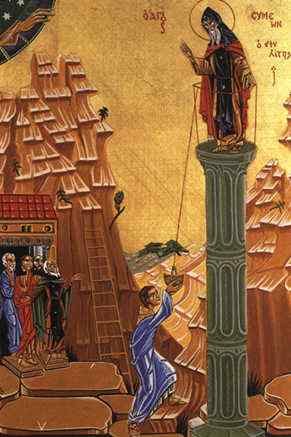
http://img15.imageshack.us/img15/7408/stsimeonstylite.jpg
 
I tend to be fascinated by ascetism and I was doing some reading when I stumbled upon the term “stylites”. Wiki tells me that stylites are “are a type of Christian ascetic who in the early days of the Byzantine Empire stood on pillars preaching, fasting and praying.” Wikipedia.

Some interesting Stylite facts:

What do you admire about these stylites, if anything?

What are your thoughts about these stylites of old?

What do you admire or not admire about ascetics?

Are there any stylites in existence today?

If you know any facts or tidbits, about stylites - please post!

By the way, we have a CAF member named “Stylites”. I never knew what the name meant. 😛
Some of the tales bout these fellows are shrouded in mist. I do not believe in most of them. In India they have got the fakirs who do strange things:
click to see
 
Some of the tales bout these fellows are shrouded in mist. I do not believe in most of them. In India they have got the fakirs who do strange things:
click to see
Wow at the picture!

Is it the length of time that these stylites spent in extreme positions that you don’t believe?
 
Simeon Stylite is legit. Princes even came asking for his advice. Pope Leo I even corresponded with him about Chalcedon. In the Guiness Book of Records he still holds the record for the longest pole sit.
 
“The monks went withou sleep because they were watching for the Lord; they did not speak because they were listening to God; they fasted because they were fed by the Word of God. It was the end that mattered, the ascetic parctices were only a means.”

“Arsenius prayed on Saturday evening with his arms stretched out to the setting sun, and he stayed there until the sun shone on his face on Sunday. The usual pattern was to say the Psalms, one after another, during the week, and to intersperse this with weaving ropes, sometimes saying, ‘Lord Jesus Christ, have mercy upon me.’ The aim was hesychias, quiet, the calm through the whole man that is like a still pool of water, capable of reflecting the sun.”
  • “The Wisdom of the Desert Fathers” translated by Sister Benedicta Ward, SLG
 
The stylites remind me that the wisdom of God appears as foolishness to men. I’d rather be a fool for Christ, but too often I am a prudish Pharisee.
 
“The monks went withou sleep because they were watching for the Lord; they did not speak because they were listening to God; they fasted because they were fed by the Word of God. It was the end that mattered, the ascetic parctices were only a means.”

“Arsenius prayed on Saturday evening with his arms stretched out to the setting sun, and he stayed there until the sun shone on his face on Sunday. The usual pattern was to say the Psalms, one after another, during the week, and to intersperse this with weaving ropes, sometimes saying, ‘Lord Jesus Christ, have mercy upon me.’ The aim was hesychias, quiet, the calm through the whole man that is like a still pool of water, capable of reflecting the sun.”
  • “The Wisdom of the Desert Fathers” translated by Sister Benedicta Ward, SLG
I have wondered if such behavior isn’t sometimes narcissistic.

What I mean by that is if unity with the trinity, contemplation, hesychias, calm, peace, stillness or other such experiences and states of being are absent service to and love for others, then does it really serves a purpose?

I know this is not the case. Many of the desert father’s lived authentical Christain lives, and there are Catholic Christian hermits who live authentic Christian lives, withdrawn from the world, practicing lives which most of us consider extreme.

Maybe I’m just projecting my own spirituality on something and someone else, but it is something I have thought about, how such extreme ascetics are not self serving. The upside down guy with his head buried appears to be the polar opposite of Mother Theresa.

Or am I looking at it the wrong way? Are they opposite sides of the same coin?

-Tim-
 
I am on the same page as you, Tim, and have wondered the same thing.
I think that the world needs some people who can devote their entire lives to prayer & contemplation such as the ‘stylites’, but I don’t think it should be a “norm”- nothing would ever get done!! 🤷
I have wondered if such behavior isn’t sometimes narcissistic.

What I mean by that is if unity with the trinity, contemplation, hesychias, calm, peace, stillness or other such experiences and states of being are absent service to and love for others, then does it really serves a purpose?

I know this is not the case. Many of the desert father’s lived authentical Christain lives, and there are Catholic Christian hermits who live authentic Christian lives, withdrawn from the world, practicing lives which most of us consider extreme.

Maybe I’m just projecting my own spirituality on something and someone else, but it is something I have thought about, how such extreme ascetics are not self serving. The upside down guy with his head buried appears to be the polar opposite of Mother Theresa.

Or am I looking at it the wrong way? Are they opposite sides of the same coin?

-Tim-
 
What I mean by that is if unity with the trinity, contemplation, hesychias, calm, peace, stillness or other such experiences and states of being are absent service to and love for others, then does it really serves a purpose?

-Tim-
Ascetics are doing what we can’t or won’t do: giving up everything they have and following Him. I read that He will feed you and I believe it. I also think they stay God’s hand from chastising humanity. If you are righteous in the sight of God, then everything else follows, including Charity. I think we need more ascetics in the Church and not such an emphasis on social work, today. The cart has been put before the horse.

Padre Pio would be an excellent example. Stayed in his friary (except when dispensed), mortified himself all his life yet was able to found a huge hospital and influenced the lives of millions.
 
“The monks went withou sleep because they were watching for the Lord; they did not speak because they were listening to God; they fasted because they were fed by the Word of God. It was the end that mattered, the ascetic parctices were only a means.”

“Arsenius prayed on Saturday evening with his arms stretched out to the setting sun, and he stayed there until the sun shone on his face on Sunday. The usual pattern was to say the Psalms, one after another, during the week, and to intersperse this with weaving ropes, sometimes saying, ‘Lord Jesus Christ, have mercy upon me.’ The aim was hesychias, quiet, the calm through the whole man that is like a still pool of water, capable of reflecting the sun.”
  • “The Wisdom of the Desert Fathers” translated by Sister Benedicta Ward, SLG
Hi there Stylites! 😃
 
I have wondered if such behavior isn’t sometimes narcissistic.

What I mean by that is if unity with the trinity, contemplation, hesychias, calm, peace, stillness or other such experiences and states of being are absent service to and love for others, then does it really serves a purpose?

I know this is not the case. Many of the desert father’s lived authentical Christain lives, and there are Catholic Christian hermits who live authentic Christian lives, withdrawn from the world, practicing lives which most of us consider extreme.

Maybe I’m just projecting my own spirituality on something and someone else, but it is something I have thought about, how such extreme ascetics are not self serving. The upside down guy with his head buried appears to be the polar opposite of Mother Theresa.

Or am I looking at it the wrong way? Are they opposite sides of the same coin?

-Tim-
I would say that everyone is not called to do that just as everyone is not meant to be a nun. One might ask if an enclosed nun is not missing something by not caring for the world or if they don’t love their fellow man. If they are praying for souls, they are doing a much needed work.

Is there a place for those who give up all, even their own discomfort?

I would also say being a recluse does not mean one does not love others.

Did these stylites pray for souls?


Generations of pilgrim souvenir collectors from times past have chipped the actual pillar to a stump.

Something makes me think that he must have had a rich patron. Erecting a pillar like that is expensive. However, I don’t think it was extremely high, it may not have been much taller than the stump is today.

 
I think there had to be more to it than what is portrayed in the image; otherwise, how did they clean themselves, eat, or go to the bathroom? :confused:

It sounds wonderful to “live in pure contemplation” for 50 some years, but they would have starved to death pretty quickly if they didn’t have some way to get food and water up the pillar, and waste materials down from it to a sanitary disposal site.

Also, how did they go to Mass? :confused:
 
I think there had to be more to it than what is portrayed in the image; otherwise, how did they clean themselves, eat, or go to the bathroom? :confused:

It sounds wonderful to “live in pure contemplation” for 50 some years, but they would have starved to death pretty quickly if they didn’t have some way to get food and water up the pillar, and waste materials down from it to a sanitary disposal site.

Also, how did they go to Mass? :confused:
I don’t believe the Desert Fathers went to Mass, but priests would travel out into the desert and bring Holy Communion to the hermits and ascetics.

Here’s from the wikipedia on Simeon Stylies:

Simeon was the son of a shepherd. He was born at Sis, now the Turkish town of Kozan in Adana Province. Sis was in the Roman province of Cilicia, and after the western Roman Empire fell in 395 it remained part of the eastern Roman Empire and Christianity grew quickly there.

According to Theodoret, Bishop of Cyrrhus, Simeon developed a zeal for Christianity at the age of 13, following a reading of the Beatitudes. He subjected himself to ever-increasing bodily austerities from an early age, especially fasting, and entered a monastery before the age of 16.

On one occasion, moving nearby, he commenced a severe regimen of fasting for Lent and was visited by the head of the monastery, who left him some water and loaves. A number of days later, Simeon was discovered unconscious, with the water and loaves untouched. When he was brought back to the monastery, it was discovered that he had bound his waist with a girdle made of palm fronds so tightly that days of soaking were required to remove the fibres from the wound formed. At this, Simeon was requested to leave the monastery.

He then shut himself up for one and a half years in a hut, where he passed the whole of Lent without eating or drinking. When he emerged from the hut, his achievement was hailed as a miracle.He later took to standing continually upright so long as his limbs would sustain him.

After one and a half years in his hut, Simeon sought a rocky eminence on the slopes of what is now the Sheik Barakat Mountain and compelled himself to remain a prisoner within a narrow space, less than 20 meters in diameter. But crowds of pilgrims invaded the area to seek him out, asking his counsel or his prayers, and leaving him insufficient time for his own devotions. This at last led him to adopt a new way of life.

Atop the pillar

In order to get away from the ever increasing number of people who frequently came to him for prayers and advice, leaving him little if any time for his private austerities, Simeon discovered a pillar which had survived amongst ruins, formed a small platform at the top, and upon this determined to live out his life. It has been stated that, as he seemed to be unable to avoid escaping the world horizontally, he may have thought it an attempt to try to escape it vertically. For sustenance small boys from the village would climb up the pillar and pass him small parcels of flat bread and goats’ milk.

. . .

This first pillar was little more than four meters high, but his well-wishers subsequently replaced it with others, the last in the series being apparently over 15 meters from the ground. At the top of the pillar was a platform, with a baluster, which is believed to have been about one square meter.

en.wikipedia.org/wiki/Simeon_Stylites
 
I have wondered if such behavior isn’t sometimes narcissistic.

What I mean by that is if unity with the trinity, contemplation, hesychias, calm, peace, stillness or other such experiences and states of being are absent service to and love for others, then does it really serves a purpose?

I know this is not the case. Many of the desert father’s lived authentical Christain lives, and there are Catholic Christian hermits who live authentic Christian lives, withdrawn from the world, practicing lives which most of us consider extreme.

Maybe I’m just projecting my own spirituality on something and someone else, but it is something I have thought about, how such extreme ascetics are not self serving. The upside down guy with his head buried appears to be the polar opposite of Mother Theresa.

Or am I looking at it the wrong way? Are they opposite sides of the same coin?

-Tim-
Well, the proponents of the contemplative life point to the Gospel account of Martha, who was busy serving Christ, while Mary sat at His feet. But as for the Desert Fathers, although many were hermits there were also many monastic communities, and charity was always practiced. And yes, the Church came to discourage extreme asceticism, as I recall there later came a competative trend which was unhealthy.

The vineyard workers of today work for a few hours and get the same wages as those who had toiled all day in the hot sun.
 
Wow at the picture!

Is it the length of time that these stylites spent in extreme positions that you don’t believe?
I think that above all it is the night time that puzzles me. It is hard to keep the balance sleeping unless they had some forms of staying there.
Anyhow, my opinion is just 1 millimeter in the whole scene. 🙂
 
Status
Not open for further replies.
Back
Top