Sunday Scripture Readings: Studies and Meditations, October 24

  • Thread starter Thread starter Fidelis
  • Start date Start date
Status
Not open for further replies.
A reflection on the second reading for application from Catholic Matters:
**APPLICATION: **What a wonderful thing, what a source of courage and consolation it would be for us, if we could, like St. Paul, say on our death-beds: “I have fought the good fight, I have finished the race, I have kept the faith”! There are few followers of Christ in the history of the Christian Church who did, and suffered for the faith of Christ, what Paul did and suffered. He was exceptional even among exceptional saints. Then of course, his was an exceptional vocation. The Risen Christ appeared to him while he was on his way to persecute and arrest the Christians of Damascus, having already done great damage to the infant Church in Jerusalem. That appearance, and the words of Christ, turned a fanatical adversary of the faith into an ardent Apostle of Christ. He devoted every moment of his remaining thirty years to bringing the knowledge of Christ and the good news of the Incarnation, that act of infinite love of God for men, to the Gentile world.
We cannot and we should not hope to imitate him in death, as we did not, nor were we called on, to imitate him in life. That, however, does not mean that each one of us could not repeat his words of courage and confidence on our very ordinary death-beds. There are outstanding saints in heaven, and it will be part of our eternal happiness to meet them and admire them, or maybe rather to admire the omnipotent God who was able to make such saints of them. Let us never forget that there are, please God, millions of ordinary saints in heaven, men and women like ourselves, who were not called on to do anything very extraordinary here below, but who lived the ordinary Christian life well. That last word “well” is the secret of their success.
These citizens of heaven have got there through the grace of God and through living their hum-drum daily Christian lives as God wished them to be lived. Because they lived each day as faithful Christians, keeping the laws of God, accepting the rough with the smooth, measuring their daily actions with the yard-stick of eternity, they could (on the day or night that God decided to call them to himself) say with St. Paul: “I have fought the good fight, I have finished the race, I have kept the faith.” With that same assurance as St. Paul, they could expect the reward which the just judge had in store for them.
Most of us have the wrong idea of what a saint is. We hear only of men and women who lived lives of severe mortifications, men and women who were completely detached from all that this world has, who never seemed to have any earthly interests or joys. There were some such people and they are now in heaven. But they are a tiny minority. Heaven is for the Toms, Dicks, and Harrys, as well as for the Pauls, Patricks and Teresas. If not, Christ and Christianity would be sad failures!
No, heaven is for all of us. Getting there is much easier than what our pious literature would suggest. Judging by the legends that hagiographers collected or invented most of their saints were born not made. The facts are otherwise. These men and women became saints because they lived Christian, but at the same time, human lives. They did not spend their days gazing heavenwards, with hands joined in prayer. They did an honest day’s work, and earned their livelihood. They were not always weeping and bemoaning the sins of the world and their own. They were instead full of joy and were the most cheery of companions. The great reformer of the Carmelites, St. Teresa of Avila, who lived a strict life of poverty and personal mortification, is said to have uttered the prayer: “May God protect me from sour-faced saints!”
Granted that heaven is for all of us and granted that most of us are not called on to do anything extraordinary in life, we are called on to live our very ordinary day in a Christian manner. Each ordinary day that we offer to God, and live for him, as well as for our own earthly necessities, brings us a day nearer to the death-bed on which we can truly say with St. Paul : “I have fought the good fight, I have finished the race, I have kept the faith.” The rest I can safely leave to the good and just God.
 
GOSPEL: Luke 18: 9-14

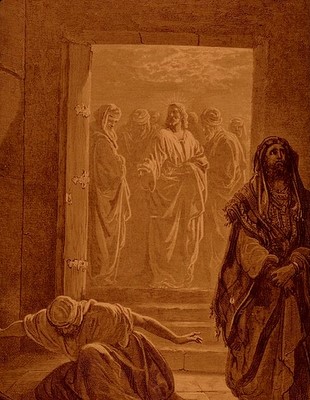
As we proceed from our gospel reading last week which presented Jesus’ first parable on prayer, we now hear the second parable on prayer. Recall that the question has often been put to Jesus “When and how will the end come?” Jesus’ answer is always that we are to persevere in prayer and humility–indeed, in humble prayer. These two parables (the one we heard last week and this one) appear only in Luke and in this one we are reminded that our virtuous works what we are proud of will not earn us entrance into God’s kingdom.

Here is the Gospel Reading as we will hear it this Sunday:
Jesus addressed this parable
to those who were convinced of their own righteousness
and despised everyone else.
“Two people went up to the temple area to pray;
one was a Pharisee and the other was a tax collector.
The Pharisee took up his position and spoke this prayer to himself,
'O God, I thank you that I am not like the rest of humanity –
greedy, dishonest, adulterous – or even like this tax collector.
I fast twice a week, and I pay tithes on my whole income.’
But the tax collector stood off at a distance
and would not even raise his eyes to heaven
but beat his breast and prayed,
‘O God, be merciful to me a sinner.’
I tell you, the latter went home justified, not the former;
for whoever exalts himself will be humbled,
and the one who humbles himself will be exalted.”
 
From the Navarre Bible Commentary (with RSV-CE text):
Parable of the Pharisee and the Tax Collector
---------------------------------------------

[9] He (Jesus) also told this parable to some who trusted in themselves that they were righteous and despised others: [10] “Two men went up into the temple to pray, one a Pharisee and the other a tax collector. [11] The Pharisee stood and prayed thus with himself, God, I thank Thee that I am not like other men, extortioners, unjust, adulterers, or even like this tax collector. [12] I fast twice a week, I give tithes of all that I get.' [13] But the tax collector, standing far off, would not even lift up his eyes to Heaven, but beat his breast, saying, God, be merciful to me a sinner!’ [14] I tell you, this man went down to his house justified rather than the other; for every one who exalts himself will be humbled, but he who humbles himself will be exalted.”
**9-14. **Our Lord here rounds off His teaching on prayer. In addition to being persevering and full of faith, prayer must flow from a humble heart, a heart that repents of its sins: “Cor contritum et humiliatum, Deus, non despicies” (Psalm 51:19); the Lord, who never despises a contrite and humble heart, resists the proud and gives His grace to the humble (cf. Peter 5:5; James 4:6).
The parable presents two opposite types–the Pharisee, who is so meticulous about external fulfillment of the Law; and the tax collector, who in fact is looked on as a public sinner (cf. Luke 19:7). The Pharisee’s prayer is not pleasing to God, because his pride causes him to be self-centered and to despise others. He begins by giving thanks to God, but obviously it is not true gratitude, because he boasts about all the good he has done and he fails to recognize his sins; since he regards himself as righteous, he has no need of pardon, he thinks; and he remains in his sinful state; to him also apply these words spoken by our Lord to a group of Pharisees on another occasion: “If you were blind, you would have no guilt; but now that you say, `We see,’ your guilt remains” (John 9:41). The Pharisee went down from the temple, therefore, unjustified.
But the tax collector recognizes his personal unworthiness and is sincerely sorry for his sins: he has the necessary dispositions for God to pardon him. His ejaculatory prayer wins God’s forgiveness: “It is not without reason that some have said that prayer justifies; for repentant prayer or supplicant repentance, raising up the soul to God and re-uniting it to His goodness, without doubt obtains pardon in virtue of the holy love which gives it this sacred movement. And therefore we ought all to have very many such ejaculatory prayers, said as an act of loving repentance and with a desire of obtaining reconciliation with God, so that by thus laying our tribulation before our Savior, we may pour out our souls before and within His pitiful heart, which will receive them with mercy” (St. Francis de Sales, “Treatise on the Love of God”, Book 2, Chapter 20).
 
Good info–Thanks. 👍 It would, indeed to be able to reference those texts for the variant renderings–or talk to someone who can! 🙂
It is remarkable the resources that one can find on the internet. The word in question is actually a perfect active passive participle (hgaphkosin) and this same word is found in both the Alexandrian texts and the Byzantine texts.

The Navarre Bible and commentary is the best translation. For this particular participle (from what I understand) is a past action that continues into the present. "**having loved’ **his appearing.

I am certainly not a Greek linguist, (I can barely read Greek) so I don’t pretend to have the definitive explanation, but I am satisfied that the Navarre translation is superior to the Douay-Rheims version.

Much thanks, for the impetus to research this reading.
God Bless.
 
…The word in question is actually a perfect active passive participle (hgaphkosin) and this same word is found in both the Alexandrian texts and the Byzantine texts…

…For this particular participle (from what I understand) is a past action that continues into the present. "**having loved’ **his appearing…
I suspected as much. When there is a range of legitimate translation options of a particular Greek word (kecharitomene in Luke 1:28 is another well known example), there is usually a unusual
grammatical construction involved.

Thanks for digging around for this. This is good stuff!
 
From the Douay Rheims Bible with 1869 Commentary:
The Pharisee and the publican.
9 He spoke also this parable to some who trusted in themselves as just, and despised others.
Ver. 9. In this chapter we have three examples of prayer: one of the persevering widow; another of the poor publican, who solicits the divine mercy by the acknowledgment of his crimes; and the third of the proud Pharisee, who only goes to the temple to pronounce his own panegyric, and enter upon an accusation of his humble neighbour, whose heart is unknown to him. (Calmet)
10 Two men went up into the temple, to pray: the one a Pharisee, and the other a publican:
11 The Pharisee standing, prayed thus with himself: O God, I give thee thanks that I am not as the rest of men, extortioners, unjust, adulterers, nor such as this publican:
**Ver. 11. **The Pharisee standing. The Greek is, standing by himself, i.e. separated from the rest. Some understand this term, standing, as if in opposition to kneeling or prostrating, which they suppose to be the general posture in which the Jews offered up their prayers, and that of the humble publican. The Christians borrowed this practice from them. We see the apostles and disciples praying on their knees: Acts vii. 59, ix. 40, xx. 36. In the Old Testament, we see the same observed. Solomon, (3 Kings viii. 54.) Daniel, (vi. 10.) and Micheas, (vi. 6.) prayed in that posture. Others however, think that the people generally prayed standing, as there were neither benches nor chairs in the temple. (Calmet) — There are four ways by which men are guilty of pride: 1st, By thinking they have any good from themselves; 2nd, by thinking that though they have received it from above, it was given them as due to their own merits; 3rd, by boasting of the good they do not possess; and fourthly, by desiring to be thought the only persons that possess the good qualities of which they thus pride themselves. The pride of the Pharisee seems to have consisted in attributing to himself alone the qualities of which he boasted. (St. Gregory, mor. lib. xxiii, chap. 4.) — He who is guilty of publicly speaking against his neighbour, is likewise the cause of much damage to himself and others. 1st, He injures the hearer; because if he be a sinner, he rejoices to find an accomplice; if he be just, he is tempted to vanity, seeing himself exempt from the crimes with which others are charged. 2nd, He injures the Church, by exposing it to be insulted for the defects of its members. 3rd, He causes the name of God to be blasphemed; for, as God is glorified by our good actions, so is he dishonoured by sin. 4th, He renders himself guilty, by disclosing that which it was his duty not to have mentioned. (St. Chrysostom, Serm. de Phar. et Pub.)
12 I fast twice in the week: I give tithes of all that I possess.
Ver. 12. See how the Pharisee here, by pride, lays open to the enemy his heart, which he had in vain shut against him by fasting and prayer. It is in vain to defend a city, if you leave the enemy a single passage, by which he may enter in. (St. Gregory, mor. lib. xix. chap. 12.)
*13 And the publican, standing afar off, would not so much as lift up his eyes towards heaven: but struck his breast, saying: O God, be merciful to me a sinner.
14 I say to you, this man went down to his house justified rather that the other; because every one that exalteth himself shall be humbled; and he that humbleth himself shall be exalted.
Ver. 14. If any one should ask why the Pharisee is here condemned for speaking some few words in his own commendation, and why the like sentence was not passed on Job, who praised himself much more; the difference is evident: the former praised himself without any necessity, merely with an intention of indulging his vanity, and extolling himself over the poor publican; the latter, being overwhelmed with misery, and upbraided by his friends, as if, forsaken of God, he suffered his present distress in punishment of his crimes, justifies himself by recounting his virtues for the greater glory of God, and to preserve himself and others in the steady practice of virtue, under similar temptations. (Theophylactus)
 
From the Douay Rheims Bible with 1869 Commentary:
These Sunday Scripture Readings/Studies and Reflections are a valuable resource.
My thanks are to God who is making this availabe through your dedication and efforts.
 
These Sunday Scripture Readings/Studies and Reflections are a valuable resource.
My thanks are to God who is making this availabe through your dedication and efforts.
Amen zarathan. To God be the glory.
 
Some other thoughts on the Gospel Reading:
9 He then addressed this parable to those who were convinced of their own righteousness and despised everyone else: The object of this parable seems to be the Pharisee, but in fact it is directed to all who meet this description.
**
10 "Two people went up to the temple area to pray:** The traditional Jewish hours of prayer were 9 A.M. and 3 P.M.
one was a Pharisee and the other was a tax collector: The Pharisees took great pains to make themselves completely “just” before the Law, that is why this particular Pharisee had such confidence in himself. Tax collectors were seen as collaborators with the Roman occupiers and extortionists. As such, they were always considered to be sinners.
11 The Pharisee took up his position: i.e., “stood,” a common prayer posture (Mt. 6:5; Mk 11:25).
and spoke this prayer to himself, 'O God: Even though both the Pharisee and the tax collector both begin their prayers by invoking God (verse 13), the Pharisee speaks his prayer “to himself.”
**I thank you that I am not like the rest of humanity–greedy, dishonest, adulterous–or even like this tax collector: **
**12 I fast twice a week, and I pay tithes on my whole income.’: **The Pharisee carefully spells out why he is just, just in case God hadn’t noticed. Because the Pharisee is prideful, he will be “humbled” (18:14) for presuming that his adherence to traditional forms of piety is an automatic guarantee of divine blessing (18:12). He sadly overlooked his need for God’s mercy (CCC 588).
13 But the tax collector stood off at a distance and would not even raise his eyes to heaven but beat his breast: A sign of repentance and mourning.
and prayed, ‘O God, be merciful to me a sinner.’: A prayer of humility and dependence on God. Unlike the Pharisee, he parades none of his credentials before God and begs only for forgiveness (Ps 51:1-4; Dan 9:18) (CCC 2559, 2839).
**
14 I tell you, the latter went home justified, not the former; for everyone who exalts himself will be humbled, and the one who humbles himself will be exalted.": **The tax collector is forgiven of his sins because of his humble repentance. He has recognized his need of God’s mercy and has shown sorrow for his sins.
 
This Sunday’s Gospel is cited often in the Catechism of the Catholic Church. Sections where it appears include:
**588 **Jesus scandalized the Pharisees by eating with tax collectors and sinners as familiarly as with themselves.364 Against those among them “who trusted in themselves that they were righteous and despised others”, Jesus affirmed: "I have not come to call the righteous, but sinners to repentance."365 He went further by proclaiming before the Pharisees that, since sin is universal, those who pretend not to need salvation are blind to themselves.366
Code:
364. Cf. Lk 5:30; 7:36; 11:37; 14:1.
Code:
**365. Lk 18:9**; 5:32; cf. Jn 7:49; 9:34.
Code:
366. Cf. Jn 8:33-36; 9:40-41.
Prayer as God’s gift
2559 "Prayer is the raising of one’s mind and heart to God or the requesting of good things from God."2 But when we pray, do we speak from the height of our pride and will, or “out of the depths” of a humble and contrite heart?3 He who humbles himself will be exalted;**4 **humility is the foundation of prayer, Only when we humbly acknowledge that "we do not know how to pray as we ought,"5 are we ready to receive freely the gift of prayer. "Man is a beggar before God."6
Code:
2. St. John Damascene, Defide orth. 3,24:PG 94,1089C.
Code:
3. Ps 130:1.
** 4. Cf. Lk 18:9-14.**
Code:
5. Rom 8:26.
Code:
6. St. Augustine, Sermo 56,6,9:PL 38,381.
**2613 **Three principal parables on prayer are transmitted to us by St. Luke:
Code:
- The first, "the importunate friend,"75 invites us to urgent prayer: "Knock, and it will be opened to you." To the one who prays like this, the heavenly Father will "give whatever he needs," and above all the Holy Spirit who contains all gifts.
Code:
- The second, "the importunate widow,"76 is centered on one of the qualities of prayer: it is necessary to pray always without ceasing and with the patience of faith. "And yet, when the Son of Man comes, will he find faith on earth?"
Code:
- The third parable, "the Pharisee and the tax collector,"**77** concerns the humility of the heart that prays. "God, be merciful to me a sinner!" The Church continues to make this prayer its own: Kyrie eleison!
Code:
75. Cf. Lk 11:5-13.
Code:
76. Cf. Lk 18:1-8.
Code:
**77. Cf. Lk 18:9-14.**
**2631 **The first movement of the prayer of petition is asking forgiveness, like the tax collector in the parable: "God, be merciful to me a sinner!"105 It is a prerequisite for righteous and pure prayer. A trusting humility brings us back into the light of communion between the Father and his Son Jesus Christ and with one another, so that "we receive from him whatever we ask."106 Asking forgiveness is the prerequisite for both the Eucharistic liturgy and personal prayer.
Code:
**105. Lk 18:13.**
Code:
106. 1 Jn 3:22; cf. 1:7-2:2.
2667 This simple invocation of faith developed in the tradition of prayer under many forms in East and West. The most usual formulation, transmitted by the spiritual writers of the Sinai, Syria, and Mt. Athos, is the invocation, “Lord Jesus Christ, Son of God, have mercy on us sinners.” It combines the Christological hymn of Philippians 2:6-11 with the cry of the publican and the blind men begging for light.**18 **By it the heart is opened to human wretchedness and the Savior’s mercy.
Code:
18. Cf. Mk 10:46-52; **Lk 18:13.**
And forgive us our trespasses . . .
2839 With bold confidence, we began praying to our Father. In begging him that his name be hallowed, we were in fact asking him that we ourselves might be always made more holy. But though we are clothed with the baptismal garment, we do not cease to sin, to turn away from God. Now, in this new petition, we return to him like the prodigal son and, like the tax collector, recognize that we are sinners before him.133 Our petition begins with a “confession” of our wretchedness and his mercy. Our hope is firm because, in his Son, "we have redemption, the forgiveness of sins."134 We find the efficacious and undoubted sign of his forgiveness in the sacraments of his Church.135
Code:
**133. Cf. Lk **15:11-32; **18:13**.
Code:
134. Col 1:14; Eph 1:7.
Code:
135. Cf. Mt 26:28; Jn 20:23.
 
Some questions on the Gospel Reading for personal study and reflection:
Code:
* In the Gospel reading, to whom did Jesus direct his parable?
Code:
* What group of people would be the Pharisees today? The tax collectors? What would be the “Pharisee’s prayer?”
Code:
* Why might it be dangerous to compare your practice of the faith to that of others?
Code:
* How does this parable complement the one we heard last week on persistence   (vv 1-8)? How do both demonstrate faith?
Code:
* When have you been like the Pharisee? The tax collector? What accounts for the difference?
Code:
* Right now, knowing your attitude toward others, who are you most like?
Code:
* How do you walk humbly with God (Micah 6:8. See 1 Peter 5:5; James 4:6)?
 
A reflection for personal application from Daily Scripture Readings and Meditations:
"Everyone who exalts himself will be humbled"
Scripture: Luke 18:9-14
He also told this parable to some who trusted in themselves that they were righteous and despised others: “Two men went up into the temple to pray, one a Pharisee and the other a tax collector. The Pharisee stood and prayed thus with himself, God, I thank thee that I am not like other men, extortioners, unjust, adulterers, or even like this tax collector. I fast twice a week, I give tithes of all that I get.' But the tax collector, standing far off, would not even lift up his eyes to heaven, but beat his breast, saying, God, be merciful to me a sinner!’ I tell you, this man went down to his house justified rather than the other; for every one who exalts himself will be humbled, but he who humbles himself will be exalted.”
**Meditation: **What kind of prayer is pleasing to God? Jesus told a vivid story of two people who went to the house of God to pray. Why did the Lord accept one person’s prayer and reject the other’s prayer? Luke gives us a hint: despising one’s neighbor closes the door to God’s heart. Contempt is more than being mean-minded. It springs from the assumption that one is qualified to sit in the seat of judgment and to ascertain who is good and just. Jesus’ story caused offense for those who regarded “tax collectors” as unworthy of God’s grace and favor. How could Jesus put down a “religious leader” and raise up a “public sinner”? Jesus’ parable speaks about the nature of prayer and our relationship with God. It does this by contrasting two very different attitudes towards prayer. The Pharisee, who represented those who take pride in their religious practices, exalted himself at the expense of others. Absorbed with his own sense of self-satisfaction and self-congratulation he mainly prayed with himself. His prayer consisted of prideful boasts of what he did and of disdain for those he despised. The Pharisee tried to justify himself; but only God can justify. The tax collector, who represented those despised by religious people, humbled himself before God and begged for mercy. His prayer was heard by God because he had remorse for his sins. He sought God with humility rather than with pride.
This parable presents both an opportunity and a warning. Pride leads to illusion and self-deception. Humility helps us to see ourselves as we really are and it inclines us to God’s grace and mercy. God dwells with the humble of heart who recognize their own sinfulness and who acknowledge God’s mercy and saving grace. I dwell in the high and holy place, and also with him who is of a contrite and humble spirit (Isaiah 57:15). God cannot hear us if we despise others. Do you humbly seek God’s mercy and do you show mercy to others, especially those you find difficult to love and to forgive?
*“Lord, may your love direct all my thoughts and actions that I may do what is pleasing to you. Show me where I lack charity and forgiveness toward my neighbor and help me to be generous in giving to others what you have so generously given to me.” *
 
regarding the 2 Timothy “appearing,” I wonder if there is a reference here not only to the First and Second Comings of the Lord but also to the Eucharist? I believe I have read that the word Parousia was used to refer to all three. So I checked and the word in Timothy is not parousia but Ephipany (ἐπιφάνεια) - another word that has multiple reference points, so I suspect Paul is indeed referring here to all the ways that the Lord “appears” to us.
 
Henceforth there is laid up for me the crown of righteousness, which the Lord, the righteous judge, will award to me on that Day, and not only to me but also to all who have loved his appearing.
regarding the 2 Timothy “appearing,” I wonder if there is a reference here not only to the First and Second Comings of the Lord but also to the Eucharist? I believe I have read that the word Parousia was used to refer to all three. So I checked and the word in Timothy is not parousia but Ephipany (ἐπιφάνεια) - another word that has multiple reference points, so I suspect Paul is indeed referring here to all the ways that the Lord “appears” to us.
Even though a direct reference to the Eucharist doesn’t seem to be in mind here, I don’t think the context rules it out so, yes, I think we can draw a spiritual analogy between Christ appearing in the Eucharist and other kinds of appearances of him. I would certainly like to consider myself one of those who love his appearing in the Eucharist AND having a crown of righteousness laid up for me on the Day when I meet my Lord. Thanks for the insight! 🙂
 
From “The Word Among Us” magazine:
*“O God, be merciful to me, a sinner.” *(Luke 18:13)
Imagine the scene Jesus paints in this parable: Standing with lowered eyes behind the other men in the Temple was a tax collector. Well aware of his unworthiness, he was filled with contrition, and he was looking for forgiveness and peace with God. In front of him stood a Pharisee, a frequent visitor to the Temple. Obviously pleased with himself and expecting God to be pleased as well, he offered as his prayer a list of his achievements. He thanked God that his works placed him above others—especially above that wretched man behind him.
But Jesus said that it was the tax collector who went home justified (Luke 18:14). What did he find so pleasing in this lowly figure?
Once, when criticized for eating with other “tax collectors and sinners,” Jesus said he had come not for the healthy but for the sick (Luke 5:30-32). Of course, everyone is spiritually sick and in need of Jesus’ help. But only those with humble hearts actually see and acknowledge their need. People like the Pharisee consider themselves healthy—and through their own efforts! They are in danger of judgment because they believe that they have a right to God’s favor. Failing to see themselves as spiritually needy, they see no need for God’s grace and mercy.
What about you? Do you see yourself as beloved by God and surrounded by—and in great need of—his grace? Do you know the freedom of not having to prove your goodness to God day after day after day? Trusting in Jesus’ love and mercy rather than in our own goodness is the secret behind Paul’s words: “When I am weak, then I am strong” (2 Corinthians 12:10).
Today at Mass, let the Holy Spirit fill you with God’s mercy. Do your best to admit your neediness, confident that God will delight in lifting you up and send you home “justified”!
“Have mercy on me, O God, for I need you. I see my sin and want to be done with it forever. Cleanse me, Lord, that I might do your will. I love you.”
Questions for Reflection or Group Discussion
  1. In the first reading, we hear that “the one who serves God willingly is heard; his petition reaches the heavens.” How “willing” is your response to God? To what extent do you respond just out of duty versus responding out of an experience of God’s love and mercy toward you? Which one do you believe is more important or more lasting? Why?
  1. Both the first reading and the responsorial psalm say that God hears the cries of the “weak,” “oppressed,” ”poor,” “lowly,” and “brokenhearted.” Why do you think this is so? Take some time now to pray for those you know who are going through difficult circumstances. Also, what additional steps can you take to care for those who are not as fortunate as yourself or those who are going through some rough times?
  1. In the letter to Timothy, Paul uses a sport’s metaphor to say that he has “completed well; I have finished the race,” that is, God’s will for his life. When you look at your life, how important is it to “finish the race” God has given you? Why?
  1. In the Gospel, the tax collector, whose prayer was humble and lowly, had his prayer “justified” by God, while the Pharisee did not. What are some specific qualities of humility in the short, but powerful, prayer of the tax collector? How could they be incorporated by you into your own prayer?
  1. The meditation asks us these questions: “Do you see yourself as a sinner in need of grace? Or are you a good, upright person who just needs to keep improving a little bit at a time?” How would you answer these questions? The meditation goes on to say that “Trusting in Jesus’ love and mercy rather than in your own goodness is how we discover the secret behind Paul’s words: ‘When I am weak, then I am strong’ (2 Corinthians 12:10).” Do you agree with this? Why or why not?
 
**In the End, Judgment Belongs to God — A Biblical Reflection for 30th Sunday in Ordinary Time, Year C:
**
Last Sunday’s Gospel focused on the necessity of prayer (Luke 18:1-8). The second of two parables in Chapter 18:9-15 condemns the self-righteous, critical attitude of the Pharisee and teaches that the fundamental attitude of the Christian disciple must be the recognition of sinfulness and complete dependence on God’s graciousness.
Today’s Gospel parable recalls Luke’s story of the pardoning of the sinful woman (7:36-50) where a similar contrast is presented between the critical attitude of the Pharisee Simon and the love shown by the pardoned sinner.
One of Luke’s favorite themes, the reversal brought about by the coming of Jesus, is beautifully illustrated in today’s Gospel. The story of the Pharisee and the tax collector is directed to a particular kind of people: those who were law-abiding in their own eyes but who looked down on everyone else. The Pharisee, a member of the group of the so-called righteous, prayed “with himself,” and the whole prayer he gives is focused on himself and his good works. He is a legend unto himself, shining in his own eyes, especially as he compares himself to the tax collector, the one who belonged to the despised group in society.
The great distance
The tax collector knew that he wasn’t any good. He couldn’t reverse the cheating he had done. Acts of penance, like trying to pay back the people he had cheated, wouldn’t really help. He couldn’t expect people to excuse or forgive him. The only thing he knew was that it was only possible to admit his guilt when he came and brought it before God. That God would forgive him, he didn’t dare to hope. And it was only in this way that he was able to experience Jesus’ word to him, “You are good because I have accepted you.”
In the parable we are told that the tax collector stood at a great distance. This great distance separating the two people is not only a matter of geographical or physical distance, but rather of the great distance in their status in society and in their attitudes. When the tax collector prays, he cries out to God, begging him for mercy. In the end, judgment belongs to God.
The provocative story warns us of our own behavior in prayer, word and deed. This parable was a shock to its first hearers. If anyone in Judaism would not go home from the temple justified, it would be a tax collector. One who worked for a foreign government collecting taxes from his own people, a participant in a harsh and corrupt system, politically a traitor, religiously unclean, a publican, was a reprehensible character. While his prayer was in the spirit of the Miserere (Psalm 51), his life was offensive.
Doing justice to the parable
The Pharisee is not a venomous villain and the publican is not the generous, common man or woman. To reduce these characters to caricatures does not do justice to the parable. If the Pharisee is pictured as a villain and the tax collector a hero, then each gets what he deserves, there is no surprise of grace and the parable is stripped of its real meaning. The meaning of the story is not that all Pharisees are by their nature false, dishonest, proud and arrogant, and that all tax collectors are really poor, humble, truthful people deep down inside. Luke tells us that to set oneself apart from “the rest” is to go home unjustified, unapproved and ungraced by God.
In Jesus’ parable, what each person receives is “in spite of,” not “because of.” When the two men are viewed in terms of character and community expectations, without labels or prejudice, the parable still shocks us, and still carries the power both to offend and bless. We cannot preach about this parable and depict the characters in such a way that people go out the doors of our Churches this day saying to themselves, and perhaps to others, “Thank God I am not like the Pharisee.” It is possible that the reversal could be reversed!
Continued on the next post…
 
The prayer of the lowly is heard
The words of today’s first reading from Sirach (35:12-14, 16-18) are most fitting to understand the spirit required of us in today’s Gospel parable:
  • The one who serves God willingly is heard; his petition reaches the heavens. The prayer of the lowly pierces the clouds; it does not rest till it reaches its goal, nor will it withdraw till the Most High responds, judges justly and affirms the right, and the Lord will not delay.*
    **
    Paul’s life poured out like a libation**
Today’s Second Letter of Timothy (4:6-8, 16-18) offers us an important insight into St. Paul’s ministry. Paul, in prison in Rome, saw death approaching and sketched an evaluation full of recognition and hope. He was at peace with God and with himself and faced death serenely, in the knowledge that he had spent his whole life, sparing no effort, at the service of the Gospel. Paul knew that his death through martyrdom was imminent. He regards it as an act of worship in which his blood will be poured out in sacrifice (cf. Exodus 29:38-40; Philippians 2:17). At the close of his life Paul could testify to the accomplishment of what Christ himself foretold concerning him at the time of his conversion, “I will show him what he will have to suffer for my name” (Acts 9:16).
Having spent the past two weeks in Rome preparing for and taking part in the canonization ceremonies of six new saints for the Church on Sunday, October 17, the memory of Peter and Paul hovers mightily over this city. Peter and Paul, each with his own personal and ecclesial experience, testify that the Lord never abandoned them, even amid the harshest trials. The Lord was with Peter to deliver him from the hands of his opponents in Jerusalem; he was with Paul in his constant apostolic endeavors to communicate to him the strength of his grace, to make him a fearless proclaimer of the Gospel for the benefit of the nations (2 Timothy 4:17).
Paul modeled his life on Jesus Christ. During the Last Supper, Jesus had already anticipated the event of Calvary. He accepts the death on the cross and with his acceptance transforms the act of violence into an act of giving, of self-giving poured forth, “Even if I am to be poured out as a libation on the sacrificial offering of your faith,” Paul says on the basis of this and in regard to his own imminent martyrdom in Philippians 2:17. At the Last Supper the cross is already present, accepted and transformed by Jesus.
To live in constant intimacy with God
In conclusion, I offer you an excerpt of Pope Benedict XVI’s letter to seminarians that was published on October 18, 2010. Though written on the occasion of the conclusion of the Year of Priests last June, the rich, personal, Papal message speaks to all of us in light of today’s Scripture readings:
Anyone who wishes to become a priest must be first and foremost a ‘man of God,’ to use the expression of St. Paul (2 Timothy 6:11). For us God is not some abstract hypothesis; he is not some stranger who left the scene after the “big bang.” God has revealed himself in Jesus Christ. In the face of Jesus Christ we see the face of God. In his words we hear God himself speaking to us. It follows that the most important thing in our path towards priesthood and during the whole of our priestly lives is our personal relationship with God in Jesus Christ.
Code:
The priest is not the leader of a sort of association whose membership he tries to maintain and expand. He is God’s messenger to his people. He wants to lead them to God and in this way to foster authentic communion between all men and women. That is why it is so important, dear friends, that you learn to live in constant intimacy with God. When the Lord tells us to ‘pray constantly,’ he is obviously not asking us to recite endless prayers, but urging us never to lose our inner closeness to God.
Code:
Praying means growing in this intimacy. So it is important that our day should begin and end with prayer; that we listen to God as the Scriptures are read; that we share with him our desires and our hopes, our joys and our troubles, our failures and our thanks for all his blessings, and thus keep him ever before us as the point of reference for our lives. In this way we grow aware of our failings and learn to improve, but we also come to appreciate all the beauty and goodness, which we daily take for granted and so we grow in gratitude. With gratitude comes joy for the fact that God is close to us and that we can serve him.
May the Lord make us better servants who do what we ought, never focusing on being better than or above others, but recognizing our obligation to be greater servants to others, precisely because we have been given so much, forgiven so much, and blessed so much. May God grant us generous hearts as we serve Him and love him in others! To him be glory forever and ever.

Fr. Thomas Rosica CSB,
CEO, Salt and Light Catholic Media Foundation

 
Pharisee and the Publican, by Marcellino D’Ambrosio, Ph.D
Each year, at one of our country’s leading Catholic universities, a professor does a survey with his incoming class of students. He puts to them this question: “if you were to die tonight and appear at the pearly gates, what would be your entry ticket?
Nine out of ten bet their good character and behavior will gain them admission.
This is exactly the strategy used by the Pharisee in the parable that we find in this Sunday’s gospel (Luke 18:9-14) about the Pharisee and the publican.
As we listen to this story today, the Pharisee strikes us as conceited. His real problem, though, is that he, like the students noted above, is out of touch with reality. And, by the way, being out of touch with reality is the definition of insanity.
Reality is that we are creatures and God is the creator. Heaven is the experience of sharing intimately in God’s inner life, participating in his immortality and friendship. We have less of a claim to intimate friendship with God than a flea has to intimate friendship with us. As the Danish philosopher Kierkegaard said, there is an infinite qualitative distance between us and God.
In fact, standing on our own merits, we have absolutely no claim whatsoever on God. A claim is based on justice. Justice is about receiving our due and paying what we owe. We receive our very being and all we need to sustain that being from God. Therefore we owe him everything – perfect love, honor, obedience, and worship. Showing up at church from time to time, tossing a few bucks in the basket, and trying to be basically decent people doesn’t quite cover the debt.
In fact, considering what we all owe, the Pharisee’s merits don’t appear all that more impressive than the tax-collector’s.
That’s why God sent Jesus. Through his act of perfect humility, obedience and love on the cross, He paid the debt that the entire race owed to God. That’s justice. And then he credited it to our account. That’s mercy. Another name for mercy is grace.
In the sixteenth century, Martin Luther, an Augustinian friar, studied St. Paul’s letters and came to a startling conclusion: “for by grace you have been saved through faith; and this is not your own doing, it is the gift of God–not because of works, lest any man should boast” (Ephesians 2:8). Wait a minute. Isn’t this Protestant doctrine? No. In the words of Peter Kreeft, the Protestant Reformation began when a Catholic monk rediscovered a Catholic doctrine in a Catholic book.
Talking to most Catholics in Luther’s day, you’d never know this was Catholic doctrine. And the college survey noted above illustrates that the same is regrettably true today. Most appear to be under the illusion of the Pharisee that they deserve salvation based on their good deeds.
The Catholic Church’s teaching has always been clear–it’s all grace. Whatever natural blessings we enjoy–health, job, family, education–are gifts. Did we have to labor at all to attain what we have? Usually. But we were created out of nothing. Our very existence and ability to labor is a gift. If we enjoy a personal, intimate relationship with God as our Father and Jesus as our brother, that’s all gift as well. Do we have to labor spiritually to do God’s will and walk in the path of good works that God has marked out for us? (Eph 2:10). Of course. But the very ability to know God’s will and love as God loves is pure grace.
The publican was under no illusions: he knew that he deserved nothing but judgment. So he asked for mercy. This is the sane thing to do. The Pharisee, under the illusion that his works made him righteous, didn’t think he needed grace, so didn’t ask. That’s insane.
Humility is not only sane, it is liberating. It enables us to stop thinking about what we’ve done and what we deserve and focus instead on what He’s done and how much He deserves. Humility may begin with beating one’s breast and looking at the ground. After all, the term “humility” comes from the word “humus” or earth. But mature humility looks exuberantly up to heaven. Not with the arrogance of the Pharisee, mind you, but with joyful thanksgiving of those who are thrilled to know that they are loved.
 
It’s Me Oh Lord, Standing in the Need of Prayer – A Meditation on the Gospel of the 30th Week of the Year, by: Msgr. Charles Pope
There’s an old saying on pride that goes: “Faults in others I can see, but praise the Lord, they’re none in me!” It’s a steel trap statement because one is snared in sin by the very act of claiming they have no sin. And it’s the biggest sin of all: Pride!
In today’s Gospel, the Lord illustrates this very point in speaking to us of two men who go to to the temple and pray. One man commits the greatest sin of all, pride, and leaves unjustified. The other, though a great sinner, receives the gift of justification through humility. Let’s look at what the Lord teaches us.
  1. Prideful Premise - Jesus addressed this parable to those who were convinced of their own righteousness . When it comes to parables, it is possible for us to go right to the parable and miss the introductory statement that often tells us what spurred Jesus to give the parable. Many simply see this parable as being about arrogance. But there is more to it than that. Jesus is addressing this parable to those who are convinced of their own righteousness. They are under the illusion that they are capable of justifying and saving themselves. They think they can have their “own righteousness,” and that it will be enough to save them. But the truth is, there is no saving righteousness apart from Christ’s righteousness. I do not care how many spiritual push-ups you do, how many good works you do, how many commandments you keep. It will never be enough for you to earn heaven. On your own you are not holy enough, to ever enter heaven or save yourself. Scripture says, One cannot redeem himself, pay to God a ransom. Too high the price to redeem a life; he would never have enough (Psalm 49:8-9) Only Christ and HIS righteousness can ever close the gap, can ever get you to heaven. Even if we do have good works, they are not our gift to God, they are his gift to us. We cannot boast of them, they are his. Again Scripture says, For by grace you have been saved through faith, and this is not from you; it is the gift of God; it is not from works, so no one may boast. For we are his handiwork, created in Christ Jesus for the good works that God has prepared in advance, that we should walk in them (Eph 2:8-10).
But the Pharisee in the Parable has a prideful premise that is operative. Jesus says he is convinced of his OWN righteousness. Notice how, in his brief prayer he says “I” four times:
Code:
* ***I ***thank you
* ***I*** am not like the rest of humanity – greed, dishonest, adulterous
* ***I ***fast
* ***I*** pay tithes
It is also interesting that the Lord, when telling the of the prideful Pharisee, indicates that he “spoke this prayer to himself.” Some think it merely means he did not say the prayer out loud. But others suspect that more is at work here, a double meaning if you will. In effect, the Lord is saying that his prayer is so wholly self-centered, so devoid of any true appreciation of God that it is actually spoken only to himself. He is congratulating himself more than really praying to God, and his “thank you” is purely perfunctory and serves more a premise for his own prideful self adulation. He is speaking to himself alright. He is so prideful that God can’t even hear him.
Continued on the next post…
 
Hence we see a prideful premise on the part of the Pharisee who sees his righteous as his own, as something he has achieved. He is badly mistaken.
  1. **Problematic Perspective **- and despised everyone else. To “despise” means to look down on others with contempt, to perceive others as beneath us. Now the Lord says the Pharisee did this. Notice how the Pharisee is glad to report that he is “not like the rest of humanity.” Not only is his remark foolish, it is also impertinent. For, it is a simple fact that you and I will not get to heaven merely by being a little better than someone else. No indeed, being better than a tax collector, prostitute, drug dealer, or dishonest business man is not the standard we must meet. The standard we must meet is Jesus. He is the standard. And Jesus said, Be perfect, therefore, as your heavenly Father is perfect (Matt 5:48). Now, somebody say, Lord have mercy! It is so dangerous, and a total waste of time, to compare our self with others because it wholly misses the point. The point is that we are to compare our selves to Jesus and to be conformed to him by the work of his grace. And, truth be told, any honest comparison of our self to Jesus should make us fall to our knees and cry out for mercy, because the only way we stand a chance is with boatloads of grace and mercy.
It is so silly, laughable really, that we compare our selves to others. What a pointless pursuit! What a fool’s errand! What a waste of time! God is very holy and we need to leave behind the problematic perspective of looking down on others and trying to be just a little better than some poor (and fellow) sinner. It just won’t cut it. There’s a lot of talk today about being “basically a nice person.” But being nice isn’t how we get to heaven. We get to heaven by being Jesus. The goal in life isn’t to be nice, the goal is to be made holy. We need to set aside all the tepid and merely humanistic notions of righteousness and come to understand how radical the call to holiness is and how unattainable it is by human effort. Looking to be average, or a little better than others, is a problematic perspective. It has to go and be replaced by the Jesus standard.
Let’s put it in terms of something we all can understand: money. Let’s say that we’re on our way to heaven and you have $50 and I have $500. Now I might laugh at you and feel all superior to you. I might ridicule you and say, “I have ten times as much as you!” But then we get to heaven and find out the cost to enter is 70 trillion dollars. Oops. Looks like we’re both going to need a LOT of mercy and grace to get in the door. In the end, we are both in the same boat and all my boasting was a waste of time and quite silly to boot. We have a task so enormous and unattainable that we simply have to let God grant it and accomplish it for us. And this leads to the final point.
  1. Prescribed Practice - But the tax collector stood off at a distance and would not even raise his eyes to heaven but beat his breast and prayed, ‘O God, be merciful to me a sinner.’ Given everything we have reflected on, we can only bow our head and cry from the heart, “Lord have mercy!” Deep humility coupled with lively hope are the only answers. And here too, being humble isn’t something we can do. We have to ask God for a humble and contrite heart. Without this gift we will never be saved. We are just to proud and egotistical in our flesh. So God needs to give us a new heart, a new mind. Notice that the tax collector in today’s parable did three things, three things we ought to do:
  1. Realize your distance – the text says he stood off at a distance. He realizes that he is a long way from the goal. He knows how holy God is, and he himself is very distant. But his recognition of his distance is already a grace and a mercy. God is already granting the humility by which he stands a chance.
  2. Recognize your disability – The text says he would not even raise his eyes to heaven. Scripture says, No one can see on God and live (Ex 33:20). We are not ready to look on the face of God in all its glory. That is evident by the fact that we are still here. Scripture also says, “Blessed are the pure of heart for they shall see God” (Matt 5:8). This tax collector recognizes his disability, his inability to look on the face of God for his heart is not yet pure enough. So in humility he looks down. But his recognition of his disability is already a grace and a mercy. God is already granting the humility by which he stands a chance.
  3. **Request your deliverance **– the text says he beat his breast and prayed, ‘O God be merciful to me, a sinner.” Notice then how his humility is steeped in hope. He cannot save himself but God can. He cannot have a saving righteousness of his own, but Jesus does. So this tax collector summons those twins called grace and mercy. In this man’s humility, a grace given him by God. He stands a chance. For, by this humility, he invokes Jesus Christ who alone can make him righteous and save him. Beg for humility. Only God can really give it to us. The humble, contrite heart the Lord will not spurn (Ps 51:17). And thus Jesus says, whoever humbles himself will be exalted.
Beware of Pride. It is our worst enemy. Beg for the gift of humility, for only with it do we even stand a chance.
 
Status
Not open for further replies.
Back
Top