Sunday Scripture Readings: Studies and Meditations

  • Thread starter Thread starter Fidelis
  • Start date Start date
Status
Not open for further replies.
F

Fidelis

Guest
To help you prepare for this coming Sunday, here are the readings and reflections for this coming Sunday’s Scripture readings. In this Sunday’s Gospel Reading, Jesus addresses the Pharisees and all those who “are lovers of wealth” (Luke 16:14) with the story of the Rich Man and Lazarus. This Sunday is the 26th Sunday in Ordinary Time, Cycle C.

Here are the Scripture readings from the U.S. Catholic bishops website.

My own weekly study can be found here under “Current Study.”

Reflections on the Sunday Scriptures to share with the younger ones in your family by Emily and Jeff Cavins can be found at Family Night .

Here are three audio reflections on the readings by Sister Ann Shields, Dr. Scott Hahn and Fr. Robert Barron.

Here is a Catholic Bible study podcast on the Gospel Reading, about an hour long, at Sunday Gospel Scripture Study.

The Navarre Bible Commentary for each reading can be viewed here.

Further study resources for the Readings: St. Charles Borromeo Bible Study can be found here, and Catholic Matters can be found here.

Discussion, questions and charitable comments are always welcome. Have a blessed week!
 
First Reading
Amos 6:1a, 4-7


Last Sunday we heard the prophet Amos condemn the rich men of the northern kingdom, Israel, for their injustice and their oppression of the poor. In today’s extract from the same prophet, we see him denouncing the luxurious living of the leaders in Judah, and foretelling a day of retribution which awaits them.
1a
Woe to the complacent in Zion…
4
Lying upon beds of ivory, stretched comfortably on their couches, They eat lambs taken from the flock, and calves from the stall!
5
Improvising to the music of the harp, like David, they devise their own accompaniment.
6
They drink wine from bowls and anoint themselves with the best oils; yet they are not made ill by the collapse of Joseph!
7
Therefore, now they shall be the first to go into exile, and their wanton revelry shall be done away with.
 
From the Navarre Bible Commentary–

RSV-CE text:
A life of luxury gives a false sense of security
-----------------------------------------------------------------

Thus says the Lord the God of hosts:
[1] “Woe to those who are at ease in Zion!
[4] Woe to those who lie upon beds of ivory,
and stretch themselves upon their couches,
and eat lams from the flock,
and calves from the midst of the stall;
[5] who sing idle songs to the sound of the harp,
and like David invent for themselves instruments of music;
[6] who drink wine in bowls,
and anoint themselves with the finest oils,
but are not grieved over the ruin of Joseph!
[7] Therefore they shall now be the first of those to go into exile,
and the revelry of those who stretch themselves shall pass away.”
**
Commentary: **
6:1-7. The third “woe” (v. 1; cf. 5:7, 18) marks the start of the last section of this part of the book. Two distinct fragments can be detected in this passage, but they both attack pleasure-seeking and pride. The first (vv. 1-7) reproaches those who live thoughtlessly (vv. 4-6), be they in Samaria or in Zion (v. 1), putting their trust in the ruling classes of “the first of the nations”, that is, the Northern kingdom, Samaria. In describing the country in that way, Amos is being sarcastic. But there is no sarcasm about his threat that those who “anoint themselves with the finest oils” (v. 6) “will be the first of those who go into exile” (v. 7). The main charge laid against them is that of living a life of luxury, heedless of the misfortunes of others, of “the ruin of Joseph (v. 6). Concern for others is always a religious duty: “Coming down to practical and particularly urgent consequences, this council [Vatican II] lays stress on reverence for man; everyone must consider his every neighbour without exception as another self, taking into account first of all his life and the means necessary to living it with dignity. …] In our times a special obligation binds us to make ourselves the neighbour of every person without exception and to actively help him when he comes across our path, whether he be an old person abandoned by all, a foreign labourer unjustly looked down upon, a refugee, a child born of an unlawful union and wrongly suffering for a sin he did not commit, or a hungry person who disturbs our conscience by recalling the voice of the Lord, ‘As long as you did it for one of these the least of my brethren, you did it for me’ (Mt 35:40)” (Gadium et spes, 27).
 
From the on-line Scripture study resource, Catholic Matters:
**lie upon beds of ivory: **Their wooden bedsteads were inlaid with ivory, an expensive and completely unnecessary ornamentation.
stretch . . . couches: They had so much wealth that they could loll all day on their comfortable couches.
lambs . . . calves from the . . . stall: Lambs and milk-fed calves—the most expensive of meats.
sing . . . of the harp: Musicians played for them while they ate.
**Like David: **David was king and musician himself—there is no record of music being played while he ate his meals. Their lives are far more luxurious.
wine in bowls . . . anoint. . . oils: Wine in moderation was usually drunk at meals but these people drink it in bowlfuls. They also use the most expensive oils to anoint their bodies.
Ruin of Joseph: Joseph stands for Israel, the northern kingdom. It is about to fall a prey to Assyria. But this does not worry the leaders of Judah, even though the citizens of Israel are their blood-relations, their blood-brothers. They think of nothing but their own luxurious comfort.
first . . . to go into exile: A prophecy fulfilled in 597. In that year the king of Babylon laid siege to Jerusalem and took Jehoiachin the king, with his officers and nobles prisoner to Babylon. Ten years later, the poorer classes of the city and of the land were made prisoner (2 Kgs. 24: 12).
**revelry . . .away: **As prisoners in Babylon, they did not quaff wine and loll on expansive couches all day.
 
A meditation on the First Reading for personal application, also from Catholic Matters:
**APPLICATION: **This warning of the prophet Amos, who was only an uneducated shepherd before God called him to the prophetic ministry, does not come from Amos but from God, in whose name he spoke. God’s Chosen People, to whom he had in his goodness given the land of Canaan to be their homeland for all time, were about to lose their land and their freedom, because they had forgotten their divine Benefactor and thought only of themselves and their own comfort.
While the well-to-do, to whom Amos speaks, were wallowing in luxury and sin, there were thousands of their fellow citizens who went short of the bare necessities of life. This did not worry these selfish, self-centered egoists. Nor did the warning sent them through the prophet awaken any sense of guilt in their long-silenced consciences. They continued their licentious way of life until finally the wrath of God caught up with them. They lost not only their luxuries; they lost their freedom and their homeland forever.
Is there not a very practical lesson for our day and age in these words uttered nearly three thousand years ago? Four fifths of the wealth of our world is in the hands of one fifth of the population of this earth. To translate this into practical cash means that for every 80 dollars a relatively wealthy man has to spend on himself, four of his less fortunate brothers have to survive on 5 dollars each. The proportion is even worse in parts of our world. There are thousands dying of sheer hunger in many parts of the under-developed nations, while most, if not all, of these countries are continually living on the border-line of starvation.
Even in the wealthy parts of our world the inequitable distribution of goods, which God gave for all, is a disgrace to our humanity. The leftovers from a banquet of company directors would feed a poor family of ten for a week. The price of the second or third car in the rich family’s garage—a mere status symbol to keep up with the Joneses—would keep three poor families in bread and milk for more than a year. We wonder why our world is in turmoil. We are annoyed by protest marches and shocked by the absurd demands of civil rights groups. Agitators and up-setters of our “status quo,” we call them! Lazy, good-for-nothings is what they are! We ask why they do not provide for themselves, though we have taken all the provisions! We are disgusted that they will not bake bread for themselves when we have locked all the flour in our safes!
Communists have come forward with a specious answer—the state own everything, no individual has any rights to possess personal property, each one works for the common good and all things are evenly divided. An excellent solution for the proper distribution of the goods which God put in this world for man’s use if, but what an if, all men were honest and free from sinful selfishness. There are millions in the communist countries who know from sad experience that, apart from any religious tenets, the system of common possession of all the goods of the earth, will not work unless men become angels and then they will not need the goods of this earth!
The answer to this pressing problem is, of course, a return to Christian justice and charity. Thank God, there are moves in this direction in the last decade. We have societies giving of their time and of their personal property, to help their less fortunate brethren at home and abroad. We have brave, generous young men and women who are dedicating their lives to teaching others how to help themselves. Every true Christian should be ready to lend a hand to help these apostles of Christian justice and charity. Many cannot do much because of their own straitened circumstances, but there are few who cannot spare a little of their time and of their possessions to help a neighbor who is in greater need.
Today, take a little time out to look at your way of living. It may not be the type of luxury condemned by God through Amos. It may have lots of little comforts and extras however, which you would not miss but which would be a boon and a god-send for a poorer neighbor. Please God you may be able to boast that you have never been unjust to a fellowman, but were you always, and are you now, charitable to all your neighbors? If your Christian justice and charity are as they should be you are playing a big part in making this world what it ought to be and what God wants it to be—a home for all his children.
 
Second Reading
1 Timothy 6:11-16


On Timothy and on this epistle see the Twenty-Fourth Sunday of the Year. In these verses St. Paul is exhorting Timothy to strive to become daily more perfect in his observance of the Christian faith. He had made a public and noble profession of that faith on the occasion of his baptism (he was then a young man). He must continue to profess it.
11
But you, man of God, avoid all this. Instead, pursue righteousness, devotion, faith, love, patience, and gentleness.
12
Compete well for the faith. Lay hold of eternal life, to which you were called when you made the noble confession in the presence of many witnesses.
13
I charge (you) before God, who gives life to all things, and before Christ Jesus, who gave testimony under Pontius Pilate for the noble confession,
14
to keep the commandment without stain or reproach until the appearance of our Lord Jesus Christ
15
that the blessed and only ruler will make manifest at the proper time, the King of kings and Lord of lords,
16
who alone has immortality, who dwells in unapproachable light, and whom no human being has seen or can see. To him be honor and eternal power. Amen.
 
From the Navarre:
An Appeal to Defend the Faith
-----------------------------

[11] But as for you, man of God, shun all this; aim at righteousness, godliness, faith, love, steadfastness, gentleness. [12] Fight the good fight of the faith; take hold of the eternal life to which you were called when you made the good confession in the presence of many witnesses. [13] In the presence of God who gives life to all things, and of Christ Jesus who in his testimony, before Pontius Pilate made the good confession, [14] I charge you to keep the commandment unstained and free from reproach until the appearing of our Lord Jesus Christ; [15] and this will be made manifest at the proper time by the blessed and only Sovereign, the King of kings and Lord of lords, [16] who alone has immortality and dwells in unapproachable light, whom no man has ever seen or can see. To him be honor and eternal dominion. Amen.
Commentary:
11-16. The letter’s final piece of advice is given with special solemnity. There are two reasons for constancy in the fight (v. 12): the call to eternal life, and fidelity to the confession of faith made at Baptism. The second obligation, to keep what is commanded (v. 14), is urged with an appeal to the presence of two witnesses–God the Father, and Jesus Christ (v. 13), who firmly proclaimed his kingship to Pontius Pilate.
There is a very close connection between perseverance and the eternal sovereignty of God (v. 16): “The eternity of God”, St Bernard teaches, “is the source of perseverance …]. Who hopes and perseveres in love but he who imitates the eternity of his charity? Truly, perseverance reflects eternity in some way; only to perseverance is eternity granted or, to put it better, only perseverance obtains eternity for man” (“Book of Consideration”, 5, 14).
  1. “Man of God”: this expression was used in the Old Testament of men who performed some special God-given mission–for example, Moses (Deut 33:1; Ps 40:1), Samuel (1 Sam 9:6-7); Elijah and Elisha(1 Kings 17:18; 2 Kings 4:7, 27, 42). In the Pastoral Epistles (cf. also 2 Tim 3:17) it is applied to Timothy insofar as ordination has conferred on him a ministry in the Church. Through ordination "the priest is basically a consecrated man, a “man of God” (1 Tim 6:11) …]. The ministerial priesthood in the people of God is something more than a holy public office exercised on behalf of the community: it is primarily a configuration, a sacramental and mysterious transformation of the person of the man-priest into the person of Christ himself, the only mediator (cf. 1 Tim 2:5) " (A. del Portillo, “On Priesthood”, pp. 44-45).
“Fight the good fight”: St Paul often uses military comparisons to describe the Christian life (cf., e.g., 2 Cor 10:3-6; Eph 6:10-17; Col 1:29; 2 Tim 2:3; 4:7), and they have found their way into the ascetical tradition of the Church (cf. note on 1 Tim 1:17-19). Here and in 2 Timothy he is referring more to keeping the truth unsullied, and to preaching: the “good fight of the faith” is of great importance to
everyone.
“Confession in the presence of many witnesses”: in addition to the day of his consecration (cf. 1 Tim 4:14), Timothy would have often had occasion to make public confession of his faith. However, this phrase is couched in such formal terms that it seems to refer rather to the profession of faith which has been made at Baptism ever since the early years of the Church (cf. Acts 2:38-41).
Continued below…
 
13-14. “Keep the commandments”: the Greek may be referring to one specific commandment (as the RSV reflects); but it can also mean law as a whole and, more likely, the truths of Revelation, that is, the deposit of the faith professed at Baptism.
St Paul very formally calls in, as witnesses to this instruction, God the Father and Christ Jesus, “who in his testimony before Pontius Pilate made the good confession”. Jesus’ “testimony” includes his entire passion and the declaration he made to the Roman procurator about messianic kingship and his true identity (cf. Jn 18:36-37).
“Until the appearing of our Lord Jesus Christ”: when referring to the second coming of Christ the New Testament often uses the term “parousia” (cf. 1 Cor 15:23; 2 Pet 3:4) or “revealing” (cf., e.g., 1 Cor 1:7); the Pastoral Epistles prefer “appearing”, epiphany, manifestation (cf. 2 Tim 4:1, 8; Tit 2:13), which better reflect the coming of Christ in glory as Savior (cf. 2 Tim 1:10). There is, of course , a wonderful continuity between the redemptive work of Christ, the action of the Church in conserving Revelation and passing it on, and the final coming of Christ at the end of time.
15-16. This doxology or hymn of praise, one of the richest and most beautiful in the New Testament, may have been taken from the Church’s liturgy (which may also be the case with the other hymns in this letter: cf. 1:17 and 3:15 -16). It was possibly a reply to pagan hymns honoring rulers and emperors as gods. However, it is more likely that this particular hymn was inspired by the Old Testament, which speaks of God in similar language. Whatever its origin, the important thing about the hymn is that it expresses faith in God who merits all praise.
At a time known only to him (cf. Mt 24:36), God the Father will bring about the glorious manifestation of Jesus Christ. The text refers to four attributes which show the power and sublimity of God: he is the “only Sovereign”, from whom all lawful rulers on earth receive their authority (cf. Jn 19:11). He is the “King of kings and Lord of lords” (literally, “the King of those who reign and the Lord of those who wield lordship”); this is not, then, a merely honorific title: he does actually exercise sovereignty over those who claim to possess it (cf. Rev 17:14; 19:16). He is “immortal”, for immortality is proper to God, who is Life (cf. Jn 1:4); angels and souls are immortal only by virtue of the nature given them by God. Finally, he is “light” and brightness: these are attributed to God (cf. Ps 104:2) to show his sublimity: God transcends all created things and cannot be fully comprehended by man. St Thomas explains that an object can be invisible on two counts either because it lacks brightness, as occurs with things which are dark and opaque, or because it is too bright, as occurs in the case of the sun, which is so bright that the human eye cannot look at it; God is so far beyond the capacity of the human mind that man cannot entirely take him in even though what we can learn about him by the right use of reason and through revelation is true and accurate (cf. “Commentary on 1 Tim, ad loc.”). The conclusion of the hymn, which is liturgical and pedagogical in style, is similar to that found in 1:17: there it says “honor and glory”, here “heaven and eternal dominion”, putting more
stress on God’s sovereignty.
This and the other hymns which appear in the letter show that the first Christians were fully aware that man’s true purpose in life is to give glory to God. “We do not live for the world, or for our own honor, but for the honor of God, for the glory of God, for the service of God. That is what should motivate us!” ([St] J. Escriva, “The Forge”, 851).
 
Man of God: A title given to Moses and the prophets of the Old Testament. It aptly describes Timothy who has dedicated his life to preaching the word of God and is now the leader of the Church in Ephesus.
righteousness . . . gentleness: Paul mentions some of the virtues which he must practice every day : “integrity,” honesty in all his dealings; “faith and love,” a firm belief in the revelation of God and trust in his promises, as also true love for God and neighbor; “steadfastness” (or “patience”); perseverance in his good resolutions no matter what the opposition. It is surprising that after “faith and love” we should see hope, but the word patience can be identified with hope as well. Finally “a gentle spirit” that is kindness and meekness in his dealings with all men, but especially as a pastor of souls.
Fight the good fight: Literally, “Fight the beautiful fight.” St. Paul knew something about boxing and other Greek athletic contests and uses these as examples. Any boxer who throws in the towel loses his fight automatically. We are reminded of spiritual warfare, which is so beautifully explained in Ephesians 6.
take hold . . . life: Not that he does not possess eternal life at this time, but only that he should do all in his power to not let go of it. He must always retain and keep before his mind the reason of his vocation to be a Christian, to gain eternal life.
**
make . . . witnesses:** He was an adult when Paul baptized him, together with his mother and grandmother (2 Tim. 1: 5), during his first missionary journey. It was evidently a public ceremony and Timothy had publicly accepted the Christian doctrine as taught him by St. Paul.
God . . . life to all: Paul charges him in God the Creator’s name, and Christ Jesus: In the name of Christ Jesus who “made his noble profession before Pontius Pilate,” that is, who died willingly on the cross, under Pontius Pilate, to prove his claim that he was the Messiah and the Son of God. It was on this last claim that the Sanhedrin found him deserving of death.
until . . . our Lord: Timothy must continue to the end, living his faith and bearing witness to it. Paul did not know when the “parousia” the second coming of Christ as Judge, would be, but Timothy would meet the Lord at his death or at the parousia, whichever came first.
This . . . time: All Paul can say of the second coming is that God alone knows it and he will bring it to pass when the time he has appointed arrives.
only . . . King of kings: Literally, “of all the kings and lords there are now.” This, like the oath earlier could have been dangerous in a time and place where the Roman emperors considered themselves gods and executed those who would not acknowledge it. It is possible that Paul is here quoting a doxology or hymn of praise already in the Christian churches. Most of the titles given to God were given to him already in the Old Testament, from which the Christians inherited them.
**
no man . . . or can see:** A pure spirit cannot be seen by human eyes, whose objects are material things. But in our risen, glorified bodies, we shall be able to “see” God in our limited, finite way (Mt. 5: 8). Additionally, it identifies God with the God of Mount Sinai that the Israelites feared to approach (Exodus 19; Hebrews 12
to him . . . dominion: “Thy kingdom come,” to all men, for all time.
 
A meditation on the Second Reading for personal application, also from Catholic Matters:
We have here a story of two men whose states, both in this life and in the next, are dramatically opposed. The rich man had everything a man could desire on this earth and he set his heart on this wealth, to such a degree that he excluded all thought of God or of what followed after death. It was not that he was ignorant of God or of a future life (our Lord was addressing the parable to the Pharisees); he admits that he had Moses and the prophets, but he paid no heed to them. He was too busy trying to squeeze the last ounce of pleasure out of his few years on earth.
On the other half of the picture we have a beggar, a man not only in dire destitution, but suffering bodily pains as well. He bore his lot patiently. He was quite content if he got the crumbs that fell from the rich man’s table, which he probably did not always get. He must have been disappointed that this rich man never thought of giving him a helping hand but there is no mention of his ever criticizing or blaming him. He left these things to God.
Both men die eventually. The beggar goes straight to heaven to a state of endless happiness. His bodily sufferings have ended forever, he will never be in want again. The rich man fares very differently. His enjoyments are over forever. He is now in torments and he is told that he can expect no relief. They will have no end. Abraham tells him why he is in his present state: he abused his time on earth. He sees the truth of this. He knows that he has no one to blame but himself which must add greatly to his torments. It is also a cause of additional grief to him that his bad example will lead his brothers (his fellowman) to a like fate.
All the parables of our Lord are based on everyday happenings. While we hope and pray that the case of the rich man described here is not an everyday occurrence. We cannot doubt but that such cases have happened and will happen again. This rich man is not in eternal torments because he was rich and even very rich, but because he let his wealth become his master and forgot God and his neighbor and his own real welfare, eternal life. There are men like him in our world today, men who completely ignore their real future. While they are convinced that their stay on this earth is of very short duration and that they will have to leave it very, very, soon, they still act and live as if they had a permanent home here.
This is true not only of those who try (ineffectively most probably) to keep from their minds all thought of a future life, but even of some who openly profess to be Christians and who recite so often the words of the Creed: “I believe in the resurrection of the dead and the life of the world to come.” Yet, they are so busy trying to get the wealth and the pleasures of this life, or to increase all they have of them already, that they haven’t a moment to spare for the thing that really matters—their future unending life after death.
God forbid that any of us should be numbered amongst these foolish people, for there is no greater folly on earth than to miss the real and only purpose in life because of a few trivial, passing attractions. We are not forbidden to have some of this world’s goods. We need some, and God it was who provided them for our use. But we must use them properly and we must not set them up as idols to be adored. On all sides of us there are Lazaruses placed at our gates by God to give us an opportunity to exercise fraternal charity. Be a true brother to them now and you will not have to envy them hereafter.
If on the other hand your lot is that of a Lazarus—and many there are whose life is one long, continual struggle against poverty, disease and hardship—try to carry your cross patiently. Envy of your neighbor and rebellion against God will only add to, and do not cure, your ills. The day of judgment, which for you will be the day of reward, if you are humble and patient, is around the corner. Eternal happiness is worth twenty lives of earthly ill-fortune.
 
Oops! Let me try that one again! We’ll see the meditation on the previous post when we get to the Gospel Reading.:o
A meditation on the Second Reading for personal application, also from Catholic Matters:
All Christians are “men of God,” for through our baptism we have been made new men, sons of God. We are no longer mere mortal men. We are no longer mere citizens of this world. We are destined for a new, everlasting life in heaven. So even though we are not bishops or official leaders in the Church, we are all, in our own way, preachers of the Christian faith to others. St. Paul’s instruction to Timothy therefore, applies to all of us. Each one of us must be a witness, a testimony, to our fellow-Christians and to non-Christians, of the faith that is ours.
We must seek after “integrity” that is, our lives must correspond with our faith. The Christian who is unjust in his dealings with his fellowman is not only sinning against God and his neighbor, he is also betraying the faith he professes. Instead of being a light to lead others to the faith, he is a hindrance to people who might feel attracted to it. He will have a lot to answer for.
We must practice the virtues of faith, hope and charity, but especially charity, the queen of all the virtues. It is how one treats one’s neighbors who need spiritual or temporal aid, that it will distinguish the true Christian from the nominal one. There are Christians who try to excuse themselves from helping others by saying that they have more than enough to do to look after themselves. If they act on that false premise, they certainly will have more than enough to do to get to heaven, in fact they will fail ignominiously. The Christian who ignores his neighbor on the road will not stay long on the right road himself. He has left it already when he makes such a statement.
We must be “steadfast” in our Christian way of living. Life has many difficult moments for all of us. We must be ready to take the rough as well as the smooth. The boxer in the ring, whom Timothy is told to imitate, must be ready, and know how to take blows as well as to give them. He knows he is not dealing with a punch-bag. So, too, we must be willing to bear sufferings when God sends them to us, and to remain as close to God in the storm as we do in the calm. This is steadfastly living the Christian faith.
We must develop a gentle spirit, a spirit of kindliness towards all. Many devout Christians seem to think that they are obliged to frown all the time on this sinful world of ours. They often see evil where there is none. They feel they must have the hard word of disapproval for even minor departures from their own Christian standard. The gentle, kindly Christian, will always try to make allowances for others’ weaknesses, and when out of true Christian charity he corrects his erring brother, it will be in a truly gentle and kindly way. St. Francis de Sales said one catches more flies with a spoon of honey than with a barrel of vinegar.
Finally, we must “take a firm hold of the everlasting life to which we were called,” on our baptism day. We were then made brothers of Christ, heirs to heaven and adopted sons of God. Our life’s span on earth is really a homeward voyage to our true home. We must ever keep our eyes on the compass of faith, we must see to it that no storm blows us off course. When the going gets hard let us remember our leader, Christ Jesus, who for our sakes bore the tortures of crucifixion. Our sufferings will never be as severe as his, and we are suffering for our own sakes.
 
The Gospel Reading from Luke 16:
19
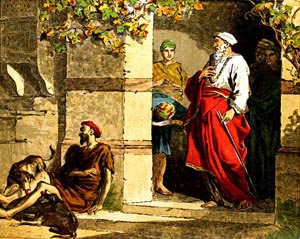
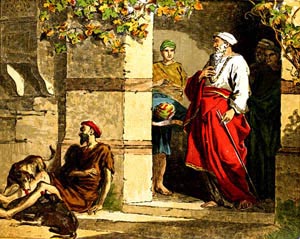
“There was a rich man who dressed in purple garments and fine linen and dined sumptuously each day.
20
And lying at his door was a poor man named Lazarus, covered with sores,
21
who would gladly have eaten his fill of the scraps that fell from the rich man’s table. Dogs even used to come and lick his sores.
22
When the poor man died, he was carried away by angels to the bosom of Abraham. The rich man also died and was buried,
23
and from the netherworld, where he was in torment, he raised his eyes and saw Abraham far off and Lazarus at his side.
24
And he cried out, ‘Father Abraham, have pity on me. Send Lazarus to dip the tip of his finger in water and cool my tongue, for I am suffering torment in these flames.’
25
Abraham replied, ‘My child, remember that you received what was good during your lifetime while Lazarus likewise received what was bad; but now he is comforted here, whereas you are tormented.
26
Moreover, between us and you a great chasm is established to prevent anyone from crossing who might wish to go from our side to yours or from your side to ours.’
27
He said, ‘Then I beg you, father, send him to my father’s house,
28
for I have five brothers, so that he may warn them, lest they too come to this place of torment.’
29
But Abraham replied, ‘They have Moses and the prophets. Let them listen to them.’
30
He said, ‘Oh no, father Abraham, but if someone from the dead goes to them, they will repent.’
31
Then Abraham said, ‘If they will not listen to Moses and the prophets, neither will they be persuaded if someone should rise from the dead.’”
 
From The Navarre Bible Commentary on Luke’s Gospel:

(RSV-CE translation)
Lazarus and the Rich Man
------------------------

(Jesus told them this parable) [19] “There was a rich man, who was clothed in purple and fine linen and who feasted sumptuously every day. [20] And at his gate lay a poor man named Lazarus, full of sores, [21] who desired to be fed with what fell from the rich man’s table; moreover the dogs came and licked his sores. [22] The poor man died and was carried by the angels to Abraham’s bosom. The rich man also died and was buried; [23] and in Hades, being in torment, he lifted up his eyes, and saw Abraham far off and Lazarus in his bosom. [24] And he called out, Father Abraham, have mercy upon me, and send Lazarus to dip the end of his finger in water and cool my tongue; for I am in anguish in this flame.' [25] But Abraham said, Son, remember that you in your lifetime received your good things, and Lazarus in like manner evil things, but now he is comforted here, and you are in anguish. [26] And besides in all this, between us and you a great chasm has been fixed, in order that those who would pass from here to you may not be able, and none may cross from there to us.’ [27] And he said, Then I beg you, father, to send him to my father's house, [28] for I have five brothers, so that he may warn them, lest they also come into this place of torment.' [29] But Abraham said, They have Moses and the prophets; let them hear them.’ [30] And he said, No, father Abraham; but if some one goes to them from the dead, they will repent.' [31] He said to him, If they do not hear Moses and the prophets, neither will they be convinced if some one should rise from the dead.’”
Commentary:
19-31. This parable disposes of two errors–that of those who denied the survival of the soul after death and, therefore, retribution in the next life; and that of those who interpreted material prosperity in this life as a reward for moral rectitude, and adversity as punishment. This parable shows that, immediately after death, the soul is judged by God for all its acts–the “particular judgment”–and is rewarded or punished; and that divine revelation is by itself sufficient for men to be able to believe in the next life.
In another area, the parable teaches the innate dignity of every human person, independently of his social, financial, cultural or religious position. And respect for this dignity implies that we must help those who are experiencing any material or spiritual need: “Wishing to come down to topics that are practical and of some urgency, the Council lays stress on respect for the human person: everyone should look upon his neighbor (without any exception) as another self, bearing in mind above all his life and the means necessary for living it in a dignified way lest he follow the example of the rich man who ignored Lazarus, the poor man” (Vatican II, “Gaudium Et Spes”, 27).
Another practical consequence of respect for others is proper distribution of material resources and protection of human life, even unborn life, as Paul VI pleaded with the General Assembly of the United Nations: “Respect for life, even with regard to the great problem of the birth rate, must find here in your assembly its highest affirmation and its most reasoned defense. You must strive to multiply bread so that it suffices for the tables of mankind, and not rather favor an artificial control of birth, which would be irrational, in order to diminish the number of guests at the banquet of life” (“Address to the UN”, 4 October 1965).
  1. Apparently this reference to the dogs implies not that they alleviated Lazarus’ sufferings but increased them, in contrast with the rich man’s pleasure: to the Jews dogs were unclean and therefore were not generally used as domestic animals.
22-26. Earthly possession, as also suffering, are ephemeral things: death marks their end, and also the end of our testing-time, our capacity to sin or to merit reward for doing good; and immediately after death we begin to enjoy our reward or to suffer punishment, as the case may be. The Magisterium of the Church has defined that the souls of all who die in the grace of God enter Heaven, immediately after death or after first undergoing a purging, if that is necessary. “We believe in eternal life. We believe that the souls of all those who die in the grace of Christ–whether they must still make expiation in the fire of Purgatory, or whether from the moment they leave their bodies they are received by Jesus into Paradise like the Good Thief—go to form that people of God which succeeds death, death which will be totally destroyed on the day of the resurrection when these souls are reunited with their bodies” (Paul VI, “Creed of the People of God”, 28).
The expression of “Abraham’s bosom” refers to the place or state “into which the souls of the just, before the coming of Christ the Lord were received, and where, without experiencing any sort of pain, but supported by the blessed hope of redemption, they enjoyed peaceful repose. To liberate these holy souls, who, in the bosom of Abraham were expecting the Savior, Christ the Lord descended into hell” (“St. Pius V Catechism”, I, 6, 3).
Continued below…
 
  1. “Both the rich man and the beggar died and were carried before Abraham, and there judgment was rendered on their conduct. And the Scripture tells us that Lazarus found consolation, but that the rich man found torment. Was the rich man condemned because he had riches, because he abounded in earthly possessions, because he `dressed in purple and linen and feasted sumptuously every day’? No, I would say that it was not for this reason. The rich man was condemned because he did not pay attention to the other man, because he failed to take notice of Lazarus, the person who sat at his door and who longed to eat the scraps from his table. Nowhere does Christ condemn the mere possession of earthly goods as such. Instead, He pronounces very harsh words against those who use their possessions in a selfish way, without paying attention to the needs of others…].”
The parable of the rich man and Lazarus must always be present in our memory; it must form our conscience. Christ demands openness to our brothers and sisters in need–openness from the rich, the affluent, the economically advantaged; openness to the poor, the underdeveloped and the disadvantaged. Christ demands an openness that is more than benign attention, more than token actions or half-hearted efforts that leave the poor as destitute as before or even more so …].
“We cannot stand idly by, enjoying our riches and freedom, if, in any place, the Lazarus of the Twentieth Century stands at our doors. In the light of the parable of Christ, riches and freedom mean a special responsibility. Riches and freedom create a special obligation. And so, in the name of the solidarity that binds us all together in a common humanity, I again proclaim the dignity of every human person: the rich man and Lazarus are both human beings, both of them equally created in the image and likeness of God, both of them equally redeemed by Christ, at a great price of the `precious blood of Christ’ (1 Peter 1:19)” ([Pope] John Paul II, “Homily in Yankee Stadium”, 2 October 1979).
24-31. The dialogue between the rich man and Abraham is a dramatization aimed at helping people remember the message of the parable: strictly speaking, there is no room in Hell for feelings of compassion toward one’s neighbor: in Hell hatred presides. “When Abraham said to the rich man `between us and you a great chasm has been fixed…’ he showed that after death and resurrection there will be no scope for any kind of penance. The impious will not repent and enter the Kingdom, nor will the just sin and go down into Hell. This is the unbridgeable abyss” (Aphraates, “Demonstratio”, 20; “De Sustentatione Egenorum”, 12). This helps us to understand what St. John Chrysostom says: “I ask you and I beseech you and, falling at your feet, I beg you: as long as we enjoy the brief respite of life, let us repent, let us be converted, let us become better, so that we will not have to lament uselessly like that rich man when we die and tears can do us no good. For even if you have a father or a son or a friend or anyone else who have influence with God, no one will be able to set you free, for your own deeds condemn you” (“Hom. on 1 Cor.”).
 
a rich man . . . feasted . . . every day: The rich man is nameless while the beggar’s name is given as if to reverse the world’s opinions. This nameless rich man had more of this world’s wealth than he could use. He dressed as a prince (purple dye was extremely expensive and sometimes restricted by law to only the upper classes) and feasted splendidly (the language has the sense of something like a Thanksgiving meal) every day—he led the life of the idle rich.
at his gate lay . . . Lazarus: It was customary at that time for a family or friends to place a cripple at a street comer or at one of the gates of the city or near the entrance to a rich man’s home so that he could collect enough alms to eke out some kind of living. The fact that the rich man even had a gate and wall around his house was further proof of his great possessions.
full of sores: As well as being crippled he suffered from some skin disease.
what fell from the rich man’s table: The wealthy would use pieces of bread as napkins to wipe the grease from their mouths and hands and throw it under the table for the dogs. Lazarus would have been happy to have these.
dogs came and licked his sores: The dumb animals showed more interest in him than did the rich man. This was also an expression of his degradation.
the poor man . . . and rich man . . . died: Now the scene changes. Lazarus is now happy in the bosom of Abraham, the abode of the just. The rich man is in torment.
**Father Abraham have mercy upon me: **Abraham was considered the father of the Hebrew nation (John 8:31-40). He calls on Abraham to help him. He is told it is too late now, the time for mercy has past. He had his happiness on earth, Lazarus has his now.
**I have five brothers: He admits that he abused his wealth and his time on earth, but he pleads on behalf of his five brothers. Let someone go to warn them now—someone from the dead—or they will do as he did and suffer the same consequences.
**
They have Moses and the prophets:
What they should do has already been revealed to them. There is no need for any special messenger from the dead.
**
If they do not hear Moses: **The rich man argued that if Lazarus went back from the dead his brothers would heed his warning. Abraham says that is not so. If they do not heed Moses and the prophets then they will not listen to Lazarus returned from the dead. This is an allusion to Jesus’ own resurrection from the dead. Some will not believe in him after that happens as well.
 
A couple of apologetics notes from Catholic Answers “Quick Questions”:
** Q:“I was told that all the people who died prior to Jesus (including Moses and Abraham) went to hell. Is this true?"**
A: By his death and Resurrection, Jesus opened heaven (CCC 1026). Prior to that time all who died went to “hell”; however, the just went to a place in hell referred to as “the Bosom of Abraham,” where they would be comforted. The parable of the Rich Man and Lazarus (Luke 16:19-31) seems to indicate that there were two parts of hell. Both Lazarus and the rich man died and went to hell, but Lazarus was comforted in the bosom of Abraham while the rich man was in a place of torment. A great chasm separated the two parts.
The Catechism explains,
Code:
Scripture calls the abode of the dead, to which the dead Christ went down, "hell"— Sheol in Hebrew or Hades in Greek—because those who are there are deprived of the vision of God. Such is the case for all the dead, whether evil or righteous, while they await the redeemer: which does not mean that their lot is identical, as Jesus shows through the parable of the poor man Lazarus who was received into "Abraham’s bosom": "It is precisely these holy souls, who awaited their Savior in Abraham’s bosom, whom Christ the Lord delivered when he descended into hell." Jesus did not descend into hell to deliver the damned, nor to destroy the hell of damnation, but to free the just who had gone before him. (CCC 633)
For a fuller explanation, see “Hell? Yes! Part I”
**Q: “In Luke 16:19–31 about the parable of Lazarus and the rich man, I’ve read that the rich man, when he called to Abraham, was in purgatory, not hell. The reason given is that the rich man demonstrates love and concern for his brothers and requests Abraham to help them by sending Lazarus to teach them the error of their ways. Since love and concern for others cannot exist in hell, the rich man must be in another place.
My question is that if one unrepented mortal sin, such as adultery, will cause someone to go to hell, what happens to the love that such a person had for his children, friends, and spouse? Does God purge this love from this person before he is put in hell?"**
**A:**To say that the rich man must have been in purgatory because love cannot exist in hell is a conclusion based on an unsupportable premise. The Church does not teach that those in hell are bereft of all kinds of love. It is true that supernatural love of God cannot exist in hell, but a disordered love is involved in every mortal sin, and this perverse loving will remain.
What may appear as the rich man’s love and concern for his brothers may in fact be nothing more than self-interest. Thomas Aquinas asserted that the rich man knew that if his kin were damned his own suffering would increase. “[The damned’s] punishment would be greater if all their kindred were damned, and others saved, than if some of their kindred were saved. For this reason the rich man prayed that his brethren might be warded from damnation: for he knew that some are guarded therefrom” (ST Supp.–III:98:4 ad 1).
Also according to Aquinas, the damned are consumed with envy for those who attain glory, even for their own kin, though perhaps to a lesser degree.
God does not purge people of all types of love before they enter hell, but in hell the separation from God and his divine love is accomplished forever, making supernatural love, or charity, impossible. Love of evil, however, remains.
 
Here is the meditation on the Gospel for application from Catholic Matters:
We have here a story of two men whose states, both in this life and in the next, are dramatically opposed. The rich man had everything a man could desire on this earth and he set his heart on this wealth, to such a degree that he excluded all thought of God or of what followed after death. It was not that he was ignorant of God or of a future life (our Lord was addressing the parable to the Pharisees); he admits that he had Moses and the prophets, but he paid no heed to them. He was too busy trying to squeeze the last ounce of pleasure out of his few years on earth.
On the other half of the picture we have a beggar, a man not only in dire destitution, but suffering bodily pains as well. He bore his lot patiently. He was quite content if he got the crumbs that fell from the rich man’s table, which he probably did not always get. He must have been disappointed that this rich man never thought of giving him a helping hand but there is no mention of his ever criticizing or blaming him. He left these things to God.
Both men die eventually. The beggar goes straight to heaven to a state of endless happiness. His bodily sufferings have ended forever, he will never be in want again. The rich man fares very differently. His enjoyments are over forever. He is now in torments and he is told that he can expect no relief. They will have no end. Abraham tells him why he is in his present state: he abused his time on earth. He sees the truth of this. He knows that he has no one to blame but himself which must add greatly to his torments. It is also a cause of additional grief to him that his bad example will lead his brothers (his fellowman) to a like fate.
All the parables of our Lord are based on everyday happenings. While we hope and pray that the case of the rich man described here is not an everyday occurrence. We cannot doubt but that such cases have happened and will happen again. This rich man is not in eternal torments because he was rich and even very rich, but because he let his wealth become his master and forgot God and his neighbor and his own real welfare, eternal life. There are men like him in our world today, men who completely ignore their real future. While they are convinced that their stay on this earth is of very short duration and that they will have to leave it very, very, soon, they still act and live as if they had a permanent home here.
This is true not only of those who try (ineffectively most probably) to keep from their minds all thought of a future life, but even of some who openly profess to be Christians and who recite so often the words of the Creed: “I believe in the resurrection of the dead and the life of the world to come.” Yet, they are so busy trying to get the wealth and the pleasures of this life, or to increase all they have of them already, that they haven’t a moment to spare for the thing that really matters—their future unending life after death.
God forbid that any of us should be numbered amongst these foolish people, for there is no greater folly on earth than to miss the real and only purpose in life because of a few trivial, passing attractions. We are not forbidden to have some of this world’s goods. We need some, and God it was who provided them for our use. But we must use them properly and we must not set them up as idols to be adored. On all sides of us there are Lazaruses placed at our gates by God to give us an opportunity to exercise fraternal charity. Be a true brother to them now and you will not have to envy them hereafter.
If on the other hand your lot is that of a Lazarus—and many there are whose life is one long, continual struggle against poverty, disease and hardship—try to carry your cross patiently. Envy of your neighbor and rebellion against God will only add to, and do not cure, your ills. The day of judgment, which for you will be the day of reward, if you are humble and patient, is around the corner. Eternal happiness is worth twenty lives of earthly ill-fortune.
Please check back for more meditations tomorrow. Good night and God bless you, 🙂
 
Good morning, and a blessed Lord’s Day!

Here is a meditation on the First Reading from The Word Among Us magazine:
“Woe to the complacent in Zion!” (Amos 6:1)
What a life for Israel’s upper class! They sleep on “beds of ivory.” They feast on “lambs” and “calves.” They “drink wine from bowls and anoint themselves with the best oils” (Amos 6:4,6). Of course, there is nothing intrinsically wrong with all of this, and Amos knows it. The real problem that the prophet points to is that these privileged folk “are not made ill by the collapse of Joseph” (6:6). In other words, the needs of the poor among them fail to pierce their hearts or affect their behavior.
How about us? We live in an information-heavy age, when news hits our computer screens and televisions immediately as it is happening. All the tragedies and catastrophes of life can fill us with a sense of fear, frustration, and even sadness. And after a while, we can become hardened to it all, so accustomed to it that it no longer registers in our minds.
Don’t let that happen! Instead, take hold of the emotional energy you feel in the face of bad news and redirect it. Don’t withdraw from it all. Let it move you out into the world, eager to take action. Remember: These are your brothers and sisters—Jesus’ own brothers and sisters—who are suffering and crying out for help.
If a particular situation is laying heavy on your heart, commit to interceding for it. Ask God to help you find someone who is involved in that issue so that you can get involved yourself. Consider becoming a regular donor to a cause that is dear to your heart. There is no lack of opportunity!
None of us should feel helpless or inept when it comes to the needy of the world. And we certainly should not allow ourselves to become complacent in the face of suffering and hardship. We are all Jesus’ hands and feet in this world. Connected to him, we really can move mountains!
“Father, give me your heart of love toward the least of your brothers and sisters. Show me how to hold them up to you in prayer—and how to reach out to them with your love.”
 
A meditation from Daily Readings and Meditations, by Don Schwager:
** “Lazarus died and was carried by the angels to Abraham’s bosom”**
Scripture: Luke 16:19-31
19 “There was a rich man, who was clothed in purple and fine linen and who feasted sumptuously every day. 20 And at his gate lay a poor man named Laz’arus, full of sores, 21 who desired to be fed with what fell from the rich man’s table; moreover the dogs came and licked his sores. 22 The poor man died and was carried by the angels to Abraham’s bosom. The rich man also died and was buried; 23 and in Hades, being in torment, he lifted up his eyes, and saw Abraham far off and Laz’arus in his bosom. 24 And he called out, Father Abraham, have mercy upon me, and send Laz'arus to dip the end of his finger in water and cool my tongue; for I am in anguish in this flame.' 25 But Abraham said, Son, remember that you in your lifetime received your good things, and Laz’arus in like manner evil things; but now he is comforted here, and you are in anguish. 26 And besides all this, between us and you a great chasm has been fixed, in order that those who would pass from here to you may not be able, and none may cross from there to us.’ 27 And he said, Then I beg you, father, to send him to my father's house, 28 for I have five brothers, so that he may warn them, lest they also come into this place of torment.' 29 But Abraham said, They have Moses and the prophets; let them hear them.’ 30 And he said, No, father Abraham; but if some one goes to them from the dead, they will repent.' 31 He said to him, If they do not hear Moses and the prophets, neither will they be convinced if some one should rise from the dead.’”
Meditation: What most absorbs your time and attention, and your heart? Jesus’ parable about a man who had everything he needed and a man who had nothing turns our understanding of what makes a person happy and successful upside down. In this story Jesus paints a dramatic scene of contrasts – riches and poverty, heaven and hell, compassion and indifference, inclusion and exclusion. We also see an abrupt and dramatic reversal of fortune. Lazarus was not only poor, but sick and unable to lift himself. He was “laid” at the gates of the rich man’s house. The dogs which licked his sores probably also stole the little bread he got for himself. Dogs in the ancient world symbolized contempt. Enduring the torment of these savage dogs only added to the poor man’s miseries and sufferings. The rich man treated the beggar with contempt and indifference, until he found his fortunes reversed at the end of his life! In God’s economy, those who hold on possessively to what they have, lose it all in the end, while those who share generously receive back many times more than they gave way.
The name Lazarus means God is my help. Despite a life of misfortune and suffering, Lazarus did not lose hope in God. His eyes were set on a treasure stored up for him in heaven. The rich man, however, could not see beyond his material wealth and possessions. He not only had every thing he needed, he selfishly spent all he had on himself. He was too absorbed in what he possessed to notice the needs of those around him. He lost sight of God and the treasure of heaven because he was preoccupied with seeking happiness in material things. He served wealth rather than God. In the end the rich man became a beggar! Do you know the joy and freedom of possessing God as your true and lasting treasure? Those who put their hope and security in heaven will not be disappointed (see Hebrews 6:19)?
“Lord Jesus, you are my joy and my treasure. Make me rich in the things of heaven and give me a generous heart that I may freely share with others the spiritual and material treasures you have given to me.”
Psalm 146:7-10
7 The LORD sets the prisoners free;
8 the LORD opens the eyes of the blind. The LORD lifts up those who are bowed down; the LORD loves the righteous.
9 The LORD watches over the sojourners, he upholds the widow and the fatherless; but the way of the wicked he brings to ruin.
10 The LORD will reign for ever, thy God, O Zion, to all generations. Praise the LORD!
 
The Hell There Is – A Meditation on the Gospel for the 26th Sunday of the Year
By: Msgr. Charles Pope
In the Gospel for today about the rich man and Lazarus the Lord gives us some important teachings on judgment and on hell. Now it is a fact that we live in times where many consider the teaching on Hell to be untenable. Many struggle to understand how a God described as loving, merciful and forgiving can assign certain souls to Hell forever. No matter that the Doctrine of Hell is taught extensively in Scripture and quite a lot by Jesus himself, the doctrine does not comport well with many modern notions and emphases of God, and, hence many think it has to go.
But this reading goes a long way to address some of the modern concerns about Hell and so we ought to look at it. Prior to doing that however it might be important to state why Hell has to exist. I have done that more extensively on this blog here: blog.adw.org/2010/07/hell-has-to-be/ However I summarize that lengthier article in the next paragraph
Hell has to exist essentially for one reason: “Respect.” God has made us free and respects our freedom to chose his Kingdom or not. Now the Kingdom of God is not a mere abstraction. It has some very specific values and these values are realized and experienced perfectly in heaven. The values of the Kingdom of God include: Love, kindness, forgiveness, justice to the poor, generosity, humility, mercy, chastity, love of Scripture, love of the truth, worship of God, God at the center and so forth. Now the fact is that there are many people in our world who do not want a thing to do with chastity, or forgiveness, or being generous and so forth. And God will not force them to adopt and live these values. While it is true that everyone may want to go to heaven, heaven is not merely what we want, it is what it is, as God has set it forth. Heaven is the Kingdom of God and the values thereof in all their fullness. Hence there are some (many?) who live in such a way that they consistently demonstrate that they are not interested in heaven, since they are not interested in one or many of the Kingdom values. Hell “has to be” since God respects their freedom to live in this way. Since they demonstrate they do not wnat heaven, God respects their freedom to choose “other arrangements.”
Now this leads to today’s Gospel which we can see in three stages.
  1. **The Ruin of the Rich Man **- As the Gospel opens we see described a rich man (some call him Dives, which simply means “rich”). There was a rich man who dressed in purple garments and fine linen and dined sumptuously each day. Now it is clear he lives very well as has the capacity to help the poor man, Lazarus, outside his gate. But he simply does not. His sin is not so much one of hate, but of indifference. He is living in open rejection of one of the most significant Kingdom values, that of the love of the poor. His insensitivity is a “damnable sin” in the literal sense since it lands him in Hell. So the ruin of this rich man is his insensitivity to the poor.
Now the care of the poor may be a complicated matter and there may be different ways of accomplishing it, but in no way can we ever consider ourselves exempt from caring for the poor if it is in our means to help them. We simply cannot avoid judgement for our greed and insensitivity. As God said in last week’s reading from Amos regarding those who are insensitive to the poor:* The LORD has sworn by the pride of Jacob: Never will I forget a thing they have done! *(Amos 8:7) God may well “forget” many of our sins (cf Is 43:23; Heb 8:12) but apparently, trampling the poor and disregarding their needs isn’t one of them.
Hence this rich man has willfully and repeatedly rejected the Kingdom and is ruined by his greed and insensitivity. He lands in Hell since he doesn’t want heaven where in the poor are exulted (cf Luke 1:52) Abraham explains the great reversal to him: ‘My child, remember that you received what was good during your lifetime while Lazarus likewise received what was bad; but now he is comforted here, whereas you are tormented.
Continued below…
 
Status
Not open for further replies.
Back
Top