J
Jrp72
Guest
Does anyone view Matthew 5:25-26 as a support for purgatory? That verse has always stood out the me.

5:25-26
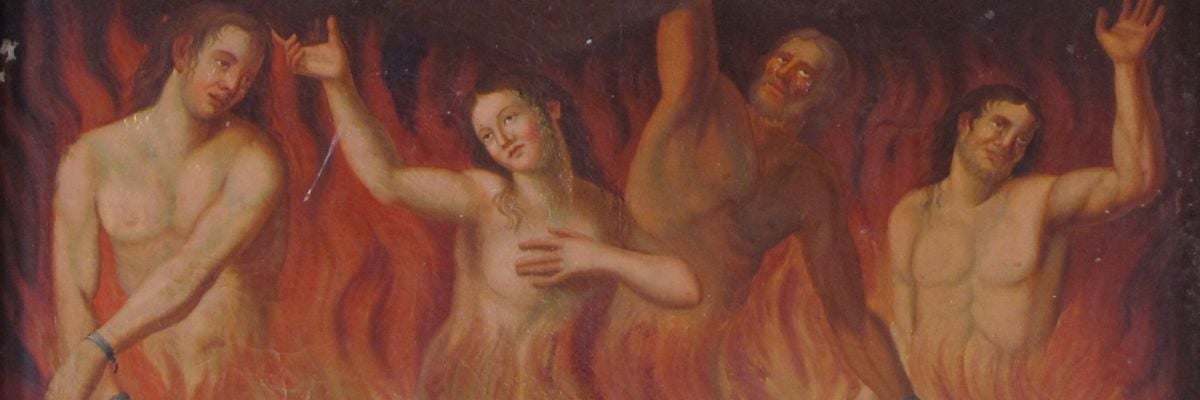
Agree whilst you are in the way, or wayfaring men, i.e. in this life, lest you be cast into prison, i.e. according to Sts. Cyprian, Ambrose, and Origen, into purgatory…
Matthew Henry’s Commentary on these verses can be found here.What is the common interpretation of these two verses by Protestants?
1 Cor 3:15; 1 Pet 1:7; Mt 12:32-36, are used by the Catholic Church for this.Does anyone view Matthew 5:25-26 as a support for purgatory? That verse has always stood out the me.
1031 The Church gives the name Purgatory to this final purification of the elect, which is entirely different from the punishment of the damned. [Cf. Council of Florence (1439): DS 1304; Council of Trent (1563): DS 1820; (1547): 1580; see also Benedict XII, Benedictus Deus (1336): DS 1000.] The Church formulated her doctrine of faith on Purgatory especially at the Councils of Florence and Trent. The tradition of the Church, by reference to certain texts of Scripture, speaks of a cleansing fire. [Cf. 1 Cor 3:15; 1 Pet 1:7.]
As for certain lesser faults, we must believe that, before the Final Judgment, there is a purifying fire. He who is truth says that whoever utters blasphemy against the Holy Spirit will be pardoned neither in this age nor in the age to come. From this sentence we understand that certain offenses can be forgiven in this age, but certain others in the age to come. [St. Gregory the Great, Dial. 4, 39: PL 77, 396; cf. Mt 12:32-36.]
Yes. However, I think you mean from the Spiritual Sense (which includes allegory and analogy)…I would think in the context of this discussion its more anagogical than analogical.As Catholics, we can interpret this passage in a allegorical and analogical sense which fits in the doctrine of Purgatory.
My version of this isIt seems that purgatory is necessary for us, since there is no imperfection in heaven. The Church gives a cleansing for the effects that sin has caused, so we can “be perfected”.