Sir Knight, you would probably like this statue of St. Paul in St. Peter’s Square.
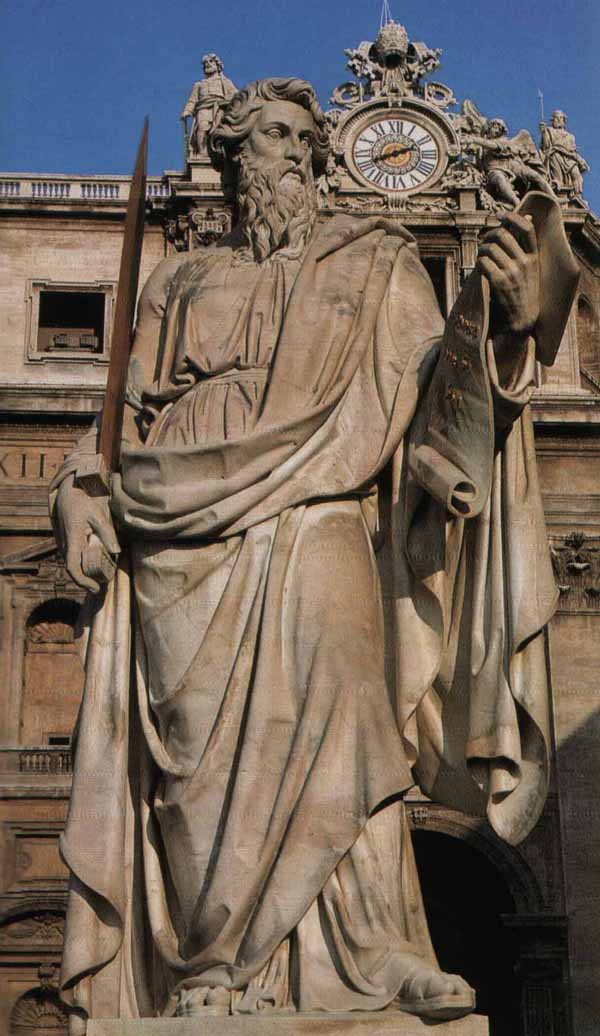
It was restored in 1985-86 through the generosity of the Order of the Knights of Columbus.

This website has more statues.
'Peter and Paul died for the sake of righteousness, although Peter died a more painful death than Paul, for he loved the flesh more than Paul; he also had to be more conformed to me through his painful death since he held the primacy of my church. Paul, however, inasmuch as he had a greater love of continence and because he had worked harder, died by the sword like a noble knight, for I arrange all things according to merit and measure. So, in God’s judgment it is not how people end their lives or their horrible death that leads to their reward or condemnation, but their intention and will.
The Son of God, to St. Bridget of Sweden
'At the appointed time, Peter arrived in Rome. He raised some people to the positive rank, others to the comparative rank, and still others to the superlative. To the positive rank belonged those who accepted the true faith and lived in matrimony or in another honorable state. To the comparative rank belonged those who gave up their possessions out of love for God, and set others the example of a good life in words and example and deed and did not put anything ahead of Christ. To the superlative rank belonged those who offered their physical lives out of love for God. But let us make a search of these ranks to find out where there is now a more fervent love of God. Let us search among the knights and the learned. Let us search among the religious and those who have scorned the world. These people would be thought to belong to the comparative and superlative ranks. Yet, indeed, very few are found.
There is no life more austere than the life of a knight, if he truly follows his calling. While a monk is obliged to wear a cowl, a knight is obliged to wear something heavier, namely, a coat of mail. While it is hard for a monk to fight against the will of the flesh, it is harder for a knight to go forth among armed enemies. While a monk must sleep on a hard bed, it is harder still for the knight to sleep with his weapons. While a monk finds abstinence a burden and trouble, it is harder for the knight to be constantly burdened by fear for his life. Christian knighthood was not established out of greed for worldly possessions but in order to defend the truth and spread the true faith. For this reason, the knightly rank and the monastic rank should be thought to correspond to the superlative or comparative rank. However, those in every rank have deserted their honorable calling, since the love for God has been perverted into worldly greed. If but a single florin were offered them, most of them in all three ranks would keep silent about the truth rather than lose the florin and speak the truth.’
The Blessed Virgin Mary, to St. Bridget of Sweden
"My daughter, love the Mother of mercy. She is like the flower or reed shaped like a sword. This flower has two sharp extremities and a graceful tip. In height and width it excels all other flowers. Similarly, Mary is the flower of flowers, a flower that grew in a valley and extended over all the mountains. A flower, I say, that was raised in Nazareth and spread itself on Mount Lebanon. This flower had, first of all, height, in the sense that the blessed Queen of heaven excels every creature in dignity and power. Mary also had two sharp edges or leaves, that is, the sorrow in her heart over her Son’s passion along with her steadfast resistance to the attacks of the devil by never consenting to sin.
The old man prophesied truly when he said: 'A sword shall pierce your soul. In a spiritual sense she received as many sword-strokes as the number of wounds and sores she saw her Son receive and that she also had already foreseen. Mary had also a great width, I mean, her mercy. She is and was so kind and merciful that she preferred to suffer any hardship rather than let souls be lost. United now with her Son, she has not forgotten her native goodness but, rather, extends her mercy to all, even to the worst of men. Just as the sun brightens and sets ablaze the heavens and earth, so too there is no one who does not experience Mary’s sweet kindness, if he asks for it. Mary also had a graceful tip, I mean, her humility.
Her humility made her pleasing to the angel when she called herself the Lord’s handmaid, although she was being chosen to be his Lady. She conceived the Son of God in humility, not wanting to please the proud. She ascended the highest throne through humility, loving nothing but God himself. Come forward, then, Conduit, and greet the Mother of mercy, for she has now arrived!"
Blessed Agnes, in a vision of St. Bridget of Sweden’s


