
Syro Malabar Church after Coonan Cross Oath- Vicariates and formation of hierarchy

  • Thread starter Thread starter lukathomas
  • Start date Start date
Status
Not open for further replies.
L

lukathomas

Guest
PS- No Source less repetitive junk posts encouraged in this thread.

Coonan Cross Oath


In 1652, Ahatallah arrived in Mylapore who informed the Saint Thomas Christians that he is the Patriarch of All India and China who has all the powers given by Pope. In the name of Mary, Mother of God, he invited all the Thomas Christians to rally around him. The whole Thomas Christian community was roused and insurrections took place everywhere. Fr. Manoel de Leira SJ, from Mylapore informed the Portuguese about the movements of Ahatallah. The Portuguese authorities arrested and deported him to Goa via Cochin.

The Archdeacon reached Cochin with a number of soldiers and demanded to see Patriarch Ahatallah and to examine his credentials. He said he would not demand the Patriarch’s release if the credentials were found false. The Portuguese agreed first but soon they deported Ahatallah to Goa with out showing him or his credentials to the Archdeacon and his followers. The behavior of Archbishop Gracis SJ has been haughty. A false rumor was spread that Ahatallah was drowned by the Portuguese off the coast of Cochin. The Archdeacon wrote to the Portuguese Captain that they wont obey any Jesuit and let any other four religious order come and they are ready to obey with out hesitation.

All moved to Mattancherry near Cochin tied a long rope as tradition says to the open air cross called the Coonan Cross and holding the rope swore they would never be under the Paulists. ( ie, the Jesuits). All the Thomas Christians except a few ( 400 or 500 or 4000) adhered to those who had taken the Oath on Friday, January 3rd 1653.
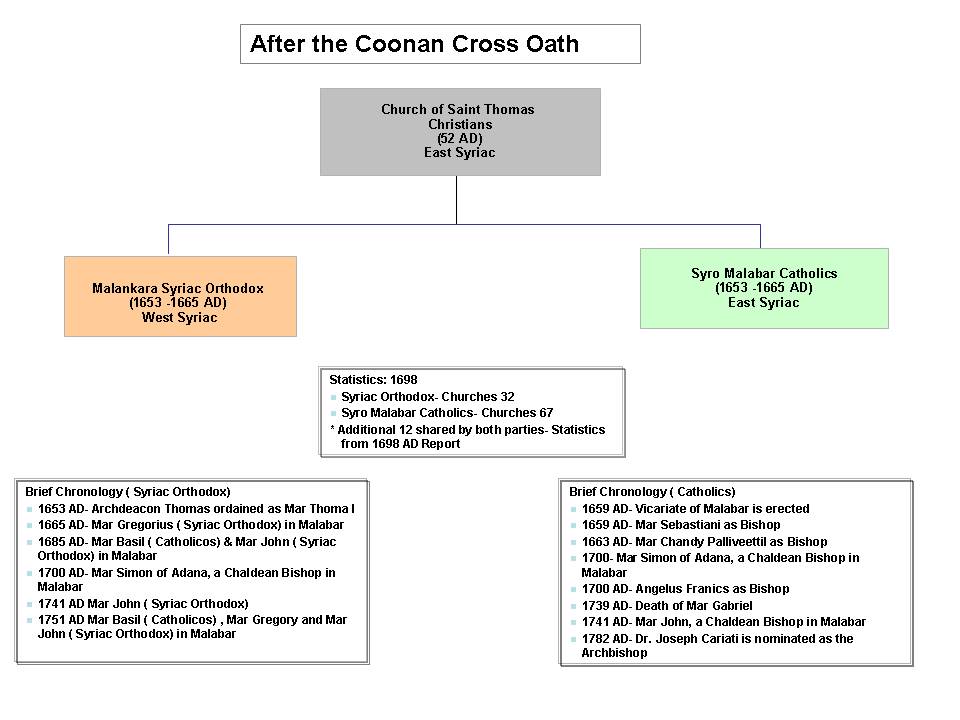
 
After the Coonan Cross Oath

A meeting was held at Edapally and then again at Alangat on May 22, 1653, twelve priests imposed their hands on Archdeacon Thomas calling him Archbishop Mar Thomas I. A new letter said to be of Ahatallah was also produced. The meeting also provided four councilors to Archdeacon. Alexander Parampil of Kuravilangadu, Alexander Kadavil of Kaduthuruthy, George Vendur of Angamale and Anjilimootil Ittithomman of Kallicherry were the four councilors. A manifesto was also produced and it was said that Jesuits did not paid attention to the mandate of Pope and that the Archbishop was ordained by the order and command of Patriarch Ahatallh who came by the order of Pope.

Rome send Carmelities in two groups under the Propagada Congregation to Malabar headed by Fr. Sebastiani and Fr. Hyacinth. Fr. Sebastiaini arrived first in 1655. He began directly deal with the Archdeacon, Mar Thomas I. Fr. Sebastianini gained the support of many, especially with the support of Alexander Parampil, Alexandar Kadavil and the Vicar of Muttam, ( the three councilors were reconciled with Gracia SJ before the arrival of Sebastaini according to some Jesuit reports) . Fr.Sebastaini went back to Rome to submit the Report leaving behind Fr.Matheo. In his absence the other group of Carmelites under the Fr.Hyacinth arrived and negotiated with the Archdeacon Thomas . But since another Archdeacon was appointed by Bishop Gracia SJ and he was not ready to give up his position, Mar Thomas I resumed his former stand.

Sebastiani came back in 1661 as Bishop and Administrator of Cranganore. Bishop Gracia SJ had already died in 1659. The Dutch defeated the Portuguese and captured Cochin in 1662 and forced all other Europeans to leave Malabar. Bishop Sebastaini, then consecrated Alexander Parampil as the Bishop. Fr. Matheo, who was a botanist, gained the favor of Dutch government and stayed back in Malabar.

Between 1661 and 1662, out of the 116 churches, the Carmelites reclaimed eighty-four churches, leaving Archdeacon Thomas only thirty-two churches. The eighty-four churches and their congregations were the body from which the Syro Malabar Church and Chaldean Syrian Church have descended. The other thirty-two churches and their congregations represent the nucleus whence the Syriac Orthodox (Jacobites & Orthodox) , Thoziyur, Mar Thoma (Reformed Syrians), Syro Malankra Catholics have originated.

In 1665, Mar Gregorius a Bishop send by the Syriac Orthodox Church of Antioch arrived in Malabar and was received by Mar Thomas I. In the mean time, two new terms, Pazhayakuttukar to represent Catholic Syrians and Puthankuttukar to represent Jacobites also emerged. According to Paulinus of Saint Bartholmew, these names was already existing before the arrival of Mar Gregorius, that representations were already sent to Rome and that those who had decided to abide by the decision of Rome were called Pazhaykuttukar and others as Puthankuttukar.
 
The Catholic Syrians were ruled by Mar Parampil Chandy ( Alexander de Campo) . Arch Bishop Parambil Chandy is the first known indigenous bishop of the whole of India. Arch Bishop Parambil Chandy ( also known as Alexander de Campo) was consecrated on the 31st of January 1663, at Kaduthuruthi by Msgr. Joseph, with the title of Bishop Megara in Achala. He was a native priest of Karuvilangad.

http://kuravilangad.org/images/chandymethran.jpg

He had an instrumental role in reclaiming eighty-four churches in Catholic side after the Coonan Cross Oath. After his death from 1678 till 1896 there were no native Bishops in Syro Malabar Church.
 
In 1674, Mar Parambil Chandy requested Rome to elect a coadjutor and proposed his nephew, Mathew for the position. Carmelites arrived in India in 1676, with special Dutch passports ( as Dutch wont allow any other European to work in their areas) and they were asked by Rome to elect an Indian. They elected Raphael Figueredo in 1677, who was not a Syrian Catholic but born as an Indian in the sense that he was a half caste Portuguese. This election shook the confidence Syrian Catholics had in Carmelites and quarrels started to arise. Bishop Raphael Figueredo was later suspended and Custodius de Pinho was appointed as the Vicar Apostolic in his place. Mar Parampil Chandy died in 1687. Raphael Figueredo and Custodius de Pinho died in 1695 and 1697 respectively.

In 1694, the nephew of Mar Parampil Chandy, Mathew was nominated as the Archdeacon under Padroado. In 1700, Angelus Francis was nominated as Vicar Apostolic of Malabar under Propaganda. Since no Portuguese Bishop would give him Episcopal consecration, he was consecrated by a Chaldean Bishop Mar Simon of Ada who arrived in Malabar. Ribeiro SJ was nominated as Archbishop of Cranganore in 1704. In 1704, many Catholic Syrians met at Kaduthuruthy and manifested their desire to be under Carmelites. Archdeacon Mathew and party was against Carmelites but all were asking a Bishop of their own rite. Catholic Syrians were given permission to pass under Propaganda, if they disliked the Padroado. Another Chaldean Bishop Mar Gabriel came in 1709 and some 22 churches of both Catholic and Jacobites joined him. The churches under Padroado was comparatively enjoying peace in consideration to churches under Propaganda jurisdiction. The representatives of 73 churches under Propaganda met at Angamale and they had a mind to reinstate the ancient office of Archdeacon. The Carmelitie Visitor Apostolic Lawrence Justiniani rushed to the place and put his signature on all their proposals except one.

Mar Cariattil Thomas ( Prelate 1782-1786), Paremmakal Thomas and Sankurikal George were Administrators under Padroado. After Mar Cariattil’s death Paremmakal became the administrator of Cranganore. Under him the representatives of all the 84 Churches assembled at Angamale and executed the famous Angamale Padiola.

Source- nasrani.net/2007/01/14/saint-thomas-christians-history-of-divisions-churches/
 
In 1878 the Holy See decided on placing the Syrian Christians under separate administration, appointing two vicars Apostolic of the Latin Rite for the purpose.

These were, Rev. Charles Lavinge, S.J., former private secretary of the late Father Beckx, General of the Society, consecratedin Belgium before coming out, appointed to the See of Kottayam, later called of Changanacherry and Rev. A.E. Medlycott, Ph.D., Military Chaplain in the Punjab, educated in the Propaganda College,Rome, and consecrated by the Apostolic Delegate Mgr. A. Ajuti on 18 Dec., 1887, at Ootacamund,titular Bishop of Tricomia, appointed to the Vicariate Apostolic of Trichur.
 
The Vicariate of Kottayam (Changanacherry) had a Catholic population of 150,000, with 108 parish churches and 50 dependent chapels, served by a numerous clergy of over 300 priests; it had 35 Tertiary monks besides novices, in five monasteries; also three convents of native Tertiary Carmelite nuns educating girls, two orphanages under Tertiary Sisters of St. Francis, four catechumenates, two seminaries, with 96 students.

Education

The parochial schools numbered 200, but the number of pupils was not published. There were three English Schools:Mananam, 60; Campalam, 80; and another with 20 students.
 
The Vicariate of Trichur had a Catholic Syrian population of 108,422 with 83 parish churches and 22 chapels-of-ease, served by 118 priests of Syrian Rite, besides 23 Syrian Carmelite Tertiary monks, in two monasteries; there was also a conventof 24 native Tertiary nuns with a middle-class school of 33 girls.

Education

The bishop on taking charge found that there is practically no schools, except that one provided for clerics; he took early steps to open as many elementary parish schools as possible; within nine years (1888-96) the vicariate was provided with no less than 231 elementary parish schools for both sexes. A catechumenate was opened, where annually about 150 heathen converts were baptized.
 
The two vicariates described above were split into three, and they were styled Ernaculam,Changanacherry and Trichur.

The changes were carried out under Leo XIII by Brief of 28 July, 1896, “Quae Rei Sacrae”. Rev. John Menacherry, as Bishop of Paralus, was appointed to Trichur. Rev. Aloysius Pareparampil, titular Bishop of Tio, was appointed to Ernaculam, and Rev. Mathew Makil, Bishop of Tralles, was appointed toChanganacherry; all three received consecration from the Apostolic Delegate Mgr. Zaleski, at Kandy on 15 Oct., 1896.

**At the time of these changes, the ecclesiastical returns of these three vicariates (1911) gave:

• Changanacherry: Catholic population, 134,791
• Ernaculam: Catholic population, 94,353
• Trichur: Catholic population, 91,064**

Source- newadvent.org/cathen/14678a.htm
 
PS- No Source less repetitive junk posts encouraged in this thread.

Coonan Cross Oath


In 1652, Ahatallah arrived in Mylapore who informed the Saint Thomas Christians that he is the Patriarch of All India and China who has all the powers given by Pope. In the name of Mary, Mother of God, he invited all the Thomas Christians to rally around him. The whole Thomas Christian community was roused and insurrections took place everywhere. Fr. Manoel de Leira SJ, from Mylapore informed the Portuguese about the movements of Ahatallah. The Portuguese authorities arrested and deported him to Goa via Cochin.

The Archdeacon reached Cochin with a number of soldiers and demanded to see Patriarch Ahatallah and to examine his credentials. He said he would not demand the Patriarch’s release if the credentials were found false. The Portuguese agreed first but soon they deported Ahatallah to Goa with out showing him or his credentials to the Archdeacon and his followers. The behavior of Archbishop Gracis SJ has been haughty. A false rumor was spread that Ahatallah was drowned by the Portuguese off the coast of Cochin. The Archdeacon wrote to the Portuguese Captain that they wont obey any Jesuit and let any other four religious order come and they are ready to obey with out hesitation.

All moved to Mattancherry near Cochin tied a long rope as tradition says to the open air cross called the Coonan Cross and holding the rope swore they would never be under the Paulists. ( ie, the Jesuits). All the Thomas Christians except a few ( 400 or 500 or 4000) adhered to those who had taken the Oath on Friday, January 3rd 1653.
Your version of the Coonan cross is doubtful. Then why the syriac orthodox is saying that it was the Patriarch of Antioch who was the Ahatalla. Why they going to venerate him as a saint. I found eralier it was a doubtful case. Now it seems that there are substantial evidences to prove that Ahatallah was the then Patriarch of Antioch Ignatios Hidayat Allah. Also the oath of coonan cross. I found there is a reference to the see of Antioch in the oath. Also the term Paulists refers to Jesuits. Is it correct? From the Apostolic acts and letter of St Paul to Romans, if I say that Paulists refer to the Pauline see of Rome, not Petrine see. The term Paulists may refer ot Roman church, I say.
 
MathewJoseph, you must have read the first sentence. No opinions with out sources.

What i posted about Coonan Cross Oath was not my version. I only did a copy and paste from the link I cited as source. The statements are from Placid Podipara from the book - The Thomas Christians. Each statement is supported by one or more documents of the period 1652- 1653, which are available in archives. Are you aware of any documents of 1652-1653 or even 17th century which say differently about Coonan Cross Oath ?

Ahatallah was not Patriarch of Antioch. This theory is from some one who does not know more about neither Ahatallah nor Patriarch of Antioch.

There may be people who look at the list of bishops names and make suggestions and theories. I also have so many theories but those has no value as it is with out factual and documentary support.🙂

There are studies conducted about who was Ahatallah by few Syro Malabar and Syro Malankara researches using available documents of the period. The first Bishop to come from Syriac Orthodox Church of Antioch was Mar Gregogorius in 1965.By that time Mar Chandy Parambil was a validly consecrated Bishop in Catholic side, which made some 70% of the total Saint Thomas Christians at that time.

There are not any references about Antioch in any of these documents. The term Paulists may refer to Roman church was not known to Saint Thomas Christians in 17th century. Neither it was known to some 70% of the Thomas Christians who was in Catholic fold after few years of the Coonan Cross Oath. This theory may be something which few people in Kerala learnt after the arrival of Anglicans from Canterbury. They came in the middle of 19th century. There numbers are very few. Some 75 % of Saint Thomas Christians are Catholics in Syro Malabar and Syro Malankara and they dont buy these theories. I heard they don’t need Anglican help to learn about 17th century Coonan Cross Oath when there are documents available.

Please read the statements quoted about Coonan Cross and do cite sources and documents if there are any difference.


Tombstone- Arch Bishop Mar Chandy Parambil, the first known indigenous bishop of the whole of India. Also known as Alexander de Campo was consecrated on the 31st of January 1663. He was buried at Marth Mariam Church, Kuravilangad
 
Status
Not open for further replies.
Back
Top