
Syro Malabar Church Phoenix Arizona

  • Thread starter Thread starter syroMalabar_AZ
  • Start date Start date
Status
Not open for further replies.
Is that a threat? Good you posted it on this international American Catholic forum. I am sure you are aware that in India Christians are not particularly popular these days. The fact that you consider it necessary to issue a threat because I have a different take on the history of Christianity in Kerala based on what I know from local traditions and what I have read, somehow portrays you as an Indian Christian, in a very bad light.

Do you practice a Christianity that uses threats with people who do not agree with you? You have had no qualms about insulting me and all St Thomas Christians belonging to Syro Malabar Catholic Church of 1887 Vicariate of Thrissur and their traditions on this forum. You seem to even consider it your right. Why?
Where were Your Thought When You were insulting Travancore Syrian Christians?You cannot see the wood on Your Eye;But Can Easily Find Faults with OTHERS?WE ARE SEEING THIS FOR A LONG TIME NOW.YOUR WAY OF DEBATING ITSELF IS BIASED,FICTIOUS.
what threat?Infact you have insulted our traditions and our people.where was your brain while doing that?We the SMC of Travancore knows what the Latin Rite Folks are doing here.and You ,You have issued a threat to Me?Wow!You vandalized almost every thread about SMC here and You are thinking you are right?I have to tell the reality of the latin rite catholics from thrissur who wants to spread blasphemy here freely about Authentic Ancient Christians of Travancore?Where was your emotion when you were doing So?
You think yourself.what were you doing by bashing Travancore Syrian Christians in every possible way may be to vent out your frustration on our people?You Want US to conceal the reality?
Well,the Reality is - Thrissur Arch Diocese contains very few number of Syrian Christian Families.Most of the members including Chavakkad,palayoor,kodungallur are MAJOR LATIN CENTRES OF KERALA.The Syrian Dioceses there cannot show really a proper history BECAUSE - Whatever You maryamkutty try to Hide out ,TIPU SULTAN’s Invasion forced the Real Syrian Christians of Thrissur to the Western Coastal towns of Travancore.This is Well Documented As the Travancore King Dharma Rajah Who gave asylum to Hindus and Christians of cochin kingdom(particulary CHAVAKKAD - Tipu Sultan’s Army Definitely Raided those places ) in Travancore.

Some of the Syrian christians returned to thrissur district after few Years.But MOST of the remaining(infact not at all a majority that time too compared to travancore which is the place of Syrian Christians) Syrian christians may be in few thousands in number are settled in parts of Alappuzha,mavelikkara region.
Now ,When There was very Few Suriyani Christians in Thrissur ,HOW COME THEY CAN CLAIM THEY ARE AUTHENTIC?I MEAN THEY ARE AUTHENTIC LATIN CATHOLICS DISGUISED AS SYRIAN CHRISTIANS.
This is the reality.These paravoor,kodungallur ,chavakkad etc are very old places.These Places saw various invaders,traders coming to India and Malabar for the first time.The blood line of the current settlers of these chavakkad,palayoor are suspicious even to claim authentic latin catholics,leave syrian christian identity.

The Cheraman perumal’s,the dravida Kingdom are located in this place called Kodungallur and western coastal area near to that town including chavakkad.
I mean How can The Latin Catholics there can insist that they are authentic?Isn’t that Why We have You here to spread blasphemy against Authentic Ancient Syrian Christians of Travancore?
 
By Latin Rite Folks in above post ,I meant the latin catholics of syrian christian diocese of thrissur,iringalakuda.
 
pjk123

The most pathetic part of your claims is that without the fiction about migration of St Thomas Christian from Thrissur to Kottayam - Pathanmthitta districts (don’t say Travancore, because the kingdom of Travancore annexed the region of Kottayam - Pathanamthitta Districts only in 1754; and the whole region south of Cochin till Travancore in the deep south, which was a small principality until 1741, consisted of several small kingdoms) you don’t seem to have any history at all. How sad ! You also need this fiction about thousands of Thrissurians fleeing to Kottayam - Pathanamthitta districts when Tippu Sultan came, as if Kottayam - Pathanamthitta was the closest village to Thrissur. What is well known is that the small principalities of Thrissur region surrendered immediately because they had no armies and they had been under the protection of Zamorin of Calicut. There was no blood bath in Thrissur and no migrations. That is invented by people who needs something to support their migration fiction.

People who settled in Kunnamkulam in 1693 claim as an after thought that they came because of Tippu Sultan. But it is a Dutch settlement before the time of Tippu Sultan. If anything the native St Thomas Christians belonging to See of Cranganore, living there might have had to flee Kunnamkulam when the Dutch came. And the Dutch settlement would have had to flee from not to Kunnamkulam when Tippu Sultan came. But we have no fiction about migrations in Thrissur at all.

You seem to forget Hyder Ali and his son Tippu Sultan from Mysore were fighting European traders who had control on Malabar Coast.

Write any fiction you want about Kottayam - Pathanamthitta districts. Just leave the fiction of migrations from Thrissur District out. It truly pathetic if you need such a fiction.

Let me assure you I have done sufficient background reading about the visit of Rev Dr Claudius Buchanan, CMS missionaries, the establishment of Third Order of Carmelites Discalced (TOCD, renamed CMI) and their work in Kottayam, about the Dutch period…There is tons more left to read, but I have got a general idea that is clear.

I know you’d like to imagine I am writing fiction without any real information.

You are of the opinion that no one has the right to challenge the fiction of Coonan Cross Oath and non-existent migrations from Thrissur to Kottayam - Pathanamthitta, all invented in the nineteenth century.

I have given due credit for the rapid education, wealth and development in your region of Kottayam - Pathanamthitta district since the arrival of CMS missionaries, setting up of press, seminary, college and plantation of rubber, an effect which spilled over to the Catholic group. But education and wealth does not automatically translate to antiquity. Just as the developments and wealth generated in the US does not automatically buy them antiquity.

***We must agree to disagree forever on this topic.

I did not post here to make you, Mr LukaThomas or Mr SyroMalankara to change your minds you know. I don’t ever expect to make any difference to your views. If this discussion generates another round of spin pushing the same old migration theory, so be it. At least a few people will have read that there is another version to all this that could be looked into if they are sufficiently interested.

In closing I do wish that you didn’t post as if you were a member of a hate group or something. That really is bad for the image of Indian Christians.

Good Luck ! Merry Christmas and Happy New Year 2010 !
 
good!Continue the fiction writing.what surrender?it is your own discovery.But ,the fact is historically noted that ,any syrian christians who were in thrissur district fled to the few towns of alappuzha,mavelikkara etc.
We,The Travancoreans have Proper History from the days of St.Thomas’s visit of Kerala.It is YOU Who don’t have a history to prove except that the Thrissur&north Ernakulam are Portugese bloodline in general.

For the Travancorean Syrian Christians they have authentic history related to the St.Thomas Churches Niranam,Kollam,Nilackal .It is a Group in North Travancore aka Kottayam where Some of them traces their history to kodungallur.

Yeah ,But My Question is ,Why Do The Portugese Baptized Latin Catholics of Chavakkad and Thrissur does in this Section of Eastern Catholic Churches?What History are You claiming?Fictious history!!!.Nothing More.Just faking to the maximum to act as authentic(latin catholics).Way to go!Blasphemy mongers!..

Look at the families of Thrissur district.10 families approximately can trace some Suriyani Heritage there.the latin families have family names copied these family names and act as some does here :“authentic ancient”…blah ?

North or South Travancore - The Travancore Nasrani’s don’t want a Latin Syrian Catholic’s fiction writing skills here.
I mean it - North Western parts of Ernakulam district ,thrissur district are Latin Catholic stronholds of some of them recently changed their dress to syrian christian claim.
EVERYTHING About Syrian Christian Tradition,Rituals EVERYTHING is traced from TRAVANCORE PARTS.What You latin syrian thrissur hate mongers can claim?St.Thomas came there?But that does not mean Saint Baptized Your People.You were more close to portugese,arabs,dutch,British.That is the TRUTH.

PS:I personally Hates Thrissur and Everything Related to that Place.infact ,I feel their language slang itself is of hate and their culture is that similar to tamilnadu or karnataka ,Not to that of Travancore.I am writing this as a Catholic.But these are facts acknowledged by every Malayalee.Thiruvananthapuram and thrissur slangs are so provocative.I am Happy that I proven correct by Your posts which justified the typical thrissurian mentality who doesnot even know a single thing about TRAVANCORE- The Majestic Kingdom of South India.
 
But I wonder how the Jacobite group that formed a new church, Syro Malankara Catholic Church, could use the same as the non-Catholic group. You already mentioned in an earlier post that the Syro Malankara Catholic liturgy was long in the making. It had to be because it started out as a non-Catholic Liturgy.
What kind of logic is this?

I have no idea what you mean.

The Syro-Malankara Catholic Liturgy (aka West Syriac Liturgy) is the same as the one the Syriac Orthodox and Syriac Catholics use - it is from the time of the Apostle St. James of Jerusalem, after which it was practiced in Antioch with the Jewish Christian community who were Christianized there.

Why would it “have to be” started as non-Catholic? All ancient Apostolic Liturgies and Traditions are Catholic, because the Catholic Church is the One, Holy, Apostolic Church.
 
Is that a threat? Good you posted it on this international American Catholic forum. I am sure you are aware that in India Christians are not particularly popular these days. The fact that you consider it necessary to issue a threat because I have a different take on the history of Christianity in Kerala based on what I know from local traditions and what I have read, somehow portrays you as an Indian Christian, in a very bad light.

Do you practice a Christianity that uses threats with people who do not agree with you? You have had no qualms about insulting me and all St Thomas Christians belonging to Syro Malabar Catholic Church of 1887 Vicariate of Thrissur and their traditions on this forum. You seem to even consider it your right. Why?
Since Mr SyroMalankara tends to give a malicious twist to everything I write, I feel the need to make sure nobody misunderstands what I meant by : “In India, Christians are not particularly popular these days.”

I was referring to the increasing anti-Christian feeling in India fueled by propaganda by certain groups. Indian Muslims are also victims of the propaganda. It is a well known fact. On recently a US report about religious freedom put India on the watch list for that reason. Since then politicians and religious leaders alike have been taking extra steps to build religious harmony between the different religious groups. So the militant style of communication of Mr LukaThomas, pjk123 and to a lesser extent Mr SyroMalankara came as a great disappointment. I didn’t expect it from Indian Christians. I have known no Indian Christian with such militant attitudes.

Kerala as a state has been well known for religious harmony. Malayali (those who speak Malayalam, the language of Kerala) Muslims are not Moghuls from North India. The Muslim Moghul Empire of India which lasted for 300 years, did not extend to present Kerala. The rule of Muslim rulers from Mysore, Hyder Ali and his Tippu Sultan, who annexed parts of Malabar Coast lasted for a very short time 1766 - 1795. They did not actually set up base in Malabar Coast during that period. They ruled from Mysore. Malayali Muslims have never been rulers in Malabar Coast. In Kerala there are 19% Christians, 24.7% Muslims and the rest are Hindus. The districts south of Cochin, Idukki, Kottayam, Pathanamthitta, Alapuzha (Alleppey), Kollam (Quilon) and Thiruvanathapuram (Trivandrum) has very few Muslims, if any. This has to do with the historical fact that they were not port areas. However Europeans starting with Portuguese set up base in Kollam (Quilon), Pallipuram, and British in Anjengo etc. The Portuguese settlements were taken over by the Dutch and the new settlements by Dutch were also constructed. Christians are concentrated in areas where Europeans had trading posts.

The earliest Arab traders came to Kodungallur and Kozhikode (Calicut). Malayali Muslims are concentrated in the northern districts - mostly Mallapuram and Kozhikode (Calicut), connected with Arab trade. Wayanad district in North Kerala produces the most abundant and best quality pepper in Kerala. Thrissur district also has Muslims in its two coastal Taluks - Chavakkad and Kodungallur (Cranganore), both incidentally connected to the Apostle Thomas tradition. Palayur is in Chavakkad Taluk.

Just as I speak for no one else, neither any member of my family, church or diocese or country, neither do I take it that Mr LukaThomas, pjk123 and Mr SyroMalankara speak for anyone else. I do not take their inability to deal with difference of opinion to apply to all Christians who belong to their churches. There would be no scholars in any of their churches if it were so. But it is a fact that there are many scholars and apologetics in their churches who are capable of making their case, as they have done for two centuries, apparently without much opposition.
 
What kind of logic is this?

I have no idea what you mean.

The Syro-Malankara Catholic Liturgy (aka West Syriac Liturgy) is the same as the one the Syriac Orthodox and Syriac Catholics use - it is from the time of the Apostle St. James of Jerusalem, after which it was practiced in Antioch with the Jewish Christian community who were Christianized there.

Why would it “have to be” started as non-Catholic? All ancient Apostolic Liturgies and Traditions are Catholic, because the Catholic Church is the One, Holy, Apostolic Church.
Please refer to my numerous posts on development of Syriac Liturgies among non-Catholics and schismatics in Kerala since 1806 and the role of Rev Dr Claudius Buchanan, CMS missionaries, Lutheran Basel Mission, Church of England, Church of Scotland etc.

I have a bit of a problem when I read about this St James Liturgy being that of Apostle James. From what I have read in the Book of Acts and other letters of Apostles in the New Testament, the early days of Christianity was a time of intense evangelization, and there was persecution of Christians in Jerusalem, which made all Christian converts flee, but the Apostles chose to remain in Jerusalem in the first instance (they would start to go to other places much later, as Apostle Thomas did), except Apostle Paul who traveled widely to preach among the Gentiles from the beginning. The New Testament definitely does not give the Apostolic period as a time of development of Christian Liturgies. It was a time of intense evangelization and building of Christians communities. The writing of the New Testament was still in its infancy, leave alone finalized. The Nicean Creed was not yet formulated. The early Christians worshiped in Jewish synagogues in Jerusalem along with other Jews, until they were thrown out of synagogues in Jerusalem and elsewhere. There is every reason to believe that Christianity was considered as merely a Jewish sect in the Apostolic period, the Apostles of Jesus all being Jews.

I have read elsewhere that the Syriac Liturgy of St James was a Greek Liturgy formulated sometime in the third or fourth centuries, which was later translated into Syriac. There was a large group of Greek Jews among new converts right from the beginning.
 
Mr SyroMalankara, you should know better than to post a Wikipedia link as an authoritative source of information. Every single person in the world knows anyone may write an article for Wikipedia and anyone may edit it at any time. If everyone in the world doesn’t know that fact, it is time they did.

Sorry, an article in the Wikipedia for me has no more authority than an opinion piece in a tabloid. I know Wikipedia does its best to ensure the quality of contribution is the best, but the way the website is set up, they cannot prevent anyone from posting anything.

As to St James Liturgy being that of Apostle James, you need to be able to convince me of an authority that is greater than the New Testament, and the well recorded history of the time frames of when and how the New Testament was put together.

When I write about Apostle Thomas traditions as I know them, my knowledge is not personal opinion. My conclusions of what I consider primary writings I have read are personal. But local traditions as I know them are not personal interpretations. I hasten to add that I do not speak on behalf of my family, church or diocese, only because I do not want anyone else to be held responsible for anything I write on this forum.
 
The Wikipedia article gives a brief general overview - let the reader determine it’s accuracy based on the other two links.

OrthoWiki CANNOT be edited by anyone and everyone, one MUST be a member. Therefore your statement toward Wikipedia does not apply.

The third link is a scholarly written, academic book - pick a copy up and read it. I invite anyone else to do the same.
 
No scholarly work can undo the fact that at the time of the visit of Rev Dr Claudius Buchanan to Malabar Coast in 1806, there was only ONE non-Catholic group. They were not under a a Middle Eastern Patriarch. The joint training with CMS for twenty years included study of Syriac and Syriac Liturgies of the Middle East. The development of the separate St James Order of Church of Scotland has much in common with the development of the Syriac Liturgy of the non-Catholic group. It was only at Synod of Mavelikara 1836, twenty years of joint training of 150 non-Catholic clergy with CMS missionaries later, that the non-Catholic group founded a proper church and formulated its basics. At the time of the visit of Rev Dr Buchanan, the non-Catholic group is said to have had an extremely simple set of Christian beliefs.
 
Since the Syriac St. James Liturgy has much in common with the Greek St. James used by the entire Eastern Orthodox Church on special occasion (and always at Jerusalem), and is from before the 4th Century prior to any creation of the Church of Scotland, you theory is completely a flop.

The Syriac Liturgy used in India was not “developed”, it is wholly the same as used by the Syriac Orthodox in the Middle East, which is similar to the one used by the Greeks, Russians, Slavs, etc.

Instead of unsubstantiated opinion, lets look into the facts. For a scholarly article on the West Syriac Liturgy used in the Middle East and in India:

The Eucharistic Liturgy of The Syrian Orthodox Church
Written by Very Rev. Chorepiscopus John Meno
 
We are going round and round the mulberry bush I guess Mr SyroMalankara. I am not discussing the history of Liturgies in the Middle East. I never did.
 
Originally posted by SyroMalankara: Since the Syriac St. James Liturgy has much in common with the Greek St. James used by the entire Eastern Orthodox Church on special occasion (and always at Jerusalem), and is from before the 4th Century prior to any creation of the Church of Scotland, you theory is completely a flop.
The Syriac Liturgy used in India was not “developed”, it is wholly the same as used by the Syriac Orthodox in the Middle East, which is similar to the one used by the Greeks, Russians, Slavs, etc.
The Syriac St James Liturgy is known to be the translation of the St James Liturgy of the fourth century. It was adopted by the non-Catholic group in Malabar Coast only in the nineteenth century. After twenty years of joint training with CMS, only at Synod of Mavelikkara 1836, was the proper foundation for the new church laid.

The ancient native St Thomas Christians in Malabar Coast however used the Syriac Liturgy of St Addai and Mari. They continued to use it after Synod of Diamper 1599, although allegiance to Patriarch of Babylon was replaced with allegiance to Pope in Rome. Whatever modification might have been undertaken in the course of history of See of Cranganore established in 1599 which continued as Vicariate of Thrissur in 1887, is part of its history. The vicariate does not lose it history or antiquity just because it modified its Syriac Liturgy. The history or antiquity of the Roman Catholic church does not disappear just because there has been modifications of its Latin Liturgy in the course of its history or new dogmas introduced into the church.

But take the history of non-Catholics on Malabar Coast. At the time of Rev Dr Claudius Buchanan’s visit, they were one group and they had no Patriarch from the Middle East nor did they follow the Syriac translation of the St James Liturgy. The organization of the non-Catholic group could well have been of the Dutch Reformed Church. The Dutch were after all in Malabar Coast from 1658 to 1795, over 130 years.

In the joint training for twenty years in the CMS seminary, they studied Syriac Liturgies of the Middle East in depth and adapted the Syriac translation of St James Liturgy. The foundation and rules for the newly formed church was set down at the Synod (Padiola) of Mavelikkara in 1836.

From that time on we see three main break away factions of non-Catholics, who came to be known as Jacobites from 1836.

Jacobite - Metran (bishop) faction was the core group from which others broke away to form new churches

Jacobite Reformed faction modified their Syriac Liturgy in the course of their association with Church of England and became the Mar Thoma Church.

Jacobite Bava (Patriarch) Faction modified their Liturgy after they had come in communion with a Patriarch in the Middle East.

One priest from the patriarch faction and two priests from the bishop faction undertook modifications in the Syriac liturgy to come in communion with RCC in 1932 as the Syro Malankara Church. The original St Thomas Christian group had been on their part forced to undertake modification to their Syriac Liturgy of St Addai and Mari when they came in communion with RCC in 1599.

The name Jacobite was replaced with Malankara only much later in the history of the non-Catholic churches.

From 1806 when there was only one non-Catholic group, by 1932, there were several different churches formed from that one group, each in communion with different larger and older churches.

The Latin Rite Diocese of Cochin studied the Syriac Liturgy of St Addai and Mari in the Middle East in the nineteenth century before the schism took place. The original Chaldean Church in Iraq, which had sent bishops to St Thomas Christians in Malabar Coast until 1597 was already in communion with RCC. The new Chaldean Syrian Church that was formed, which was NOT in communion with RCC was done with the help of Church of England who consecrated the earliest priests and bishops for the new church, until a Patriarch could be installed.

The Third Order Carmelite Discalced (TOCD), renamed CMI in 1958, founded in Mannanam, Kottayam in 1855, under the auspicious of Carmelites of Papal Congregation of Propaganda Fide, undertook great scholarship in Syriac Liturgies in the nineteenth century. TOCD and its women counterpart CMC established in 1866, undertook great missionary work in Kottayam - Changanasserry, the most important of which was to prevent further schisms of Latin Rite Catholics and making new converts which would go to form the 1887 Vicariate of Kottayam of the Syro Malabar Catholic church.

The scholarly work in the field of Syriac Liturgies of the Middle East undertaken after joint training of non-Catholics in CMS seminary, which could be continued because Syriac as a language was taught at CMS College since 1817, involved (name removed by moderator)ut from Church of England, Church of Scotland and Lutheran Basel Mission, because Rev Dr Claudius Buchanan had sent out a call in Britain encouraging scholarship.

I am highlighting the scholarship of the nineteenth and twentieth century that was invested by the churches formed on Malabar Coast after the arrival of Rev Dr Claudius Buchanan.

The different churches in Scotland, Church of Scotland, Scottish Episcopal Church, also developed Liturgies which differed slightly from Church of England Liturgy, although there was only one common liturgy, that of the Roman Catholic church until the start of Reformation.

I am signing off…finally.
 
In search of truth I came
To scholarship I called
With a fearless voice.

Little did I know
Truth hides in dark corners
In history of long long ago.

Now in peace I leave
Knowing my two cents
Could produce a million thoughts. Maybe.
 
***I realize I might have been brazen and provocative in some of my comments. It was not directed personally at anyone, but just at points I disagree with. So here my sincere, heartfelt apologies to anyone who might have taken offense at my “prophetic” style, if my communication style did not convey my intention to disagree only with ideas which IMHO obscure truth, as I know it at this point in time.

I like the idea of journeying from truth to greater truth, while constantly trying to identify untruths, in order to shed them along the way, until, at the point of my death, I reach Truth itself, Jesus Christ.

May the Advent Season and every day in the New Year be filled with peace and joy of Jesus Christ!

Merry Christmas!

Happy New Year 2010!
 
***In search of truth I came
To scholarship I called
With a fearless voice.

Little did I know
Truth now hides in dark corners
In history of long long ago.

In unbroken traditions of natives,
Before they were superimposed
With politics from outside.

Scholarship a double edged sword,
Must serve truth but could serve politics.
Each one a free choice must make.

Now in peace I leave
Knowing my two cents
Could produce a million thoughts. Maybe***.
 
I drove passed this Church and the way home from work and did a search and this old thread came up. I just wanted to update with this article from “The Catholic Sun” the Diocese of Phoenix monthly news paper. (11/2013)


catholicsun.org/2013/11/20/local-indian-community-rejoices-in-dedication-of-new-church/
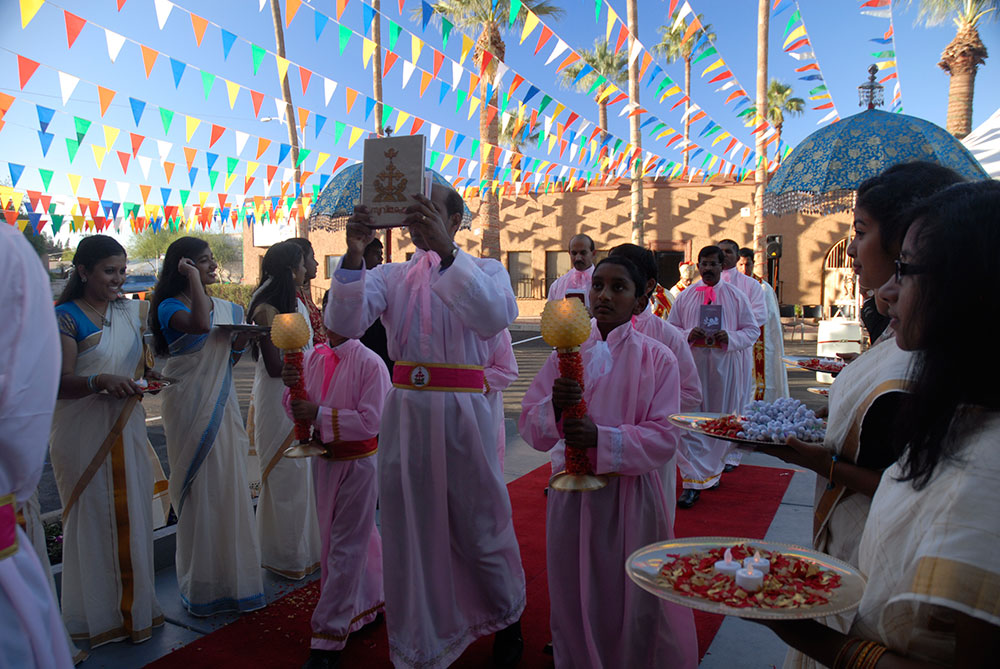
Beneath colorful banners and jeweled umbrellas, hundreds of men, women and children dressed in native attire stood assembled in the parking lot of the Syro-Malabar church on 24th Street, appropriately enough, near Thomas Road.
The Syro-Malabar Catholics — an Eastern Catholic Church — were originally evangelized by St. Thomas the Apostle back in the first century. Today, the local community, comprised of 100 families, is the largest Indian Christian community in Arizona.
For the last eight years, this immigrant flock has celebrated Mass at the Missionaries of Charity’s Our Lady of Fatima Mission on south 17th Street. After purchasing an office building and gutting the interior, the Syro-Malabar community was able to establish its own church which was named Holy Family. Much of the work on the building was done by parishioners. Bishop Jacob Angadiath ventured from the Syro-Malabar diocesan headquarters in Chicago for the dedication ceremony and opening liturgy Nov. 2.
The celebration began with a procession and performance in the parking lot as proud parents and onlookers snapped photos of 120 children, students of the catechism school that meets on Sundays for 90 minutes prior to Mass.
Groups of 10-15 students, beginning with the youngest, danced to the beat of a native drum just outside the entrance to the new church. Young girls decked out in immaculate white dresses tied with magenta sashes waved pom-poms. Older boys wearing yellow hats marched with yellow and white flags and older girls dressed in crimson saris danced as music blared from the loudspeaker and voices chanted saldadum, saldadum, welcome!
Bishop Angadiath blessed the altar and the walls to the left and right of the sanctuary as well as the sacred vessels with chrism. After the Mass, chanted and prayed entirely in Malayalam except for the Our Father rendered in English, the decree from Bishop Angadiath declaring that the mission was now a full-fledged parish, was read. Fr. Mathew Munjanattu was named Holy Family’s first pastor.
Bishop Gerald N. Dino of the Holy Protection of God Byzantine Eparchy, as well as various other Eastern Church clergy, participated in the dedication ceremony and Mass as well.
Bishop Thomas J. Olmsted of the Phoenix Diocese, pointed to the “rich Catholic culture that traces itself back to the preaching and heroic witness of St. Thomas the Apostle” in the modern-day state of Kerala in the south of India, the birth place of many of those who belong to the new parish.
“I rejoice with the Catholics of the Syro-Malabar Rite as they consecrate their new church in Phoenix,” Bishop Olmsted wrote. “We welcome them as true brothers and sisters in Christ, and assure them of fraternal love and prayers.”
St. Thomas suffered martyrdom on July 3 in the year 72 A.D at Mylappoor, India and the Syro Malabar Church observes July 3rd as a holy day of obligation. There are 27 Syro-Malabar dioceses in India and one in the U.S., with headquarters in Chicago.
 
Status
Not open for further replies.
Back
Top