Ten most common liturgical abuses

  • Thread starter Thread starter victrolatim
  • Start date Start date
Status
Not open for further replies.
My responses were “weak” because I don’t feel the need to justify anything, and I don’t actually care about the topic. Fr. Z actually holds to the same interpretation. And it does actually says that the faithful are not to assume postures proper to the priest. If you think it’s wrong, how do you interpret that line?
 
Last edited:
I think the Hail Mary it is strandard in England? At least it was when I lived there. In all the parishes I attended it was always said after the bidding prayers. I might be wrong. I was shocked when I left the UK and it’s not said. I asked and we told it war only said in England, but I can’t remember the reason why. But there was an explanation.
 
Your counter examples were folding hands and standing. I wouldn’t put that in the same ballpark. The laity are instructed to stand at many points of the Mass, so that’s not even relevant. With regard to folding hands, I don’t know. However, the orans is a definitive priestly posture. How else do you interpret that line?
 
Actually, a quick google search turned up a number of sources that agree with my “interpretation”. I’ll post them later today or tomorrow when I get a chance.
 
Does this not mean that hand holding is a liturgical gesture which is not in the rubrics? And that it was not introduced officially?
I would assert that hand-holding, per se, isn’t a liturgical gesture; after all, then all hand-holding inside church during Mass would be “liturgical gesture”, right? And that’s just a ludicrous suggestion!

Therefore, what they’re saying is that hand-holding, at that point in the liturgy, is being introduced specifically as a liturgical gesture, and with the goal of replacing the sign of peace. It’s this combination – the intent of inserting a liturgical gesture, and with the goal of deleting another, that makes it something that the Church is reprobating. (Not general hand-holding as such. So, don’t worry – you can still hold your spouse’s hand during the Liturgy. 😉 )
Generally speaking is it OK to make personal and spontaneous additions to the liturgy on your own initiative without any official permission?
It depends on what you mean. There are spontaneous acclamations and gestures made all the time. The question becomes ‘intent.’
And if you do so, would it be considered a liturgical abuse?
Not a priori, I’d assert.
I don’t think the Church cares if a couple spontaneously decides to hold hands in the Our Father. But I was in one parish a few decades ago where it was practically mandatory.
Notice that the Church’s issue isn’t with hand-holding as such. It’s the fact that it had been attempted to be introduced as a different gesture than one already present in the liturgy, with the intent to eliminate the other gesture. That’s what the Church is responding to, here!
However, the orans is a definitive priestly posture. How else do you interpret that line?
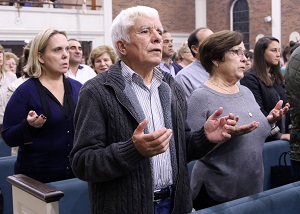
By understanding it in its context. Does the raising of one’s hands during the Lord’s Prayer represent an intent to “use gestures which are proper to the priest celebrant”? Is the intent to “quasi-preside at Mass while leaving only that minimal participation to the priest which is necessary to secure validity”?

If not – and I’d argue that this is not the case here (most clearly with respect to the latter, and perhaps even the former!) – then I’d assert you’re interpreting this line far too aggressively.

 
This thread seems to be dying out, so I’ll post these before I forget. This is mainly to show that I’m not the only one who thinks the faithful should refrain from the orans, and that I did not make up my interpretation out of thin air. I certainly did not come up with it and then use the Vatican document to retroactively justify it. To be fair I will admit that many of these sources state that it is not forbidden, so perhaps that wording was too strong. None seem to support it as a good idea though, and one, from the Bishop of Covington, specifically tells the laity not to.

https://www.praytellblog.com//wp-co...toral-Letter-with-Decree-Bulletin-Insert.pdf- page 3 paragraph C


http://stlouiscatholic.blogspot.com/2008/11/our-father-and-posture-orans-you-glad.html-The priest who wrote this mentions in his response that the US Bishops attempted to “mandate” the orans for the faithful, in order to discourage hand-holding, but that Rome rejected the mandate since the orans is a priestly-posture. I’m still trying to find sources for this.

https://adoremus.org/2003/11/15/about-that-orans-posture/- This references that same incident, but does not provide the document from Rome.

The Faithful Are NOT To Use the Orans Posture During the Our Father | Catholicsay. -This annoyingly ad-laden article is certainly not authoritative, but it shows that I did not just make up my view and use a “Vatican document to lend authority to my interpretation”.

https://www.thebostonpilot.com/opinion/article.asp?ID=178135-This one actually supports your argument.

That’s all I have time for now. It won’t convince anyone, but that’s not really my intention. Have a great day.
 
Last edited:
I’m not the only one who thinks the faithful should refrain from the orans
Whether or not the laity should refrain, doesn’t imply that not doing so rises to the status of a “liturgical abuse.”
it shows that I did not just make up my view and use a “Vatican document to lend authority to my interpretation”.
But does it show that others have done so, as well? 🤔
It won’t convince anyone, but that’s not really my intention. Have a great day.
👍
 
Last edited:
So holding hands during the Our Father is not a Liturgical Abuse.
The article says differently:
Yes, the article claims it is, but then it also condemns dictating posture. So it is contradictory. It dictates a posture not in the GIRM.
 
I don’t think that’s correct, given that Orans during the Our Father is done all over the Archdiocese of Phildelphia under Archbishop Chaput for years, including during Masses he is saying.
Archbishop Chaput has addressed this before. He doesn’t view it as a something worth fighting. It’s not that he approves of it, but doesn’t see it as something worth fighting because there are some many bigger problems.

He’s also not really a “liturgical conservative” like Archbishop Sample and others who have publicly said the laity should not be using the Orans position during mass.
 
Last edited:
I understand the Orans position to be arms open and bent forward, palms up. One of my fellow parishioners called that the Byzantine method. I find it a more open method of praying, that the body language is one of openly offering or openly receiving what God wants us to receive from the prayer, and nobody ever objected when I felt compelled to use it during congregational prayer at Mass. I never associate it with trying to imitate the priest. That never entered my mind. I just felt like praying in a more open manner to God.

It must not be strictly prohibited, or somebody would have said something. We have a few nitpicking folks in the congregation, so it surely would have been mentioned if it was objectionable.

BTW, when I say the blessing at meals during family gatherings, I use this open method of prayer giving thanks.
 
What percentage of Catholics have ever thought one way or the other whether or not the laity orans posture during the Our Father is an abuse or that anyone even debates if it’s proper? I never thought twice about it until I read it on this forum. I see it often but have never done it
 
#6 is actually a lot of different abuses with reception in the hand and the use of extraordinary ministers of Holy Commmunion implied to be abuses even though they are allowed. The author seems a bit irked by that, but if the Pope grants an indult then admitting that practice is not an abuse. I’d say that sometimes obedience is in abiding by what is not allowed but sometimes it is in abiding by what is.

#10 isn’t even a liturgical abuse because the holy water at the entrance of the church isn’t used in the liturgy. It is also a bit funny to say “There is no positive spiritual benefit in depriving the faithful of this legitimate aid at any time” in one paragraph and then, in the next paragraph to write “By the way, because the penitential rite of the Mass and reception of the Eucharist remit venial sins, there’s no need to use holy water on the way out of Mass. Unless you’ve been up to some mischief in those few minutes.” Well, if there is no benefit in depriving the faithful of a “legitimate aid” then what is the point of discouraging people from touching holy water because they are leaving the church? What, there is no reason to touch holy water except consciousness of guilt? Who said that?

I don’t know, I think I’d title it “My Ten Top Pet Peeves at Church.” Mostly, those are liturgical abuses, but the author doesn’t have the slightest idea whether or not they’re the most common. For all the author knows, it is more common that priests wear their stoles outside their chasubles or something.

Oh, and then he cites “parish hopping” as an addendum by saying “if you flee your home parish when things get ugly, you are in a sense not living up to your responsibility as a lay person. It is your duty to point out that liturgy is not entertainment.” It seems to me that he is inventing a duty of the faithful (a) to correct the clergy and (b) to attend Mass in their home parish. I’d say that to say “your are in a sense not living up to your responsiblity” that translates as “you are not doing what I think is your responsibility.”

It isn’t out of place for us to ask questions of our clergy if we think there are problems, but the author has no business inventing duties that are not in fact our duties.

In short, sometimes the author is talking about actual liturgical abuses, although it isn’t an exhaustive list and he has no idea what the prevalence of various abuses are. Sometimes, though, he’s kind of just being a busybody.
 
Last edited:
One of my fellow parishioners called that the Byzantine method.
I wish I had the handout that Father gave us a couple of years ago on different prayer postures . . . but it’s out there, somewhere, a single page.

Of most interest to me that the common hands together, palm to palm . . . became popular for christians because it could bemused while shackled . . . 😱
 
http://stlouiscatholic.blogspot.com/2008/11/our-father-and-posture-orans-you-glad.html-The priest who wrote this mentions in his response that the US Bishops attempted to “mandate” the orans for the faithful, in order to discourage hand-holding, but that Rome rejected the mandate since the orans is a priestly-posture. I’m still trying to find sources for this.
This link is dead and you haven’t been able to find a source yet, but I will respond to what you said. I don’t know if Rome rejected a mandate or not and without documentation it is hard to assess the claim. I have read that the US bishops discussed, but ultimately decided against, requesting permission to make it officially an optional posture.

For what it’s worth, the Italian Bishops conference did request official permission for those who wish to adopt the orans posture to do so, and permission was granted.

In some countries, Italy, for example, the Holy See has granted the bishops’ request to allow anyone who wishes to adopt this posture during the Our Father. Usually about a third to one-half of the assembled faithful choose to do so.

Despite appearances, this gesture is not, strictly speaking, a case of the laity trying to usurp priestly functions.

The Our Father is the prayer of the entire assembly and not a priestly or presidential prayer. In fact, it is perhaps the only case when the rubrics direct the priest to pray with arms extended in a prayer that he does not say alone or only with other priests. Therefore, in the case of the Our Father, the orantes posture expresses the prayer directed to God by his children.

The U.S. bishops’ conference debated a proposal by some bishops to allow the use of the orantes posture while discussing the “American Adaptations to the General Instruction to the Roman Missal” last year. Some bishops even argued that it was the best way of ridding the country of holding hands. The proposal failed to garner the required two-thirds majority of votes, however, and was dropped from the agenda.
 
Here’s the original link:

http://stlouiscatholic.blogspot.com/2008/11/our-father-and-posture-orans-you-glad.html

When I added my comment the word “The” got inserted into the hyperlink, causing an issue. The above should work.

I haven’t actually been looking for the source anymore since the thread seems to have died.
Thanks for posting it.

This statement is at odds with what Father McNamara wrote, when he said that the US Bishops considered requesting permission to allow (but not mandate) the orans posture at Mass. I’m sure that the documentation of what occurred is out there, perhaps buried in the minutes of a bishops’ conference meeting
The Holy Father, however, rejected their petition, because the orans posture is recognized as a priestly posture and inappropriate for the laity to assume at Mass.
This is what makes me doubt the accuracy of the link that you posted. Why would the posture be rejected on these grounds (regardless of whether it would be mandatory or voluntary), but accepted in Italy?
 
It’s not the handholding itself that’s inherently a problem. The problem is that some parishes made it essentially mandatory, a new rubric, sometimes with priest joining in.

This is liturgical abuse, parish created rubrics.
 
If ever a topic deserved a moratorium, surely it would be “ Communion in the hand.” There’s another thread , the most recent of 6,488 threads on this subject, going on now. And for that matter, the point of posting lists of alleged “common abuses” has always been lost on me. I don’t understand what this does for posters. These always remind me of the Spiro Agnew quote: “Wallowing in Watergate.”
Sounds to me like you just equated Communion in the hand to Watergate…🤣
 
The problem is that some parishes made it essentially mandatory, a new rubric, sometimes with priest joining in.

This is liturgical abuse, parish created rubrics.
That I understand, except I might not grasp what you meant “mandatory.” From my understanding, the line is crossed when it is stated that the laity are to hold hands, as that is actually proscribing a posture. But then, I object when the opposite happened and someone forbids it, again, adding to the GIRM.
 
Status
Not open for further replies.
Back
Top