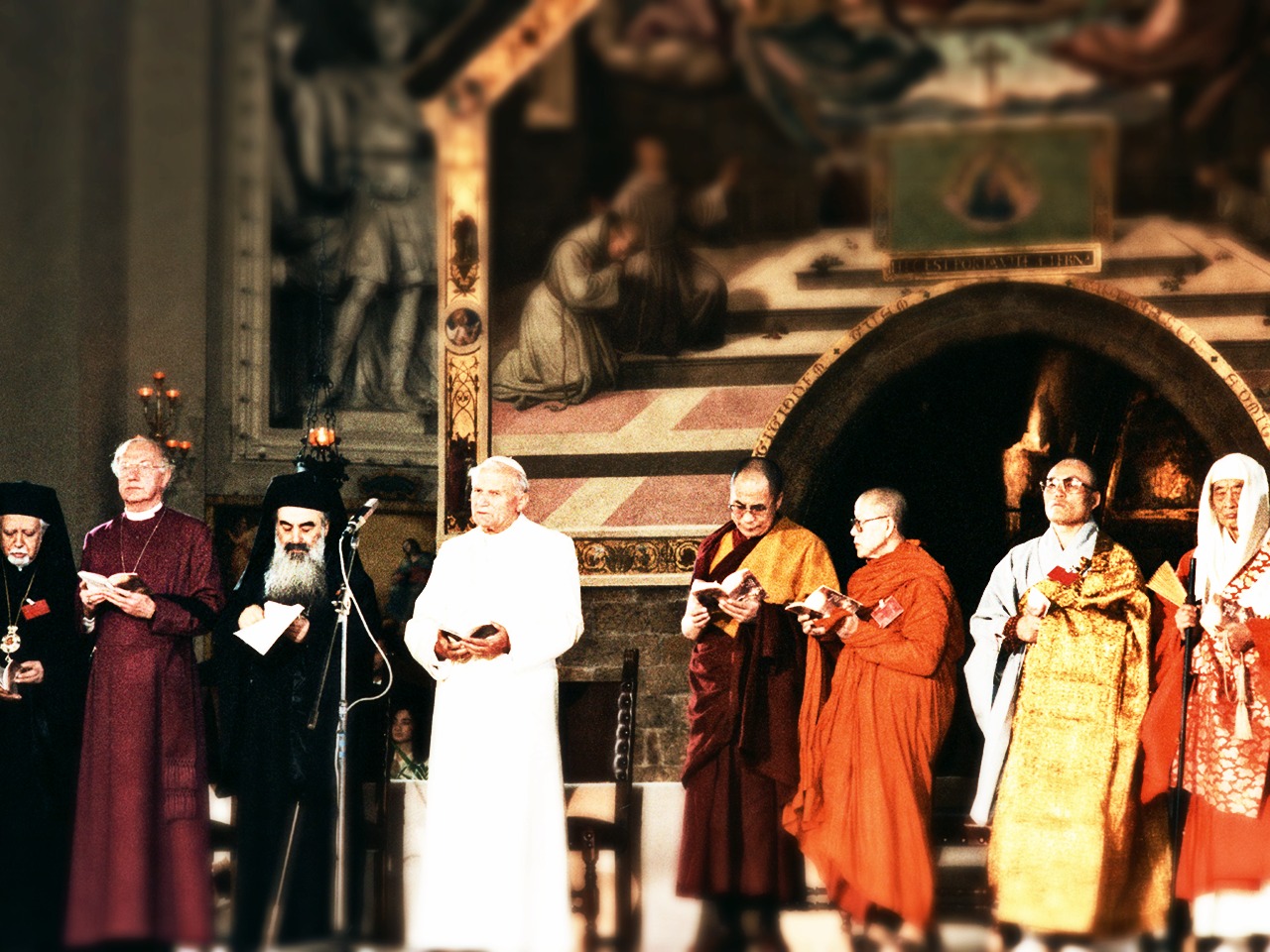
That Buddha on the altar when JPII was in Assisi

  • Thread starter Thread starter gracepoole
  • Start date Start date
Status
Not open for further replies.
G

gracepoole

Guest
I had heard stories about a small statue of Buddha being placed over the tabernacle of St. Peter Church was Pope St. John Paul II was there in 1986. I just read a general reference claiming that this is not entirely factual and has been debunked in some way. Is anyone familiar with sources that prove this event didn’t happen or didn’t happen as it’s often depicted?
 
Last edited:
I had heard stories about a small statue of Buddha being placed over the tabernacle of St. Peter Church was Pope St. John Paul II was there in 1986. I just read a general reference claiming that this is not entirely factual and has been debunked in some way. Is anyone familiar with sources that prove this event didn’t happen or didn’t happen as it’s often depicted?
On October 1986, St. Pope John Paul II held the “World Day of Prayer for Peace of Assisi” which Archbishop of Canterbury and the Dalai Lama joined, among others.
 
Yes, I understand that. I’m asking if a small statue of Buddha was placed over the tabernacle and, if so, whether the Vatican condoned it.
 
Yes, I understand that. I’m asking if a small statue of Buddha was placed over the tabernacle and, if so, whether the Vatican condoned it.
I doubt it. First, the Dalai Lama himself would never ask or suggest something like that. Second, the popes staff wouldn’t see a need or reason for it. Saint pope JPII took amazing unprecedented steps in inter-faith dialogue, some of which are bound to cause confusion. However, saint pope JPII also knew exactly what was appropriate and what was not.
I had heard stories about
I’ve read lots of stories like that, normally from pseudo-traditionalist schismatic sites (I’ll caution there are plenty of such sites that pose as being run by “trads” but are actually run by entities that have no connection to being Catholic whatsoever. The reason is there are plenty of pseudo-religions living of posing a symbiosis/opposition to the catholic church, and those distortions play into the imaginary of their audience. You can also find sites that are exact copies of each other, with slight differences - one being for example “luciferian” the other “spiritst”.)

The most worrisome such cases are those emanating from within the Catholic Church itself.

I could link here -please don’t request that I do so- facebook pages and sites of certain dioceses that are run by the laity -like for example the “catechists group FB page from a Cathedral” in the second largest dioceses in a European country, where plenty of pictures from the popes with quotes like:“Allah, Buda and Christ are all the same god” are shared, liked, and echoed. Of course the quotes are fake, no pope ever said that. So the origin is someones ignorance echoing lies. If you backtrack some of those images to their original source, you will be lead to third world countries where catholics and sects of all kinds share the same space. So, one of them knows how to use photoshop and imposes some heresy on a picture of the pope, short after its gone viral…)
 
Last edited:
Yes, I understand that. I’m asking if a small statue of Buddha was placed over the tabernacle and, if so, whether the Vatican condoned it.
According to NY Times “the participants formed 12 groups this morning so that each faith could pray separately”. and “At no time did all of the participants pray together.”

The NY Times also reported that:
The day produced some extraordinary cultural encounters. For example, the Buddhists, led by the Dalai Lama, quickly converted the altar of the Church of San Pietro by placing a small statute of the Buddha atop the tabernacle and setting prayer scrolls and incense burners around it.

Two American Indians, John and Burton Pretty On Top, of the Crow tribe, caused a stir wherever they went in their plumed headdresses. And when they smoked a peace pipe at the final ceremony, the crowd responded with a great clicking of pocket cameras and then applause.
 
So yes, it did happen, but not when the Pope was present at that particular place. (It is a big church with a lot of levels and altars.)

The only bright spot is that the consecrated hosts must surely have been removed from the tabernacle, because that is standard procedure for any event involving strangers. But it was wrong for a non-priest to be doing anything even secular with an altar, and it was sacrilege to bring anything pagan into sacred areas, much less chonking it on top of a tabernacle.

The moral of the story is that, if you do anything ecumenical or inter-faith on any piece of Church property, you need to have somebody around to watch like a hawk, to prevent inadvertent sacrilege or blasphemy. (Or in this day and age, to prevent sacrilege on purpose.)

Apparently the folks running the Assisi conference were thinking everything would magically be full of proper decorum, which was naive.
 
The Assisi meeting wasn’t the greatest moment of St. John Paul’s papacy. I don’t think he intended to come across as a promoter of religious indifferentism. He wanted to promote peace. Don’t forget, he lived through war and totalitarianism. I guess he was just trying to restore a little civility in the world. Peaceful dialogue is much better than war. That’s all he was promoting.

People often say that the older popes would never have done something like that. But remember, the older popes didn’t live through the bloodiest century in history. They didn’t see the mass slaughter of millions in two world wars. They didn’t see the rise of messianic totalitarianism in the form of Nazism and Communism. John Paul lived through the most dangerous, most evil time in history. He had to do something to restore a culture of life. He had to bring people together. It wasn’t about religion - it was geopolitical.
 
Last edited:
And to be fair to him, while the images communicated a spirit of indifferentism, his words at the event did not. For example, the Pope did state to all present that “peace bears the name of Jesus Christ.” Additionally he said:

“I profess here anew my conviction, shared by all Christians, that in Jesus Christ, as Saviour of all, true peace is to be found, “peace to those who are far off and peace to those who are near”. His birth was greeted by the angels’ song: “Glory to God in the highest and peace among men with whom he is pleased”. He preached love among all, even among foes, proclaimed blessed those who work for peace and through his Death and Resurrection he brought about reconciliation between heaven and earth. To use an expression of Paul the Apostle: “He is our peace.””

http://w2.vatican.va/content/john-p...i_spe_19861027_prayer-peace-assisi-final.html
 
Last edited:
This piece from One Peter Five is one that I was considering when asking the question here. In general, it’s easy to locate MANY traditionalists who view this event as a sacrilege. Honestly I might too if JPII had knowingly permitted it. I’m just doubtful that that’s what truly happened.
 
Last edited:
I agree that it wasn’t a good idea. But I know what St John Paul II intended. His intention was to promote peace. The Assisi meeting should be viewed as a geopolitical rather than a religious event.
 
And Pope Benedict’s inter-faith meeting in Assisi in 2011 ?

(Please Note: This uploaded content is no longer available.)
 
Last edited:
Here’s a good blog article about Pope Benedict’s interfaith prayers


As for the Buddha business, while it wasn’t a smart thing to permit, it seems to have happened without Pope JPII’s being present or involved, and seeing as how we’re 30 years down the road, it’s not a priority for me to get all worked up about now.
 
And Pope Benedict’s inter-faith meeting in Assisi in 2011 ?
It still had some of the same potentially misleading images, but it did tone down the danger of implying common prayer. As Cardinal Kasper put it, “Christians and the followers of other religions can pray, but cannot pray together. Every form of syncretism is to be excluded.”

The 1986 meeting was proposed not as common prayer per se, but people praying in different ways in the same place, but this distinction was lost on most.

The 2011 version did not have such almost-common prayer. It was mostly about dialogues, although some speakers did unfortunately invoke idols before their speeches.
 
Last edited:
Oddly enough, I just listened to Taylor Marshall’s interview with Michael Matt and this topic came up as the catalyst for Archbishop Lefebvre’s decision to ordain bishops. Some clearly have taken this issue very seriously and it’s at least had some significant consequences.
 
As for the Buddha business, while it wasn’t a smart thing to permit, it seems to have happened without Pope JPII’s being present or involved, and seeing as how we’re 30 years down the road, it’s not a priority for me to get all worked up about now.
I’m not sure I think it would be good to “get all worked up” about it now. But if confusion about what took place is creating further rifts within the faith and leading others away from the faith, yeah, I sort of think it’s important to nail down what actually happened.
 
I also listened to that interview. It was amazing. It was perhaps the most important one so far, next to the ones with James Grein.
 
I was nervous when I saw it being promoted – sometimes Matt gets worked up and can come off like he’s just ranting. And sometimes Marshall can overtake an interview. But it actually was an extremely measured – and an extremely optimistic – conversation. I’m really glad they worked together and I’m really glad I listened to it. 👍
 
I remember when Pope John Paul II had the service in Assisi and the accusation that he had a statue of the Buddha on the Altar was made by radical conservative Catholics. The only photo shown, was too blurred to make out, but it was said that it was not a statue of the Buddha, but a statue of the Baby Jesus as depicted in the Middle East, a fat little rolly polly baby.

Still enemies of St John Paul II keep raising their heads.

Jim
 
Status
Not open for further replies.
Back
Top