
P
patrick457
Guest
In 1886/7, what is thought to be a monk’s grave dating from the 8th-9th century was excavated at Akhmim in Upper Egypt. Apart from the physical remains, the tomb contained a small, amateurishly complied parchment codex with fragments of four texts. Although the chief excavator Urbain Bouriant appeared to put more importance on the third text found (hitherto unevidenced Greek fragments of 1 Enoch), what excited everyone else was the first text, which contains a partial but fairly extensive fragment of a previously unknown gospel.
Covering nine continous pages of Greek text, the first document provided a variant version of events from the life of Jesus from His trial until after the resurrection, when some of the disciples quit Jerusalem to return to their work as fishermen. At two points, the narrative breaks into a first-person account; the second instance (occuring just before the text breaks off mid-sentence) identifies the implied narrator as Peter. Coupled with this, there exists a tradition preserved by the historian Eusebius (Church History 6.12.2-6; 6.13.1a) that there was once a gospel which circulated under Peter’s name, which was condemned by Bishop Serapion of Antioch upon inspection at Rhossus in around 190.
…and another word which was put together by him, About the Gospel Called According to Peter, which he has made refuting the things falsely said in it on account of certain ones in the community at Rhossus who were diverted into heterodox teachings by the profession of said writing, from which it seems well to set out brief sayings through which he sets forth the opinion that he had about the book:
Consequently, scholars were quick to identify the Akhmim text with the gospel mentioned by Eusebius. Although this is not an unreasonable assumption, caution should still be exercised, and while the identification is highly appealing, it is ultimately still a hypothesis. Various texts survive that are written in the first person in Peter’s name, which may mean that Serapion’s and Eusebius’ Gospel of Peter may not be the same text found at Akhmim.
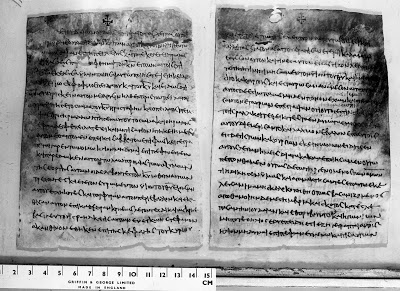
The opening two pages of the text of the “Gospel of Peter.”
Covering nine continous pages of Greek text, the first document provided a variant version of events from the life of Jesus from His trial until after the resurrection, when some of the disciples quit Jerusalem to return to their work as fishermen. At two points, the narrative breaks into a first-person account; the second instance (occuring just before the text breaks off mid-sentence) identifies the implied narrator as Peter. Coupled with this, there exists a tradition preserved by the historian Eusebius (Church History 6.12.2-6; 6.13.1a) that there was once a gospel which circulated under Peter’s name, which was condemned by Bishop Serapion of Antioch upon inspection at Rhossus in around 190.
…and another word which was put together by him, About the Gospel Called According to Peter, which he has made refuting the things falsely said in it on account of certain ones in the community at Rhossus who were diverted into heterodox teachings by the profession of said writing, from which it seems well to set out brief sayings through which he sets forth the opinion that he had about the book:
For we, brethren, receive both Peter and the other apostles as Christ, but the pseudepigrapha that go by their name we reject, as experienced men, knowing that we did not recieve such things. For I myself, when I was with you, had in mind that you all were bearing into the right faith, and, without going through the gospel borne forth by them in the name of Peter, I said that, if this was all that seems to bring about pettiness for you, let it be read. But having now learned from what was said to me that their mind was holing up in some heresy, I shall hasten to be with you again; wherefore, brethren, expect me in quickness. But we, brethren, taking in of what kind of heresy Marcianus was, who also contradicted himself, not thinking about what he was saying, which things you will learn from the things that I have written to you, were enabled by others who studied this same gospel, that is, by the successors of those who began it, whom we called docetics, for most of the thoughts are of their teaching, using [material] from them to go through and find that most things are of the right word of the savior, but some things are spurious, which things we order out for you.
And these things are those of Serapion.
And these things are those of Serapion.
Consequently, scholars were quick to identify the Akhmim text with the gospel mentioned by Eusebius. Although this is not an unreasonable assumption, caution should still be exercised, and while the identification is highly appealing, it is ultimately still a hypothesis. Various texts survive that are written in the first person in Peter’s name, which may mean that Serapion’s and Eusebius’ Gospel of Peter may not be the same text found at Akhmim.
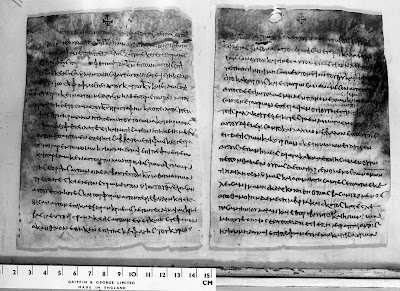
The opening two pages of the text of the “Gospel of Peter.”

 Take for example,