The Book of Revelation-step by step

  • Thread starter Thread starter patrick457
  • Start date Start date
Status
Not open for further replies.
P

patrick457

Guest
Here’s my feeble attempt at a step by step mini-commentary on the Book of Revelation. Comments and criticism welcome:

THE REVELATION OF JOHN

The title:
The title of the work found on earliest manuscripts are ‘The Apocalypse of John’ (Apokalypsis Iōannon), while the most common title found on later manuscripts is ‘The Apocalypse of the Theologian’ (Apokalypsis tou Theologou).

Apokalypsis: The Greek word ‘Apokalypsis’, from the verb ‘Apokalyptō’ (Apo ‘off, away’+Kalpyto ‘to cover up, to hide’), means 'disclosure, unveiling, revelation.

Canonicity: The work itself seems to have been known to many Christians at an early date but was either rejected or accepted into the Biblical Canon depending on the local Church, as the Muratorian Canon (between 170 AD-4th c.) and Eusebius testifies to:
For John also in the Apocalypse, though he writes to seven churches, nevertheless speaks to all…We receive only the Apocalypses of John and Peter, though some of us are not willing that the latter be read in church.
Eusebius, Church History, Book III, 25: 2b, 4
…After them is to be placed, if it really seem proper, the Apocalypse of John, concerning which we shall give the different opinions at the proper time. These then belong among the accepted writings…Among the rejected writings must be reckoned also the Acts of Paul, and the so-called Shepherd, and the Apocalypse of Peter, and in addition to these the extant epistle of Barnabas, and the so-called Teachings of the Apostles; and besides, as I said, the Apocalypse of John, if it seem proper, which some, as I said, reject, but which others class with the accepted books.
Nepos, a 3rd century Bishop from Egypt also expressed his doubts about the authorship of the work (Eusebius, Church History, Book VII 25: 1b-4):
Afterward he speaks in this manner of the Apocalypse of John:
“Some before us have set aside and rejected the book altogether, criticising it chapter by chapter, and pronouncing it without sense or argument, and maintaining that the title is fraudulent. For they say that it is not the work of John, nor is it a revelation, because it is covered thickly and densely by a veil of obscurity. And they affirm that none of the apostles, and none of the saints, nor any one in the Church is its author, but that Cerinthus, who founded the sect which was called after him the Cerinthian, desiring reputable authority for his fiction, prefixed the name…But I could not venture to reject the book, as many brethren hold it in high esteem. But I suppose that it is beyond my comprehension, and that there is a certain concealed and more wonderful meaning in every part. For if I do not understand I suspect that a deeper sense lies beneath the words. I do not measure and judge them by my own reason, but leaving the more to faith I regard them as too high for me to grasp. And I do not reject what I cannot comprehend, but rather wonder because I do not understand it.”
After this he examines the entire Book of Revelation, and having proved that it is impossible to understand it according to the literal sense, proceeds as follows:
“Having finished all the prophecy, so to speak, the prophet pronounces those blessed who shall observe it, and also himself. For he says, ‘Blessed is he that keeps the words of the prophecy of this book, and I, John, who saw and heard these things.’ Therefore that he was called John, and that this book is the work of one John, I do not deny. And I agree also that it is the work of a holy and inspired man. But I cannot readily admit that he was the apostle, the son of Zebedee, the brother of James, by whom the Gospel of John and the Catholic Epistle were written. For I judge from the character of both, and the forms of expression, and the entire execution of the book, that it is not his. For the evangelist nowhere gives his name, or proclaims himself, either in the Gospel or Epistle.”…
Nepos then continues on what he perceives as differences between other works attributed to John and the Revelation and the bad grammar of the original Greek text, which led him to theorize that some other John wrote the work.
1: The revelation of Jesus Christ, which God gave to Him, that He might show His servants what things which must shortly come to pass. He made it known by sending His angel to His servant John,
2: who bears witness to the word of God, and to the testimony of Jesus Christ and of things that he saw.
3: Blessed is he who reads and those who hear the words of the prophecy, and heed what is written in it, for the time is at hand!
Blessed is he who reads: Greek ‘Makarios o anaginōskōn’. The phrase ‘Blessed is he who…’ occurs in a total of seven times throughout the whole book of Revelation, reflecting the sevenfold motif present in the work.

Commentary: St. Victorinus (died 303 or 304), Bishop of Poetovio (Slovenian: Ptuj, German: Pettau) in Pannonia (present-day Western Hungary, Austria, Croatia, Serbia, Slovenia, and Bosnia and Herzegovina) writes in his Commentary on the Apocalypse:
The beginning of the book promises blessing to him that reads and hears and keeps, that he who takes pains about the reading may thence learn to do works, and may keep the precepts.
 
4: John, to the seven Churches which are in Asia: Grace to you and peace from Him who is, and who was, and who is to come; and from the seven spirits who are before His Throne;
Commentary by St. Victorinus:
Grace to you and peace from Him who is, and who was, and who is to come.
He is, because He endures continually; He was, because with the Father He made all things, and has at this time taken a beginning from the Virgin; He is to come, because assuredly He will come to judgment.
And from the seven spirits who are before His Throne;
We read of a sevenfold spirit in Isaiah, -namely, the spirit of wisdom and of understanding, the spirit of counsel and might, of knowledge and of piety, and the spirit of the fear of the Lord (Isaiah 11:2).
Commentary by St. Bede the Venerable (Expositio Apocalypsis):
seven. By these seven churches he writes to every church, for universality is wont to be denoted by the number seven, in that all the time of this age is evolved from seven days.
Grace. Grace he desires for us, and peace from God, the eternal Father, and from the sevenfold Spirit, and from Jesus Christ, Who gave testimony to the Father in His Incarnation. He names the Son in the third place, as he was to speak further of Him. He names Him also the last in order, as He is the first and the last; for He had already named Him in the Father by saying, “Who was to come.”
Seven churches which are in Asia: More specifically, in the western portion of the Roman province of Asia Minor (present-day western Turkey):

http://upload.wikimedia.org/wikiped...asia.svg/463px-Seven-churches-of-asia.svg.png

Thyatira: present-day town of Akhisar in Manisa Province, Turkey
Ephesus: present-day Efes (archeological site), 3 kilometers south of the Selçuk district of İzmir Province, Turkey
Philadelphia: present-day town of Alaşehir in Manisa Province, Turkey
Smyrna: present-day city of İzmir, capital of İzmir Province, Turkey
Pergamon: located north and west of present-day city of Bergama, İzmir Province in Turkey
Laodicea on the Lycus: located near the village of Eskihisar, Denizli Province, Turkey.
Sardis: present-day Sart (archaeological site) in the Manisa province of Turkey.
5: And from Jesus Christ, the Faithful Witness, the Firstborn of the dead, and the prince of the kings of the earth.
To Him who loves us, and had washed us from our sins by His Blood,
Commentary by St. Victorinus:
And from Jesus Christ, the Faithful Witness, the Firstborn of the dead.
In taking upon Him manhood, He gave a testimony in the world, wherein also having suffered, He freed us by His blood from sin; and having vanquished hell, He was the first who rose from the dead, and death shall have no more dominion over Him, (Romans 6:9) but by His own reign the kingdom of the world is destroyed.
Commentary by St. Bede
the first-begotten. This is the same that the Apostle says, “We have seen Jesus Christ for the suffering of death crowned with glory and honour.” (Heb. 2:9-10) And in another place, in setting forth the reproach of the cross, he added, “Wherefore also God highly exalted Him, and gave Him the Name which is above every name.” (Phil. 2: 9)
6: and made us kings and priests to His God and Father, to Him be glory and power to the ages (of ages)! Amen.
Commentary by St. Victorinus:
And He made us a kingdom and priests unto God and His Father.
That is to say, a Church of all believers; as also the Apostle Peter says: A holy nation, a royal priesthood. (1 Peter 2:9)
1 Peter 2:9-10: But you are a chosen race, a royal priesthood, a holy nation (cf. Exodus 19:6 ‘You shall be to me a kingdom of priests, a holy nation’), a people of His own, so that you may announce the praises of Him who had called you out of darkness into His wonderful light. In times past you were “no people” (cf. Hosea 1:9 'Then the LORD said: Give him the name Lo-ammi, for you are not my people, and I will not be your God’) but now you are the people of God; you “had not obtained mercy” but now you have obtained mercy.

You shall be to Me a kingdom of priests, a holy nation (Ex. 19:6): (Greek) “Ymeis de esesthe moi basileion ierateuma, kai ethnos agion.

But you are a chosen race, a royal priesthood, a holy nation (1 Pet. 2:9): (Greek) “Ymeis de genos eklekton, basileion ierateuma, ethnos agion, laos eis peripoiēsin.

Commentary by St. Bede:
priests. Because the King of kings and heavenly Priest united us unto His own body by offering Himself for us, there is not one of the saints who has not spiritually the office of priesthood, in that he is a member of the eternal Priest.
 
7: Behold, He comes with the clouds;
And every eye shall see Him, including those who pierced Him;
And all the tribes of the Earth shall wail because of Him.
Yes, Amen.
Behold, He comes with the clouds: cf. Daniel 7:13.
Including those who pierced Him: cf. John 19: 33-34.

Those who pierced Him…shall wail because of Him: cf. Zechariah 12: 10, Masoretic.

And all the tribes of the Earth shall wail because of Him: Greek 'Kai kopsontai ep’auton pasai ai phylai tēs gēs’; cf. Matthew 24: 30:
And then the sign of the Son of Man will appear in Heaven, and all the tribes of the Earth shall mourn (Greek: Kai tote kopsontai pasai ai phylai tēs gēs), and they shall see the Son of Man coming upon the clouds of Heaven with power and great glory.
Commentary by St. Victor:
Behold, He shall come with clouds, and every eye shall see Him.
For He who at first came hidden in the manhood that He had undertaken, shall after a little while come to judgment manifest in majesty and glory.
Commentary by St. Bede:
cometh. He Who was concealed, when at the first He came to be judged, will be manifested at the time when He shall come to judge. He mentions this, that the Church which is now oppressed by enemies, but is then to reign with Christ, may be strengthened for the endurance of sufferings.
pierced. When they see Him as a Judge with power, in the same form in which they pierced Him as the least of all, they will mourn for themselves with a repentance that is too late.
Amen. By interposing an Amen, he confirms that without doubt that will happen, which, by the revelation of God, he knows most surely is to come to pass.
Haydock’s Catholic Bible Commentary:
Behold, he cometh, or is to come at the day of judgment.
8: “I am Alpha and Omega,” says the Lord God, “Who is, and who was, and who is to come, the Almighty.”
I am Alpha and Omega: Greek ‘Egō eimi Alpha kai to Ō’; compare this instance of ‘Egō eimi’ with:
Jesus said to them, “Amen, amen, I say to you, before Abraham came to be, I Am (Egō eimi).” So they picked up stones to throw at him; but Jesus hid and went out of the temple area. (John 8: 58-59)
Jesus, knowing everything that was going to happen to him, went out and said to them, “Whom are you looking for?” They answered him, “Jesus the Nazorean.” He said to them, “I Am.” (Egō eimi) Judas his betrayer was also with them. ( John 18: 4-5)
And God said to Moses: “I Am the Being” (Greek: Egō eimi o ōn, Hebrew ‘Ehyeh-asher-Ehyeh’, ‘I Am that I Am’). And He added, “Thus shall say to the sons of Israel, that the Being has sent me to you.” (Exodus 3: 14, Septuagint)
The Almighty: Greek ‘Pantokratōr’, meaning ‘All-Powerful’ (Panto+Kratos ‘strength’) or ‘Ruler of All’ (Panto+Krateō ‘to accomplish something’, ‘to sustain something’). Used in the Septuagint to translate the Hebrew term Shaddai. The root word of Shaddai is either Hebrew relative pronoun She+Dai ‘sufficient’ (thus giving El-Shaddai the meaning ‘God who is Sufficient’) or Hebrew shadadto overpower’, ‘to destroy’ or Hebrew shadayim, ‘breasts’; which would connect it with the notion of God’s fertility and His blessings on humanity:
May El-Shaddai bless you and make you fruitful and increase your numbers…(Gen. 28:3)
I am El-Shaddai; be fruitful and increase in number…(Gen. 35:11)
…By El Shaddai who will bless you with blessings of heaven above, blessings of the deep that lies beneath, blessings of the breasts [shadayim] and of the womb [racham]…(Gen. 49:25)
St. Bede’s Commentary:
Alpha and Omega. He is the beginning Whom no one precedes, the end Whom no one succeeds in His kingdom.
Who is. He had said this same thing of the Father, for God the Father came, as He also is to come, in the Son.
Haydock’s Catholic Bible Commentary:
I am Alpha, and Omega. These, the first and last letters of the Greek alphabet, signify the same as what follows, the beginning, and the end, the first cause and last end of all intelligent beings, who is, and who was, and who is to come, the Almighty: These words agree only to him, who is the true God, and here are applied to our blessed Redeemer, who is to come and judge all.
 
9: I, John, your brother and fellow-partaker in the tribulation, and the kingdom, and patience in Jesus, was in the island called Patmos because of the word of God and the testimony of Jesus.
Patmos: A small Greek island in the Aegean Sea. One of the northernmost islands of the Dodecanese complex, it has a population of 2,984 and an area of 34.05 km (13 square miles). The highest point is Profitis Ilias, 269 meters above sea level. While seldom mentioned by ancient writers, it was an inhabited island under the , especially during the 6th-4th centuries BC.

It was during Roman rule that the population of the island started to decline, and Patmos found another use as a place of exile for criminals. Patmos is completely uninhabited by the 6th century AD, until the year 1088, when Osios Christodoulos arrived to found the Monastery of St. John the Theologian. Population started to grow again on the island due to Byzantines fleeing from the Fall of Constantinople in 1453, and Cretan immigrants fleeing the fall of Chandakas (Crete) in 1669.

Commentary by St. Bede:
I John. He indicates the person, the place, and the reason of the vision; and he also testifies that he saw this in the spirit, lest he should be supposed to have been deluded by fleshly apparition.
Patmos. It is a well-known story that John was banished to this island by the Emperor Domitian for the Gospel’s sake, and it was fitly given him to penetrate the secrets of heaven, at a time when it was denied him to go beyond a certain spot on earth.
Was in the island called Patmos: Many Church Fathers are unanimous that John the Apostle was exiled to Patmos, either during the reign of Claudius or Domitian. Some, like Eusebius suscribes to the latter view; Eusebius says in his Church History (Book III, 17-18):
Domitian, having shown great cruelty toward many, and having unjustly put to death no small number of well-born and notable men at Rome, and having without cause exiled and confiscated the property of a great many other illustrious men, finally became a successor of Nero in his hatred and enmity toward God. He was in fact the second that stirred up a persecution against us, although his father Vespasian had undertaken nothing prejudicial to us. It is said that in this persecution the apostle and evangelist John, who was still alive, was condemned to dwell on the island of Patmos in consequence of his testimony to the divine word.
Irenaeus, in the fifth book of his work Against Heresies, where he discusses the number of the name of Antichrist which is given in the so-called Apocalypse of John, speaks as follows concerning him: ‘If it were necessary for his name to be proclaimed openly at the present time, it would have been declared by him who saw the revelation. For it was seen not long ago, but almost in our own generation, at the end of the reign of Domitian.
While others, like St. Epiphanius of Salamis, thinks that John was exiled during Claudius’ reign. He writes in his Panarion:
Later, therefore, though from caution and humility he had declined to be an Evangelist, the Holy Spirit compelled John to issue the Gospel in his old age when he was past ninety, after his return from Patmos under Claudius Caesar, and several years of his residence in Asia. (Panarion, Haer. 51, 12:1)
St. John…prophesied before his falling asleep, during the time of Claudius Caesar and earlier, when he was on the isle of Patmos. (Panarion, Haer. 51, 33: 9)
Because of the word of God and the testimony of Jesus: cf. Revelation 12: 17.
 
10-11: I was in the spirit on the Lord’s Day and heard behind me a great voice as a trumpet, which said: “Write on a book what you see and send it to the seven churches: to Ephesus, Smyrna, Pergamum, Thyatira, Sardis, Philadelphia, and Laodicea.
I was in the spirit: cf. Numbers 11:25:
Then the Lord came down in a cloud, and spoke to him. Taking some of the spirit that was on Moses, He gave it to the seventy elders. And it came to pass, that when the Spirit had rested on them they prophesied (, nor did they cease afterwards).
1 Samuel 19: 23:
As [Saul] set out from the hilltop toward the sheds, the spirit of God came upon him also, and he continued on in a prophetic condition until he reached the spot.
Ezekiel 1: 28, 2:1-3, 8:3:
Such was the vision of the likeness of the glory of the Lord. When I saw it, I fell upon my face and heard a voice of One speaking: “Son of man, stand up on your feet and I will speak with you.” As he spoke to me, the Spirit entered into me and set me on my feet, and I heard the one who was speaking say to me: “Son of man, I am sending you to the children of Israel, to a rebellious nation who have rebelled against Me; they and their fathers have revolted against me to this very day.”…
Lord’s Day (Kyriake imera): St. Jerome explains the Christian Lord’s Day thus:
“The Lord’s day, the day of the Resurrection, the day of Christians, is our day. It is called the Lord’s day because on this day the Lord ascended to the Father as Victor; but when the heathens call it the day of the sun, we are most happy to acknowledge their title, for today has risen the Sun of righteousness with healing in His wings (Malachi 4.2).”
That it was identified with Sunday even on an early date can also be clearly seen on Acts 20:7 (‘On the first day of the week * the disciples came together to break bread’) and the Didache, which may have been written in the late 1st-early 2nd century, states that:
'But on the Lord’s Day (Kyriake de Kyriou
, literally, “the Lord’s [day] of the Lord”), after that you have assembled together, break bread and give thanks, having in addition confessed your sins, that your sacrifice may be pure’.

By the 2nd century, the Apocryphal Gospel of Peter (written 2nd century AD), used the word Kyriake to signify the first day of the week, the day of Jesus’ resurrection:
Early in the morning, as the Sabbath dawned, there came a large crowd from Jerusalem and the surrounding areas to see the sealed tomb. But during the night before the Lord’s Day dawned
, as the soldiers were keeping guard two by two in every watch, there came a great sound in the sky, and they saw the heavens opened and two men descend shining with a great light, and they drew near to the tomb. The stone which had been set on the door rolled away by itself and moved to one side, and the tomb was opened and both of the young men went in…

Early on the Lord’s Day, Mary of Magdala, a disciple of the Lord, was afraid of the Jews, for they were inflamed with rage, so she had not performed at the tomb of the Lord the things that are cusomary for women to do for their loved ones that have died. She took with her some women friends and came unto the tomb where he had been laid…

In another Apocryphal work, the Acts of Peter (late 2nd century AD) Dies Dominica (Latin for “the Lord’s Day”) was “the next day after the Sabbath.” From the same time period, the Acts of Paul present St. Paul praying “on the Sabbath as the Lord’s Day (Kyriake) drew near.” These suggest that Christians already knew the first day of the week (Sunday) as the Kyriake, the day of the Lord.

Commentary by St. Bede:
The Lord’s day
. He indicates also a fit time for a spiritual vision, for Scripture is wont to express the reason of things in terms, as, frequently, of the place, or the body, or the air, and in like manner, the time. The Angels, namely, visit Abraham at noon, Sodom in the evening; Adam after midday was afraid at the voice of the Lord, walking up and down; and Solomon received at night the wisdom which it was not to be his to retain.

Heard. He is first admonished by a voice, that he may direct his attention to the vision.

Seven churches. The Church of Christ was not at the time in these places alone, but all fullness is comprised in the number seven. Asia, which is interpreted elevation, denotes the proud exaltation of the world in which the Church is sojourning, and, as is the method of the divine mystery, the genus is contained in the species. For the Apostle Paul also writes to seven churches, but not to the same as St. John. And although these seven churches are a sevenfold figure of the whole Church, still the things which he blames, or praises, came to pass in them one by one.

Commentary by St. Andrew of Caesarea:
Having mentioned the place and time, St. John indicates likewise his own condition, in which he was vouchsafed the apocalyptic visions. I was in the Spirit on the Lord’s day
, he says. In the language of the Prophets, to be in the Spirit is to be in the spiritual condition of a man who sees, hears and feels not only with his bodily organs, but with all his inward being. This is not a dream, for such a condition occurs also when one is awake. In such an extraordinary condition of his spirit, St. John heard a loud voice as of a trumpet.*
 
patrick457
Wow. You just did the whole job over there! Good luck with your site.
Thanks! I still need to take a lot of time to just edit my catena in order to make it’s appearance look neat. Feel free to use whatever you want from it. I designed it to provide quotes from all the Patrisitic sources that I could find. One day I may finish the job, but right now my heart is set on the Daily Mass Readings and their commentary.
 
12-13: I turned to see whose voice it was that spoke to me, and when I turned, I saw seven gold lampstands. And in the midst of the lampstands was one like a Son of Man, clothed to the foot, with a golden sash around his chest.
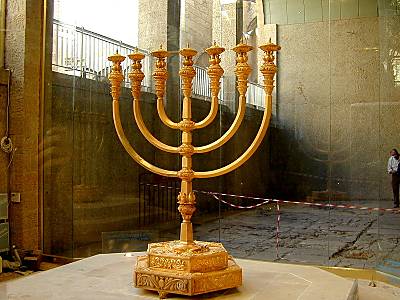
Seven gold lampstands: This may be a reference to the seven-branched Menorah (Exodus 25:31-40) originally located inside the Jewish Temple, in the Sanctuary before the Holy of Holies:


A modern reconstruction of the Menorah

This would seem likely given the description of the ‘One like a Son of Man’ as wearing priestly garments, suggesting Temple imagery.

One like a Son of Man: cf. Daniel 7:13.

Clothed to the foot: Jewish priests (Kohanim) wore an ankle-length tunic (Ketonet) made of pure linen with long sleeves as their standard piece of clothing (Exodus 28: 40-41, 39: 27-28). Those worn by priests were plain while the one worn by the High Priest (Kohen Gadol) was embroidered (Exodus 28: 39). On Yom Kippur, the High Priest would change into a special ketonet made of fine linen that was not embroidered when he would enter the Holy of Holies. This ketonet could only be used once, with a new set made for each year.

http://www.jewishweaving.com/images/Menorah-&-High-Priest-cropp.gif
A reconstruction of the Jewish High Priest’s vestments. The ketonet is visible under the purple-bluish Me’il Techelet (Robe of the Ephod), a sleeveless robe made of a single piece without seam (Exodus 29:31-32, 38:22-26; compare John 19:23-24).

Commentary by St. Victorinus:
And what says He?
And I turned, and saw seven golden candlesticks; and in the midst of the seven golden candlesticks one like the Son of man. He says that He was like Him after His victory over death, when He had ascended into the heavens, after the union in His body of the power which He received from the Father with the spirit of His glory.
As it were the Son of man walking in the midst of the golden candlesticks. He says, in the midst of the churches, as it is said in Solomon, I will walk in the midst of the paths of the just, (Proverbs 8:20) whose antiquity is immortality, and the fountain of majesty.
Clothed with a garment down to the ankles. In the long, that is, the priestly garment, these words very plainly deliver the flesh which was not corrupted in death, and has the priesthood through suffering.
And He was girt about the paps with a golden girdle. His paps are the two testaments, and the golden girdle is the choir of saints, as gold tried in the fire (1 Peter 1: 7). Otherwise the golden girdle bound around His breast indicates the enlightened conscience, and the pure and spiritual apprehension that is given to the churches.
Commentary by St. Bede:
turned. Here the figure of the Church is beautifully represented, as holding forth the light of divine love in the brightness of a chaste breast, according to that which the Lord said, “Let your loins be girt, and your lamps burning.” (Luke 12:35) And he denotes its perfection within and without by the two parts of the number seven; and the individual members of it, consisting of the four qualities of the body, “love the Lord their God with all their heart, with all their soul, and with all their strength.” (Deut. 6:5; cf. Matt. 22:37, Mk. 12:30, Lk. 10:27)
Son of Man. He means that he is like the Son of Man when He had overcome death, and had ascended into heaven. For “Although we knew Christ after the flesh, yet henceforth know we Him no more.” (2 Cor. 5:16) And it is well said, “in the midst,” for “All”, he says, “who are round about Him shall offer gifts.” (Ps. 75 [76]: 11 [12])
garment. “Proderis,” which is called in Latin, “tunica talaris,” and is a sacerdotal vestment, shows the priesthood of Christ, by which He offered Himself for us, as a victim to the Father, upon the Altar of the Cross.
girdle. By the “paps” he here means the two Testaments, with which He feeds the body of the saints in communion with Himself. For the golden girdle is the choir of saints, which cleaves to the Lord in harmonious love, and embraces the Testaments, “keeping,” as the Apostle says , “the unity of the Spirit in the bond of peace.” (Eph. 4:3)
Haydock’s Commentary:
I saw seven golden candlesticks, which, by the last verse of this chapter, represented the seven Churches of Asia. We may suppose these candlesticks to have been shown to St. John, like what is described (Exodus 25:31). For in these visions of St. John are frequent allusions to the former tabernacle, and to things relating to the service and worship of God, which Moses was ordered to make.
And in the midst of the seven golden candlesticks, i.e. walking among the candlesticks, like unto Christ, as he many times called himself the Son of man, and at other times told the Jews he was the Son, the only begotten Son of God. By this walking among the candlesticks is signified his providential care over all the particular Churches, which make up one Catholic Church. With a long garment, and a golden girdle, with a resemblance to the habit of the priests.
Jesus Christ is in the midst of his Church to enlighten it, to defend and sanctify it, the true model of pastors, who should reside in the midst of their flock, be clothed with sanctity and justice, and girt with the golden girdle, i.e. with singular purity, always ready for combat and labour, by their charity and zeal.
 
14: And His head and His hairs was as white as white wool, as white as snow; and His eyes were like a flame of fire,
Hairs…as white as white wool: cf. Daniel 7:9
Eyes…like a flame of fire: cf. Rev. 19:12.

Commentary by St. Victor:
And His head and His hairs were white as white wool, as white as snow. On the head the whiteness is shown; but the head of Christ is God (1 Cor. 11:3). In the white hairs is the multitude of abbots like to wool, in respect of simple sheep; to snow, in respect of the innumerable crowd of candidates taught from heaven.
His eyes were as a flame of fire. God’s precepts are those which minister light to believers, but to unbelievers burning.
Commentary by St. Bede:
white. The antiquity and eternity of majesty are represented by whiteness on the head, to which all the chief ones adhere, as hairs, who, because of the sheep which are to be on the right hand are white, like wool, and because of the innumerable multitude of the white-robed and the elect, who come forth from heaven, are glistering like snow.
eyes. The eyes of the Lord are preachers, who, with spiritual fire, bring light to the faithful, and to the unbelieving a consuming flame.
Commentary by St. Nicholas of Lyra:
And his head and his hairs were white. The Angel appeared in the form of a priest, because he was clothed with a long robe and also appeared in the form of a judge-from his mouth a sharp, 2-edged sword came, as is seen below. The maturity in age and in character designated by the whiteness is appropriate for judges and priests; therefore, he appeared in white-otherwise it is inappropriate to be found in white, and for that reason in Song of Songs, where Christ is described as the young bridegroom, His hair is called black, “His locks are palm fronds and black as the raven (Song:11).”
And his eyes were as a flame of fire. For the acute vision of God reaches to know the innermost parts of things, “All are naked and laid bare to His eye (Heb. 4:13).”
Commentary by Apringius of Beja:
The head of Christ is God, and He Himself is white on account of the brightness of the purity of the Unbegotten and on account of the unmixed light of the Only Begotten and on account of the pure radiance of the Holy Spirit and the immaculate glory of His righteousness.
And not without reason is He called white, because He is compared to white wool and to snow on account of His tenderness which He gives without ceasing to the sinners. As it is written: “Though your sins are like scarlet, they shall be as white as snow; and though they are red as crimson, they shall become as wool (Is. 1:18).”
15: And His feet was like fine brass, as if it had been refined in a furnace; and His voice was like the sound of many waters,
His feet was like fine brass: cf. Daniel 10:6 and Ezekiel 1:7, where the ‘man’ (Angel) Daniel sees and the Cherubim Ezekiel sees are described as having feet looking like burnished brass.

His voice was like the sound of many waters: cf. Daniel 10:6 (the ‘man’s’ voice was like ‘the roar of a multitude’), Ezekiel 1:24 (the sound of the Cherubim’s wings are described as ‘like the roaring of mighty waters, like the voice of the Almighty’).

Commentary by St. Bede:
feet. By the “fiery feet” he means the Church of the last time, which is to be searched and proved by severe afflictions. For orichalcum is brass, which by much fire and various ingredients, is brought to the colour of gold. Another translation, which renders it, “like orichalcum of Lebanon,” (The Syriac and Arethas render this as ‘like brass from Lebanon’) signifies that in Judea, of which Lebanon is a mountain, the Church will be persecuted, and especially at the last. The Temple also frequently received the name of Lebanon, as there is said to it, “Open, O Lebanon, thy gates, and let the fire devour thy cedars.” (Zech. 12:1)
voice. The voice of confession, and preaching, and praise does not resound in Judea alone, but among many peoples.
Commentary by St. Victorinus:
His feet were like fine brass, as if burned in a furnace.
He calls the apostles His feet, who, being wrought by suffering, preached His word in the whole world; for He rightly named those by whose means the preaching went forth, feet. Whence also the prophet anticipated this, and said: “We will worship in the place where His feet have stood (Ps. 132:7).” Because where they first of all stood and confirmed the Church, that is, in Judea, all the saints shall assemble together, and will worship their Lord.
His voice as it were the voice of many waters. The many waters are understood to be many peoples, or the gift of baptism that He sent forth by the apostles, saying: "Go ye, teach all nations, baptizing them in the name of the Father, and of the Son, and of the Holy Ghost (Matt. 28:19).
Commentary by Oecumenius, Bishop of Trikka:
And His voice as the sound of many waters.
This is an appropriate way of speaking. For how would His voice reach into all the earth and the proclamation concerning Him into the corners of the world, unless it were audible, and not merely by virtue of the perceptible voice but by the power of the proclamation?
 
16: And in His right hand He held seven stars, and out of His mouth proceeded a sharp two-edged sword, and His face was like the sun shining in its power.
Seven stars: The Irano-Roman god Mithras and some Roman Emperors were at times represented with seven stars (usually interpreted as the Pleiades, the seven planets, or the Big Dipper), symbolizing their universal dominion.

In His right hand: A position at the right hand was regarded as the chief place of honor and power (as per many ancient cultures’ view of the right hand in a positive light), cf. Ps. 45:9, 80:17, 110:1, Matt. 26:64, Lk. 22:69, Acts 2:23, Hebrews 8:1-2; 10:12-13, 1 Peter 3:22.

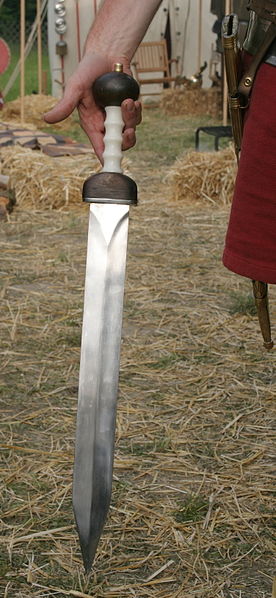
Two-edged sword (Romphaia distomos): The word rhomphaia was originally used to mean a close combat bladed weapon (a polearm) used by the Thracians as early as 400 B.C, a variant of the Dacian Falx.

http://content.answers.com/main/content/wp/en-commons/thumb/b/b5/180px-Falx_bgiu.png
A drawing of a falx. Most Thracian rhomphaia have much more longer handles than this one.

The word was later used to mean a sword (Plutarch: Life of Aemilius Paulus 18, Eustathius, on Iliad verse VI 166, Hesychius, Luke 2:35 and Revelation), which it still carries today in modern Greek (‘a big broad sword’).


A Roman gladius, with a double-edged blade

Out of His mouth proceeded a sharp two-edged sword: The word of God, cf. Eph 6:17; Hebrews 4:12.

His face was like the sun: Symbolizing the majesty of God. Heavenly beings (i.e. God or the Angels) and humans who were exposed to the Divine Presence (i.e. Moses) were described to have faces and/or clothing that shone so brightly, cf. Exodus 34: 28-30, Judges 5:31, Isaiah 60:19, Ezekiel 1:27, Daniel 10:6, Matthew 17:2; 28: 3, Luke 24:4, Rev 10:1; 21:23.

Commentary by Oecumenius of Trikka:
He himself goes on to interpret these stars, saying they were the angels of the 7 churches, about whom blessed Gregory (of Nazianzus) spoke at the coming of the bishops: “with reference to the presiding angels, I believe that each is a guardian of each church, as John teaches in the Revelation (Orationes 42.9).” I think that he calls the holy angels stars on account of the abundant light of Christ, which is in them.
Commentary by St. Bede:
hand. In the right hand of Christ is the spiritual Church. “On Thy right hand,” he says, “stood the queen in a vesture of gold.” And as it stands on His right hand, He saith, “Come, ye blessed of My Father, receive the kingdom.”
mouth. He, the Judge of all things visible and invisible, “after He has killed, has power to cast into hell fire.
countenance. Such as the Lord appeared on the Mount, will He appear after the judgment to all the saints, for at the judgment the ungodly will behold Him whom they pierced. But all this appearance of the Son of Man belongs also to the Church, for He Himself was made the Christ in the same nature with it, and He gives to it a sacerdotal dignity and a judicial power, and to “shine as the sun in the kingdom of His Father (St. Matt. 13:43).”
Commentary by St. Jerome on the two-edged sword:
The Lord, therefore, gives the sword from His mouth to His disciples. It is a two-edged sword, namely, the word of His teachings. It is a two-edged sword, historically and allegorically, the letter and the spirit. It is a two-edged sword that slays adversaries and at the same time defends His faithful. A two-edged sword- the sword has two heads. It speaks of the present and future world. Here below, it strikes down adversaries: above, it opens the kingdom of Heaven.
Commentary by St. Nicholas of Lyra:
And he had in his right hand seven stars,” that is, the bishops, who are called stars, as it is explained at the end of the chapter, because they are to illuminate the Church equally in life and in doctrine, “*And those who lead many to righteousness, like the stars forever and ever *(Dn. 12:3).” The stars are said to be in the right hand of Christ, because without Him they are not able to work justly, “*Apart from me you can do nothing *(Jn. 15:5).” Christ says this to the apostles, whose successors are the bishops in the Church of God, as it is said in the Decretal (Dist. 21, ca. In novo Testamento).
And from his mouth came out a sharp two edged sword,” that is, a just sentence.
"And his face was as the sun shineth in his power,“ for He is the true light that enlightens everyone coming into the world.(Jn. 1:9)
 
**
:** Many Church Fathers are unanimous that John the Apostle was exiled to Patmos, either during the reign of Claudius or Domitian. Some, like Eusebius suscribes to the latter view; Eusebius says in his Church History (Book III, 17-18):

While others, like St. Epiphanius of Salamis, thinks that John was exiled during Claudius’ reign. He writes in his Panarion:

Because of the word of God and the testimony of Jesus: cf. Revelation 12: 17.
Did Domitian preceed Claudius ? If so, then Irenaeus and St. Epiphanius may not be in conflict here.
 
Did Domitian preceed Claudius ? If so, then Irenaeus and St. Epiphanius may not be in conflict here.
Tiberius Claudius Caesar Augustus Germanicus reigned from 41-54 AD while Titus Flavius Domitianus reigned from 81-96 AD, so there is a bit of a gap between the two (between them were Nero, Galba, Otho, Vitellius, Vespasian and Titus).
 
Tiberius Claudius Caesar Augustus Germanicus reigned from 41-54 AD while Titus Flavius Domitianus reigned from 81-96 AD, so there is a bit of a gap between the two (between them were Nero, Galba, Otho, Vitellius, Vespasian and Titus).
Clearly 41-54 AD is way too early. Eusebius had it correct believing Irenaeus over the St. Epip.

Eusebius is the best ‘overall’ source of early Church history … and a good Catholic.
 
Clearly 41-54 AD is way too early. Eusebius had it correct believing Irenaeus over the St. Epip.

Eusebius is the best ‘overall’ source of early Church history … and a good Catholic.
As for the two Emperors:

Claudius was reported by Suetonius (Claudius 25:4) and Luke (Acts 18:2) to have expelled the Jews from Rome due to a new Jewish sect called the ‘Chrestians’ by the general public (which could either be Christians or some other followers of a man named Chrestus), however Cassius Dio minimizes the event and Josephus does not mention anything about it at all, leading some to think that either the event did not happen at all or that those expelled were only missionaries.
Suetonius: “Since the Jews constantly made disturbances at the instigation of Chrestus, [Claudius] expelled them from Rome…”
“There [Paul] met a Jew named Aquila, a native of Pontus, who had recently come from Italy with his wife Priscilla, because Claudius had ordered all the Jews to leave Rome.” (Acts 18:2)
Cassius Dio: As for the Jews, who had again increased so greatly that by reason of their multitude it would have been hard without raising a tumult to bar them from the city, he did not drive them out, but ordered them, while continuing their traditional mode of life, not to hold meetings.
Luke states that ‘all’ Jews were expelled; however Cassius Dio states that Jews were numerous in the city (it is estimated that there were about 40-50,000 Jews living in Rome at that time), which leads me to lean to the theory that while the order affected prominent Jews (such as Aquila and Prisca), having all Jews expelled from Rome was difficult to do.

There had been several attempts to ban all astrologers from Rome, in each case without signal success, so the scenario may have been not too much different from that, especially with the number of the Jewish population at that time (somewhere around 49 AD, if we follow the 5th-century writer Orosius’ opinion). This then led Claudius to just ban the remaining Jews in Rome from holding meetings while still tolerating their lifestyle.

As for Domitian, early evidence of any Christian persecutions during his reign are slim; while Jews were heavily taxed during this time no contemporary authors mention trials or executions based on religious offenses other than those within the Roman religion. However, this does not prevent us from thinking that anti-Christian policies existed during at some parts of the Roman Empire and that John may have been a victim of one of these.
 
As for Domitian, early evidence of any Christian persecutions during his reign are slim; while Jews were heavily taxed during this time no contemporary authors mention trials or executions based on religious offenses other than those within the Roman religion. However, this does not prevent us from thinking that anti-Christian policies existed during at some parts of the Roman Empire and that John may have been a victim of one of these.
Oftentimes prominent Jews were the cause of much Christian misery. They would petition the Emperor to put penalty on this or that Christian who was causing trouble or ignoring Roman laws.

The fact that John was only banned to isle of Patmos for a period of time … rather than martyred … suggest his sentence may of come from a more lenient Roman ruler [Domitian perhaps ?]
 
17-18: When I saw Him, I fell down at His feet as though dead. But He laid His right hand upon me and said, “Do not fear; I am the First and the Last, and the One who lives; and was dead, and behold, I am alive to the ages of ages, and I hold the keys to Death and Hades.”
When I saw Him, I fell down at His feet as though dead: It was believed that to see the face of God would be fatal to a human being, cf. Genesis 16:13; 22:30, Exodus 19:21; 33:20, Judges 6:22-23; 13:22, Isaiah 6:5.

The One who lives: cf. Job 19:25, Ps 18:46, John 14:19, Romans 6:9, 2 Corinthians 13:4, Galatians 2:20, Col. 3:3, Heb. 7:25.

And was dead: cf. Romans 14:8-9, 2 Corinthians 5:14-15.

I am alive to the ages of ages: cf. Rev. 4:9; 5:14, Heb. 7:16, 25.

I hold the keys to Death and Hades: cf. Matthew 28:18 (“All power in Heaven and Earth has been given unto me”).

Hades: The Hebrew Sheol (Sh’ol), the abode of the dead; cf Rev 20:13-14; Numbers 16:33.


Commentary by St. Irenaeus (Adversus Haereses):
But when John could not endure the sight for he says, “I fell at his feet as dead;” that what was written might come to pass: “*No man sees God, and shall live *(Ex. 33:20)”, and the Word reviving him, and reminding him that it was He upon whose bosom he had leaned at supper, when he put the question as to who should betray Him, declared: “I am the first and the last, and He who lives, and was dead, and behold I am alive for evermore, and have the keys of death and of hell.
Commentary by St. Nicholas of Lyra:
And when I had seen him, I fell at His feet as dead.” Here, consequently, the fear of John is noted, when It is said, when I had seen him, This, moreover, was able to show human fragility in the face of angelic power. A parallel case concerns Daniel in the angelic vision of Dan. 10. This, nevertheless, holds a greater place in the program, because the angel appeared representing the divine Person, as was noted above, who exceeds the angelic incomparably.
And he laid his right hand,” Here, consequently, the consolation of the fearful one is addressed, when it is said: “And he laid his right hand upon me,” In order to comfort my fragility.
Therefore, it is added: “Fear not.” And he adds the reason: “I am the First and the Last.” By this it is signified what was noted above: “*I am Alpha and Omega *(1:8).”
It is similarity explained, as if he says, "I am strong to save you, therefore do not be afraid.
And alive, and was dead.” In His assumption of humanity for the salvation of humankind, on account of which you should not fear, “And behold, I am living for ever and ever,” Because Christ, the Man, rose to immortal life.
And have the keys of death and of hell,” That is, the power of leading the just from thence, which He also did in His own resurrection, and the power to shut up the impious there, which He will specifically do at the last judgment, saying that terrible word, “Depart you evil ones into the eternal fire. (Mt. 25:41)”
Commentary by St. Andrew of Caesarea:
(verse 17) From this one may conclude that the beloved disciple, who had once lain on the breast of Jesus, did not recognize in the One Who had appeared a single familiar feature. And this is not surprising; for if the disciples did not easily recognize their Lord after His Resurrection in His glorified body on earth, all the more difficult would it be to recognize Him in this resplendent heavenly glory.
(verse 18)…From these words St. John was to understand that the One Who appeared was none other than the Lord Jesus Christ, and that His appearance could not be fatal for the Apostle, but on the contrary would be life-giving. To have the keys to something signified among the Jews to receive authority over something. Thus the keys of Hades and death signify authority over the death of the body and the soul.
**Commentary by St. Bede: **
I fell at His feet, etc. As a man, he trembles at the spiritual vision, but his human fear is banished by the clemency of the Lord.

Do not fear; I am the First and the Last. He is the first, because “*by Him were all things made *[John 1:3, Col. 1:16];” the last, “*because in Him are all things restored *[Eph. 1:10].”
I hold the keys of death and of hell. Not only, He saith, have I conquered death by resurrection, but I have dominion also over death itself. And this He also bestowed upon the Church by breathing upon it the Holy Spirit, saying, “Whose sins ye remit, they are remitted unto them, etc [Jn. 20:23].”
 
Nicely done … quoting the early saints and Church fathers, the vision pictures, etc.
 
Status
Not open for further replies.
Back
Top