One of the most distinguishing features of medieval churches is the Choir Screen. Variations of the
transenna were common from the early Church until the seventeenth century. Since the early days of the Church there has been a tradition of veiling the sacred mysteries by screening the Altar off from the congregation, which is derived from the liturgical practices of the Jewish Temple.
Contrary to common belief, the Latin Church has never made use of the Eastern tradition of the Iconostasis, although both the Iconostasis of the East and the Choir Screen of the West possessed a common origin. The original Screen was a barrier similar to the Communion Rail found Latin churches, separating the nave from the sanctuary with a gate to allow the passage of the celebrant and assisting deacons and acolytes. The image below is a reconstruction of the transenna of seventh century monastery at Melec in Austria.
http://www.carantha.net/8bd611b0.jpg
In early churches the choir, composed mostly of laymen, would have been found on either side of the nave, but as choirs (especially in monastic and cathedral churches) became dominated by the clergy and religious they were moved into the sanctuary, partly in order to emphasize the important liturgical role they played. To accommodate them the sanctuary was enlarged and the Altar moved further back from the nave. The screen itself became enlarged and associated with the medieval
Rood.
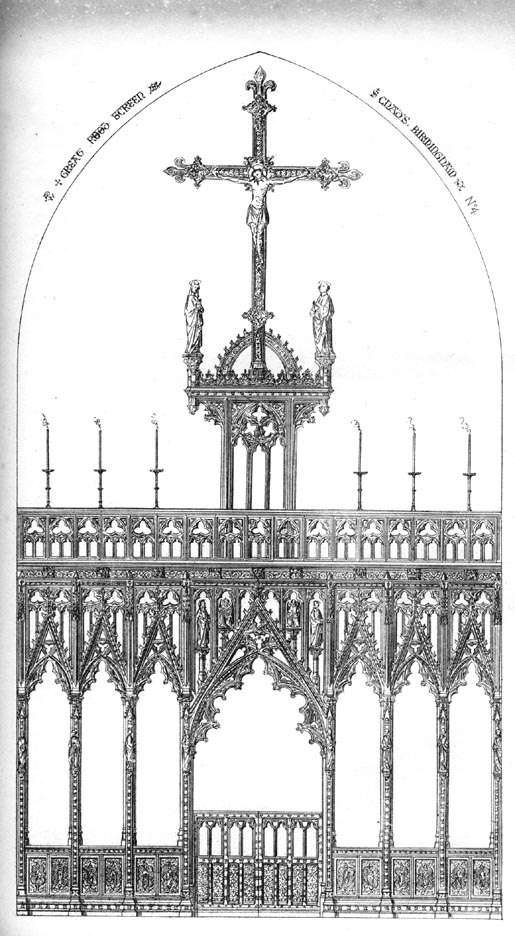
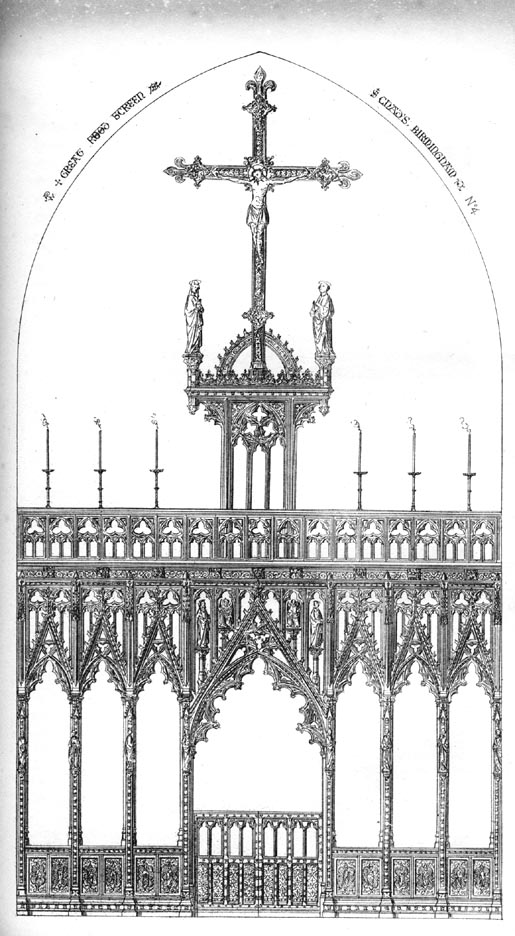
Above is an image of the medieval Rood Screen. The transenna has been merged with the later practice of placing a large cross (the Rood) atop a beam spanning the width of the chancel arch at the entrance to the sanctuary, with candles or lamps placed along the beam. This particular screen, like many in medieval Europe, is large enough to have walking space along the top, enough for a gallery or loft overlooking the nave. It was from the center of this loft, beneath the Rood, that sermons would be preached, Papal and Episcopal decrees read, and various readings and prayers intoned on certain occasions (it is thought that these lofts were the origin of the raised pulpit). The loft was also used for Exposition of the Blessed Sacrament, and in cathedrals for Episcopal blessings.
The most common forms of the Choir Screen either have grilles or windows, which allowed the laity to see through into the sanctuary. However in monastic and cathedral churches where a large number of clergy and religious would use the sanctuary for Mass and the Divine Office, the screen was often solid to provide them with privacy and security. In smaller churches and chapels curtains were sometimes used in place of the screen (even in some larger churches which had a proper transenna, the Altar itself would often be curtained off from the rest of the sanctuary at times during the Mass). Choir Screens were usually wooden, though stone and marble screens are not rare; smaller, grille-like screens of the late-middle ages and renaissance (such as the one below) were made of metal or gold.

The Protestant Reformation condemned the use of the Choir Screen and, though many have survived, they are not often found in Catholic churches built after the seventeenth century (although some Anglicans make use of them).
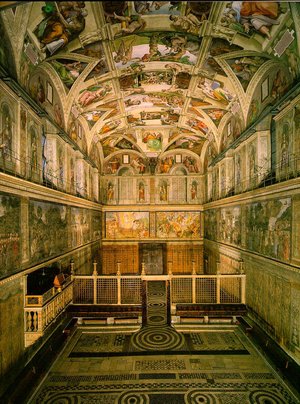
Here is the screen in the Sistine Chapel:

And the famous Rood Screen of St. Etienne Du Mont in Paris:
http://www.artoftheprint.com/jpegimages/toussaint_charles_henri_interiorviewofacathedralinterior.jpg