J
johnnyt3000
Guest
When did the Church start using statues and images and why?

From the earliest days, for the same reasons the United States has the Lincoln Memorial.When did the Church start using statues and images and why?
The Church has used images forever and we use them because the Bible shows us that the Apostles and Jesus used them.When did the Church start using statues and images and why?
As soon as the Church understood the power of the Roman statues and images, they copied it.When did the Church start using statues and images and why?
Yes, that’s also the reason God commanded the making of images, such as the serpent in the desert…because of the power of Roman statues and images. Solomon also copied the Roman image-power when he adorned God’s temple with these statues and images. God and Solomon, and everyone else who makes statues and images, copied the Romans because of the power of Roman statues. [End sarcasm.]As soon as the Church understood the power of the Roman statues and images, they copied it.

Amen! Yes, images have been used to tell stories as far back as we can historically trace “history”. In our modern age, we take photographs of our loved ones, and some people even frame these pictures, or make busts of famous musical composers, or make collages of our friends and families so that we can remember certain things/times.Please also remeber that for many, many centuries, the majority of Catholics (especially during the first 1,500 years) were illiterate. The use of art, including statues, tapestries, paintings and the like, served to help the common people understand the most important elements of the bible. By seeing the Virgin Mary depicted as the Mother of baby Jesus, they could relate to her and uderstand that she was human, like them, and her Son was both human and God. Some of the most famous classical paintings helped the illiterate masses with their faith.
We have inherited an amazing collection of religious art from these masters and they still inspire and intrigue us today. Religious art, of any kind, is to charge the imagination and bring bible stories to life.
Even here in the US, there are some wonderful folk art traditions, such as bible quilts, which were also used to pass on stories to the poor and illiterate members of our society.
Thank you for that, but I already knew the answer, and I think the answer is easy to discover, and it was a bit of a rhetorical question. The iconoclastic period began mid-Eighth Century, and originated in the East (Constantinople). Nobody disputes this (either the date or source). Nobody claims that the earliest Church had no artistic images of Jesus. Nobody claims that an image-deprived early Church had to contend with the introduction of artistic images.I think David Filmer’s question deserves an answer, and I hope someone will be courteous enough to answer it. “When [did] certain factions of the Church begin to oppose such images?”
The earliest images which we could definitively identify as Christian appeared somewhere about AD 200. (We don’t exactly know where Christian images started: an older theory favors Rome, but a more recent idea favors the East.) Christian art was really a grassroots movement, being more the preserve of the laity; some clergymen (but not all, apparently) at the time opposed it, not so much due to the ban in the OT against graven images per se, but to a natural association in the early Christian mind of images and image-making with pagan religion and the whole pagan way of life. In other words, out of fear that image-making might lead to idolatry, and out of a desire to distinguish themselves from pagans, a number of authorities opposed image-making at the time. This partly explains why we don’t have that much surviving evidence of Christian use of art during the first two centuries, save for possible scattered references here and there. By the mid-3rd century, however, we have evidence in Christian literature of changing attitudes and by the next century, religiously meaningful paintings began to occur in Christian contexts.When did the Church start using statues and images and why?
Patrick457 :: I always appreciate your contributions on this issue and the data you bring to the table is consistently top-rate. You always provide dates and pictures of examples to back up what you are saying. But there’s something I want to criticize. When history scholars come up with these dates for early Christian art, they often say things like, “These are the earliest examples of Christian art,” or “The history of Christian art begins in the year 200 A.D.,” or statements to that effect, and I think there are limitations and caveats to those statements that need to be clearly stated and stressed – namely, those dates are calculated based only on “surviving” Christian art.The earliest images which we could definitively identify as Christian appeared somewhere about AD 200.
When I read the writings of Christians from before 200 A.D., that’s not what I find. Just to give a few examples from before 200 A.D.:some clergymen (but not all, apparently) at the time opposed [sacred images], not so much due to the ban in the OT against graven images per se, but to a natural association in the early Christian mind of images and image-making with pagan religion and the whole pagan way of life.
Heh heh, I knew you’d comment.Correct me if I’m wrong, but I think what you are saying is that 200 A.D. is roughly the date of the earliest examples of Christian art which we still have. Other scholars agree with this date. But it seems to me that we need to stress two things: first, this refers to religious art that we can definitively identify as being for Christian use, and second, there may be examples from before that, but if there are, they either haven’t survived, or we haven’t identified them yet.
Does that sound like it’s basically correct to you?
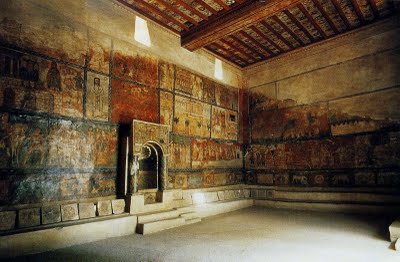
And yes! That is what I’m saying: the oldest specimens of art that we can identify as ‘Christian’ (not really an easy task, particularly for pre-4th/5th century art) come from around the early-to-mid 3rd century. You have the paintings in the house church at Dura Europos in Syria (ca. 233-256) or some of the catacombs in Rome as examples. That doesn’t necessarily mean that Christian art just sprang out of nowhere in the AD 200s - there could have been more earlier examples, but these are either lost or remain undiscovered.Now it’s my turn to comment: the temple of Solomon and the temple of Herod are not the same. Yes, it’s true that Solomon’s temple is filled with imagery (mainly of common motifs from Ancient Near Eastern art) - but the one thing you’ll notice about Herod’s temple based on ancient descriptions of it is the near lack of any figural depiction. According to Josephus, there was a golden vine at the entrance to the sanctuary, and a ‘Babylonian tapestry’ serving as the dividing veil between the Holy Place and the Holy of Holies “on [which] was portrayed a panorama of the heavens, the signs of the Zodiac excepted.” (War 5.212-214) There were no longer any cherubim - in fact, Josephus pretty much says that their appearance had already been forgotten: “no one knew what they looked like.” Since the Ark of the Covenant was already lost, the Holy of Holies was virtually empty.The Gospel of Luke and the Acts of the Apostles both say that the early Christians worshiped in the Temple of Jerusalem, which contained sacred images, for a significant period of time before separate places of worship were established. (That’s in Luke 24:52-53, Acts 2:46, Acts 3:1-3, 8, Acts 5:21, 42.) It also says they occasionally worshiped in the Temple after the Council of Jerusalem. That Council seems to have made it clear that Christianity and Judaism were separate, but as long as the Apostles were welcome in the Temple, they used it: Acts 21:26, Acts 22:17, Acts 24:18, Acts 26:21. I think that shows that the Apostles were comfortable using a building with sacred images in it as a place of worship. It is evidence against the idea that they associated sacred images with paganism.


I wrote this in another thread:Galatians 3:1 compares the Crucifixion to a graphic image in a positive way. That seems to associate images with Jesus rather than with paganism.
The Letter of Barnabas says that Moses made religious art in the form of the bronze serpent, and it says he called the people together to honor that image, and that it was a figure for the Crucifixion. (Letter of Barnabas Chapter 12) That sounds to me like he associated sacred imagery with Jewish and Christian tradition, not paganism. …]
The problem with your citations really is that they address imagery from the Old Testament. They don’t really address the issue of contemporary art. You might even say that the common excuse could have been applicable here: they are exceptions because God Himself ordered Moses to have them made. He might have been the One who laid the laws in the first place, but He doesn’t have to be bound to it.Like the epistle of Barnabas, Jesus also says the bronze statue that Moses made was a figure for the Crucifixion – John 3:14-15. That doesn’t sound like He associated sacred images with paganism. It sounds to me like He associated it with the Jewish religion and Himself.
What about the author of the apocryphal Acts of John, Origen, Tertullian, Clement of Alexandria, Eusebius, Epiphanius of Salamis? I’m not disputing the fact that some early Christians had no problem with images at all (I agree with you about Irenaeus). What I’m really questioning is the other extreme: ignoring instances of early Christians who did have a problem with images in a Christian context. That’s why I said “some clergymen (but not all, apparently) at the time opposed it.” But then again, I should have just written “early Christian opinion on images and imagemaking was divided.” It’s more accurate that way.To me, there’s lots of evidence from before 200 A.D. that the early Christians generally had no problem with sacred images. Sacred images and/or image-making are mentioned in the New Testament and in some of the earliest Church Fathers, and they are not associated with paganism but with Christian and Jewish tradition. I think you should take account of this evidence in the future. You seem to be saying that the early Christians didn’t want to make images because it reminded them of paganism, but I think the evidence suggests the opposite.
I don’t think Gal. 3:1 has to refer to an actual image of the crucifixion in order for us to use it to support sacred images. If I’m reading you right, you’re basically saying that Paul only meant, “Our preaching was so intense on this subject that it painted a metaphorical picture in your minds, O Galatians.” That interpretation is fine with me. But that still compares the Crucifixion to an image in a positive way.I wrote this in another thread:
I think you’re both reading too much into the verse and its use of “publicly portrayed” (proegraphē). The literal sense of the word is “to write before,” either in a temporal or spatial sense (cf. Romans 15:4; Ephesians 3:3; Jude 4). The phrase “before whose eyes” requires the verb be translated in another sense: to proclaim or portray publicly. I don’t think Paul was talking so much about a literal piece of sculpture or painting showing Jesus crucified but rather about how his preaching had the graphic effect of presenting the crucified Christ to the Galatians. In other words, his public declaration served as a visual image of the Messiah nailed on a cross for them.
I think that any author who addresses sacred images in a positive way supports contemporary use of sacred images, unless the author gives a reason otherwise, such as saying that this was permitted in the Old Testament due to the hardness of hearts. (I haven’t yet found an ecclesiastical author who says that, but I’ll bet someone in history did if we looked hard enough.) As an example, when the Iconoclast controversy was happening, the iconodules mostly defended images using arguments drawn from Old Testament imagery. But they wanted us to infer that contemporary art is okay.The problem with your citations really is that they address imagery from the Old Testament. They don’t really address the issue of contemporary art.
I don’t think we should attribute that argument to an author unless he himself makes it.You might even say that the common excuse could have been applicable here: they are exceptions because God Himself ordered Moses to have them made. He might have been the One who laid the laws in the first place, but He doesn’t have to be bound to it.
With Tertullian, although he did not like sacred images, I think he can be used to support them in several ways, not least of which is, after he became a Montanist one of his arguments against the Catholics was that they had carved images of the Good Shepherd and of the Shepherd of Hermas on their chalices. That tells me that Catholics were using images to decorate holy objects.What about the author of the apocryphal Acts of John, Origen, Tertullian, Clement of Alexandria, Eusebius, Epiphanius of Salamis? I’m not disputing the fact that some early Christians had no problem with images at all (I agree with you about Irenaeus). What I’m really questioning is the other extreme: ignoring instances of early Christians who did have a problem with images in a Christian context.
:bowdown: :bowdown2:
