The cross is a pole?

  • Thread starter Thread starter melissa09
  • Start date Start date
Status
Not open for further replies.
M

melissa09

Guest
So one of my instructors at college has been telling us that Jesus was crucified on a straight pole with his arms above his head instead of outstretched to the right and left. She claims the church “glossed” over the crucifixion. I asked her where she got her information and she said history. I realize she has more education than I do and I can’t say I know my faith so well, but this doesn’t sound right at all!!! Are there any truth to her statements or is there any way I can find research to prove her wrong? How do I respond? Please help:confused:
 
Sounds like a Jehovah’s Witness. They believe that Jesus was killed on a “torture stake” rather than a crucifix. BTW… the Jehovah’s Witnesses also don’t believe in the Trinity. They think Jesus is the earthly incarnation of Michael the Archangel, and that the Holy Spirit is just God’s “active force”. Their beliefs are radically different from almost all other Christian groups.

There is no evidence for this, btw. Crucifixion was very common in the Roman world, and has been substantiated by lots of historical evidence.
 
Here’s an article giving a very good refutation of that claim.

I must note that, while impaling/hanging someone on a stake is one method (impalement was actually an ancestor of crucifixion), it is hardly the ONLY way of crucifying someone. The evidence we have actually supports the traditional assumption that crosses were in use by the time of Jesus, despite your instructor’s claims.


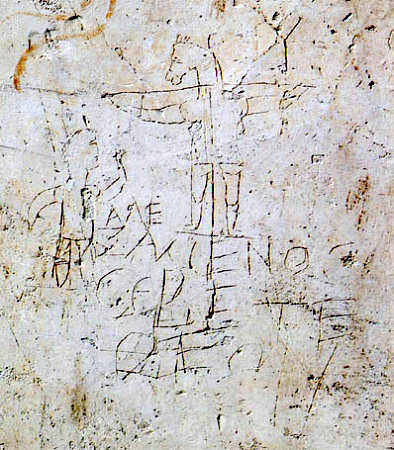
The Alexamenos Graffito in Rome (dating from late 1st-3rd century AD), depicting a man with the head of a donkey hanging on what appears to be a Tau (T-shaped) cross. To the left of the image is a man raising one hand in a gesture possibly suggesting worship. The inscription in Greek means, “Alexamenos, worship god” or “Alexamenos worships [his] god”. The graffito is commonly understood to be a jibe to this Alexamenos who was apparently a Christian (based on the crucified figure, who has a donkey’s head probably as an insult).
The accusation that Christians practiced onolatry (donkey-worship) seems to have been common at the time. Tertullian, writing in the late second or early 3rd century, reports that Christians, along with Jews, were accused of worshipping a donkey-headed deity. He also mentions an apostate Jew who carried around Carthage a caricature with a donkey’s ears and hooves, labeled Deus Christianorum Onocoetes, “the God of the Christians, born of a donkey” (Ad Nationes, 1.11, 14).
 
Jesus said, ‘take up your cross,’ not, ‘take up your pole’ (though, I acknowledge, this is translation).

We cross ourselves, either our foreheads or our bodies, which is a church practice going back to the beginning. We cross ourselves in the Name of the Father and of the Son and of the Holy Ghost and this asserts three things:
  1. The Trinity
  2. The Cross
  3. We are asking for God’s blessing.
“X” is St. Andrew’s cross and “X” in general, is an abreviation of, “cross”.
 
Sounds like a Jehovah’s Witness. They believe that Jesus was killed on a “torture stake” rather than a crucifix.
Oddly enough, in the early days the Witnesses themselves once believed that Jesus was nailed on a cross. However, they eventually backed out from this and suggested instead that He was, well, ‘stake-ified’.

I can joke here about how ‘crucifixion’ as a word is a lot better than ‘stakeification’ - it rolls off the tongue in a more pleasant way - but I’ll refrain from doing so. 😃
 
I can joke here about how ‘crucifixion’ as a word is a lot better than ‘stakeification’ - it rolls off the tongue in a more pleasant way - but I’ll refrain from doing so. 😃
Thank you for your pious restraint.
 
Melissa, here’s St. Justin Martyr (A.D. 100-165) on the shape of the Cross:
But in no instance, not even in any of those called sons of Jupiter, did they imitate the being crucified; for it was not understood by them, all the things said of it having been put symbolically. And this, as the prophet foretold, is the greatest symbol of His power and role; as is also proved by the things which fall under our observation. For consider all the things in the world, whether without this form they could be administered or have any community. For the sea is not traversed except that trophy which is called a sail abide safe in the ship; and the earth is not ploughed without it: diggers and mechanics do not their work, except with tools which have this shape. And the human form differs from that of the irrational animals in nothing else than in its being erect and having the hands extended, and having on the face extending from the forehead what is called the nose, through which there is respiration for the living creature; and this shows no other form than that of the cross. And so it was said by the prophet, “The breath before our face is the Lord Christ.” And the power of this form is shown by your own symbols on what are called “vexilla” [banners] and trophies, with which all your state possessions are made, using these as the insignia of your power and government, even though you do so unwittingly. And with this form you consecrate the images of your emperors when they die, and you name them gods by inscriptions. Since, therefore, we have urged you both by reason and by an evident form, and to the utmost of our ability, we know that now we are blameless even though you disbelieve; for our part is done and finished. “First Apology of Justin Martyr”

 
A good question to ask is: What would be the *purpose *for the Church to invent or perpetuate the “gloss” that Jesus died on a cross rather than a “torture stake”? Was it invented by someone who wanted to sell representations of a crucifix rather than a stake?:confused:

Even the word **“crucifix” **implies the traditional understanding, since it literally means “fixed on a cross (from the Latin crux)” .:rolleyes:
 
A good question to ask is: What would be the *purpose *for the Church to invent or perpetuate the “gloss” that Jesus died on a cross rather than a “torture stake”? Was it invented by someone who wanted to sell representations of a crucifix rather than a stake?:confused:
I think the answer lies on the opinions that (1) the shape of the cross is attested in various ‘pagan’ cultures and (2) the usual story that the Catholic Church is very evil, wicked and (insert negative adjective here). Because - according to them - the Church is a pagan cult of sorts masquerading as true Christianity it would be just normal for them to take a ‘pagan’ symbol and make it appear that Jesus died on one. :rolleyes:
Even the word **“crucifix” **implies the traditional understanding, since it literally means “fixed on a cross (from the Latin crux)” .:rolleyes:
Which is probably why supporters of this opinion try to avoid using the term, since it ‘reeks’ so much of the cross.

I tried inventing the word ‘stake-ifixion/stake-ification’ to describe the method of being fixed on a stake or pole two posts ago, but as mentioned it just doesn’t sound too natural. I thought of trying to recourse to the more natural way and use Latin, yielding words such as pali-fixion or stili-fixion or talea-fixion (from the words palus, stilus, and talea, respectively). Okay, sorry about that. :o
 
I think the answer lies on the opinions that (1) the shape of the cross is attested in various ‘pagan’ cultures …
:sad_yes: That probably is their reasoning (if you want to call it reasoning). :whacky:

And, of course, what they are doing is embracing the logical fallacy that similar appearance necessitates a similar (or identical) origin, Just because a symbol used by one group is similar to another it doesn’t mean it means they both got it from the same place or that they derive a similar significance from it. Anti-Catholics use this type of faulty reasoning all the time.

One famous example is when they point to pictures of Mary and baby Jesus that Catholics like to have in their homes and equate those with pagan (usually Egyptian) gods and their mothers. “See.” they say, “Veneration of Mary is tied to paganism!”

The trouble with that line of 'reasoning" is (a) the faulty common symbol/common origin fallacy above and (2) the fact there are a such limited amount of simple and evocative symbols in the world that some are bound to come up again and again, with each culture attaching it’s own significance to it. I mean, isn’t the image of a cross (not to mention that of a mother and child) pretty universal? :cool:
 
So one of my instructors at college has been telling us that Jesus was crucified on a straight pole with his arms above his head instead of outstretched to the right and left. She claims the church “glossed” over the crucifixion. I asked her where she got her information and she said history. I realize she has more education than I do and I can’t say I know my faith so well, but this doesn’t sound right at all!!! Are there any truth to her statements or is there any way I can find research to prove her wrong? How do I respond? Please help:confused:
Oh, I remember when I was in college (you weren’t even born yet!) and we had a theologian teaching whatever the course was (don’t remember), but he was such a pompous *** and many of us didn’t take him seriously. We just put up with him because we needed the credit.
 
it seems both versions carry half truths.It is mentioned more than once in scriptures that the upright stake was a tree that was already in place and the same tree/s were used again and again,So what Jesus and the others really carried was the horizontal cross piece to which His extended hands were lashed and nailed and this cross piece was via a already permanently fixed pulley dragged up the tree before the legs were fixed in position imho - twinc
 
Why do we waste our time pi**ing in the wind over useless things?

i’m sure the devil is laughing his a off as he watches us argue over whether the ocean is blue or teal or azure or sky or steel or…**

**Jesus died for our sins. He was Crucified & His Blood is on our hands. No theory, no hypothesis, no doubt.
**
**The real discussion revolves around how we respond? **

Do we accept our guilt & search for the Truth, or do we argue over trivial garbage, like what academics & intellectual “pin heads” propose to distract us from the Truth!!

i could spend a lifetime proposing false & alluring arguments against the Love of Jesus Christ. i could be hailed by Presidents, pundits & the vast majority of the ignorant masses as a hero, but i would still be a pitiful man with no credible facts. Yet my popularity would influence so many, leading to the continued Crucifixion of Jesus.

Despite my popular, pompous, self-serving, self-proclaimed as incredibly intelligent & verbose diatribe, i cannot change the Truth.

Spend your time reading Sacred Scripture & attend Sacred Mass, read the Catechism & try to disprove everything. Then & only then, will you accept the Love you deserve, the Perfect Love God has given you!!!

Sancta Maria, Mater Dei, Ora Pro Nobis Peccatoribus!

mark
 
The professor mentioned in the original post is a JW. My problem with the use of the torture stake instead of the cross is in the Gospel of Matthew (27:37). Pilate has the inscription (“Jesus, King of the Jews”) placed above His head. If Jesus is on a single vertical stake, His arms would be stretched above His head. My question to the JW is shouldn’t this verse read “over his hands,” or “above his arms” ?

I figure the Watchtower response would be some song-and-dance attempt at creative interpretation.

My two cents.

Joe
 
:sad_yes: That probably is their reasoning (if you want to call it reasoning). :whacky:

And, of course, what they are doing is embracing the logical fallacy that similar appearance necessitates a similar (or identical) origin, Just because a symbol used by one group is similar to another it doesn’t mean it means they both got it from the same place or that they derive a similar significance from it. Anti-Catholics use this type of faulty reasoning all the time.
As an aside, I think we could say the same thing about some elements of Israelite religion. If you’ve noticed, the Israelites had some practices which were similar to their neighbors in the Ancient Near East. For example, animal sacrifices? Other cultures also practiced this.
Incense? Again, a common item.
Horned altars? They’re also a pretty much common element, if we look at the archeological evidence.
The Ark of the Covenant? Functionally it’s quite similar to those portable shrines and thrones where a god is supposed to be sitting. We might also note the practice of placing the copy of a treaty under the god’s ‘feet’ (which we can parallel with the placing the two tablets and the copy of the Law within the Ark).
Solomon’s Temple? There’s not much difference, design-wise, from other temples in the region (after all, Phoenician craftsmen had a hand in constructing the building).
Circumcision? The Israelites were hardly the only ones who did them. The Egyptians apparently practiced them, and so did many other Semitic peoples other than the Israelites. Certain ethnic groups in the Pacific and Africa still have a similar practice today.

Now, we could apply this logical fallacy here and say that well, the Israelites themselves were a bunch of ‘pagans’ since they employed many practices which are also attested in neighboring cultures! :rolleyes:
 
Status
Not open for further replies.
Back
Top