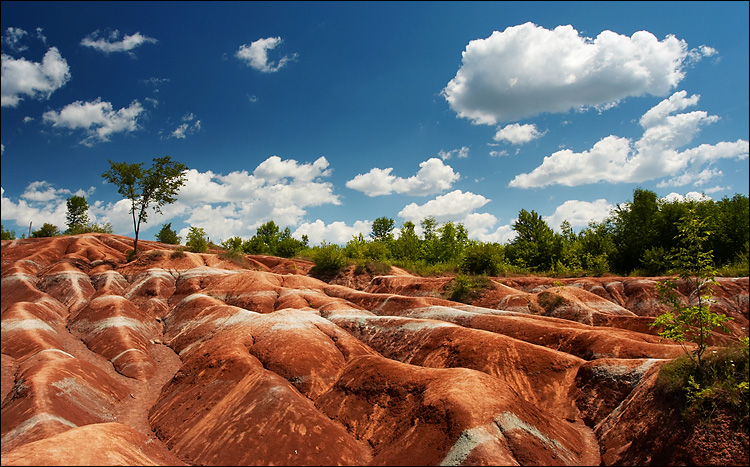
The two on mudstones were in Science which I’ve already posted 2007 or so. The one on sandstone ripples being formed by rapid moving waters instead of by sand storms over eons of time was in a 2009 geologic convention this past fall or in December; it was also posted. When I have time I will look up the references.
Indiana Un flume studies was for mudstones—go google mudstone flume studies at IU.

Here are some exerpts from the Mudstone articles with references below the quotes:
This article comes from June 8, 2009 issue of Science News. It is referring to the articles by Schieber, Southard, and Thaisen which were published in the journals Science and Geology.
***Most of the sediments in the world are mudstones – including shale and clays. Until recently these were thought to form only in calm, placid seas. Now, two geologists are continuing to show that they can form in flowing or turbulent water. Two years ago, Schieber and Southard burst a paradigm by explaining how mudstones could form in flowing water (see 12/14/2007). They’ve been experimenting ever since. In flume experiments, they have found new ways to image what is going on in turbulent muddy water. Their latest paper in Geology shows that mudstone particles can form ripples, just like sand.1 The particles clump into floccules several millimeters in size. Even though smaller and lighter than sand, they behave like sand particles – climbing up slopes and avalanching down the lee sides, forming the familiar ripples kids see on the beach as the waves recede. This happens even though floccules have slight attractions to each other via van der Waals forces. They behave as if independent particles – just like sand grains. The authors were also surprised to find that ripple formation occurs even when the mud is highly dilute: “this is remarkable when one considers that floccule ripples consist of as much as 90 vol % water.” ***
In the original paper from 2007:
Mudstones constitute up to two-thirds of the sedimentary record and are arguably the most poorly understood type of sedimentary rocks (ref. 9). …
Our observations do not support the notion that muds can only be deposited in quiet environments with only intermittent weak currents . Instead, bedload transport of flocculated mud and deposition occurs at current velocities that would also transport and deposit sand.
In the Tonto group of the Grand Canyon Guy Berthault has shown by using Paleohydraulics that the Tonto group was formed catastrophically in rapid flowsing water.
Dr. A. Lalomov in Russia has shown rapid formations in his studies in a major location in one of the Russian Republics that was thought to have taken 30 M years to form.
Dr. S. Austin has identified a huge grave yard of Nautilius’s in the Grand Canyon.
Dr. M.E. Clark has shown by experimental studies and on site studies of the Paluxy River Tx that the limestone strata in which fossil human and dinosaur footprints were discovered in the second and six strata [River bottom] was laid down in twice daily tides carrying huge amounts of “Limy mud.” The hypothesis is that the humans and dinosaurs fled to higher ground in between tides then returned to feed perhaps on clams etc. I’ve seen clam holes in the top strata and down stream there are huge clam beds with the shells “closed” suggesting that they were buried rapidly while still alive.
C-14 dating of the fossils from wood to dinosaur bones from TX to Alaska confirm a cataclysm suggested by evolutionary paleontologist Dr. John Horner but NOT 65 M years ago to which he subscribes. But in the range of C-14 dating.
Big Jack Horner sat in a corner
scraping a dinosaur bone.
Some soft tissue appeared
And he said, “Just what I feared!
Evolution’s long ages are gone!”
There are many other studies of geologic basins that support the rapid formation of the geological column as well as immense fossil grave yards. [more later if you want to hear about them but me spous wants to eat out tonight.]
IDvolution - God “breathed” the super language of DNA into the “kinds” in the creative act. Buffalo
- Juergen Schieber and John B. Southard, “Bedload transport of mud by floccule ripples—Direct observation of ripple migration processes and their implications”, Geology, June 2009, v. 37, no. 6, p. 483-486, doi:10.1130/G25319A.1.
- Juergen Schieber, John B. Southard, Kevin Thaisen,“Accretion of Mudstone Beds from Migrating floccule ripples", Science, 14 Dec. 2007, v. 318, no. 5857 p. 1760-1763
- Science News June 6, 2009
- Berthault G, “Analysis of main principles of stratigraphy on the basis of experimental data” Lithol Polezn Iskop, 2002,No. 5 P442-446 "
- Berthault G. “Sedimentological Interpretation of the Tonto group stratigraphy” (Grand Canyon Colorado river) Lithology and Mineral resources Vol 39, No. 5, 2004