You’re giving me credit where it is not due, my brother. I’m seriously asking you, to whom do you want it returned? I’m not expert on the Shroud? What did you mean by that? I’m not pretty quick, it was a genuine question…

I had composed a very nice post on this subject, but I accidentally lost it

. I lack the time to go into this in depth at present.
If the shroud is genuine (and I believe that it is) it had to have been in the east originally. It may be the famous Holy
Mandylion, a representation of which can be found in most Orthodox temples even today.
Of course, the origins of the Mandylion are also cloudy and legendary, but it did not originate in France by any accounts. Even in legend it’s origins trace from Palestine to Edessa and through the Sassanid capture of Edessa to it’s relinquishing and deposit in Constantinople.
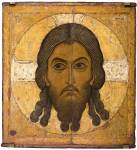
The Knights of the Temple supposedly possessed this article from 1204AD until their suppression and dissolution by king Philipe of France and Pope Clement (1307AD).
Interestingly, one of the heresy charges against the knights was that they ‘worshiped a human head’. In fact it was charged that initiates into the order were ritually accepted through a profession in front of an image of a human head. Pretty scary stuff.
http://www.greatbigcanvas.com/image...computer-enhanced-image-face-Shroud-Turin.jpg
The theory is that the De Charney family inherited the relic from their prominent family member Geoffrey de Charny. He was a preceptor of the Knights of the Temple who died in flames along with de Molay in 1314AD. He would have had sufficient authority within the order to have removed it from the vaults during the crises, and hidden it away.
It was a nephew of Geoffrey de Charny who first announced to the western Christian world the existence of the shroud, in 1357AD. An heir of the family willed, granted or sold the relic to the House of Savoy.
The following
article spells out the testimony of two witnesses to the burial shroud of Christ being in Constantinople before the sack.
1171 - Almaric, the last Christian King of Jerusalem visited Emperor Manuel I Commenus of Constantinople, his father-in-law. William, Archbishop of Tyre, in his Historia rerum in partibus transmarinis gestarum wrote “…] nothing was hidden. Nothing sacred which had been placed in the hidden places of the sacred rooms from the time of the blessed Emperors Constantine, Theodosius and Justinian but was familiarly revealed to the king and his companions. …]”. The relics included the “…] most precious evidence of the Passion of Our Lord, namely the cross, nails, lance, sponge, reed, crown of thorns, sindon (that is the cloth in which He was wrapped) and the sandals …]”.
1203 - Robert de Clari in his La Conquête de Constantinople wrote “…] There was another church which was called My Lady Saint Mary of Blachernae, where there was the sydoines in which our Lord had been wrapped, which every Friday, raised itself upright, so that one could see the features of our Lord on it, and no one, either Greek or French, ever knew what became of this sydoines when the city was taken …]”.
1205 - Theodore Ducas Angelos in a letter to Pope Innocent III wrote “…] In April last year a crusading army, having falsely set out to liberate the Holy Land, instead laid waste the city of Constantine. During the sack troops of Venice and France looted even the holy sanctuaries. The Venetians partitioned the treasures of gold, silver and ivory, while the French did the same with the relics of the saints and, most sacred of all the linen in which our Lord Jesus Christ was wrapped after his death and before the resurrection. We know that the sacred objects are preserved by their predators in Venice, in France and in other places, the sacred linen in Athens. So many spoils and sacred objects should not be taken contrary to all human and divine laws, nevertheless in your name in the name of Jesus Christ our Lord, albeit against your will, the barbarians of our age have done just that …]”.



 It’s silly to think there was some secret “code” or secret knowledge left in the shroud for us to find out. If so, it would render Jn 15:15 meaningless: