The Libri Carolini and Images

  • Thread starter Thread starter patrick457
  • Start date Start date
Status
Not open for further replies.
Anyone familiar with the Libri Carolini here?

Somewhat answering my own question: 😊

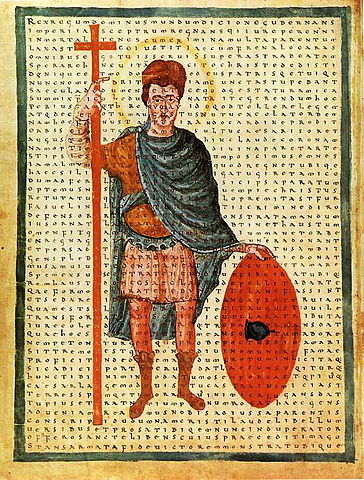
The Libri Carolini refers to a work in four books composed on the command of Charlemagne, around 790, to refute the supposed conclusions of the Second Council of Nicaea (787), particularly as regards its acts and decrees in the matter of images.

To put things in perspective: the Byzantine empress Irene had summoned a council to meet at Nicaea in 787, and at this council, which was attended by representatives of pope Hadrian, the heresy of Iconoclasm was oficially condemned. The council had decreed that images of Christ, Mary or the saints might be represented since these stimulated the spectator to think of the original, and while these images were not deserving of latreia (the type of worshp proper only to God), they were deserving of proskynesis, an expression of abject humility often involving prostration, usually accorded in the East to the emperors.

We, therefore, following the royal pathway and the divinely inspired authority of our Holy Fathers and the traditions of the Catholic Church (for, as we all know, the Holy Spirit indwells her), define with all certitude and accuracy that just as the figure of the precious and life-giving Cross, so also the venerable and holy images, as well in painting and mosaic as of other fit materials, should be set forth in the holy churches of God, and on the sacred vessels and on the vestments and on hangings and in pictures both in houses and by the wayside, to wit, the figure of our Lord God and Saviour Jesus Christ, of our spotless Lady, the Mother of God, of the honourable Angels, of all Saints and of all pious people. For by so much more frequently as they are seen in artistic representation, by so much more readily are men lifted up to the memory of their prototypes, and to a longing after them; and to these should be given due salutation and honourable reverence (aspasmon ke timitikin proskynisin), not indeed that true worship of faith (latreian) which pertains alone to the divine nature; but to these, as to the figure of the precious and life-giving Cross and to the Book of the Gospels and to the other holy objects, incense and lights may be offered according to ancient pious custom. For the honour which is paid to the image passes on to that which the image represents, and he who reveres the image reveres in it the subject represented. For thus the teaching of our holy Fathers, that is the tradition of the Catholic Church, which from one end of the earth to the other has received the Gospel, is strengthened. Thus we follow Paul, who spoke in Christ, and the whole divine Apostolic company and the holy Fathers, holding fast the traditions which we have received. So we sing prophetically the triumphal hymns of the Church, Rejoice greatly, O daughter of Sion; Shout, O daughter of Jerusalem. Rejoice and be glad with all your heart. The Lord has taken away from you the oppression of your adversaries; you are redeemed from the hand of your enemies. The Lord is a King in the midst of you; you shall not see evil any more, and peace be unto you forever.

Those, therefore who dare to think or teach otherwise, or as wicked heretics to spurn the traditions of the Church and to invent some novelty, or else to reject some of those things which the Church has received (e.g., the Book of the Gospels, or the image of the cross, or the pictorial icons, or the holy relics of a martyr), or evilly and sharply to devise anything subversive of the lawful traditions of the Catholic Church or to turn to common uses the sacred vessels or the venerable monasteries, if they be Bishops or Clerics, we command that they be deposed; if religious or laics, that they be cut off from communion.

A very bad Latin translation of the acts of the council was made in Rome and forwarded to Charlemagne. His scholars were horrified to find in it what they considered to be a sanction of idolatry; both the bad translation and the western ignorance of Byzantine forms and formulas contributed to the misunderstanding. In response to this supposed heresy was drafted a now-lost work known as the Capitulare adversus synodum (preserved only in Hadrian’s point-by-point refutation of it) which criticized the decisions taken at Nicaea. Frankish theologians challenged the evidence adduced in support of icon veneration as an established and ancient Christian tradition, and insisted that the BIble never supported the making or the veneration of images. (The refutation also somewhat verged at times on petty ad hominem, calling into question Irene’s - a woman’s - ability to convoke and preside at a council and the orthodoxy of Tarasios’ elevation to the patriarchate.) In response to Hadrian’s refutation a more detailed evaluation of the issue was ordered, which led to the writing of the Libri Carolini.
 
Anyone familiar with the Libri Carolini here?
I am not familiar with it. However, since you are interested in the Iconoclasm debate, you might be interested in an essay written by John Damascene re: the Fathers who were before him vis-a-vis holy imagery.

The best ones are these:

St. Eusebius of Caesaria, Proof of the Gospel, Book 5 (completed before 311 A.D.): “Hence, even now the inhabitants cherish the place where visions appeared to Abraham, (Gen 18.1) as divinely consecrated. The turpentine tree is still to be seen, and those who received Abraham’s hospitality are painted in picture, one on each side, and the stranger of greatest dignity in the middle. He would be an image of our Lord and Saviour, whom even rude men reverence, Whose divine words they believe.” St. Athanasius, The Hundred Chapters, chapter 38 (written between 328 and 373 A.D.): “We, who are of the faithful, do not worship images as gods, as the heathens did, God forbid, but we mark our loving desire alone to see the face of the person represented in image. Hence, when it is obliterated, we are wont to throw the image as so much wood into the fire. Jacob, when he was about to die, worshipped on the point of Joseph’s staff, not honouring the staff but its owner. Just in the same way do we greet images as we should embrace our children and parents to signify our affection.” St. Cyril of Jerusalem, Catechetical Lectures 12:5, (A.D. 348): “All the works of creation were good, but none of these was an image of God, save man only. The sun was formed by a mere command, but man by God’s hands: Let us make man after our image, and after our likeness. A wooden image of an earthly king is held in honour; holy much more a rational image of God?” St. Basil of Caesarea, On the Spirit, chapter 18 (A.D. 375): “The image of the king is also called the king, and there are not two kings in consequence. Neither is power divided, nor is glory distributed. Just as the reigning power over us is one, so is our homage one, not many; and the honour paid to the image passes on to the prototype. Now what in the one case the image is by reason of imitation, that in the other case the Son is by nature; and as in works of art the likeness is dependent on the form, so in the case of the divine and uncompounded nature the union consists in the communion of the Godhead.” St. Basil also praises a certain martyr, whose statue he admired, with these words: “I contemplate the hand put out to the flames, more powerfully dealt with by you. I see the struggle more clearly depicted on your statue.”

St. Gregory of Nyssa, The Formation of Man, chapter 4 (A.D. 379): “For as, in men’s ordinary use, those who make images of princes both mould the figure of their form, and represent along with this the royal rank by the vesture of purple, and even the likeness is commonly spoken of as a king, so the human nature also, as it was made to rule the rest, was, by its likeness to the King of all, made as it were a living image, partaking with the archetype both in rank and in name.” When I read St. Irenaeus “Against Heresies,” which comes from 180 A.D., I noticed several positive comments about images. Book II, chapter 32, paragraph 2 goes through a list of “virtues” and includes “the arts” and specifies “the art of painting and sculpture, brass and marble work, and the kindred arts.” Thus he calls making images a virtue. Also book 4, chapter 17, paragraph 5 says that when a king paints an image of his son, and sends it around his kingdom, that is like how God sent the Word of Christ around the world, who is His living image, and Who is glorified. (This particular argument may be said to be part of the Church’s tradition, I think, since it is picked up by St. Cyril, St. Basil, and St. Gregory – see above – and they specifically say that such images may be respected out of honor due to the king). And in book 3, chapter 17, paragraph 3, he uses the denarius in an analogy, mentioning particularly its image and inscription of Caesar, which he likens to the fact that God gives us His Son and a new name – and he says nothing disparaging about the coin. (Jesus Himself used the denarius and its image as an example of His holy teaching about taxes. So perhaps this argument in a certain sense goes back to Christ Himself.)

Tertullian also mentions that the Catholics had images on their chalices, for when he was a Montanist, he wrote an essay against the Catholic practice of admitting sinners back into the fold through penance; he called this essay De Pudicitia, and in chapter 7, he says, “You can begin with those parables, wherein the lost sheep is spoken about, searched for by its pastor and brought back on his shoulders. Even the images themselves on your chalices may be adduced, if possibly by them any light can be shed upon the interpretation of this sheep, whether it will with regard to restoration be applicable to a Christian sinner or to a pagan.” In chapter 10 he also mentions that the Catholics have carved the Shepherd of Hermas on their chalices: “I should admit you were right, if the tract, called ‘Pastor’, which only stands up for the adulterers, had deserved to be taken up in the Holy Writ… [And] perhaps [you are] supported by that pastor, which you have carved on your chalice, even this one dishonouring the Christian sacrament…”
 
I am not familiar with it. However, since you are interested in the Iconoclasm debate, you might be interested in an essay written by John Damascene re: the Fathers who were before him vis-a-vis holy imagery.
Thanks for mentioning St. John of Damascus’ work here, because it’s a good contrast.

The anonymous author of the Libri Carolini (who is probably Theodulf of Orléans) expresses a viewpoint midway between the Iconoclast and Iconodule positions: he thinks that images are useful for their ability to recall, remind and instruct, but he rejects the opinion originally voiced by St. Basil of Caesarea that the images partook in some degree of the nature of the subject portrayed (the prototype) and thus is against their veneration.

For the author, all images - whether sacred or profane - are technically ‘false’ since they are the products of artists’ imaginations and thus not the truth. As examples of images that are untrue and manifestly ridiculous, the work describes nature personifications (i.e. the earth as a woman, rivers as men pouring water out of urns, seasons as human figures). The author argues that painters cannot truthfully represent sacred subjects either, but at best are only capable of “a certain ability to remind one of things that have happened.”

The Libri Carolini condemned the Iconodules for what the author perceived to be an almost-idolatrous treatment of images on their part: he disapproved of various pious practices before images, such as burning incense and lamps before them or touching and kissing them, and even claimed that the stories of miracles wrought by images are sheer fiction, or worse, deceptions of the devil.

The author rejects the various appeals to the Old Testament (“If images may be likened to the ark of the Lord, they would have to have a propitiatory, as it also had, and that fearful oracles be delivered from them. But no oracles have ever come from images; therefore, they are not to be equated with the ark of the Lord”), to pious tradition (where in the Bible does it state that Jesus corresponded with King Abgar or sent him His image?), to visions and dreams (something which should be sifted and tested properly - visions and dreams are mentioned in Scripture, yes, but those are individual, exceptional cases) and to Byzantine imperial custom (bowing before royalty is a pagan custom which should have been abolished; and don’t even start comparing the emperors to the apostles or upholding them as defenders of Christian orthodoxy!) in support of veneration of images.

The author reasserts that God alone is to be worshipped and the saints are to be venerated: however, proper show of veneration can only be performed before the relics of the saints, not before lifeless portrayals of them. (The issue was not between latreia and proskynesis - adoratio and veneratio are interchangeable terms in 9th-century Latin - but to who is the object of said veneratio/adoratio.) Indeed, relics are deemed to be highly superior to icons because of their direct association with the saints, and because only the bodies of the saints would share in the final resurrection: “They [the Greeks] place almost all the hope of their credulity in images, but it remains firm that we venerate the saints in their bodies or better in their relics, or even in their clothing, in the ancient tradition of the Fathers.”

Images are not to be equated with the relics of the martyrs or confessors to the faith … for the latter come from a body or have been in contact with a body … and will rise again in glory with the saints at the end of the world. … But images sometimes turn out beautiful and sometimes ugly, according to the understanding ingenium] and skill artificium] of the artist. They have neither lived, nor will they rise again but, as we know, will be burned or will decay, and they merely obstruct us in the adoration that is due to God alone.
 
The author shares a similarity with the Iconoclasts in that he makes an exception for the Cross, both due to its direct association with Jesus and due to its symbolism as a token of the majesty of Christ and the triumph of the faith. He deems the Cross to be of a different caliber than other images, which do not have the right to be venerated even if a name of a saint is tagged on them. (Case in point, he proposes that a supporter of images should be shown two identical portraits, differing only on the title: one should be claimed to be a portrait of Mary and the other of Venus! “Holiness is conferred on people endowed with reason on account of merit and good works; on inanimate things it is conferred, not by an inscription, but by consecration by a priest and the invocation of the name of God.”)

However, the author does not share the Iconoclast idea that Christians are to actively get rid of images altogether. He acknowledges that the Iconoclasts destroyed images as though they were idols, and thinks that that is their greatest fault:

They do not know that the image is a general genus], whereas the idol is a special species], so that one cannot be related to the other. Although almost every idol is an image, not every image is an idol. An idol is defined quite differently than is an image imago]. Images are there to ornament [churches] and to demonstrate the story of salvation, whereas idols serve only to mislead wretched people into sacrilegious rites and hollow superstition. The image refers to something else; the idol, as it is called, only to itself.

This is the view that author of the Libri Carolini has. For him, images are generally okay in that they could serve an educational purpose (teaching tools for the illiterate, a biblia pauperum - the same idea Pope St. Gregory the Great once expressed), as well as commemorative (as reminders of sacred persons and events) and aesthetic (images could be used to decorate a church) purposes, but they are ultimately just that, images: ‘useful’, but not inherently ‘holy’. The artist making such images wasn’t even considered to be doing a sacred task as the Eastern iconographer is: he is viewed as a mere craftsman doing something no different from any other human activity. If images are to be shown respect, it should be for the sake of the subjects portrayed, not of themselves (which would be - for the author - tantamount to idolatry).

But even then, the author did not think that images are necessary in the long run. A Christian should be able, the Libri Carolini claims, to contemplate God and the virtues of the saints with oculus mentis, the “mind’s eye,” without the need for sensual means. Carolingian theologians generally distinguished between the faculties of the “interior” and the “exterior” person. For Charlemagne’s scholars, it is the “interior man” who is made in the image of the triune God. This is why for the writer, the Iconodules’ veneration of images was of a kind inappropriate for God, since it confuses the spiritual quality with the gross, bodily “exterior person.” To give too much attention to the outward image is then to confuse the first, corrupt Adam with the second, new Adam.

The mind’s eye cannot discern how much distances the sacrament of the Lord’s body and blood from the images depicted by the iconographer’s art: while the one is effected invisibly through the work of the Spirit of God, the other is visibly produced by the hand of the artisan; the former is consecrated by the priest invoking the Divine Name, the other is painted by the artistry of a human agent.

Images aren’t ‘windows to heaven’ but are things of the corporeal world, distinct from the intellectual and spiritual encounter with God. Christians then should thus use their “mind’s eye” as opposed to the fleshly eye of carnal materiality to keep the two worlds distinct and separate.

As extreme as it sometimes could be, the Libri Carolini shows the difference between the historical view of images between the East and the West. The author, all in all, deemed the Eastern mind to have confused the material with the spiritual; whereas the Byzantines cast the artist in a priestly light (as one who “incarnates” the Word of God in culture), the Libri Carolini insisted on sharp (and sometimes artificial) distinctions. As the above quote shows, the author insisted that the artist and his crafts could never take the place of a priest and his confection of the Eucharist. For him the East had invested art and the world of imagination that it tapped with an unwarranted sacramentality. “God is to be adored, but He is not to be embraced.”
 
I noted earlier how the author rejected those passages in the Old Testament concerning the making of the Ark of the Covenant or the bronze serpent which Iconodules often used as prooftext in support for making images. (In the West, this idea has already been developed well enough by the venerable Bede.) This is because while the Byzantines saw God’s command to produce and decorate the Ark and the Tabernacle as the ultimate defence of Christian imagery, the author argued that the Ark did not really justify the mundane production of religious images because it was not a human commission: God directly ordered Moses to have them made. That in itself shows that it was an exception from the norm. Besides, the Ark and the Tabernacle were pale Old Testament prefigurations which have eventually been surpassed by realities of the New. “The Jews possessed in a material way things which, through their symbolism, were open prefigurations of things to come.”

The interesting thing is that Theodulf’s chapel in Germigny-des-Prés has a mosaic on its apse (ca. 806) portraying the Ark of the Covenant, which interestingly ties in with the ideas expounded in the Libri Carolini. The mosaic shows two angels and the two cherubim on the Ark’s lid gesturing toward the empty Ark and below that, towards the altar itself. The hand of God in the centre of the composition seems to bear the stigmata. Theodulf’s version shows how the prophecies of the Old Testament (symbolized by the Ark), have been replaced by the historical reality of Christ, whose incarnation fulfilled the promises of the old Law; and whose death and resurrection superseded it. The Ark is now empty; Christ is now present in the altar under the form of the Eucharist.


Oraculum s(an)c(tu)m et cerubin hic aspice spectans et testamenti en micat arca Dei
Haec cernens precibusque studens pulsare Tonantem Theodulfum votis iungito quaeso tuis


“Behold the holy oracle and the cherubim; and contemplate the splendor of God’s ark and, while you contemplate and are eager to move the God of Thunder with your prayers, include Theodulf, I beg you, in your supplications.”
As mentioned earlier, the author did not see any connection between the image and the “truth,” and made every kind of representation into a metaphor or a symbol, whether it was a portrayal of a personification, a saint or an animal. Admittedly, this is once again a somewhat extremist view in the author’s part, but it is thought that this mentality might explain why the West did not develop a fixed system of sacred portraiture. In the West, religious art historically had a lower status than in the East, in that it did not provide a direct access to the prototype but at the same time had more freedom. (Images were not integral to Western theology, so that in fact, while the author’s (Theodulf’s?) ideas are striking, they did not have a marked impact on Carolingian thought leading to the little attention paid to the work. No one aside from a tiny handful of individuals, who like Theodulf are of Spanish origin, thought that theories of representation were urgent issues at all.)

This was why the representations of plants or animals or personified concepts in Western churches did not cause much offense: in Western thinking these artworks which celebrated the created world could be interpreted as metaphors or symbols for a higher reality, a language for understanding the divine. This concept of image as mere symbol or reminder gave birth to another mentality: that of the natural world being a reflection of the divinity but one that was distant and not direct. In other words, the terrestrial world provides an ‘image’ of God, but not in a direct manner as in Eastern icons.
 
I should add a couple of things: the Libri Carolini’s preference of relics over images is reflected in the ‘craze’ for relics in the Carolingian period. (More on this later.) The other thing is that Calvin actually invoked this work (somewhat misleadingly) to bolster his claim against religious images; as a result the Libri Carolini was placed on the Index of Forbidden Books for a time.
 
“If images may be likened to the ark of the Lord, they would have to have a propitiatory, as it also had, and that fearful oracles be delivered from them. But no oracles have ever come from images; therefore, they are not to be equated with the ark of the Lord”
I noted earlier how the author rejected those passages in the Old Testament concerning the making of the Ark of the Covenant or the bronze serpent which Iconodules often used as prooftext in support for making images. (In the West, this idea has already been developed well enough by the venerable Bede.) This is because while the Byzantines saw God’s command to produce and decorate the Ark and the Tabernacle as the ultimate defence of Christian imagery, the author argued that the Ark did not really justify the mundane production of religious images because it was not a human commission: God directly ordered Moses to have them made. That in itself shows that it was an exception from the norm. Besides, the Ark and the Tabernacle were pale Old Testament prefigurations which have eventually been surpassed by realities of the New. “The Jews possessed in a material way things which, through their symbolism, were open prefigurations of things to come.”
These arguments aren’t impressive to me. When you’re talking about the import of the Ark’s cherubim for the making of sacred art, it’s not enough for their side to point out that the command to make them was exceptional. It’s not even really true, since there was plenty of other carved works among the Jews, including carvings of human origin, such as the carved ships on the grave of Johnathan the son of Mattathias mentioned in 1 Macc. 13:25-30. But the really important point re: the Ark’s cherubim is that whether it was exceptional or not it still shows that making sacred art was not immoral. For if it was, God would not have commanded Moses to sin. Now since it is not a sin, and since it involves skill and understanding, which are virtues, it follows that art can be made without sin, and therefore should be put to use for good and sacred things – because every skill that is not sinful should be put to use for God’s glory.

Re: the other argument, that our images would have to be propitiatory, that’s just a complete non-sequitur. Do our altars have to be used for bloody sacrifices because they are typified by the Temple altars? The propitiatory purpose for which the cherubim were made does not carry over any more than the propitiatory purpose for which the altars were made. But what carries over is that the art is honorable and glorifies God in His creatures. And so I wish the Carolingian author had realized that – at least it would have given Calvin less ammo, even if he abused it, lol.

I like this part though:
This was why the representations of plants or animals or personified concepts in Western churches did not cause much offense: in Western thinking these artworks which celebrated the created world could be interpreted as metaphors or symbols for a higher reality, a language for understanding the divine. This concept of image as mere symbol or reminder gave birth to another mentality: that of the natural world being a reflection of the divinity but one that was distant and not direct. In other words, the terrestrial world provides an ‘image’ of God, but not in a direct manner as in Eastern icons.
 
These arguments aren’t impressive to me. When you’re talking about the import of the Ark’s cherubim for the making of sacred art, it’s not enough for their side to point out that the command to make them was exceptional. It’s not even really true, since there was plenty of other carved works among the Jews, including carvings of human origin, such as the carved ships on the grave of Johnathan the son of Mattathias mentioned in 1 Macc. 13:25-30. But the really important point re: the Ark’s cherubim is that whether it was exceptional or not it still shows that making sacred art was not immoral. For if it was, God would not have commanded Moses to sin. Now since it is not a sin, and since it involves skill and understanding, which are virtues, it follows that art can be made without sin, and therefore should be put to use for good and sacred things – because every skill that is not sinful should be put to use for God’s glory.
The author wasn’t so much against art - it may not be necessary in his view, but it is useful - but against what he deems to be the worship of art. Really difficult, these Frankish theologians. 🤷 😛

*Nam cum imagines plerumque secundum ingenium artificum fiant, ut modo sint formosae, modo deformes, nonnumquam pulchrae, aliquando etiam fedae, quaedam illis quorum sunt simillimae, quaedam vero dissimiles, quaedam novitate fulgentes, quaedam etiam vetustate fatescentes, quaerendum est, quae earum sint honorabiliores, utrum hae quae pretiosiores, an hae quae viliores esse noscuntur? Quoniam, si pretiosiores plus habent honoris, operis in eis causa vel materiarum qualitas habet venerationem, non fervor devotionis; si vero viliores, et hae quae minus similes sunt illorum, quibus aptari parantur, iniustum est, cum hae, quae nec opere nec materia praecellunt nec personis similes esse noscuntur, auctius propensiusque venerantur. Nam dum nos nihil in imaginibus spernamus praeter adorationem, quippe qui in basilicis sanctorum imagines non ad adorandum, sed ad memoriam rerum gestarum et venustatem parietum habere permittimus, illi vero pene omnem suae credulitatis spem in imaginibus conlocent, restat, ut nos sanctos in eorum corporibus vel potius reliquiis corporum seu etiam vestimentis veneremur iuxta antiquorum patrum traditionem, illi vero parietes et tabulas adorantes in eo se arbitrentur magnum fidei habere emolumentum, eo quod operibus sint subiecti pictorum. Nam etsi a doctis quibusque vitari possit hoc, quod illi in adorandis imaginibus exercent, qui videlicet non qui sint, sed quid innuant venerantur, indoctis tamen quibusque scandalum generant, qui nihil aliud in his praeter id, quod vident, venerantur et adorant.

Unde cavendum est, ne evangelicam sententiam subeant, qui tot pusillos ad scandalizandum (name removed by moderator)ellunt, quoniam si is, qui unum de pusillis scandalizaverit, formidolosissimae sententiae subiacet, multo magis exitiabili ille ferietur severitate, qui pene omnem Christi ecclesiam aut ad imagines adorandas (name removed by moderator)ellit aut imaginum adorationem spernentes anathemati submittit. Quod utrumque cum magna cautela vitare necessarium est, ne, dum in utramlibet partem plus se quis quam ordo exposcit (name removed by moderator)egerit, iacturam suae salutis evitare non possit.*

Because images are frequently made according to the talent (ingenium) of the artist, so that some of them are shapely or deformed, and some beautiful, and others ugly, some resemble their models, and others do not, and some are radiantly new, and others are worn by age, the question arises, which of them deserve more honor - those which are known to be more costly, or those which are known to be less costly? For if we give the more costly ones greater veneration, this means that we are venerating the work and the quality of the material, and not the power of devotion. And if we venerate the less valuable ones, those which less resemble what they wish to attain, it is unjust - because they are excellent neither in work nor in material, nor are they known to resemble persons - to accord them greater and more fervent veneration. For we reject nothing except the adoration of images, and permit images of the saints in the basilicas, not for adoration, but instead as reminders of their deeds and as decoration for the walls. They (the Greeks), however, place almost all the hope of their credulity in images, but it remains firm that we venerate the saints in their bodies or better in the remains of their bodies, or even in their clothing, in the ancient tradition of the Fathers. They adore walls and panels and so are at the mercy of painters. To be sure, some more learned people can avoid adoring the images themselves and can venerate that to which they refer. But for the unlearned, who only venerate and adore what they see, they constitute a scandal.
 
(Continued)

One must take care not to fall under the gospel saying, that one should scandalize so many of the least, for if he who scandalizes one of the least shall fall under the most dreaded sentence, how much more terrible will be the judgment against the one who either drives almost the whole church of Christ to adore images or binds with anathema those who spurn the adoration of images. Both should be avoided with great caution so, whether adhering to one party or the other, one does not do more than good order demands.

The Latin text of the Libri Carolini is available here and here (also in volume 98 of the Patrologia Latina, cols. 999-1248). The translation above is a hodgepodge taken from History of Aesthetics (J. Harrell, C. Barrett and D. Petsch), Images, Iconoclasm, and the Carolingians (Thomas Noble), and Likeness and Presence: A History of the Image before the Era of Art (Hans Belting), slightly tweaked and connected together by yours truly. (I barely know any Latin so I can’t guarantee the accuracy of the translation. I would really appreciate it if someone who does know Latin would help us out here.)
 
I should add a couple of things: the Libri Carolini’s preference of relics over images is reflected in the ‘craze’ for relics in the Carolingian period. (More on this later.)
During Charlemagne’s reign there was no attempt to reduce the importance of relics; instead, there were attempts were made to bring their veneration under central control and to use them to bolster his general program of political, social and religious consolidation. The role of saints in every aspect of daily life was of course large in both Eastern and Western Churches; however, there was a profound distinction between the place of relics in the West and icons in the East.

One historian, Andre Grabar, suggested that in the East the cultus of relics developed prior to that of images. He theorized that in Byzantium, a transition from a cultus of physical remains to a cultus of physical representation occurred, whereas in the West this development never progressed beyond the level of image-reliquary (reliquaries in human shape; cf. the reliquary of St. Faith or this reliquary of St. Martin of Tours.) More recently another historian, Ernst Kitzinger, disagreed with this view, suggesting that the cultus of images did not develop from the veneration of relics, but is the result of a conscious policy of the Byzantine emperors who expanded the official cult of the emperor’s image to include a cultus of the images of Christ and the saints.

In any case, in 801 and again in 813, the canon Item placuit of the Fifth Council of Carthage (400) requiring that all altars without relics be destroyed was enacted in the Frankish Empire, resulting of course in a huge demand for them. The transfer and the placement of relics to altars became highly-solemn, important affairs: Charlemagne used these as a tool to to focus the faith of only superficially Christianized peoples like the Saxons and the Avars. He also encouraged expansion of relics’ legal and social signficance by making the practice of using them for oath taking normative for all oaths. The ecclesiastical practice of swearing on a relic was already established by this time (the Merovingian kings swore by the cloak - the cappa - of St. Martin of Tours or on some other relic; in 794, bishop Peter of Verdun’s swearing “only in the presence of God” due to the absence of any relics or gospel book was considered remarkable): Charles turned it into law in 803, requiring that all oaths be sworn in a church or on relics. Heretofore the Germanic peoples were accustomed to take oaths on any object: one’s own beard, a ring, or a chair of a leader. Charlemagne’s throne in his chapel at Aachen represents a synthesis of Germanic and Christian ideas: it contained a niche for the insertion of relics, so technically swearing on his throne is valid. The formula “May God and the saint whose relics these are judge me” became prescribed, in fact becoming the standard oath of Charles’ successors (it was used by Charles the Bald in 853 and Louis II in 860).

http://www.sacred-destinations.com/germany/aachen-cathedral-photos/slides/IMG_8297.JPG

(Trivia: relics of the True Cross were favored in the East, while relics of saints were favored in the West.)
 
Ultimately we see here a difference between Eastern and Western (Frankish) perspectives: that of the image as a “window to heaven” and of the image as a practical, material object. In the East, the icon does not only represent the prototype but actually makes it present by participation in its uncreated energies or grace. (You can notice how it is related to the whole essence-energy debate.) The aim of the iconographer is thus to induce that presence in the icon, with divine assistance. The image achieves its full meaning by the principle of identity between the image and the prototype; identity achieved through likeness or hypostatic relation and “familiarity” wth the prototype are constitutive principles of the image. St. Theodore the Studite once pointed out how the icon and its prototype are identical in likeness and name, but are distinct from each other in essence. It is because of this relational connection that one can offer veneration to an icon, and the honor thus given to the image passes on to its prototype. The Iconodule Fathers ensured the realization of the principle of identity between image and prototype; there is a clear distinction between icon and idol.

The Iconoclast controversy is really centered around the idea of theosis, the assimilation of the divine likeness through cooperation with God’s uncreated energies. So what Christ is by nature, the icon and the saints are by grace. According to the theorists, the icons represented not just the humanity of Christ, but His deified humanity. The Iconoclasts rejected the view of the icon as a bearer of divine energies or grace (charis), which was confused with the divine essence or substance (ousia); in so doing they restricted the possibility of participation in the divine energies by means of icon veneration. The Icondules, on the other hand, had a more charismatic approach, not recognizing a division of God’s creation into sacred and profane parts. The icon, the relic, the holy man and the monk are all channels through the world was permeated by the holy, so that man himself could “[become] by grace what God is by nature.” (So St. Athanasius.)

There are also the ideas of oikonomia and enigma, as per St. Nicephorus. ‘Economy’ signifies the servitude and humiliation of God through the Son of Man. In taking on flesh, the holy countenance is made visible and salvation is brought to humanity. If the flesh of the Son is the carrier of salvation, then this salvation is likewise carried through the image, through the visible. The concept of enigma, meanwhile, goes deeper into the definition of “visibility.” It brings the system of referral into the visual medium. The iconoclast considered the icon to be the same as what is represented and must therefore refuse it on the basis of conflict between the sacred and the profane. With the concept of enigma, Nicephorus had introduced a “semiotic” dimension into the ontology of the image. This means that the image of Christ is a “visible invisibility;” in other words it makes visible in this life what will be visible hereafter: God the Father. The image is a veil, the affirmation of the hidden, and likewise the only possibility to see “what no eye has seen.” In Byzantine thinking, looking and honoring are always coupled with anagogy toward the divine being. This essence is guarded by a strictly regulated artistic canon.

 
The Frankish theologians meanwhile were unfamiliar with idea of a hypostatic relation between image and prototype and affirmed the Western idea that there could be no identity with God, neither in images, nor in man, nor in any creature. God, being spirit, cannot be fully represented by sensible things: spiritual things must be sought not in material things like pictures, but in the heart by faith. (The Libri Carolini specifically targeted the Byzantine cultus of the imperial images: he claims that the Greeks claim that they pay homage to the emperor in his image because he cannot be everywhere all at once - after all, the honor paid to it passes to the prototype, as per Eastern thinking - but how can they worship God in an image, since He is everywhere and cannot be confined at one particular place?) The derivation of the virtues of the saints from Christ may only be recognized by spiritual eyes and ears.

The author of the Libri Carolini envisioned images as having a catechetic or pedagogic function and an aesthetic function (“as reminders of the (saints’) deeds and as decoration for the walls”), but does not think that it could be venerated properly without the ignorant mistaking it for idolatry. The image is thus considered to be not an enigma, but a memoria, the function of which is to recall the word. Seeing is now reading, honoring is now knowing. All in all, the book expresses the view - common amongst many other Frankish writers, perhaps informed by the Carolingian understanding of Augustine - that writing is superior to art. The superiority however, hinges on the fact that the fullest knowledge of the truths of the faith must be acquired from Scripture. In other words, the propositional content of Scripture cannot be fully articulated in painting or sculpture: images can represent biblical people and events, but it could never adequately express things like the Ten Commandments or the Shema or the Beatitudes. They could illustrate them, but cannot state them: only language has the power to do that. So the image should be for the illiterate what the written word is for the literate.

Painters are thus able in some way to commit events to the memory; but things which are perceptible only to the mind and expressible only in words cannot be grasped and shown by painters, but by writers and other similar people. … O glorifier of images, gaze then at your picture and let us devote our attention to the Holy Scriptures. Be the venerator of artificial colours, and let us venerate and penetrate secret thoughts. Enjoy your painted pictures, and let us enjoy the word of God.

Indeed, one of the arguments the Libri Carolini lays is the fact that while the command to write down something could be found now and again in Scripture, no one is commanded to paint: heck, it is the Scriptures, not the Paintings. (Yes, the author actually makes this argument to this effect. :p) Conveying what the Lord said is the work of writers, not painters: “Painters can in some way bring the stories of past events back to memory but things that are only perceived by the senses and brought forth by words are comprehended not by painters but by writers.” At the end of the second book in the Libri Carolini, the author sums up about how images are without mystery, life, sense, reason and legitimacy, while at the same time claiming that the Scriptures possess everything one needs to know (in an academic sense): history, poetic meters, the rules of grammar, eloquence, right reasoning, arithmetic, music, geometry, astronomy. They are not always present literally or obviously, but they are there just the same and could be discerned by a reader with the proper spiritual disposition.

A similar view sharing the sentiment of the written word’s superiority over art could be found in Hrabanus Maurus’ letter to Bonosus (c. 835):

Even if painting is dearer to you than all art, I ask you not to scorn the thankless labour of writing, the effort of singing and the fervour and ardour of reading: for writing is worth more than the idle shape in the picture and gives the soul more beauty than the false painting, which shows the form of things in unfitting manner. Devout writing is the perfect rule of salvation, it has greater meaning in life and is of more use to everyone, it is quicker to the taste, and more perfect to the human mind and senses, it is easier to possess the skill to perform it, and it serves the mouth, ears and eyes. The picture gives but small satisfaction. Writing shows the truth by its countenance, its words and its content. The picture sates the sight while it is still new, but it palls once it is old, quickly loses its truth, and does not arouse faith.

Keeping this in mind, it is no surprise then that the Carolingians adopted and developed one of the greatest innovations in the ornament of script, the historiated initial (originally found in Insular art). A masterpiece of Carolingian art, the Utrecht Psalter, shows the marriage between word and image which the West embraced.


http://img62.imageshack.us/img62/7343/utrechtd.jpg
 
The Libri Carolini addresses the Iconodule chestnut that the honor paid to the image of a saint passes to the prototype in this way. “Do the saints, who on their merits were able to rise to the heavenly kingdom, and whose images they then plan to adore by irresponsible devotion, solicit these superstitious or irrelevant honors? Do they permit themselves to be adored?” Had the saints been keen for honors while still alive, they would be in Heaven now. They enjoy the Lord’s honor, what other kind to they need? Many of the saints actively spurned honors in their lifetime so how can anyone believe that they would be delighted by having their images adored? In an argument which the author often repeats (the work is really repetitive), since images are products of the whims and talents of the artists who made them, and therefore vary in artistic quality - some image are beautiful while some are just ugly - how could people know which ones are more like the saints they supposedly represent? Are more valuable images worthy of honor than less valuable ones? How fervent can devotion be that is attracted by the skill of the artist or the value of the materials in a picture? If an image is poorly made, or is made of poor materials, does it deserve less devotion?

He then focuses his attention “against those who say” (who ‘those’ are is never identified) that when Byzantine imperial images are brought into a town, people greet them, often with candles and incense, to show respect to the emperor. Thus, it is perfectly legitimate that there be icons of Jesus, Mary and the saints in churches. The author, indulging here in borderline-ad hominem irony and sarcasm (claiming that the Greeks must be either drunk or sick) true to form, points out here that if they are going to take arguments from the court or forum to support image worship, why not then take them from the theater or gladiatorial shows? Nowhere in the Scriptures are we taught that one should homage the images of the emperors so how do we get from imperial images to religious ones? If they venerate the emperor’s image because he is not omnipresent, then what is the point of worshipping God – who is everywhere – in an image? The only people who have acted this way, he notes, are the Babylonians and the Romans (both especially prone to the worship of idols), and the peoples conquered by them. The coming of Christ should have eradicated all such pagan practices. As the heirs of apostolic teaching, there is no reason for us to adore the images of dead kings.

For as the histories say, the Roman Empire received the whole inheritance of Babylon, and between these two kingdoms, as between an old father who was already losing his strength and his young son, who had not yet acquired the power of domination, much was transmitted by two other kingdoms as tutors, that is Macedon and Persia.

Taking a page from Orosius, who linked secular Rome with Babylon, the author, by connecting ‘Rome’ (the Byzantine Empire) with these idolatrous empires thereby disadvantages the Byzantines, who claim to be the new Rome. He meanwhile presents the Franks as spiritual Israelites: under the principle that everything in the old foreshadows the new (antiqua novitas, ‘ancient novelty’) while all in the new hearkens back to the old (nova antiquitas, ‘new antiquity’), the Franks are cast as the heirs of God’s promise to Abraham (who was a ‘Frank’ as per antiqua novitas ;)), with Charlemagne as a new David (as per nova antiquitas), because they alone were faithful to the Abrahamic tradition, while the ‘heretical’ Byzantines are struck out of history, at least out of the history of God’s people.

As mentioned earlier, the author deems relics and the Cross to be superior to images. Relics are holy because they are the bodies of the saints or items that they touched or used. Scripture affirms that the Hebrews tended the mortal remains of the dead carefully; the remains of the saints will be raised up at the last day, but images will not be. The devil was conquered and humanity redeemed, not through images, but through the Cross. A third item he deems to be superior to images are the sacred vessels like the chalice or the paten. He argues that the services of the church could not be celebrated without vessels, but images are unnecessary and irrelevant. Everything can be done without portraits, but nothing without vessels. All through the Scriptures, he says, one could find explicit testimony about the necessity of having vessels dedicated to the divine cult, but that, on the contrary, one never finds a requirement that an image be used in services. At the Last Supper, Jesus took a cup - a vessel - and not an image. Isaiah (52:11) did not say, “Be clean, you who carry the images of the Lord,” but “you who carry the vessels of the Lord.”

I’ve already written earlier about how the author lambasts the appeal to the construction of the Ark of the Covenant in defence of image making, noting how that was made by the command of God, not by the artifice of some artist, that it was built by a holy man, not made by somebody or other, that it derived from the lawgiver and not from a mere painter, and that it had mysteries, not colors. He follows this up with an assertion of the difference between the Eucharist and images: the bread and wine are transformed by the consecration of the priest whereas images receive no such consecration. He then begins comparing again: the Lord commanded to eat His flesh and blood, not to adore images; the Eucharist possesses the Spirit of God, an image only the skill of the painter. He then poses barbed question: if all those who do not venerate images will perish, what about small children who were baptized in the Lord but who have not yet had a chance to adore an image?
 
I noted earlier how the author rejected those passages in the Old Testament concerning the making of the Ark of the Covenant or the bronze serpent which Iconodules often used as prooftext in support for making images. (In the West, this idea has already been developed well enough by the venerable Bede.)
This is what St. Bede says:

There are some who believe that God’s law forbids us to sculpture or to paint, whether in a church or any other place, the figures of men or animals or the likeness of any other object … [They would not think thus] if they considered the works of Moses, who, at the Lord’s command, first made the cherubim in the propitiatory, and later on the brazen serpent in the desert, at whose sight the people were saved from the wild serpents’ poison. Now if it was permissible to lift up a brazen serpent on a piece of wood so that the Israelites who behold it might live, why should it not be allowable to recall to the memory of the faithful, by a painting, that exaltation of our Lord Saviour on the cross through which he conquered death, and also his other miracles and healings through which he wonderfully triumphed over the same author of death, and especially since their sight is wont also to produce a feeling of great compunction in the beholder, and since they open up, as it were, a living reading of the Lord’s story for those who cannot read? The Greek word for pictura is indeed zoographia, that is, “living writing.”
 
The Libri Carolini addresses the Iconodule chestnut that the honor paid to the image of a saint passes to the prototype in this way. “Do the saints, who on their merits were able to rise to the heavenly kingdom, and whose images they then plan to adore by irresponsible devotion, solicit these superstitious or irrelevant honors? Do they permit themselves to be adored?” Had the saints been keen for honors while still alive, they would be in Heaven now. They enjoy the Lord’s honor, what other kind to they need? Many of the saints actively spurned honors in their lifetime so how can anyone believe that they would be delighted by having their images adored?
Make that “they would not be in Heaven now.” Titivillus…😃
 
A few more examples of Carolingian art showing quite literally (sometimes quite literally) the union between art and written word which the Franks so prized, as well as providing the images for that which the author of the Libri Carolini sometimes criticized:

http://danielmitsui.tripod.com/blogpics/raban1.jpg
Picto-poem showing Christ on the cross (from Rabanus Maurus’ De laubidus sanctae crucis)


Picto-poem showing Louis the Pious (from Rabanus Maurus’ De laubidus sanctae crucis)


Centaur


Te Igitur from the Sacramentary of Charles the Bald


Vulgate Exodus with historiated initial

http://upload.wikimedia.org/wikipedia/commons/thumb/8/8f/Madrid,_Bibl._Nacional,_Cod.3307%2861v%29.jpg/344px-Madrid%2C_Bibl._Nacional%2C_Cod.3307%2861v%29.jpg


Treasure binding of the Codex Aureus of Sankt Emmeram
 
This, meanwhile, is Pope St. Gregory the Great’s letter to Bishop Serenus of Marseille (ca. AD 600), wherein in addresses and reprimands Serenus’ act to destroy the images in his church in order to curtail what the latter deemed to be idolatrous devotion to them. Gregory’s position in the letter - which was already expressed earlier by St. Paulinus of Nola - remained the standard defense of art in the West throughout the medieval period. (As we have seen, even the author of the Libri Carolini and St. Bede repeat Gregory’s line of thinking.)

The beginning of your letter demonstrated to such a degree your priestly benevolence that we were highly pleased by your fraternal sentiments. But its end is so different from its beginning that we wonder whether the epistle proceeded from one mind or from two. Your doubts about the [authenticity of the] letter we sent you made you seem very rash. For if you had really paid attention to our fraternal admonishments, you would not only have had no doubts, but you would have known that your priestly dignity ought to compel you to do. The former abbot Cyriacus who carried our letters was of such deportment and learning to make it difficult to suppose that he would have dared to do what you thought, or that he could possibly have been an imposter. Your neglect of wholesome admonition has made you guilty of this doubt, in addition to being guilty of a bad action.

Word has since reached us that you, gripped by blind fury, have broken the images of the saints with the excuse that they should not be adored. And indeed we heartily applaud you for keeping them from being adored, but for breaking them we reproach you. Tell us, brother, have you ever heard of any bishop anywhere who did the like? This, if nothing else, should have given you pause. Do you despise your brothers and think that you alone are holy and wise? To adore images is one thing; to teach with their help what should be adored is another. What Scripture is to the educated, images are to the ignorant, who see through them what they must accept; they read in them what they cannot read in books. This is especially true of the pagans. And it particularly behooves you, who live among pagans, not to allow yourself to be carried away by just zeal and so give scandal to savage minds. Therefore you ought not to have broken that which was placed in the church not in order to be adored but solely in order to instruct the minds of the ignorant. It is not without reason that tradition permits the deeds of the saints to be depicted in holy places. If you had tempered your zeal with discretion, you could certainly have better achieved what you wanted, and rather than scatter the flock that was scattered, and so have enhanced the glory of your name of pastor rather than acquired the guilty name of a disperser. But by following your own rash impulse you, as I hear, have so scandalized your flock that the larger part of it is no longer in communion with you. How will you lead wandering sheep to the Lord’s fold if you are not able to keep in it those you already have? Therefore we exhort you to lay aside false pride, and immediately to do all you can to call back, with paternal love, those disaffected souls that you know to be outside the unity of your communion.

For these dispersed children of the church must be called back, and those passages of Holy Scripture should be shown to them that prohibit the adoration of man’s handiwork, for it is written, “Thou shalt adore the Lord thy God, and Him only shalt thou serve.” But then you should add that because you saw that those painted likenesses, made for the instruction of the ignorant, so that they might understand the stories and so learn what occurred, were being adored, you were so enraged that you ordered them to be broken. And you should also tell them: “If you wish to have images in church in order to gain from them the instruction for which they were formerly made, I freely permit them to be made and placed there.” And explain that it was not the sight of the story there related in a painted text that angered you, but the worship which had been paid to them illicitly.
 
Are you bumping this to bring it to more peoples’ attention? Are you looking for an answer to the arguments made in the Libri Carolini? Are you looking for a translation of it? (You seem to be doing a pretty good job of that, for someone who, like me, doesn’t know Latin.) What exactly do you want us to tell you relative to that particular, um, essay (if that’s the right word for the work)?
 
Status
Not open for further replies.
Back
Top