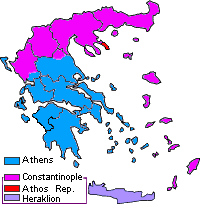
From Wikipedia, I was able to find out that the Greek Orthodox Archdiocese of America is under the Patriarch’s jurisdiction.
The article for Ecumenical Patriarch states
In addition to being the spiritual leader of 300 million Orthodox Christians worldwide,[3] he is the direct administrative superior of dioceses and archdioceses serving millions of Greek, Ukrainian, Rusyn and Albanian believers in North and South America, Western Europe, Australia and New Zealand, Hong Kong, Korea, Southeast Asia and parts of modern Greece which, for historical reasons, do not fall under the jurisdiction of the Church of Greece.
I don’t think this applies to Russian Orthodox churches in America though. But that’s just a guess.
The Ecumenical Patriarchate technically has jurisdiction for all the “new lands” in accordance with the decrees of one of the ecumenical councils. So, while the primary language spoken at the Ecumenical Patriarchate is Greek, the office of the Ecumenical Patriarch is not specifically reserved for someone who is Greek just as the position of the Pope is not reserved from someone who is Italian. As one example, St. John Chrysostom, for example was Ecumenical Patriarch and a Syrian.
Wikipedia is correct that several ethnicities and geographic boundaries fall under the Ecumenical Patriarchate. The Carpatho-Russian Diocese is also under the Ecumenical Patriarchate. The way the Orthodox Christian Church is structured is according to autocephalous or self-governing churches. There are 15 such churches around the world which include, Constantinople (Ecumenical Patriarchate), Alexandria, Antioch, Jerusalem, Moscow, Serbia, etc. The “head” or really, “First among Equals” is the Ecumenical Patriarchate. Much like the Catholic Church has tried post Vatican II, the Orthodox Church has always functioned according to the synodical model of governance.
So when it comes to the United States and the Americas in general, there’s an additional problem: immigration. When the Orthodox Christian immigrants came over the past 200+ years, they brought with them both their faith and their ties to their mother churches. So when you look at the Americas, the “jurisdiction” of a particular church or churches was determined by immigration. So Russian immigrants were under the Patriarchate of Moscow, Serbian immigrants under the Patriarchate of Serbia; Greeks, French, British and those lands under the Ecumenical Patriarchate were under the Ecumenical Patriarchate.
The canonical problem for the Orthodox in America is then that you have more than one bishop within a given area. You can have a Greek Orthodox, Ukrainian Orthodox, Serbian Orthodox, etc. with jurisdiction over the same overlapping geographic region—but only of their parishes.
Right now, all the Orthodox Churches are trying to correct this canonical anomaly. Globally, where this exists, they have formed what are called “Episcopal Assemblies” where the bishops in each region are trying to figure out among themselves how to correct the canonical anomaly.
In the Orthodox World, with the division between Catholicism and Orthodoxy, the Ecumenical Patriarch has taken on the role of
primus inter pares or first among equals. Technically, that role belongs to the Bishop of Rome, the Pope. If there would be union again between the Orthodox and Catholic Churches, the Bishop of Rome would once again be considered
primus inter pares.
The role of the Ecumenical Patriarch is also vital because he is currently the primary spokesperson for Orthodoxy world wide. So the gestures of reconciliation between the Catholic and Orthodox Churches have stemmed from the Ecumenical Patriarch. Each year, the Catholic and Orthodox Churches exchange formal delegations on the respective feast days of each Church. The Ecumenical Patriarchate sends delegations to the Vatican for the feast of Sts. Peter and Paul and the Vatican sends delegations to the Ecumenical Patriarchate for the fest of St. Andrew.
Hopefully that helps clarify things.