Hi,
The image is not a photograph in a conventional sense. Early colour photographs, 1870’s, used sensitising dyes. In the 1930’s kodak invented Kodachrome based on photosensitive emulsions.
The image on the shroud is formed on the cellulose structure of the flax itself, which makes the linen.
There are no pigments, dyes or photosensitive emulsions on the shroud, chemical photographs themselves are unstable and would probably not survive 2000 years.
The image is not coloured, it has the colour of oxidized flax - a light straw colour. The colour of the mans eyes could not be known, not least because his eyes appear to be closed and had coins on them.
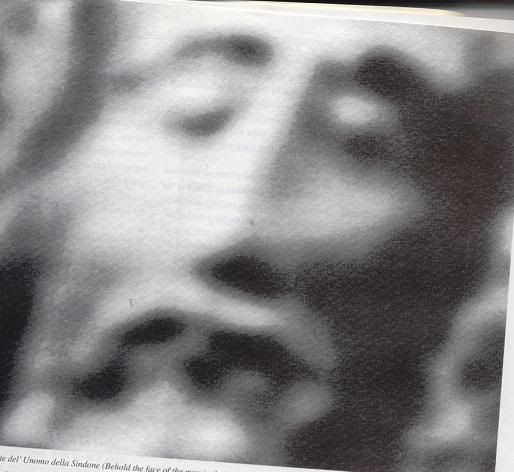
Below is an accurate image possible because of the three dimensional nature of the images formation:
http://i265.photobucket.com/albums/ii228/DODO2/image.jpg
The weave density of linen cloth is an average of a little over thirty-five threads per centimeter.
Linen threads are comprised of hundreds of fibres in maybe a 2 mm thread diameter.
Linen fibres contain fibrils which have an average 12-16 micrometers in diameter.
Fibrils are 15 microns or 15/1000 of a milimeter in diameter…
Sable hairs, one of the finest hairs used in water colour brushes are 0.15 mm.
A paint brush works by capillary action between the hairs of the brush. So at least several hairs would be needed to make a brush work.
Sable hair is 100 times the diameter of a linen fibril.
The image on the shroud is formed by some process of oxidization of the cellulose on the surface of the linen fibrils.
Only the surface of the linen fibril was oxidized.
Not possible to paint an oxidizing liquid onto the surface of the fibrils.
In any event, a liquid applied to the linen thread would immediately soak into the cloth by the same capillary action resulting in all the fibrils throughout the thread being oxidized all over their surfaces.
Wherever a fibre crosses an underlying one the underlying fibre is unaffected.
The colour change never affects more than one or two fibrils in depth, so that whatever caused the change can only have had very little depth of penetration. There are no obvious differences in the straw-yellow shade. It is merely the number of fibrils coloured that determine the intensity of the image.
Another observation of considerable significance is that when blood was, or had been, present over the fibres, it also protected the underlying fibres from whatever caused the image. This means that the blood must have been in place before the image was formed.
“One thing we can say is that the illumination for the formation of the image would seem to have come from the body. It had a limited range and was non- directional. The closer the material was to the surface of the body, the stronger the image. At a distance greater than about 2 inches or 4 centimetres, no image was produced. That is the range in air of alpha particles, mesons, and other products of nuclear disintegration. Further, these are particles whose range in solids is very small. If nuclear disintegration was the source of the illumination, then all the observations - including those recorded in the Gospels - would fall into place.”
“If the image on the Shroud was caused by a nuclear disintegration of the atoms in the body, we can say that the image was primarily due to the short range particles, and that any changes that took place in the main part of the Shroud were due to neutrons and gamma radiation.
In the areas affected by the high-energy short-range particles the effect was quite different. With molecular chains shortened and ordered regions disrupted, the mechanical strength would be greatly reduced - that is, the material would become friable, something that Dr. Adler and Dr. Heller observed.
Suggest a very high radiation dose, more than 120,000 Mrad and less than 680,000 Mrad, but probably nearer the latter.
The appearance of the image and the properties of the linen of the Shroud can thus be explained if the cause was the nuclear disintegration of the atoms in the body. With such a disintegration - a minor nuclear explosion - light and energy would also be produced. In the body the main elements involved would be carbon, hydrogen, oxygen and nitrogen, together with smaller quantities of calcium, phosphorus and sulphur. These all have lower molecular weights, and a lower proportion of internal energy, so that the energy liberated would be far less than that from the disintegration of the heavy atoms in nuclear weapons. It would still be sufficient to move the stone at the entrance to the tomb, and to make the guards think that there had been an earthquake.
An instantaneous disintegration of the nuclei of the atoms in the body would account for the formation of the image, detail by detail, and the good state of preservation of the linen of the Shroud. It would seem to be the only mechanism whereby the straw-yellow colour could be produced - and the lemon-yellow colour of the serum deposits. It would have to be instantaneous to account for the well-defined image, in terms of the clarity of detail and the range of the radiation causing the image before any collapse of the linen cloth. The minor earthquake described in the Gospels is also explained. This gives the answer to the last remaining problem faced by the STURP scientists.”