The Shroud of Turin: What's Your Opinion?

  • Thread starter Thread starter TheOldColonel
  • Start date Start date
Status
Not open for further replies.
In 2002 (as you surely know) the Shroud was subjected to a “restoration” process and the backing cloth was removed, Textile authority Methchild Flury-Lemberg was present and had the opportunity to very carefully examine the corner from which the 1988 C-14 sample had been cut. She found no evidence of any kind of reweaving repair, “invisible” or otherwise. For the reweaving idea to have been correct one would have to hypothesize that only the sample had been subjected to this repair and no adjacent area. Given the narrowness of the sample, this seems very unlikely. Furthermore the oldest date was obtained from the part of the sample closest to the edge of the Shroud, but one would expect the opposite if foreign threads had been introduced.

The discoloration of the Shroud’s linen fibers that accounts for the image is extremely superficial. (I’m sure that you already know this.) No human technique has been able to produce a human image consisting of this type of surface discoloration. The image depicts a corpse in a state of rigor mortis. No image is to be found underneath the bloodstains which have, by the way, been proven to consist of human blood. The image has the proper focus and exposure of a photograph, but it is not the product of photography. No other image of this type is known to exist anywhere in the world. It is unique.
Don’t you possess any of the many books that detail these and other findings?

So your basis for rejecting Antonacci’s Historically Consistent Hyposthesis is that it involves a miracle and is therefore not “scientific?” Sir, in case you haven’t noticed, this is Catholic Answers, and not the Scientific American forum. Here we may take the supposed identity of the person that the Shroud depicts and factor that into our deliberations. As you well know, that person had the reputation of working miracles. If the hypothesis that the corpse disappeared is the answer that is most consistent with all of the other evidence, then we may choose that idea. If you don’t believe the Gospel of Matthew account that says that Jesus’ corpse vanished from a sealed and guarded tomb, then you can’t accept the miracle of the vanishing of His corpse from inside of the Shroud. But STuRP noticed that the linen fibers under the bloodstains were completely undisturbed. If the corpse had been physically removed from the burial cloth, the coagulated stains would have torn some of the fibers. Any bandaid that is not “non-stick” give the same result when it is removed from the wound. Perhaps you have had that experience.

In conclusion we “authoritarians” say that the vanishing of our Lord’s corpse left a thermal proton and neutron radiation that accounts for Image, the excellent condition of the linen cloth, the pinkish hue of the very old bloodstains, and for the C-14 dates which show a linear progression of becoming younger as the part of the sample tested gets closer to the Image.

Mr. Antonacci wants C-14 dating to be done on Shroud samples that are within the Image as way of confirming his theory. As for myself, I don’t think that such is necessary. We have all the evidence that we need right now.
 
The discoloration of the Shroud’s linen fibers that accounts for the image is extremely superficial. (I’m sure that you already know this.) No human technique has been able to produce a human image consisting of this type of surface discoloration. The image depicts a corpse in a state of rigor mortis. No image is to be found underneath the bloodstains which have, by the way, been proven to consist of human blood. The image has the proper focus and exposure of a photograph, but it is not the product of photography. No other image of this type is known to exist anywhere in the world. It is unique.
Some of the above is true, but then again, some is not. It is easy to produce a superficial mark on the topmost fibres of a cloth, such as dabbing with thick paint or even a heated spatula. It is a challenge I often give students, to which they respond satisfactorily in a variety of ways.

Whether the figure on the Shroud is depicted in rigor mortis is disputed even by authenticists; the evidence that the blood was placed on the Shroud before the image is very weak indeed, and the blood has recently been found to include a proportion of artist’s pigment by one of the scientists who most strongly believes in authenticity. The photographic aspect of the Shroud is an inevitable consequence of the way it was painted - you can produce something very similar yourself very easily.

However, you are correct that the Shroud is unique, and that how, and why, it was made is not yet understood. That’s ongoing science for you. Nevertheless, it would be rash to say of anything; it’s never been done, therefore it never will be. I believe a full explanation of the Shroud will be discovered in only a few years time. Indeed, I think it possible that it may already be known.
Don’t you possess any of the many books that detail these and other findings?
Yes, indeed, all of them, I think, in various languages. However, for a real understanding of the issues you must go to the primary sources, not just unquestioningly accept secondhand interpretations.
So your basis for rejecting Antonacci’s Historically Consistent Hyposthesis is that it involves a miracle and is therefore not “scientific?” Sir, in case you haven’t noticed, this is Catholic Answers, and not the Scientific American forum. Here we may take the supposed identity of the person that the Shroud depicts and factor that into our deliberations. As you well know, that person had the reputation of working miracles. If the hypothesis that the corpse disappeared is the answer that is most consistent with all of the other evidence, then we may choose that idea.
No. You mustn’t be too circular in your reasoning. If the Shroud is genuine, then of course it may be miraculous, but I don’t think it is. The evidence to suggest it might be is weak and flawed. I think it is medieval, and so, unlikely to be miraculous. I do not think that it is so self-evidently a miracle that it must be authentic, and it would be wrong to claim that because it is authentic therefore a miracle is a probable explanation.
 
But STuRP noticed that the linen fibers under the bloodstains were completely undisturbed. If the corpse had been physically removed from the burial cloth, the coagulated stains would have torn some of the fibers.
The most cursory inspection of the bloodstains will show that most of the blood has been eroded away from the upper surfaces, and that many of the associated fibres are indeed torn. I do not know who first came up with the idea that the bloodstains were undisturbed, or what he meant by it, but they are most certainly not at all as they were first placed on the cloth. What he may have meant is that they do not look smeared, as wet blood might be expected to be. This was explored at length by various doctors, usually with the unsatisfactory explanation that the stains do not represent liquid blood but some kind of remoistened clot.
 
Last edited:
Sadly for them, I believe skeptics will always find an explanation to explain away any proof that Christ is the son of God or that God exists.
 
Sir, I can’t get this (and the other video) out of my mind. Questions…
1.How did he (Jesus) get clothes on under the shroud?
2. Do you think they crucified him with those bands on his arms?
3. How did they get him down from the cross with the nails still in his hands and feet?
4. Were you as amazed as I was at the type of crown used on his head to make fun of him??? Were you surprised?
Did I see that they placed him in the prone position on the slab? Face down?

I know I’m going to have to watch it all again!
 
The thorns in His crown are from olive wood.


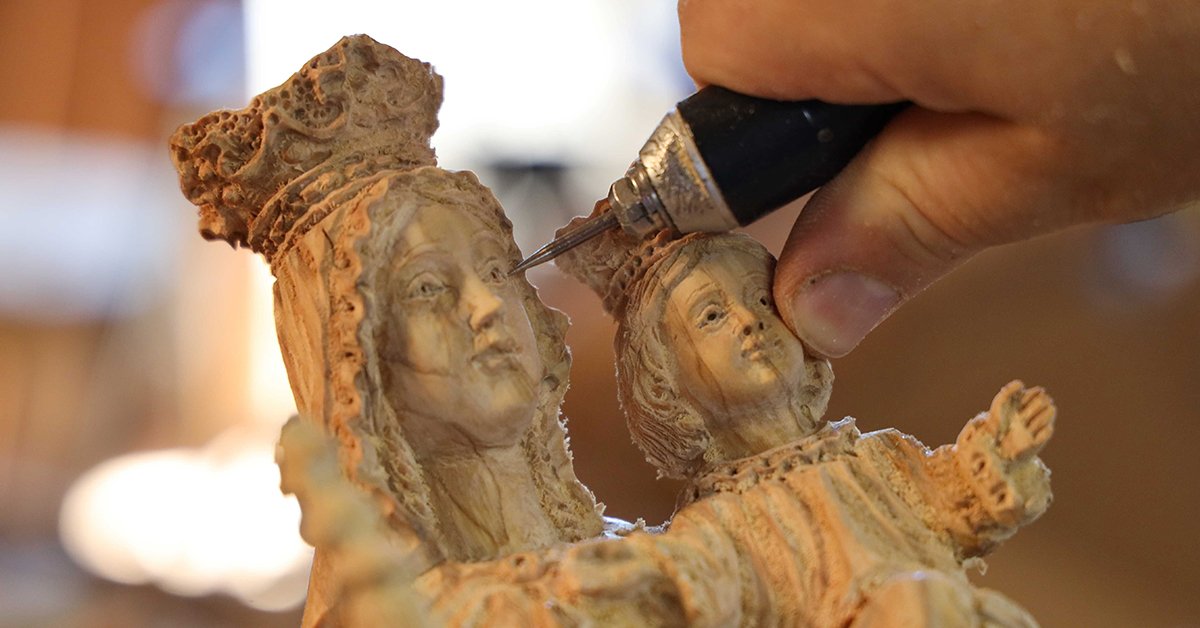
bethlehem carving group

Intended to maximize pain.

Can’t find the crown of thorns in their catalog.

The box says it was sanctified in the Church of the Holy Sepulchre.
 
Last edited:
Sadly for them, I believe skeptics will always find an explanation to explain away any proof that Christ is the son of God or that God exists.
That’s a bit ungenerous, if I may say so. I have no doubt whatever that God exists, or that my salvation depends on the message of Christ, his son. I do not find your comment relevant to the archaeological context of the Shroud. For what it’s worth, this blanket assumption, common among authenticists, that to deny the authenticity of the Shroud is tantamount to a declaration of atheism, weakens both their religious and their sindonological credibility.

Petra22 - I believe you are talking about the YouTube video: “Shroud, a New Astonishing Phenomenon Discovered in This Find”. I’m afraid I find it wholly lacking in credibility. Such evidence as it demonstrates is entirely subjective, its science and theology poor, and its misunderstanding of previous researches profound. I can’t go through it frame by frame, but will address a particular point if you like. Let me know which.
 
Hi, I am sorry I wasn’t clear. I actually wasn’t referring to the Shroud, but the general attitude of atheists and how they would most likely reject any proof.
 
Thanks, MonteRCMS, but as I mentioned earlier, there is no substitute for primary sources. Most of what Charles Wall has to say about the Shroud is from other people’s wishful interpretations of earlier sources, or just hopeful guesswork.
 
I feel like if the shroud actually in Jesus’ tomb had an image of his lifeless body miraculously burned into it, that those there would have noticed, and that it would have figured prominently in the New Testament. In fact, the image is so mysterious that it seems to me it would have been mentioned in the Roman annals as well.
 
I don’t really have an opinion. Would really be something if it’s genuine, of course.
 
I feel like if the shroud actually in Jesus’ tomb had an image of his lifeless body miraculously burned into it, that those there would have noticed, and that it would have figured prominently in the New Testament. In fact, the image is so mysterious that it seems to me it would have been mentioned in the Roman annals as well.
Remember that the Jewish religious authorities had gone to the trouble of posting a guard on Jesus’ tomb to prevent the disappearance of His corpse. They certainly would have made every effort to confiscate the image bearing linen had they known about it. As legend has it, the Shroud was immediately spirited away to Edessa which, at that time, was an independent kingdom. You might note that the linen burial cloth is the only artifact of the Passion that is mentioned after that occurrence, and it is mentioned in all four Gospels.

In Orthodox tradition we find the “Doctrine of Addai” which details how an image on a cloth was brought to Edessa by a disciple. Also correspondence between King Abgar V and Jesus was kept and transcribed. In the 7th century Pope Gelasius made a decree about books received and not received so the documents and legends which detailed the history of the Holy Image were lost to the western Church.

By the time that Rome annexed Edessa in 212 AD, the Sacred Image had already long been secreted away in Edessa’s western gate, the Gate of Vaults. So Rome. obviously, would have known nothing about it. Edessa was the first kingdom to formally adopt Christianity as its state religion. But with the Roman takeover in 212 AD, King Abgar VIII had to have the cross from his tiara removed since Christianity was still illegal in the Roman Empire at that time.
 
Last edited:
A quote from REPORT ON THE SHROUD OF TURIN:*

(At the public report of the STuRP team in New London, Conn. in the fall of 1981)
"At that point one of the real people asked, ‘Have you found anything that would preclude the Shrouds’s being the authentic?’

"‘No.’

"And that question is not a trivial one. Nothing in all the findings of the Shroud crowd in three years contained a single datum that contravened the Gospel accounts. The stigmata on the body did not follow art or legend. They were of life. They were medically accurate evidence of a man who had been scourged with a flagrum-type device, both front and back, . . .who had carried something rough and heavy across his shoulders, which had been bruised; who had something placed on his head that caused punctate bleeding wounds over the scalp and forehead; who had lesions on nose and knee commensurate with a fall; who had been beaten about the face; who had been crucified in the anatomically correct loci, the wrists; whose blood running down the arms had drips responding to gravity at the correct angles for the position of the arms in a crucifixion; whose legs appeared unbroken; who had an ellipsoid lesion in the side, whence cells and serum had come, and lying on the cloth, had post-mortem blood dribbling out of the wound and puddling along the small of the back; whose lacerating scourge marks were deep enough to be bloody, with serum albumin oozing at the margins; whose feet had been transfixed with a spike and bled; and on the soles of the feet there was dirt.

“. . . Nor was there anything else on the Shroud that would negate the actual presence of a scouraged, crucified man lying in that linen. But exactly whose body was it? Science has no way of determining the answer. . . .”

*REPORT ON THE SHROUD OF TURIN, Heller, 1983

The Historically Consistent Hypothesis** would indicate that Heller is incorrect on this last point. C-14 datings of new Shroud samples are predicted to yield progressively younger dates as they become closer to the Image until impossible future dates are obtained. Such results would be proof that the corpse that lay inside the Shroud had vanished, and that would mean that only one historical person could have been the source of that deceased body.

**TEST THE SHROUD, Antonacci, 2015
 
Last edited:
Benjamin1973,

Generally you need photographic equipment, just the right lighting conditions, and skilled physicists.

But check it out for yourself.
 
I feel like if the shroud actually in Jesus’ tomb had an image of his lifeless body miraculously burned into it, that those there would have noticed, and that it would have figured prominently in the New Testament. In fact, the image is so mysterious that it seems to me it would have been mentioned in the Roman annals as well.
This is a good point, although as undead_rat points out below, if it was kept hidden, then perhaps there would be no record of it as long as it was hidden. However, it seems to me significant that even after it was exposed, whenever that may have been, no depiction of the shroud of Jesus, in any painting or carving of the deposition, lamentation, anointing, burial, resurrection or visit of the women to the tomb, shows an image on it. The image on the Shroud, far from figuring prominently anywhere. is wholly insignificant to Christian Art, theologyor devotion. Isn’t that strange?

undead_rat, your references to Robert of Clari, and the quotation from Heller, are too detailed for refutation point by point here. I would advise you to find a copy of de Clari’s book (preferably in the original medieval French, but a modern English translation is OK) and read all he has to say about the treasures of Constantinople. As far as I know few if any books on the Shroud give his quotation in context.

As for Heller, clearly, if an artist wanted to paint a picture consistent with the biblical description of the passion of Christ, he could. Many did. The fact that the Shroud does the same is not evidence of authenticity. Furthermore, some of his “anatomically correct” details clearly aren’t (the blood on the arms for instance, or the hair), some of his details are disputed even by his fellow authenticists (the dribbles across the back, for instance), and some of the details allegedly conforming to Roman crucifixion practices (such as the scourge marks) are not based on any historical or archaeological evidence.

Mark Antonacci is quite correct in that, if a good C14 concentration gradient were found in proportion to distance from the image, and particularly if, as predicted, the material of the image itself dates to the future, it would be very strong evidence for authenticity. I have no expectation of that being so.
 
Last edited:
Another point: why would a mysterious shroud image be assumed to be Jesus? Is it really good enough logic to say, “I don’t know how this was made, so. . . must have been a miracle!”

I don’t know how the pyramids were made, either, but I’m probably; not going therefore to assume that Jesus built them.

It seems to me this constant excitement about this-or-that relic amounts to idolatry: people care more about finding magical or miraculous items than they do about finding themselves and establishing their faith, goodwill, love for neighbors, etc.-- all of which I’m totally sure Jesus would care much more about than what happens to his shroud, if it was even his.

Wherever that shroud came from, it’s not Jesus, and it’s not going to work miracles in the world of its own accord. Why, then, does it really matter?
 
Last edited:
Status
Not open for further replies.
Back
Top