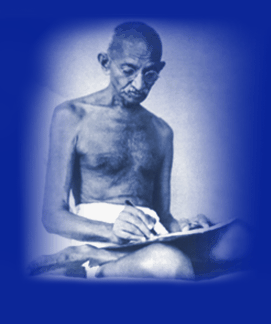
I was talking to a friend of mine, who is considering leaving the Church, about a great deal of topics within the Church. Of course the Eucharist came up. I explained that it is the essential nourishment to a Christian life, that which strengthens us against sin and promotes a virtuous life. Her response was a question. How do people outside of the Catholic Church, or even outside of Christianity completely, live exceptionally moral lives without the gift of Christ Himself? I suppose a prime example would be Gandhi. So to her, the whole idea of many paths to one mountain top makes sense. In trying to convey that there is no greater truth than the Catholic Church, where do I begin?
Thank you,
Nick
The Catholic Church teaches that although God instituted the sacraments, He is not bound to His sacraments. God is rich in mercy, and God may have mercy on someone explicitly outside the church and even someone explicitly outside of Christ.
But I want to emphasize that God MAY have mercy. We cannot presume on God’s mercy. It is like a dartboard with concentric circles. The bull’s eye is the Catholic faith. The farther a person deviates from the bull’s eye, the less that person experiences God’s grace. But the person in an outer circle who has less of God’s grace may respond more to God’s grace than a Catholic who receives more of God’s grace.
Still, for someone outside of Christ and His Church to live an exceptionally moral life is very difficult, and very rare. Even in your example of Gandhi, upon closer inspection, he was no saint. Although it was admirable that he was for peaceful resistance and was willing to live a radically ascetic life, he did have his shortcomings. His children did not talk to him when they grew up. He had this weird practise of sleeping with naked women without touching them. And, when introduced to women, he offered to give them enemas (a little perverted).
I would encourage you to read the lives of the saints. I was shocked by how much love they had, something I never saw or read about non-Catholics or a non-Christians. Why is there no non-Christian equivalent to a Mother Teresa or a Father Damien, who spent his life caring for lepers and eventually himself became a leper? Where is the non-Christian counterpart to Maria Goreti, who prayed for her killer and would-be rapist that he would join her in heaven? Where is the non-Christian counterpart to St Francis of Assisi, he took the teachings of Christ so seriously that he gave up everything and became a beggar?
Also, the whole idea of charity organizations started in the Middle Ages by Catholics. Hindus lacked this kind of compassion because they saw that poverty was the fitting punishment for the poor’s previous lives. Buddhists saw suffering as an illusion, so there no point in showing compassion for an illusion. So if the non-Christian cultures are not as compassionate as the Christian cultures, how can non-Christian individuals be just as compassionate as Christians?
I would recommend the book How the Catholic Church Changed Western Civilization by Thomas Woods. Woods show that in the Middle Ages, Christendom alone, apart from any other non-Chistian culture, showed compassion to the poor, justice to the accused and started the concept of human rights
It really shows me how more more abundant God’s grace is within His Church with His sacraments than outside it.